eBook - ePub
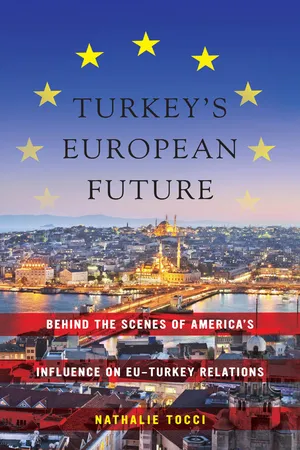
Turkey’s European Future
Behind the Scenes of America’s Influence on EU-Turkey Relations
- 240 pages
- English
- ePUB (mobile friendly)
- Available on iOS & Android
eBook - ePub
Turkey’s European Future
Behind the Scenes of America’s Influence on EU-Turkey Relations
About this book
A rapidly-changing nation and a key player in the Middle East, Turkey has long been centrally important to both the United States and the European Union. A major partner both of the EU and Turkey, the US has also been the most ardent and committed supporter of closer ties between them. Yet while Turkey's relations with the US and the EU have been intimately linked, they have not proceeded along two parallel planes. Nathalie Tocci tells the story of this dynamic triangular relationship, exploring how and why the US has shaped the course of relations among its allies. An empirical study with strong policy relevance, this volume draws on in-depth interviews and official documents to provide a succinct overview of the issues and stakeholders. Tocci argues that the Turkish situation can be viewed as a quintessential case study, tackling broader questions about US foreign policy in the region as a whole.
Information
1
Squaring the Triangle
Understanding American Influence
Turkey is of paramount importance to the United States (US) and to the European Union (EU). In the US, Turkey was viewed as a critical ally throughout the Cold War and has been considered a ‘strategic’ and ‘model’ partner since then. In Europe, Turkey has been an integral part of the continent’s centuries-long history and has enjoyed structured relations with the European integration project almost since its inception. Turkey’s ties to the US and to the EU have not proceeded along parallel paths, but they have been intimately linked. The US is not only the first and foremost partner of both the EU and Turkey. It is also among the most ardent and committed supporters of Turkey’s European integration. Rarely does a transatlantic meeting go by without Turkey featuring in the discussion. Whether discussion revolves around a question regarding nuclear proliferation, the Middle East, Russia, the Black Sea, energy, or democracy promotion, Turkey is guaranteed to emerge in transatlantic debates. Setting aside crisis countries and regions, Turkey ranks among the most constantly salient items on the transatlantic political and strategic agenda.
In support of Turkey’s European integration, Washington has set forth a variety of arguments and has attempted to influence EU decisions at critical moments during Turkey’s turbulent march to Europe. But this is only the beginning of the story to be told. American influence on Turkey’s relationship with Europe is multifaceted, operating at different levels, taking different forms, and surfacing with varying intensities. It has been direct and indirect, conscious and unconscious, and its outcomes have been both intended and unintended at different points in time. The role of the United States is a key element in the dynamics between Turkey and the EU. To date, it has not been thoroughly investigated.
The purpose of this book is to tell this complex story, understanding whether, when, and why the United States has shaped the course of relations between two of its principal partners: the EU and Turkey. Through this lens, this book unpacks the broader links between these three actors, shedding light on the triangle tying together the US, Turkey, and the EU. While covering the evolution of relations among the three over the course of the twentieth century and beyond, the main time frame investigated in this book is that since the late 1980s, when Turkey’s relationship with the EU deepened through Ankara’s application for European Community membership in 1987.
In analysing this triangular relationship, this book speaks to three broad strands of literatures. First and foremost, this is a book about US foreign policy and transatlantic relations locating itself within this diverse literature (see, for example, Hamilton 2010; Levy, Pensky, and Torpey 2005; Peterson and Pollack 2003; Pollack and Shaffer 2001), insofar as it uncovers the dynamics between America and Europe regarding a principal agenda item in their relationship: Turkey. In this respect, Turkey is considered as an object rather than as a subject in the analysis. Second, and focusing on Europe, this is a book about EU enlargement (see, for example, Sjursen 2006; Grabbe 2005; Smith 2004; Schimmelfennig and Sedelmeier 2005). Third and finally, this is a book about Turkey, Turkey’s relations with the EU and with the US, as well as Turkish foreign policy (see, for example, Aydın and Çağrı 2004; Hale 2007; Arikan 2006; Joseph 2006; Müftüler-Baç and Stivachtis 2008; Arvanitopoulos 2009; LaGro and Jorgensen 2007; Bozdağlioğlu 2003; Robins 2003a; Bal 2004; Martin and Keridis 2004). Turkey is thus also a subject and agent in this book, in that it reacts to American-induced developments in the EU, in the neighborhood, and in Turkey itself. By addressing the broad dynamics between the US, Turkey, and the EU, this book thus fills an important gap in our understanding of transatlantic politics, EU enlargement, and Turkey.
Setting the Context: Turkey’s Tortuous Path to Europe
Before proceeding with the subject and questions at the heart of this book, let us step back and set the context of EU-Turkey relations. Turkey and the EU are bound by a curious love affair. Both have always aimed at deepening relations, yet the precise interpretation of what this would entail has been highly contested. It is this odd mix between a shared commitment to each other and widely varying interpretations within (and between) both sides as to what this would mean that underpins Turkey’s tortuous path to Europe.
Turkey’s first contractual relationship with the then European Economic Community (EEC) dates back to 1963, with the signature of the Association Agreement. This agreement envisaged the establishment of a customs union between Turkey and the Community and opened the door to Turkey’s full membership if and when the political and economic conditions in Turkey were met. In 1987, following the gradual political stabilization and economic liberalization after the 1980 military coup in Turkey, Ankara submitted a formal request for full membership. But partly because of the Community’s internal task of completing the single market and partly because of the problematic state of Turkish democracy and the mounting violence in Turkey’s southeast at the time, in 1989 Ankara’s application was rejected by the European Commission and Turkey’s European future was put on hold. Although the application was rejected, the door for Turkey was left open, as the Commission in its 1989 Opinion confirmed Turkey’s eligibility for membership.
The end of the Cold War brought about radical changes to Turkey’s environment. Turkey’s role as western bulwark against Soviet expansionism ended, ushering in the way to a new period of mounting instability in the Middle East and Eurasia (Larrabee and Lesser 2001). Turkey consequently underwent an intense period of soul-searching, assessing alternative geostrategic options such as pan-Turkism or regional leadership in the Middle East and Eurasia (Landau 1995). Ultimately, the domestic debate converged on a renewed emphasis on the EU project by the mid-1990s. Turkish political démarches intensified, lobbying for inclusion in the EU custom union. The Union accepted, and in 1996 the EU-Turkey customs union entered into force, marking the beginning of higher levels of economic integration and, in Ankara’s eyes, the prelude to membership.
Nevertheless, the positive atmosphere created by the customs union agreement deteriorated rapidly in 1997. Despite strong pressure from Ankara to upgrade EU-Turkey relations into the accession process, the 1997 European Council in Luxemburg underlined that Turkey did not meet the standards for candidacy. It offered instead a ‘European strategy’ based on the exploitation of the integration prospects foreseen under existing contractual relations—the Association Agreement. Unlike 1989, this second rejection, together with the EU’s finger-pointing at Turkey’s domestic deficiencies, was perceived in Turkey as a clear case of discrimination, given that the political and economic situation in the Eastern European candidate countries at the time was certainly not enviable. In response, Turkey froze its political dialogue with the Union and threatened to withdraw its membership application and integrate with the unrecognized Turkish Republic of Northern Cyprus (Tocci 2004, 65–93). The goal of full membership was not abandoned, however, and the Turkish establishment began displaying a dichotomous approach to the Union, which would consolidate in the years ahead. While the government stepped up its campaign to obtain candidacy, the domestic political debate was rife with criticism of the Union, accusing Europe of double standards and of acting as if it were a ‘Christian club’.1
The tide turned with the December 1999 Helsinki European Council, when Turkey’s long-sought candidacy was recognized (Öniş 2003). Given the downturn in EU-Turkey relations in the 1997–99 period, the member states acutely felt the need to move EU-Turkey relations forward, and there was a growing sense within the Union of the need ‘not to lose Turkey’. The European Council in Helsinki recognized Turkey’s candidacy, but stopped short of opening accession negotiations, arguing that the country first had to fulfil the Copenhagen political criteria for membership.2 In turn, the Commission was given a mandate to monitor progress in Turkey’s domestic performance and to draft a first Accession Partnership for Turkey, recommending areas for Turkish reform. The EU also adapted its financial assistance to Turkey, redirecting aid to provide more explicit support for Turkey’s political, social, administrative, and economic reforms.
The acceleration of Turkey’s reform momentum particularly after late 2001 spilled into EU-Turkey relations, especially when the Copenhagen European Council in December 2002 concluded that it would determine whether and when to open accession negotiations with Turkey in December 2004 (Tocci and Evin 2004). The approaching green light for the opening of negotiations set the target and the timeline in the reform program of the new Justice and Development Party (AKP) government elected in November 2002. Turkey’s progress in reforms under the first AKP government meant that the December 2004 European Council’s verdict was that Turkey ‘sufficiently’ fulfilled the political criteria and that accession talks could begin in October 2005. EU actors, however, appreciated the need to sustain Turkey’s reform process throughout the course of the negotiations. Hence, the European Council foresaw a continuing EU role in determining Turkey’s reform priorities through updated accession partnerships, monitoring compliance through the Commission’s progress reports, and threatening to suspend negotiations in the event of a backtracking of the reform process. In addition, the negotiating chapter on the ‘judiciary and fundamental rights’ impinged directly on ongoing political reforms. All seemed in place for the virtuous circle between Turkey’s domestic reform and EU integration to continue.
Yet since the opening of accession negotiations in 2005, the 1999–2005 golden years in EU-Turkey relations have come to a (temporary) halt, as the relationship has slipped back into a vicious dynamic more closely resembling the 1997–99 period. Turkey’s accession negotiations have proceeded at a snail’s pace, with 13 (out of 35) chapters opened by mid-2011 and only one chapter (science and research) provisionally closed. In 2006, eight chapters were ‘frozen’ by the EU on the grounds of Turkey’s non-implementation of the Additional Protocol to its customs union agreement, which foresees the opening of Turkish ports and airports to Republic of Cyprus-flagged vessels and flights.3 The EU also declared that lest Turkey implement the Additional Protocol, no chapter would be provisionally closed. In 2007, France blocked the opening of an additional five chapters on the shaky grounds that they were too evidently related to full EU membership, to which French President Nicolas Sarkozy is openly opposed.4 In 2009, in view of Turkey’s persisting non-implementation of the Protocol, the Republic of Cyprus vetoed five more chapters, including the energy chapter which had already been blocked due to a dispute with Turkey over oil exploration rights.5 Insofar as Turkey links its extension of the customs union to southern Cyprus to progress in the Cyprus peace process or at the very least to the lifting of the EU’s isolation of northern Cyprus—an unkept promise by the EU since the 2004 failure of the UN-brokered ‘Annan Plan’6—the Cyprus quagmire is becoming increasingly entangled with EU-Turkey relations.
Since the turn of the century, Turkey has thus been part of the EU accession process. For all candidates before Turkey, this process has always and only culminated in full membership. Yet in Turkey’s case, the accession path is fraught with roadblocks and hurdles, making the final destination uncertain at best.
American and European Approaches towards Turkey:
An Uneven Fit
With this context in mind, let us turn to the subject of this book: the triangular relationship between the United States, Turkey, and the European Union.
Over the ebbs and flows of Turkey’s tortuous path to Europe, the US, as the foremost partner of both Turkey and the EU, has watched carefully the evolution of the relationship and has had a constant say in its development. However, its views, positions, and arguments have often been distinct from those heard in both the EU and Turkey. Approaches towards Turkey on both sides of the Atlantic have, at best, only partially overlapped. As far as the US and the EU are concerned, this is because of the fundamental difference between the natures of these two actors.
The US is a nation-state, which while large and federal, is nonetheless a state. In turn, the American debate on Turkey is marked by a level of homogeneity, consistency, predictability, and resolve that is hard to find in Europe. As explored in chapter 2, there is no shortage of Turkey stakeholders in the US, rendering the debate on Turkey rich and multifaceted. But in comparison to the EU, the number of actors, debates, interests, and ideas concerning Turkey is confined. Unlike the US, the EU is a sui generis political entity in-the-making. As explained in chapter 3, European debates and policies on Turkey match the complexity of the EU itself, reflecting the Rubik’s Cube of interlocking member state positions and their evolution over time. In fact, there is no ‘EU’ debate on Turkey. The Union’s stance towards Turkey is the product of continuously negotiated intra-EU bargains and interlocking European debates oscillating over time. These negotiations and debates take place between member states and within EU institutions. Most critically, they are held within member states. Hence, not only do we need to consider debates between the French, Germans, British, or Italians in the Council of Ministers and with the European Commission. We also need to explore where foreign ministries, businesses, trade unions, and civil society actors stand within these countries, alongside how these positions are articulated in trans-European groupings such as the political families of the European Parliament or the Confederation of European Businesses. This entails a complex mosaic of subnational, national, and supranational stakeholders in the political, economic, security, and social realms, which push and pull in different directions, for reasons at times related to Turkey, at times not. The sheer number of actors involved dictates that the issues covered and the positions articulated when debating Turkey (or indeed any other issue) are far greater and more varied compared to the US.
A second reason for the uneven fit in European and American views about Turkey relates to history and geography. American encounters with Turkey have a relatively short history, dating back to the late days of the Ottoman Empire when Americans pursued limited trade with the Empire and Protestant missionaries engaged in education and health projects in Turkey. By contrast, in the post–World War II period, Turkish-American relations have been grounded on a solid strategic basis, because of Turkey’s geography at the heart of where American foreign policy interests lie (Larrabee and Lesser 2001). As we shall see, the American approach to Turkey has changed over the years, as has the US’s appreciation of Turkey’s significance, its support for Turkey, and the interests and logic driving American policies towards Turkey. But Turkey, situated on the other side of the Atlantic and with a relatively small and loosely organized Turkish-American community, will always be viewed as a matter of foreign rather than of domestic policy in the US. Whether related to geopolitics, security, energy, or trade, Washington will always view Turkey through a foreign policy lens. The same cannot be said for Europe. Turkey is and always has been part of Europe’s complex history and geography (Deringil 2007). Regardless of what EU citizens and leaders think of Turkey’s place in Europe, it is precisely an appreciation of Turkey’s European history that lies at the crux of European perceptions (and misperceptions) about Turkey. Whether what prevails in European collective memories is the ‘Battle of Vienna syndrome’ or the centuries of shared history from the Greek and Roman civilizations to this day, Turkey is viewed as an integral element of Europe’s self-understanding. Hence, debating Turkey in Europe does not entail only a discussion of foreign policy interests, norms, and objectives. The European debate/s about Turkey is/are part and parcel of the debate about Europe itself (Rumelili 2004).
Third, whereas the US deals with Turkey through the institutions, interests, and instruments of its foreign policymaking machinery, the same does not hold for the EU since Turkey entered the EU enlargement process. This partly explains why there was a far greater fit between American and European approaches towards Turkey up until December 1999, when Turkey was granted EU candidate status. With its entry into the accession process, Turkey no longer falls squarely onto the European foreign policy map, strictly defined by the Common Foreign and Security Policy (CFSP). While certainly driving at the heart of critical geopolitical and security questions for Europe, the subject matter of Turkey’s EU accession negotiations deals with technicalities in a wide range of domestic policy sectors such as competition, taxation, industry, and agriculture. Consequently, internal EU and member state questions have moved up the list of priorities when debating Turkey in Europe. When it comes to enlargement, it is not only (and not even principally) the broadly defined European foreign policy community that is mobilized for or against Turkey, but a far larger set of actors with different objectives, interests, and beliefs.
Hence, differences in history, geography, political organization, and policy frameworks between the US and the EU all point to a structural mismatch in American and European approaches towards Turkey. This imperfect fit opens the scope for our enquiry. Given on the one hand the US’s close ties with the EU and Turkey and its active interest in EU-Turkey relations, and on the other, the imperfect overlap in American and European approaches to Turkey, the core question tackled in this book is: how has the US influenced Turkey’s path to the European Union?
US Influence on EU-Turkey Relations:
Who Does America Speak To?
Exploring the links between the US, the EU, and Turkey and specifically American influence on EU-Turkey relations opens up three further corollary questions explored in the course of this book. A first corollary question is: who does the US speak to in the EU regarding Turkey? To answer this question, this book maps the stakeholders on both sides of the Atlantic, explaining their positions, arguments, and underlying interests and beliefs as far as Turkey is concerned. It does so by highlighting the contours of the discursive fit and misfit in European and American discourses on Turkey. These contours hint at what may be the potential as well as the limits of direct American influence on EU-Turkey relations.
Suffice it to say here that American stakeholders are likely to figuratively ‘speak the same language’ as a subset of European counterparts who also are primarily concerned with strategic and foreign policy questions. The mental frames, agendas, ideas, and interests may be shared between American stakeholders and European foreign ministries, foreign affairs committees in parliaments, international affairs think tanks and large businesses engaged in trade with and investment in Turkey. This does not mean that American stakeholders share the same positions as these European interlocutors as far as Turkey’s EU membership prospects are concerned. However, by being concerned with similar themes, they are more likely to engage in meaningful transatlantic debate on Turkey, thus opening the scope for exchange and reciprocal influence.
In view of this, a second corollary question is: how have American stakeholders influenced directly those European counterparts which view Turkey through a similar lens (i.e., debate Turkey by focusing on similar themes) though not necessarily sharing the same positions? In other words, when the American and European debates have overlapped, albeit imperfectly, how has the US influenced European views on and policies towards Turkey? When and why did American influence play a positive role in bolstering EU-Turkey relations and when did US advocacy backfire?
When it comes instead to other European stakeholders whose debates on Turkey are detached from the American ones, does this mean that the US has no influence at all? Is it simply the match and mismatch in transatlantic debates on Turkey that determines the contours of transatlantic interactions and influences regarding Turkey? Arguably not. Whereas the extent to which America influences European debates, positions, and policies on Tu...
Table of contents
- Cover Page
- Title Page
- Copyright Page
- Dedication
- Contents
- List of Abbreviations
- Chronology: US-Turkey-EU Relations
- Acknowledgments
- Preface
- 1 Squaring the Triangle: Understanding American Influence
- 2 The View from Washington: American Debates and Stakeholders
- 3 Behind the Scenes of the EU: European Debates and Stakeholders
- 4 Transatlantic Debates: The Role of Direct American Advocacy
- 5 Influencing Europe through the Back Door: The Role of US-Turkey
- 6 Global Implications: American Foreign Policy in Turkey’s Neighborhood
- 7 Conclusion: Unpacking the Triangle
- Notes
- Bibliography
- Index
- About the Author
Trusted by 375,005 students
Access to over 1.5 million titles for a fair monthly price.
Study more efficiently using our study tools.
Frequently asked questions
Yes, you can cancel anytime from the Subscription tab in your account settings on the Perlego website. Your subscription will stay active until the end of your current billing period. Learn how to cancel your subscription
No, books cannot be downloaded as external files, such as PDFs, for use outside of Perlego. However, you can download books within the Perlego app for offline reading on mobile or tablet. Learn how to download books offline
Perlego offers two plans: Essential and Complete
- Essential is ideal for learners and professionals who enjoy exploring a wide range of subjects. Access the Essential Library with 800,000+ trusted titles and best-sellers across business, personal growth, and the humanities. Includes unlimited reading time and Standard Read Aloud voice.
- Complete: Perfect for advanced learners and researchers needing full, unrestricted access. Unlock 1.5M+ books across hundreds of subjects, including academic and specialized titles. The Complete Plan also includes advanced features like Premium Read Aloud and Research Assistant.
We are an online textbook subscription service, where you can get access to an entire online library for less than the price of a single book per month. With over 1.5 million books across 990+ topics, we’ve got you covered! Learn about our mission
Look out for the read-aloud symbol on your next book to see if you can listen to it. The read-aloud tool reads text aloud for you, highlighting the text as it is being read. You can pause it, speed it up and slow it down. Learn more about Read Aloud
Yes! You can use the Perlego app on both iOS and Android devices to read anytime, anywhere — even offline. Perfect for commutes or when you’re on the go.
Please note we cannot support devices running on iOS 13 and Android 7 or earlier. Learn more about using the app
Please note we cannot support devices running on iOS 13 and Android 7 or earlier. Learn more about using the app
Yes, you can access Turkey’s European Future by Nathalie Tocci in PDF and/or ePUB format, as well as other popular books in Politics & International Relations & Politics. We have over 1.5 million books available in our catalogue for you to explore.