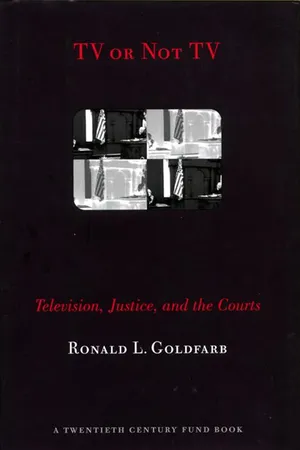
In the last quarter century, televised court proceedings have gone from an outlandish idea to a seemingly inevitable reality. Yet,debate continues to rage over the dangers and benefits to the justice system of cameras in the courtroom. Critics contend television transforms the temple of justice into crass theatre. Supporters maintain that silent cameras portray "the real thing," that without them judicial reality is inevitably filtered through the mind and pens of a finite pool of reporters.
Television in a courtroom is clearly a two-edged sword, both invasive and informative. Bringing a trial to the widest possible audience creates pressures and temptations for all participants. While it reduces speculations and fears about what transpired, television sometimes forces the general public, which possesses information the jury may not have, into a conflicting assessment of specific cases and the justice system in general.
TV or Not TV argues convincingly that society gains much more than it loses when trials are open to public scrutiny and discussion.
- 264 pages
- English
- ePUB (mobile friendly)
- Available on iOS & Android
eBook - ePub
About this book
Chapter 1
THE TRIAL OF THE CENTURY
Crime news lies at the heart of one of the more recurring and V confounding dilemmas of the twentieth century. The constitutional rights of people charged with crimes to both a “public” and a “fair” trial may present an inherent conflict. If there is too much public attention, that very openness may affect the fairness of the trial. The corresponding press right to cover crime news by its own standard—different from that of courtroom judiciousness—may cause a competing constitutional conflict. As the media become more pervasive and more influential, the potential for conflict between the press’s right to present crime news and the defendant’s right to a fair and open trial increases.
To compound the conundrum, the two constitutional rights guaranteed by the First and Sixth Amendments may be complementary as well as conflicting. As one federal appeals court judge put it, “the right of fair trial is companion, not servant, to the constitutional guarantee of public trial.”1 The two institutions—press and courts—are mutually reinforcing, and occasionally adversarial. A probing press may expose injustices, assure fair trials, and censure improprieties by judges, police, and prosecutors; the courts may preserve press independence when it is challenged. Erwin Chemerinsky, a University of Southern California law professor, argues that the supposed tension between the First and Sixth Amendments is “illusory.” The media informs public debate about important issues, and media coverage of trials “increase[s] the likelihood of fair and just proceed-ings.”2
But the constitutional companion can become a villain. This perplexing conflict was described by the late Supreme Court Justice Felix Frankfurter in an appeal of an Indiana murder conviction and capital punishment that was decided by a jury whose impartiality had been prejudiced by intensive pretrial publicity. Motions for a second change of venue and a continuance were denied. In a concurring opinion to Justice Tom Clark’s reversal, Justice Frankfurter complained: “This Court has not yet decided that the fair administration of criminal justice must be subordinated to another safeguard of our constitutional system—freedom of the press, properly conceived. The Court has not yet decided that, while convictions must be reversed and miscarriages of justice result because the minds of jurors or potential jurors were poisoned, the poisoner is constitutionally protected in plying his trade.”3 The problem is not new, but it is profoundly important: Its causes and effects are unclear, and its cures controversial.
Originally, the guarantee of an open trial was a common law reform meant to prevent closed proceedings and assure that the public was informed about and could participate in the workings of the judicial system. In the days when the press was neither ubiquitous nor pervasive, the mere presence of the public—albeit a very small and local public—was the means of subjecting government to the scrutiny of its subjects. Few could quarrel with such a democratic notion. But sometimes virtues can evolve into vices when conditions change.
During the nineteenth century, a public of local spectators was supplemented by reporters who came to trials and reported what they observed to a distant reading audience. With the invention of the telegraph, immediate reports of criminal trials could be communicated quickly to larger and more distant audiences. As the media presence and impact grew, problems arose. The very ubiquity of the press threatened to make differences in the kind as well as the degree of publicity pertaining to trials.
From the earliest days of this country’s history to the present, there have been excessively publicized criminal trials. Television is only the latest chapter in a long and evolving continuum of institutional and constitutional dynamics.
As early as the mid-1700s, public attention was riveted on dramatic courtroom battles, engaging as much for their entertainment value as for their treatment of vital political issues. The seditious libel case of John Peter Zenger in 1734 has been called no less than “a precedent. . . for the American Revolution and the Bill of Rights.”4 Andrew Hamilton, the most illustrious trial lawyer of the colonial period, argued the case for the defense, and the trial is featured in most collections of great American trials as having helped establish press freedom to honestly (if truculently) criticize government.5 Indeed, the case arose out of a newspaper war typified by provocative charges and countercharges.
When the jury announced its verdict acquitting the martyred printer, according to one report, “The roar of the crowd seemed to shake the courtroom. Vainly the angry judge rapped for order. . . . The waiting people outside in Wall St. . . . shouted their joy. Broadway answered with resounding cheers.”6 According to another account, “Long before the opening of the court the little room was crowded to its utmost. . . . The majority of the people felt that they had assembled not merely to witness the trial of the printer for libel, but that here the last fight was to be made against the administration which was so arbitrarily oppressive.”7 In striking a blow against censorship, the widely publicized case had a remarkable effect on post-Revolutionary America in places far from the courtroom in New York City. Even in England, accounts of the trial were reprinted far and wide.
Aaron Burr—senator from New York, vice president to Thomas Jefferson in 1800 (after the only tie vote in the electoral college), and survivor of a celebrated duel with Alexander Hamilton—twice successfully defended himself against charges of treason in trials presided over by then Chief Justice John Marshall. His trials in Richmond, Virginia, are often referred to by both admiring and critical biographers as early examples of the clash between public opinion and judicial dispassion in causes celebres.8
Reports of the trial told how “the throng straining to get in so far exceeded the capacity” of the chamber that the courtroom had to be expanded. Though promising a fair trial, Burr’s prosecutor, U.S. Attorney General Caesar A. Rodney, conceded that earlier reports of Burr’s alleged conspiracy “have resounded through the newspapers so long and so strongly” that they implanted in the public’s mind “the general opinion” that Burr was guilty.9 Thousands poured into town to observe the trial, “colonies of tents and covered wagons dotted the northern bank of the river,” and reporters from every large newspaper in the country sent news of the trial all over the world. Washington Irving covered the trial for the New York Gazette.
Crimes of passion particularly have provoked sensational trials and yellow journalism for centuries. What now seems an example of quaint male Victorianism—some would call it early American chauvinism—regularly led to crimes of violence committed to protect the honor of one’s spouse or family member who was considered defiled by another man, regardless of the woman’s role in that sexual liaison. Those cases, then as now, generated widespread press attention.10 For example, when in 1859 Congressman Daniel Sickles shot his wife’s lover, Washington District Attorney Phillip Barton Key, notable public figures including senators and congressmen attended the trial, and newspapers around the country (including the usually austere New York Times), and even as far away as the London Times,“commended the honorable nature of the homicide,” and finding a dispassionate jury was thus unusually difficult. After Sickles was acquitted, the New York Post reported, “extraordinary demonstrations followed the verdict. . . the shouts of the crowd for ‘a speech’ from Sickles—the offer to unharness the horses from his carriage, that men might take the places of the brutes—the noisy cavalcade rushing and hurrying down the avenue—the gratitude of the old fruit-seller, who presented a basket of oranges to the man ‘who had taught him how to defend his family honor’ . . . the serenade of the lawyers.”11
In the late nineteenth century, a time when we might have assumed the media’s influence on the justice system was insignificant, judicial causes celebres captured the public’s attention, no less than now. The notorious alienation-of-affection trial of the prominent and charismatic preacher Henry Ward Beecher could have been a modern TV movie. Nationally famous, from a notable family, yet associated with whiffs of scandal, Beecher had clashed with the well-known feminist Victoria Woodhull over standards governing the sexual mores of the times. In January 1875, Beecher was sued by his best friend, an editor named Theodore Tilton, for engaging in an affair with Tilton’s wife, Elizabeth.
It was referred to as the trial of the century, an appellation that would be adopted and repeated henceforth time and again, as if the phrase was freshly discovered each decade. The press afforded the case more coverage than any event since the Civil War.12 The six-month-long trial took place in the Brooklyn City Court. According to one account:
The proceedings provided the chief entertainment in town. Tickets were black-marketed at five dollars apiece, and as many as three thousand persons a day were turned away, affording near-by saloons a booming business. Prominent politicians, diplomats, and society leaders fought for seats in the courtroom with ordinary curious folk and went without their lunch in order to hold them, or bought sandwiches and soft drinks from vendors. Newspapers assigned as many as ten reporters to the trial. The audience was frequently unruly, having to be silenced by Judge Joseph Neilson for unseemly applauding, hissing, and whispering—there were several arrests for disorderly conduct.13
The summations by the two eminent counsels, “contests of classical erudition and oratory as much as they were legal arguments,” continued for twenty-five days, and the courtroom audience complemented the barristers’ elocutionary efforts with outbreaks of applause. During the eight days of jury deliberation, sizable crowds milled about constantly near the court, neighborhood bars were jammed, and people slept on the grass outside the court. “Reporters clung to lampposts and crowded out onto window ledges with spyglasses. Diagrams of the jury in various postures of debate were printed and analyzed, and each juror’s background was studied.” When the jury announced it could not reach a decision throngs of reporters besieged “the unfortunate twelve. The courtroom was bedlam.”14
Beecher’s was neither the first nor last of what repeatedly has come to be called the “trial of the century.” Stanford White was a “bou-levardier architect,” a fashionable socialite whom Henry Adams dubbed the Moses of Manhattan’s nouveau riche. His extraordinary career seemed straight out of an Edith Wharton novel about rich New York society at the turn of the century.15 His architectural firm, McKim, Mead, and White, designed several of the majestic public buildings and stately private clubs and mansions of that time and place, including Madison Square Garden and the Washington Square arch. Late in his life, with his business and health failing, White was shot and killed by Harry Thaw, an eccentric millionaire playboy, who was jealous of White’s earlier relationship with the actress Evelyn Nesbit, who had later become Thaw’s wife. At her husband’s murder trial, the actress testified, demurely, that she had been to a great many apartments with Stanford White and believed she had been drugged and seduced.16
The 1907 trial was a bonanza of frenzied and feverish journalism, including what has been called “massive and unrelenting character assassination” of White. One report of the case says that “the story was copy catnip.”17 Characterized as a voluptuary and pervert, White’s reputation was utterly destroyed by the press. Reporters besieged the Manhattan trial court, and Western Union set up a special office to handle the flow of news about the case and its chief characters. The huge crowds broke all prior attendance records in New York trial history.
After a hung jury, in a second trial in 1908, the defendant was acquitted by reason of insanity and hailed by the public as a hero in an American morality play. E. L. Doctorow included the scandalous trial in his novel Ragtime, Earlier, Ray Milland, Joan Collins, and Farley Granger portrayed the three characters in a movie, The Girl in The Red Velvet Swing,18 an allusion to the scene of White’s seduction of Nesbit. Press coverage of the seamy details of the lovers’ liaisons was so sensational that President Theodore Roosevelt asked the postmaster general to forbid news accounts of the salacious testimony to be transmitted in the mails.19
Another “trial of the century” soon followed, and this time radio was the culprit. In the small town of Dayton, Tennessee, in 1925, William Jennings Bryan and Clarence Darrow fought over the teaching of Darwin’s theory of evolution in what became known as the Scopes trial.20 That amazing trial, which captured the attention of distant audiences, pitted Darrow, the country’s most notorious defense counsel, against Bryan, one of the country’s most famous conservative political theorists and fundamentalist advocates. Bryan was recruited to prosecute a young high school science teacher and coach for violating the state’s newly enacted anti-evolution law.
The two nationally famous lawyers (the defendant was simply a pawn in their litigative match) opened the case with cosmic pronouncements: “Bryan announced,” The trial uncovers an attack for a generation on revealed religion. A successful attack would destroy the Bible and with it revealed religion. If evolution wins Christianity goes.’ Darrow retorted, “Scopes isn’t on trial; civilization is on trial. The prosecution is opening the doors for a reign of bigotry equal to anything in the Middle Ages. No man’s belief will be safe if they win.’”21
On the day of the trial, the courthouse was swathed in Bible-quoting banners, the courtroom overflowed with spectators, and the largest group of journalists anyone could remember seeing at a trial were in attendance. Microphones were set up to broadcast press accounts of the proceedings nationwide and abroad in several languages. One writer reported that the whole town had become “a camp meeting, a Chautauqua, a state fair, a carnival or a belated Fourth of July.” Loud “Amens” could be heard periodically during the proceedings from spectators, and applause greeted the lawyers’ repartee.
Eventually, the whole trial was moved to the lawn outside the courthouse because the unruly throngs in the courtroom were weakening the floor, which was in danger of collapsing. Five thousand spectators, sweltering in the July heat, stood around or watched from wooden benches, and the press sat at tables nearby. A huge banner proclaiming “Read Your Bible” hung from the building in clear view of the jury, alongside another stating “Read Your Evolution.”
After a tumultuous trial, which included Darrow cross-examining Bryan on his literal reading of the Bible, Darrow asked the jury to convict so the case could be appealed. Eventually, the appellate court reversed Scopes’s conviction on technical grounds. But along the way, the press had a field day, giving both the protagonists and their important issue unprecedented coverage. However, both sides savored the attention, and the public witnessed an important debate by notable advocates.
The raucous trial of Bruno Hauptmann in 1935 for the kidnapping of the Lindbergh baby offers another classic example of the persistence and growth of press coverage of sensational crimes. Charles Lindbergh was a national hero whose solo transatlantic flight in the Spirit of St. Louis made him famous worldwide. His wife, Anne Morrow Lindbergh, was the daughter of a socially prominent banker and diplomat. Their perfect life was shattered when their first child was kidnapped mysteriously from their home in Hopewell, New Jersey.
Bruno Richard Hauptmann, a carpenter who had immigrated to New Jersey from Germany twelve years earlier, was arrested and charged with the kidnapping after a two-and-a-half-year manhunt that became an avidly followed national melodrama. Though the evidence against Hauptmann has since been seriously questioned,22 the press presumed his guilt from the first headline—“Lindbergh Kidnapper Jailed”—and press coverage was by any standard excessive and prejudicial.
The scene of the trial was a courtroom in the small town of Fle-mington, New Jersey—designed in 1828 to hold two hundred spectators, but jammed with five hundred—a thirty by forty-five foot room with six pew-like wooden benches and a gallery above for spectators. Curious observers from all over the world came to see what H. L. Mencken called “the greatest story since the Resurrection.” The international press arrived in droves, including 350 reporters (William Randolph Hearst alone sent 50) and 130 cameramen. The line was crossed from news to entertainment. Celebrity commentators such as Walter Winchell and Damon Runyon, sports figures such as Jack Dempsey, and theatrical stars such as Ginger Rogers made cameo appearances. Some tourists came to see the trial, others to see the journalists and celebrities.
Telegraph and telephone facilities, set up in empty courthouse rooms to enable correspondents to file their stories quickly created a “cat’s cradle of wires.” Foreshadowing the docudramas that came later in the century, actors performed the trial participants’ roles on radio daily. Hidden movie cameras provided film clips that were shown in movie t...
Table of contents
- Cover Page
- Title Page
- Copyright Page
- Dedication
- Contents
- Foreword by Richard Leone
- Acknowledgments
- Introduction
- 1. The Trial of the Century
- 2. The Free Press, the Fair and Public Trial: A Constitutional Conundrum
- 3. Cameras in the Courts: The Experiment
- 4. A Thing Observed, a Thing Changed: What Is the Impact of Television on Trials?
- 5. The Crucible: Court TV
- 6. Conclusion: TV or Not TV
- Appendix A: Camera Coverage in the States
- Appendix B: Summary of State Camera Coverage Rules by the Radio-Television News Directors Association
- Notes
- Index
- About the Author
Trusted by 375,005 students
Access to over 1.5 million titles for a fair monthly price.
Study more efficiently using our study tools.
Information
Publisher
NYU PressYear
1998Topic
Social SciencesPrint ISBN
9780814731314
Subtopic
Media StudieseBook ISBN
9780814732564
Index
Social SciencesFrequently asked questions
Yes, you can cancel anytime from the Subscription tab in your account settings on the Perlego website. Your subscription will stay active until the end of your current billing period. Learn how to cancel your subscription
No, books cannot be downloaded as external files, such as PDFs, for use outside of Perlego. However, you can download books within the Perlego app for offline reading on mobile or tablet. Learn how to download books offline
Perlego offers two plans: Essential and Complete
- Essential is ideal for learners and professionals who enjoy exploring a wide range of subjects. Access the Essential Library with 800,000+ trusted titles and best-sellers across business, personal growth, and the humanities. Includes unlimited reading time and Standard Read Aloud voice.
- Complete: Perfect for advanced learners and researchers needing full, unrestricted access. Unlock 1.5M+ books across hundreds of subjects, including academic and specialized titles. The Complete Plan also includes advanced features like Premium Read Aloud and Research Assistant.
We are an online textbook subscription service, where you can get access to an entire online library for less than the price of a single book per month. With over 1.5 million books across 990+ topics, we’ve got you covered! Learn about our mission
Look out for the read-aloud symbol on your next book to see if you can listen to it. The read-aloud tool reads text aloud for you, highlighting the text as it is being read. You can pause it, speed it up and slow it down. Learn more about Read Aloud
Yes! You can use the Perlego app on both iOS and Android devices to read anytime, anywhere — even offline. Perfect for commutes or when you’re on the go.
Please note we cannot support devices running on iOS 13 and Android 7 or earlier. Learn more about using the app
Please note we cannot support devices running on iOS 13 and Android 7 or earlier. Learn more about using the app
Yes, you can access TV or Not TV by Ronald L. Goldfarb in PDF and/or ePUB format, as well as other popular books in Social Sciences & Media Studies. We have over 1.5 million books available in our catalogue for you to explore.