How did Martin Luther King Jr.'s birthday become a national holiday? Why do we exchange presents on Christmas and Chanukah? What do bunnies have to do with Easter? How did Earth Day become a global holiday? These questions and more are answered in this fascinating exploration into the history and meaning of holidays and rituals. Edited by Amitai Etzioni, one of the most influential social and political thinkers of our time, this collection provides a compelling overview of the impact that holidays and rituals have on our family and communal life.
From community solidarity to ethnic relations to religious traditions, We Are What We Celebrate argues that holidays such as Halloween, Fourth of July, Thanksgiving, New Year's Eve, and Valentine's Day play an important role in reinforcing, and sometimes redefining, our values as a society. The collection brings together classic and original essays that, for the first time, offer a comprehensive overview and analysis of the important role such celebrations play in maintaining a moral order as well as in cementing family bonds, building community relations and creating national identity. The essays cover such topics as the creation of Thanksgiving as a national holiday; the importance of holidays for children; the mainstreaming of Kwanzaa; and the controversy over Columbus Day celebrations.
Compelling and often surprising, this look at holidays and rituals brings new meaning to not just the ways we celebrate but to what those celebrations tell us about ourselves and our communities.
Contributors: Theodore Caplow, Gary Cross, Matthew Dennis, Amitai Etzioni, John R. Gillis, Ellen M. Litwicki, Diana Muir, Francesca Polletta, Elizabeth H. Pleck, David E. Proctor, Mary F. Whiteside, and Anna Day Wilde.
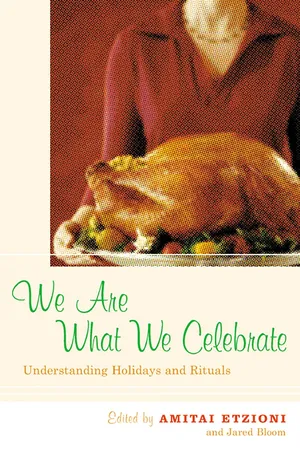
eBook - ePub
We Are What We Celebrate
Understanding Holidays and Rituals
- 253 pages
- English
- ePUB (mobile friendly)
- Available on iOS & Android
eBook - ePub
We Are What We Celebrate
Understanding Holidays and Rituals
About this book
Information
Topic
SozialwissenschaftenSubtopic
SoziologiePart I
Introduction
Chapter 1
Holidays and Rituals
Neglected Seedbeds of Virtue
On May 27, 1999, the board of the National Association of Securities Dealers (the parent organization of NASDAQ) announced that it planned to open an evening trading session for stocks between 5:30 p.m. and 9:00 or 10:00 p.m. NASDAQ president Richard Ketchum added, “there may come a day when we trade 24 hours.”1 Actually, a “24/7 week” was already at hand. People can trade stocks and much else twenty-four hours a day, seven days a week (including holidays), on the Internet. In a society that has made economic advancement a key value while downgrading others, people dedicate more and more of their time to work and commerce, and less to family, community, and holidays. Although the per capita hours in the formal workweek have not increased much, many people work overtime and take work home, and, above all, more members of the family now work outside the household.
The rise of cyberspace presents a qualitative jump in the scope of opportunities to work and trade because it knows neither clock nor calendar nor holidays. For those who seek to trade or labor within the Internet’s rapidly expanding confines, any time is as good as any other. While in the “old” pre-Internet world, banks still closed at certain hours on certain days, rapidly rising e-banks are operational at all times. And while some shops stay open late-nights and weekends, only on the Internet can one safely assume that time, day, and date do not matter. There is no day of rest for the Internet mailman; email flows into one’s PC nonstop. In short, cyberspace has no Sabbath—nor Christmas nor Yom Kippur. Cyberspace stands to eradicate whatever remains of “institutionalized” barriers, that is, those that are used to separate and protect the sacred from the profane, the social and spiritual from labor and commerce.
In examining these transformations in society’s attitudes toward work, rest, and holidays, the family dinner is a fine indicator of the changes that have taken place, as well as a ritual of importance. Once upon a time, many families sat down for dinner together at a set time. All members of the family were expected to be present. Family discussions and normative deliberations took place.2 (True, in many earlier societies, there were no set meals. And in 1950s America, the conversation over dinner may have been dominated by the father or his views and may have reinforced values that few would seek to uphold today.) In recent years, increasingly it seems, families rarely dine together, due in part to conflicting schedules and changing roles within families (the movement of women into the workforce, etc.).3 And if they do, they often watch TV while they eat.
In reaction to this trend, some efforts have been made to restore traditional holidays. One day before the announcement of the board of NASDAQ, the Central Conference of American Rabbis, the board that guides Reform Jews, voted to call on its members to return to the observance of traditional rituals such as observing the Sabbath, wearing a skullcap, and keeping kosher.4 Numerous other religious groups, including almost all Christian denominations, have initiated drives to renew religious commitment among their members through increased dedication to holidays and rituals.
Efforts to secure more room for family, community, religious life, and holidays rarely seek to simply restore tradition. They often do not constitute a simple call for a return to the past, to observe rituals and tenets “because that’s the way we’ve always done things” or “because that is the way the Lord or the scripture commands.” Instead, society faces still more choice; its members are challenged to examine which rituals they will adapt and which new rituals they will develop to protect the “sacred” from the profane. These efforts include such innocuous steps as defining places where cell phones will be turned off and declaring that bringing laptops to places of worship is inappropriate. (Amtrak now has a “silent” car on some of its trains.)5 More important, efforts may include restoring the Sabbath as a day of rest and reflection and restoring the family dinner, or perhaps dedicating one day of the week to “family time,” which could be reserved for family activities.
If one needs a symbol for the growing need to choose one’s rituals instead of merely following or reinstating traditional rituals, it may be the family dinner. Unless NASDAQ traders plan to have dinner at 11:00 p.m. or so, they are extremely unlikely to share a meal with their families on weekdays—unless they choose to miss the evening session. Most other members of society have long faced the decision of whether, given their busy households and conflicting schedules, they should plan to come together for dinner—at least on some agreed days of the week. Indeed, additional deliberate choices are involved: Those who seek weekday dinners that are occasions where family members can truly communicate with one another must formulate “policies” on matters such as turning off the TV, not answering the phone, and staying at the table until an agreed time. The same now increasingly holds for weekends and holidays.6
Selective observance, rather than a simple return to tradition, has become the norm. This is evident when one compares those rituals various individuals and groups seek to uphold or adapt versus those they choose to abandon. These are decisions that are increasingly made on the basis of what seems meaningful to the contemporary generation rather than on what is handed down from earlier ones. Observing the Sabbath thus may well be one of those rituals that many find meaningful because they see the virtue of securing time away from economic activities. At the same time, the Jewish tradition of women purifying themselves in a public bathhouse (mikvah) after they menstruate may well be one of those rituals that lack the same contemporary conviction for most.
I am not suggesting that tradition will play no role. It is one major source of options that people consider, but it is not the depository of the answer. In effect, religion can be viewed as a place where earlier approaches have been preserved so that members of contemporary societies may reembrace them. Contemporary individuals do so not merely because that is the way they are commanded by religious authorities or because it is what they have learned from their forefathers and mothers, but because they find elements of these traditions compelling and meaningful. The way people plan weddings these days is a case in point. Various alternative rituals are considered, from traditional nuptials to newly composed vows, tailored to the particular couple.7
Some of these decisions people are able to render as individuals and as families, for instance, whether or not—and when—to attend church. Other choices, though, require communal dialogues and shared decisions, for instance, whether committee and board meetings, which are increasingly conducted via email, will be conducted only on workdays and during “regular” hours (whatever that means) or whether they will go the way of twenty-four-hour stock trading.
Thus, editing and limited reengineering of holidays (rituals included) take place constantly, drawing on both new designs and old patterns. How effective this is, and can be, is a major subject for social scientists, as it currently remains largely unstudied.
Social scientists have long focused on the family as the institution that initiates the socialization process, and, in this context, much attention has been paid to the effects of family composition and structure and of the rise of other childcare institutions on the outcomes of socialization. Considerable attention has also been accorded to schools as agents of socialization. (In the past few decades, leaders and members of society at large have addressed these matters using code words such as “family values” and “character education.”) Many social scientists have also studied the role of communities (and within them, voluntary associations and places of worship) and national societies as seedbeds of virtue, that is, as places that cultivate normative behavior.
In sharp contrast, social scientists have given little consideration over the past decades to the function of holidays and rituals in general and to their role as seedbeds of virtue in particular. The term “holiday” does not even appear in the index of the sixteen volumes of the otherwise rich and elaborate International Encyclopedia of Social Sciences (1968); it is not listed in the indexes of the American Sociological Review or the American Journal of Sociology from 1975 to 1995, nor can the term be found in the Encyclopedia of Sociology (1992). There is also no entry for “holiday” in the Encyclopedia of Community (2003).
This book seeks to contribute to the development of a theory of holidays. (For the purposes of this work, the term “holidays” is used to encompass both holidays and rituals because rituals generally serve the same basic role as holidays in society. Select cases may demand that we distinguish between the two terms; when such cases arise, we will do so.) Holidays are defined as days on which custom or the law dictates a suspension of general business activity in order to commemorate or celebrate a particular event.8 They are symbolic in the sense that their essential elements (activities, foods, rules) cannot be substantively explained—the connection between these elements and the holiday they belong to is arbitrary. Just as a nation’s flag evokes much more reverence than the piece of cloth it is made of, so does a glass of wine used during religious rituals evoke much more reverence than one consumed in a bar.
Holidays and rituals are repetitive rather than one-time events. A demonstration that occurs once will turn into a ritual only if repeated over several years, in basically the same format. In this limited sense, rituals are part of tradition. They reaffirm communal bonds (although they may reaffirm some bonds at the same time that they undermine others); they are concerned with normative dimensions of society (because they all reinforce some values); and they are dramatic in the sense that in order to communicate effectively they employ narratives, displays, or some other three-dimensional, theaterlike performance.9
This book starts by examining Émile Durkheim’s well-known contributions and then suggests ways in which they may need to be extensively modified in order to further develop a more comprehensive theory.10 This volume also raises theoretical issues not directly addressed by Durkheim. To proceed, we draw on public accounts, personal observations, and findings culled from studies by contemporary social scientists, either previously published or specifically prepared for a conference that inspired this volume.11 (These papers focus on Western, especially American, society. The study of the same issues in other kinds of societies requires a separate undertaking.)
Because Durkheim’s work has been systematically analyzed, well reviewed, and effectively summarized, very little is to be gained by a reanalysis of Durkheim here.12 The main relevant points, following Durkheim’s functional approach, are merely listed briefly:
(a) Profane (secular), routine, daily life—the conduct of instrumental activities at work and the carrying out of household chores—tends to weaken shared beliefs and social bonds and enhance centrifugal individualism. For societies to survive these centrifugal, individualistic tendencies, they must continuously “re-create” themselves, by shoring up commitments to one set of shared (“common”) beliefs and practices.
(b) Rituals provide one major mechanism for the re-creation of a society in which members worship the same objects and share experiences that help form and sustain deep emotional bonds among the members.
(c) The specific elements of rituals, as well as the objects that are worshiped or celebrated in rituals—be they colored stones, woodcuts, or practically anything else—have no intrinsic value or meaning. It is the society that imbues these objects with significance, and, thus endowed, the objects become the cornerstones of the integrative rituals built around them.
Viewed this way, religious services on weekends serve to reinforce the commitments that have been diluted during the week. Holidays, in this context, are seen as supraweekends, as especially strong boosters of commitments and bonds.13
To put it in more Weberian terms, on weekdays, which are dedicated to work and commerce, people tend to abandon their commitments to shared values and communities; during holidays these commitments and shared values are reaffirmed. Hence, when holidays deteriorate, so do moral and social order. Durkheim hypothesizes that rituals (the term he uses rather than “holidays”) correlate negatively with societal disintegration (defined as excessive individualism).14 This statement, we shall see, can serve only as a first approximation. Actually, the relationships between holidays and the reinforcement of values and bonds is much more complex than Durkheim’s theory suggests. But before I can both build on this theoretical foundation and seek to modify it, a brief methodological note.
Holidays as “Global” Indicators
Holidays have a special methodological merit that makes them particularly attractive to students of societies: They provide indicators that help us to ascertain the attributes of large collectives. In studying societies, social scientists often rely on measurements based on aggregate data about myriads of individuals, objects, or transactions such as public-opinion polls, economic statistics, and census data.15 For various reasons not explored here, such aggregated data are best supplemented with indicators that tap directly into collective attributes of the macro ...
Table of contents
- Cover Page
- Title Page
- Copyright Page
- Contents
- PART I Introduction
- PART II Family Building
- PART III Community Building
- PART IV Nation Building
- About the Contributors
- Index
Trusted by 375,005 students
Access to over 1.5 million titles for a fair monthly price.
Study more efficiently using our study tools.
Frequently asked questions
Yes, you can cancel anytime from the Subscription tab in your account settings on the Perlego website. Your subscription will stay active until the end of your current billing period. Learn how to cancel your subscription
No, books cannot be downloaded as external files, such as PDFs, for use outside of Perlego. However, you can download books within the Perlego app for offline reading on mobile or tablet. Learn how to download books offline
Perlego offers two plans: Essential and Complete
- Essential is ideal for learners and professionals who enjoy exploring a wide range of subjects. Access the Essential Library with 800,000+ trusted titles and best-sellers across business, personal growth, and the humanities. Includes unlimited reading time and Standard Read Aloud voice.
- Complete: Perfect for advanced learners and researchers needing full, unrestricted access. Unlock 1.5M+ books across hundreds of subjects, including academic and specialized titles. The Complete Plan also includes advanced features like Premium Read Aloud and Research Assistant.
We are an online textbook subscription service, where you can get access to an entire online library for less than the price of a single book per month. With over 1.5 million books across 990+ topics, we’ve got you covered! Learn about our mission
Look out for the read-aloud symbol on your next book to see if you can listen to it. The read-aloud tool reads text aloud for you, highlighting the text as it is being read. You can pause it, speed it up and slow it down. Learn more about Read Aloud
Yes! You can use the Perlego app on both iOS and Android devices to read anytime, anywhere — even offline. Perfect for commutes or when you’re on the go.
Please note we cannot support devices running on iOS 13 and Android 7 or earlier. Learn more about using the app
Please note we cannot support devices running on iOS 13 and Android 7 or earlier. Learn more about using the app
Yes, you can access We Are What We Celebrate by Amitai Etzioni,Jared Bloom, Amitai Etzioni, Jared Bloom in PDF and/or ePUB format, as well as other popular books in Sozialwissenschaften & Soziologie. We have over 1.5 million books available in our catalogue for you to explore.