The lawyers and legal commentators who contribute to We Dissent unanimously agree that during Chief Justice William Rehnquist’s nineteen-year tenure, the Supreme Court failed to adequately protect civil liberties and civil rights. This is evident in majority opinions written for numerous cases heard by the Rehnquist Court, and eight of those cases are re-examined here, with contributors offering dissents to the Court’s decisions. The Supreme Court opinions criticized in We Dissent suggest that the Rehnquist Court placed the interests of government above the people, and as the dissents in this book demonstrate, the Court strayed far from our constitutional ideals when it abandoned its commitment to the protection of the individual rights of Americans.
Each chapter focuses on a different case—ranging from torture to search and seizure, and from racial profiling to the freedom of political expression—with contributors summarizing the case and the decision, and then offering their own dissent to the majority opinion. For some cases featured in the book, the Court’s majority decisions were unanimous, so readers can see here for the first time what a dissent might have looked like. In other cases, contributors offer alternative dissents to the minority opinion, thereby widening the scope of opposition to key civil liberties decision made by the Rehnquist Court.
Taken together, the dissents in this unique book address the pressing issue of Constitutional protection of individual freedom, and present a vision of constitutional law in the United States that differs considerably from the recent jurisprudence of the United States Supreme Court.
Contributors: Michael Avery, Erwin Chemerinsky,Marjorie Cohn, Tracey Maclin, Eva Paterson, Jamin Raskin, David Rudovsky, Susan Kiyomi Serrano, and Abbe Smith.
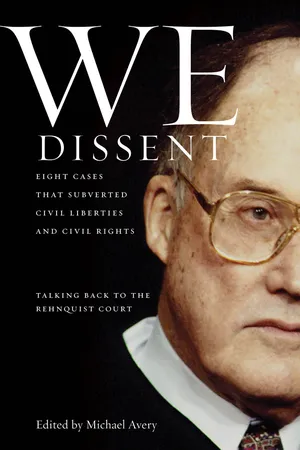
eBook - ePub
We Dissent
Talking Back to the Rehnquist Court, Eight Cases That Subverted Civil Liberties and Civil Rights
- 245 pages
- English
- ePUB (mobile friendly)
- Available on iOS & Android
eBook - ePub
We Dissent
Talking Back to the Rehnquist Court, Eight Cases That Subverted Civil Liberties and Civil Rights
About this book
1
Alden v. Maine
Sovereign Immunity—A Vestige of Monarchy
Inconsistent with Democratic Values
Inconsistent with Democratic Values
Introduction
In Alden v. Maine in 1999,1 the Supreme Court held that state governments possess sovereign immunity and cannot be sued in state court, even on federal claims, without their consent. Justice Anthony Kennedy wrote for the majority in a 5–4 decision, and his opinion was joined by Chief Justice Rehnquist and by Justices O’Connor, Scalia, and Thomas. Justice Souter wrote a dissent, which was joined by Justices Stevens, Ginsburg, and Breyer.
The case involved probation officers in the State of Maine who claimed that they were owed overtime pay by the state under the federal Fair Labor Standards Act.2 The probation officers initially sued in federal court, but the case was dismissed because of the Eleventh Amendment. They then sued in Maine state court.
By its terms, the Eleventh Amendment applies only in federal court. However, Justice Kennedy’s majority opinion concluded that there is a broader principle of sovereign immunity that bars suits against state governments in state courts on federal claims. The Court declared: “We hold that the powers delegated to Congress under Article I of the United States Constitution do not include the power to subject nonconsenting States to private suits for damages in state courts.”3
Dissent by Erwin Chemerinsky
The majority opinion invents a constitutional principle, sovereign immunity, that has no basis in the text or history of the Constitution. Even worse, it is inconsistent with one of the Constitution’s most important commands: no one, especially not the government, is above the law. For the first time in American history, the Court has held that state governments cannot be sued in state court even on federal claims. For petitioners in this case it means that there is no court, federal or state, where they can sue, even though they unquestionably have a right to overtime pay under the federal Fair Labor Standards Act.4 This violates the command long ago articulated by this Court in Marbury v. Madison,5 that “[t]he very essence of civil liberty certainly consists in the right of every individual to claim the protection of the laws, whenever he receives an injury.”
The principle of sovereign immunity is derived from English law, which assumed that “the King can do no wrong.”6 Since the time of Edward the First, the Crown of England has not been suable unless it has specifically consented to suit.
A doctrine derived from the premise “the King can do no wrong” deserves no place in American law. The United States was founded on a rejection of a monarchy and of royal prerogatives.7 American government is based on the fundamental recognition that the government and government officials can do wrong and must be held accountable. Sovereign immunity undermines that basic notion.
Sovereign immunity is a doctrine based on a common law principle borrowed from the English common law. However, Article VI of the Constitution states that the Constitution and laws made pursuant to it are the supreme law of the United States and that, as such, a federal statute should prevail over claims of sovereign immunity. Yet, the Court holds that sovereign immunity, a common law doctrine, trumps even the U.S. Constitution and bars suits against government entities for relief when they violate the Constitution and federal laws.
The fallacy in the majority’s approach can be seen first in the absence of any constitutional basis for its holding. Second, the majority’s error is evident from the pernicious consequences of its holding, especially in terms of its inconsistency with basic constitutional values. Finally, it is clear that there are not persuasive policy justifications for recognizing sovereign immunity in state courts as the majority does today.
I
The text of the Constitution is silent about sovereign immunity. Not one clause of the first seven articles remotely even hints at the idea that the government has immunity from suits. No constitutional amendment has bestowed sovereign immunity on the federal government.
A claim might be made that the Eleventh Amendment provides sovereign immunity to state governments. Yet, if this is a textual argument, a careful reading of the text does not support the claim. The Eleventh Amendment states, “The Judicial power of the United States shall not be construed to extend to any suit in law or equity, commenced or prosecuted against one of the United States by Citizens of another State, or by Citizens or Subjects of any foreign state.” By its very terms, the Eleventh Amendment applies only in federal court; it is a restriction solely on “the judicial power of the United States.”
Indeed, the majority in this case expressly recognizes this and bases its holding entirely on the broad principle of state sovereign immunity and not in any way on the text of the Eleventh Amendment. Justice Kennedy, writing for the majority, states: “[S]overeign immunity derives not from the Eleventh Amendment but from the structure of the original Constitution itself.”8 Moreover, the text of the Eleventh Amendment restricts only suits against states that are based on diversity of citizenship; it says that the federal judicial power does not extend to a suit against a state by a citizen of another state or of a foreign country. Nothing within it bars a suit against a state by its own citizens. The prohibition of suits against a state by its own citizens in federal court was the holding of Hans v. Louisiana 9 more than a century ago, but it certainly is not based on the text of the Eleventh Amendment.
Justice Kennedy’s majority opinion makes a textual argument for sovereign immunity on the basis of the premise that the existence of states is mandated by the Constitution. He writes: “The founding document ‘specifically recognizes the States as sovereign entities.’ … Various textual provisions of the Constitution assume the States’ continued existence and active participation in the fundamental processes of governance.”10 Yet, the fact that the Constitution preserves states as entities says absolutely nothing about whether states should have immunity in state court or sovereign immunity more generally. The Constitution, of course, recognizes the existence of state governments, but that does not give any indication of the scope of state power or the existence of state immunity.
Nor can sovereign immunity be justified from an originalist perspective based on framers’ intent. The Justices in the majority often describe themselves as originalists.11 It is important to remember that originalists believe that a right is protected under the Constitution, if the text is silent, only if the framers’ intent is clear in justifying protection.12 If the intent is unclear, the right is not constitutionally protected. With respect to sovereign immunity, we must recognize that, at the very least, the framers’ intent is completely ambiguous.
There was no discussion of sovereign immunity at the Constitutional Convention in Philadelphia in 1787. The issue did arise in the state ratifying conventions. The dispute was over whether Article III authorized suits against unconsenting states in federal court. Two of the clauses of Article III, §2, specifically deal with suits against state governments. These provisions permit suits “between a State and Citizens of another state” and “between a State … and foreign … Citizens.” The dispute was over whether the language of Article III quoted earlier was meant to override the sovereign immunity that kept states from being sued in state courts. As Justice Souter recently observed, “[t]he 1787 draft in fact said nothing on the subject and it was this very silence that occasioned some, though apparently not widespread dispute among the framers and others over whether ratification of the Constitution would preclude a state sued in federal court from asserting sovereign immunity as it could have done on any nonfederal matter litigated in its own courts.”13 There is no record of any debate about this issue or these clauses at the Constitutional Convention.
However, at the state ratification conventions, the question of suits against state governments in federal court was raised and received a great deal of attention. States had incurred substantial debts, especially during the Revolutionary War, and there was a great fear that suits would be brought against the states in federal court to collect on these debts. More generally, the concern was expressed that although sovereign immunity was a defense to state law claims in state court, it would be unavailable if the same matter were raised against a state in a diversity suit in federal court.
Thus, at the state ratification conventions, there was a debate over whether states could be sued in federal court without their consent.14 One group argued that the text of Article III clearly made states subject to suit in federal court. In Virginia, George Mason opposed ratification of the Constitution and particularly disliked the provisions that made the states liable in federal court:
Claims respecting those lands, every liquidated account, or other claim against this state, will be tried before the federal court. Is not this disgraceful? Is this state to be brought to the bar of justice like a delinquent individual? Is the sovereignty of the state to be arraigned like a culprit, or private offender?15
Mason believed that Article III’s explicit provision for suits against the states would have the effect of abrogating the states’ sovereign immunity defense.16 Likewise, Patrick Henry opposed the Constitution at the Virginia convention, in part because of his belief that Article III unmistakably permitted litigation against states in federal court. He labeled as “incomprehensible” the contrary claim that Article III allowed states to be plaintiffs but not defendants.17 Henry said that “[t]here is nothing to warrant such an assertion…. What says the paper? That it shall have cognizance of controversies between a state and citizens of another state, without discriminating between plaintiff and d...
Table of contents
- Cover Page
- Title Page
- Copyright Page
- Dedication
- Contents
- Introduction
- 1 Alden v. Maine
- 2 Arkansas Educational Television Commission v. Forbes
- 3 Cuyahoga Falls v. Buckeye
- 4 United States v. Whren
- 5 County of Sacramento v. Lewis
- 6 Chavez v. Martinez
- 7 Saucier v. Katz
- 8 Strickland v. Washington
- Note to the Reader Regarding Legal Citations
- About the Contributors
- Index
Trusted by 375,005 students
Access to over 1.5 million titles for a fair monthly price.
Study more efficiently using our study tools.
Frequently asked questions
Yes, you can cancel anytime from the Subscription tab in your account settings on the Perlego website. Your subscription will stay active until the end of your current billing period. Learn how to cancel your subscription
No, books cannot be downloaded as external files, such as PDFs, for use outside of Perlego. However, you can download books within the Perlego app for offline reading on mobile or tablet. Learn how to download books offline
Perlego offers two plans: Essential and Complete
- Essential is ideal for learners and professionals who enjoy exploring a wide range of subjects. Access the Essential Library with 800,000+ trusted titles and best-sellers across business, personal growth, and the humanities. Includes unlimited reading time and Standard Read Aloud voice.
- Complete: Perfect for advanced learners and researchers needing full, unrestricted access. Unlock 1.5M+ books across hundreds of subjects, including academic and specialized titles. The Complete Plan also includes advanced features like Premium Read Aloud and Research Assistant.
We are an online textbook subscription service, where you can get access to an entire online library for less than the price of a single book per month. With over 1.5 million books across 990+ topics, we’ve got you covered! Learn about our mission
Look out for the read-aloud symbol on your next book to see if you can listen to it. The read-aloud tool reads text aloud for you, highlighting the text as it is being read. You can pause it, speed it up and slow it down. Learn more about Read Aloud
Yes! You can use the Perlego app on both iOS and Android devices to read anytime, anywhere — even offline. Perfect for commutes or when you’re on the go.
Please note we cannot support devices running on iOS 13 and Android 7 or earlier. Learn more about using the app
Please note we cannot support devices running on iOS 13 and Android 7 or earlier. Learn more about using the app
Yes, you can access We Dissent by Michael Avery in PDF and/or ePUB format, as well as other popular books in Law & Courts. We have over 1.5 million books available in our catalogue for you to explore.