Winner of the 2014 Anna Julia Cooper-CLR James Book Award presented by the National Council of Black Studies
Winner of the 2014 PEN Oakland-Josephine Miles Award for Excellence in Literature
A bold and exciting historical narrative of the armed resistance of Black soldiers of the Mississippi Freedom Movement
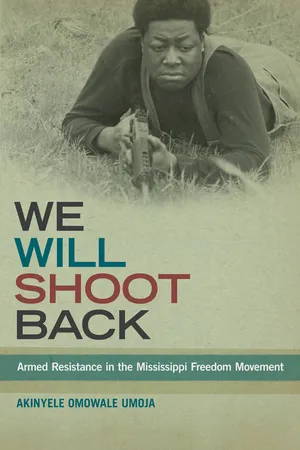
In We Will Shoot Back: Armed Resistance in the Mississippi Freedom Movement, Akinyele Omowale Umoja argues that armed resistance was critical to the Southern freedom struggle and the dismantling of segregation and Black disenfranchisement. Intimidation and fear were central to the system of oppression in most of the Deep South. To overcome the system of segregation, Black people had to overcome fear to present a significant challenge to White domination. As the civil rights movement developed, armed self-defense and resistance became a significant means by which the descendants of enslaved Africans overturned fear and intimidation and developed different political and social relationships between Black and White Mississippians.
This riveting historical narrative reconstructs the armed resistance of Black activists, their challenge of racist terrorism, and their fight for human rights.
eBook - ePub
We Will Shoot Back
Armed Resistance in the Mississippi Freedom Movement
- 336 pages
- English
- ePUB (mobile friendly)
- Available on iOS & Android
eBook - ePub
About this book
Information
1
Terror and Resistance
Foundations of the Civil Rights Insurgency
On Christmas Day in 1875, state senator Charles Caldwell, a freedman, was invited by Buck Cabell, a White associate, to a store for a friendly drink. Because of his political activity and actions in defense of his people’s liberty, Caldwell’s life had been threatened by local White citizens. Due to these threats, Caldwell’s wife, Mary, cautioned him against leaving home and traveling to town. Not wanting to offend someone he had known and respected for years, Caldwell disregarded the concern of his wife and accepted the invitation of Cabell, one of the few White men he trusted. In fact, Cabell insisted they have the drink together and escorted the Black politician to Chilton’s store in Clinton. They went to the store cellar to enjoy their drink. The two men toasted each other by tapping their glasses. With the clink of the glasses, a shot was fired from the window of the store and Caldwell fell to the floor. Suddenly, armed White men surrounded Caldwell. He recognized them, “community leaders, judges, politicians, men of substance.”1 Not wanting to “die like a dog closed up,”2 the wounded man asked to be taken from the cellar to the street. In his last act of courage, the proud politician declared, “Remember when you kill me you kill a gentleman and a brave man. Never say you killed a coward. I want you to remember it when I’m gone.”3 Christmas in Clinton was not a silent night. Dozens of shots riveted the body of Caldwell.
In the beginning of the nineteenth century, Mississippi, a territory of the United States (acquired in the Louisiana Purchase), consisted of only a few thousand White settlers and captive Africans, as well as the indigenous population. In 1817, Mississippi was granted the status of a state in the U.S. federal union. Demand for land for White settlement and expansion of commercial farming meant the expulsion of the indigenous population and the increased demand for captive African labor. Particularly due to the expansion of “King Cotton,” Mississippi had increased in population. The region east of the Mississippi River was overwhelmingly populated, with over 55 percent consisting of enslaved people of African descent. By 1860, the state had a population of 353,899 Whites and 437,404 Blacks, with a very small “free” population (773).4 The Mississippi economy was dependent on the system of racial slavery. The end of the Civil War and the corresponding policy of “emancipation” potentially undermined the White planter class, who relied on a servile and oppressed Black labor force for their livelihood, privilege, and power.
Charles Caldwell, White Terror, and the Defeat of Reconstruction
The assassination of Caldwell is symbolic of the reign of terror that defeated Reconstruction, democracy, Black political participation, as well as human rights in Mississippi and the South in the mid-1870s. Violence was central to the establishment of White domination, not only to seize power for White supremacists but also to instill fear and intimidation in the Black population and their allies. In a state with a Black majority, to secure White supremacy and to maintain Black labor, particularly rural workers, as a servile labor force, it was necessary to institutionalize fear and intimidation. Men like Caldwell represented hope for Black progress and resistance to White domination.
Who was Charles Caldwell, and why was he a threat? Caldwell was an enslaved person—a blacksmith—living in Hinds County, Mississippi, who became a leader in his community during emancipation. After the end of the Civil War, Caldwell aligned himself with the Republican Party and, in 1868, was one of sixteen Black Republican delegates to the state Constitutional Convention. Congressional invention placed the former Confederate states under martial law and would form new governments that would prevent the Confederates from securing power. To neutralize the power of the former Confederates in the South, particularly the southern elite, it was necessary to include Black people in the franchise. In Mississippi, including Black males in the body politic meant that the majority of the voting population would be people of African descent. In this political environment, Charles Caldwell emerged and was elected to the 1868 Mississippi Constitutional Convention.
With sixteen Black delegates (out of a total of ninety-four), the convention drafted the most democratic constitution in the history of Mississippi until the Civil Rights Era of the 1960s and ‘70s. It made all persons residing in the state citizens, with rights of trial by jury and other rights provided to U.S. citizens by the Constitution and Bill of Rights. The Mississippi Constitution of 1868 eliminated property criteria for holding office, jury service, and suffrage. As with other Reconstruction assemblies during this period, the Mississippi Constitution of 1868 provided for public education, the elimination of segregation in public accommodations and institutions, and universal adult male suffrage. On the other hand, Whites who were linked to the Confederate rebellion against the union were disenfranchised. This policy resulted in twenty thousand Whites, mostly elite, being denied the right to vote or hold office.5 Caldwell was an active participant in the four-month process of drafting a Reconstruction constitution for his home state.
Subsequent to the convention, Caldwell was involved in a shooting incident in Jackson, the Mississippi state capital. In “broad daylight,” a White man, who was the son of a Mississippi judge, attempted to shoot Caldwell, but in self-defense, the Black leader shot and killed his attacker. Caldwell was tried and acquitted, achieving the distinction of becoming the first, and possibly only, Black person to win an acquittal after killing a White man in Mississippi.6
Following the convention, the successful defense of his life, and acquittal in Jackson, Caldwell became involved in the Hinds County government. In 1870, he was elected to the state Senate. Caldwell and other Black politicians participated in state government. After the election of 1873, Black men were elected to the offices of lieutenant governor, secretary of state, superintendent of education, and speaker of the House. While Caldwell and other Black legislators did not possess the numbers to control either body of the state legislature, their interests were reflected in the policies developed by state government. The Mississippi Reconstruction legislatures instituted elements of the 1868 Mississippi Constitution, including universal male suffrage, elimination of chattel slavery, eradication of codes related to racial servitude and control, and establishment of public education. Vagrancy laws were eliminated and taxes for mechanics and artisans lowered. The right of married women to control their own income, autonomous from their spouses, was implemented. Husbands were also required to receive consent from their spouses on the sale of family domiciles.
In response to the democratic agenda of the Mississippi Reconstruction government, former Confederates, the White planter class, and their allies worked to undermine and ultimately defeat the Republican government. With the Democratic Party as their electoral arm and White supremacy as a mobilizing tool, they used extra-legal violence as a major vehicle to achieve their interests. According to John Lynch, U.S. congressman and first Black Mississippi State speaker of the House, “Nearly all Democratic clubs in the state were converted into armed military companies. Funds with which to purchase arms were believed to have been contributed by the national Democratic organization.”7 Lynch also stated that the paramilitary forces, primarily former Confederate military, were “tried and experienced soldiers” and “fully armed and equipped for the work before them.”8 The development and use of White terrorist organizations to neutralize and defeat Republican and Black politicians by any means necessary was the order of the day. For the Bourbon White elite and their allies, the intimidation of the Black laborers and farmers was necessary to prevent their political involvement and to maintain their subjugated location in the economy. The White elite could not maintain its interests and position without the subordination of the Black majority. Determined Black leaders like Caldwell served as obstacles to White elite power in Mississippi and throughout the South.
During the 1875 elections, the White supremacist forces intensified their offensive to undermine and harass the Reconstruction government of Mississippi. Race riots occurred in Vicksburg, Water Valley, Louisville, Macon, Friars Point, Columbus, Rolling Fork, and Yazoo City. White supremacists initiated race riots to intimidate Black voters and disrupt Republican political campaigns. In Macon, for example, twelve Blacks were killed by White vigilantes imported from Alabama. In Vicksburg, as recently emancipated Blacks celebrated their new citizenship at a Fourth of July parade, White terrorists killed large numbers of the Black population. In Yazoo City, White supremacist violence forced the Republican sheriff to leave town and took the lives of several Blacks.9
Terrorist violence disrupted an election debate on September 4, 1875, in Clinton. Caldwell, running for reelection to the state Senate, was a participant in the debate, which was witnessed by more than one thousand Blacks and approximately one hundred Whites. The Democratic candidate spoke first with no incident, but after Caldwell began his speech, heckling and other disruptive behavior by Whites escalated into shooting at the predominantly Black and Republican audience, resulting in the death of four people (two Whites, two Blacks) and injury to nine others (four Whites, five Blacks). Blacks fled Clinton, seeking refuge in Jackson—a Republican stronghold—or the swamps and woods. Caldwell, along with others who retreated to Jackson, demanded that Governor Ames provide weapons so they could protect themselves.10
In subsequent days, the terror continued, targeting Republicans, Black and White, in Clinton, with dozens of people killed. The reign of terror spread throughout Hinds County. Without a significant response from President Ulysses Grant or the Union military to suppress the terrorist onslaught, Mississippi Republican governor Adelbert Ames mobilized citizens loyal to the state Reconstruction government to form seven companies of the state militia. Recognizing the level of genocidal violence being waged on their leadership and communities, Black people answered the call for forming a militia for defense from the White supremacist onslaught. Recently emancipated Blacks were willing to defend their liberty, lives, and newly acquired political and human rights. Caldwell, who had previously defended himself on the streets of Jackson, was one of those citizens demanding arms to protect the state government as well as the freedom and humanity of his people. Five of the companies consisted exclusively of Black men. The first militia company mobilized, Company A of the Second Regiment of Mississippi Infantry, was commanded by Caldwell, who was appointed the rank of captain.
While some Black militia members possessed military experience as Union soldiers from the U.S. Civil War, the Black militias were not as well equipped or trained as the former Confederate, pro-Democratic paramilitary forces.11 However, they did possess the determination and will to maintain their newly won freedom. In an interview several decades later, Black Mississippi state senator and militia leader George Washington Albright remembered, “Our militia helped to fight off the Klan which was organized by the old slave owners to try and make us slaves again in all but name.”12
On October 9, 1875, a little more than a month after the attack on the Clinton political debate and the raid on his home, Caldwell carried out a significant military campaign. The company under Caldwell’s command had the responsibility of transporting “several wagon loads of weapons”13 to another militia company composed of Black men in the town of Edwards Station (southwest of Clinton). Returning from this mission, Caldwell consolidated his forces with two other predominantly Black companies, leading three hundred soldiers (approximately two hundred armed) into Jackson. Recognizing Caldwell’s determination and that a major engagement might encourage federal intervention, Democratic leaders ordered their paramilitary forces not to engage the troops under the captain’s command.
While they did not defeat the Black militia on the battlefield, the Democrats were able to defeat them in the courts. One month prior to Caldwell’s march through Hinds County, Democratic lawyers filed motions to prevent the state from allocating resources for the organization of state-supported militias. The state supreme court ruled in favor of the Democrats, and on October 12, 1875, three days after Caldwell and his forces initiated their march, Governor Ames demobilized the state militias. The disbanding of the predominantly Black militias significantly weakened the defense and resources available to Mississippi’s Black communities ten years after the end of chattel slavery. A Reconstruction based upon democracy and radical reform was doomed to failure in the face of a White supremacist armed rebellion, insufficient federal intervention, and the decision not to provide arms to the Black majority. White supremacy would be the order of the day in Mississippi for nearly a century. Within ten weeks of the decision to disarm Black militias, Caldwell was assassinated.
During the 1870s, Black political participation was the primary motivation for White supremacist violence. Black political participation accounted for 83 percent of the recorded mob violence of the period.14 The federal government allowed its southern adversaries back into the union through the violence, terror, and disenfranchisement of people of African descent. The U.S. government and national Republican Party proved unreliable allies as valiant men like Caldwell were assassinated, Black political officials were deposed, and the Black masses were forced into agrarian peonage.
With the Hayes-Tilden Compromise of 1877, any pretense of federal intervention in Mississippi and the former Confederacy was dropped for decades. A war was waged in the South to place emancipated Blacks, in the words of Du Bois, “back towards slavery.”15 Terrorist violence was unleashed to secure the White planter elite in power and to perpetuate a system based on White supremacy. The specter of violence remained as a means of intimidation and social control. In the decades following Reconstruction, lynching became common in the state. Between 1882 and 1940, 534 Black people were lynched in Mississippi—the highest total in the United States during that period.16 The federal government ignored terrorism waged against Black people: “Congress and the president took no action to prevent lynching, and the federal government did not prosecute the perpetrators, even when the event was publicized at least a day in advance.”17 With White supremacist violence as a major vehicle used to intimidate and suppress, within decades Blacks were excluded from representation and participation in electoral politics and apartheid was institutionalized in civil society.
Survival: Accommodation under Apartheid
As tenancy increased and White planter hegemony and apartheid consolidated itself in Mississippi politics and civil society, Blacks responded to White domination and violence in a variety of ways. Leaving Mississippi and the South was one option to escape terror.18 Of those who stayed in Mississippi and the South, some attempted to survive through accommodation to White domination and to build institutions without coming into direct confrontation with White power. Isaiah Montgomery—a prosperous Black farmer, entrepreneur, and founder of the Black town of Mound Bayou—proclaimed, “This is a white man’s country … let them run it.”19 Montgomery was the lone Black delegate to the 1890 state constitutional convention; he argued that disenfranchising Blacks was a “fearful sacrifice” to maintain peace between the races. The convention would implement a literacy provision that was liberally used to disqualify potential Black voters.20
While Montgomery was in the minority of Mississippi’s Black leadership, accommodation did charac...
Table of contents
- Cover Page
- Title Page
- Copyright Page
- Contents
- Acknowledgments
- Introduction
- 1. Terror and Resistance: Foundations of the Civil Rights Insurgency
- 2. “I’m Here, Not Backing Up”: Emergence of Grassroots Militancy and Armed Self-Defense in the 1950s
- 3. “Can’t Give Up My Stuff”: Nonviolent Organizations and Armed Resistance
- 4. “Local People Carry the Day”: Freedom Summer and Challenges to Nonviolence in Mississippi
- 5. “Ready to Die and Defend”: Natchez and the Advocacy and Emergence of Armed Resistance in Mississippi
- 6. “We Didn’t Turn No Jaws”: Black Power, Boycotts, and the Growing Debate on Armed Resistance
- 7. “Black Revolution Has Come”: Armed Insurgency, Black Power, and Revolutionary Nationalism in the Mississippi Freedom Struggle
- 8. “No Longer Afraid”: The United League, Activist Litigation, Armed Self-Defense, and Insurgent Resilience in Northern Mississippi
- Conclusion: Looking Back So We Can Move Forward
- Notes
- Index
- About the Author
Trusted by 375,005 students
Access to over 1.5 million titles for a fair monthly price.
Study more efficiently using our study tools.
Frequently asked questions
Yes, you can cancel anytime from the Subscription tab in your account settings on the Perlego website. Your subscription will stay active until the end of your current billing period. Learn how to cancel your subscription
No, books cannot be downloaded as external files, such as PDFs, for use outside of Perlego. However, you can download books within the Perlego app for offline reading on mobile or tablet. Learn how to download books offline
We are an online textbook subscription service, where you can get access to an entire online library for less than the price of a single book per month. With over 1.5 million books across 990+ topics, we’ve got you covered! Learn about our mission
Look out for the read-aloud symbol on your next book to see if you can listen to it. The read-aloud tool reads text aloud for you, highlighting the text as it is being read. You can pause it, speed it up and slow it down. Learn more about Read Aloud
Yes! You can use the Perlego app on both iOS and Android devices to read anytime, anywhere — even offline. Perfect for commutes or when you’re on the go.
Please note we cannot support devices running on iOS 13 and Android 7 or earlier. Learn more about using the app
Please note we cannot support devices running on iOS 13 and Android 7 or earlier. Learn more about using the app
Yes, you can access We Will Shoot Back by Akinyele Omowale Umoja in PDF and/or ePUB format, as well as other popular books in History & North American History. We have over 1.5 million books available in our catalogue for you to explore.