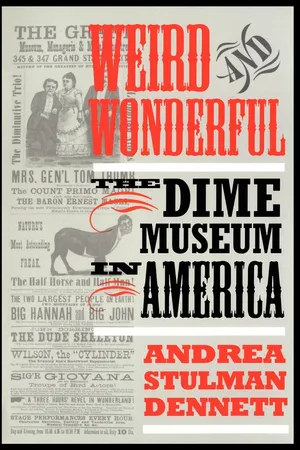
Dioramas and panoramas, freaks and magicians, waxworks and menageries, obscure relics and stuffed animals--a dazzling assortment of curiosities attracted the gaze of the nineteenth-century spectator at the dime museum. This distinctly American phenomenon was unprecedented in both the diversity of its amusements and in its democratic appeal, with audiences traversing the boundaries of ethnicity, gender, and class. Andrea Stulman Dennett's Weird and Wonderful: The Dime Museum in America recaptures this ephemeral and scarcely documented institution of American culture from the margins of history.
Weird and Wonderful chronicles the evolution of the dime museum from its eighteenth-century inception as a "cabinet of curiosities" to its death at the hands of new amusement technologies in the early twentieth century. From big theaters which accommodated audiences of three thousand to meager converted storefronts exhibiting petrified wood and living anomalies, this study vividly reanimates the array of museums, exhibits, and performances that make up this entertainment institution. Tracing the scattered legacy of the dime museum from vaudeville theater to Ripley's museum to the talk show spectacles of today, Dennett makes a significant contribution to the history of American popular entertainment.
- 214 pages
- English
- ePUB (mobile friendly)
- Available on iOS & Android
eBook - ePub
About this book
Information
1. The Origins of the Dime Museum, 1782-1840
Come hither, come hither by night or by day,
There’s plenty to look at and little to pay;
You may stroll through the rooms and at every turn
There’s something to please you and something to learn.
If weary and heated, rest here at your ease,
There’s a fountain to cool you and music to please.
There’s plenty to look at and little to pay;
You may stroll through the rooms and at every turn
There’s something to please you and something to learn.
If weary and heated, rest here at your ease,
There’s a fountain to cool you and music to please.
—Advertisement for the Western Museum of Cincinnati, 1834
The earliest museums in this country, unlike dime museums, were created in the spirit of the Enlightenment and were meant to be centers of scientific study.1 Private collections—often called “cabinets of wonders and curiosities”—were generally owned by wealthy citizens or by organizations such as libraries or so-called philosophical societies.2 Most of the objects in these cabinets were labeled and displayed according to the Linnaean system of classification, which related each object to another in the so-called great chain of being.3 Cabinets also included paintings and books, and many functioned as libraries.
Postrevolutionary America, however, was not a wealthy country, and philanthropy did not abound. But patriotism and a sense of democracy, coupled with the hope of disseminating knowledge and preserving New World culture, caused many eighteenth-century Americans who had amassed collections of books and objects to invite the public to view their assemblages, sometimes for a small fee. Some began gathering and displaying their collections as a way to earn a livelihood, or at least to supplement a meager income. Unlike the wealthy private cabinet owners, this new breed of museum proprietor depended on ticket sales to maintain his collection. Many museum managers who prided themselves on exhibiting only high-quality items, however, were soon compelled to display sensational novelties to attract crowds and remain solvent. As museums began to compete with one another for patrons, proprietors were driven to concoct gimmicks and create phony relics. The “associated-value items” (artifacts that achieved importance by virtue of their association with a famous person, for example George Washington’s shaving brush and nightcap or the bedroom curtains of Mary Queen of Scots) became essential displays. Obtaining the most novel and unusual exhibits, in fact, eventually became more important than maintaining a museum’s pedagogical goals.
By the early nineteenth century, such live performers as musicians, hypnotists, and freaks had penetrated scientific museums.4 Managers justified this innovation by claiming that their museums were repositories of rational amusements, establishments that helped divert pleasure seekers from such vices as gambling, drinking, and prostitution. These managers clearly expected live performers to attract rather than repel the bourgeois public. It was difficult, however, for them to strike the right balance between highbrow scientific exhibits and popular theatrical displays. Some collections, once reputed to be rational amusements, transformed themselves into exhibitions that pointedly favored the amusing over the rational.5 This shift in emphasis paved the way for a totally new genre of popular entertainment, the dime museum. The raison d’etre of the dime museum was the one-of-a-kind live exhibit, and a museum’s reputation, popularity, and longevity resided in its diversified program of live performance.
• • •
The rise of the dime museum in the middle of the nineteenth century was a by-product of the enormous expansion of the American urban landscape. Rural migration and European immigration created cities filled with diverse peoples who desperately needed new and respectable forms of cheap entertainment. The clash of nationalities, religions, and classes created feelings of displacement and anxiety in city dwellers. Immigrants had to adjust to a new and alien culture, farm laborers were transformed into factory workers, and white-collar employees like shop assistants, clerks, and sales and office personnel surfaced as the new middle class, uprooting older notions of class and social status. Although heterogeneity gave the modern city its distinctly American character, there was, as Lawrence Levine wrote, a “sense of anarchic change, of looming chaos, and of fragmentation.”6 Traditional forms of culture began to erode and new cultural expressions developed in response to the dynamics of city life.
Demographic growth and industrialization destroyed local communities, produced slums, and threatened to change the structure of the nuclear family. While democratic capitalism promoted faith in the idea that an individual could achieve comfort and success, the realities of life in crowded cities and dingy factories perpetually challenged the validity of this belief. People had to make fundamental changes in their lives, thoughts, and culture.7 Life became less home-centered, because for many, home was no longer a private house. Quiet family gatherings, where people exchanged stories, songs, and jokes, were no longer possible in the boardinghouses or the dark, airless, and overcrowded tenements of the period, where strangers were forced to live together and disease was rampant. Boardinghouse and tenement life played an important role in the emergence of a new mass culture.
While the domestic chores of tenement apartments—washing clothes, dishes, and floors and preparing meals—kept both employed and unemployed women busy at home, working-class men found many diversions that allowed them to escape appalling residential and working conditions—the most common lure being the saloon. Drink, food, shelter, and companionship could all be found there. Madelon Powers has written that “the primary function of the saloon was to offer the basic amenities of home in a public space.” The saloon, Powers claimed, “offered the emerging working class a wide array of facilities, services, and contacts often available nowhere else.”8 Neighborhood saloons with regular patrons fostered a camaraderie, a group identity among working-class men that provided solace during this period of economic and social upheaval. But many families needed several incomes to survive, and working women and children, who had no claim to their own wages, watched helplessly as their husbands and fathers sometimes drank up their pay. Money for food, clothing, and shelter was squandered at the saloon, and women were often beaten or abandoned by their drunken husbands. Alcoholism became a formidable problem for many urban families.
Between 1840 and 1850 numerous antiliquor organizations were formed. They included people from all classes, both sexes, and various ethnic groups. The temperance crusade was by no means monolithic or even roughly unified; advocates looked at the growth of cities and the connection to drink from many different perspectives. They had distinct agendas, but most agreed that intemperance was the great destroyer of the American family.9 “There seems to be little doubt,” wrote Ruth Bordin, “that the Temperance movement developed in response to a social evil that was both real and widespread.”10 While some reformers believed that the abuse of alcohol was fostered by the social forces of industrial capitalism and the problems created by burgeoning cities, historian John Frick has postulated that the hatred of drunkenness and the dread of its consequences for the next generation and the country’s future “became a ‘symbolic expression of deeper fears about the direction of American Society.’ “11 The drunken husband thus came to epitomize the evils of a fragmented modern society, and, as head of the household, he was often seen as an oppressor of his wife and family.
In the midst of the social and economic chaos of antebellum America, new forms of culture emerged in response to the problems created by the modern city. The working and middle classes needed to form a common urban identity, a shared culture that minimized the housing and labor inequities caused by urbanization and industrialization. One of the functions of the new commercial amusements that got their start before the Civil War was to knit, momentarily, a heterogeneous audience into a cohesive whole by promoting assimilation, patriotism, and temperance, and by diminishing the contrast between the wonders of the machine age and the impoverishment, injustice, and human degradation that accompanied them.12
At the beginning of the nineteenth century the theater catered to a wide range of social and economic classes, which were distinguished—within the theater—by where they were seated. According to Robert Toll, each section of a theater formed a society of its own.13 Box and orchestra seats were reserved for the upper classes and genteel women, while the pit was for mechanics and artisans and the gallery for the lower classes. The third tier, with its separate entrance and bar, was reserved for “unescorted women.” Prostitutes did not attend the theater to see a play; their primary business was to make arrangements for the evening, and they either took their clients to a brothel or conducted their trade right in the theater.14
An evening’s entertainment was not restricted to a five-act play. Between the acts of a full-length drama were variety numbers: jugglers, acrobats, dancers, trained animals, and human anomalies. The heterogeneous theater audience often drank, ate, and smoked during the performance, and it was not unusual for audience members to swear at performers they did not care for. If they enjoyed a performance, they yelled, cheered, and insisted on an encore. American theater had a reputation for condoning prostitution, liquor consumption, and rude behavior and was not considered a respectable form of entertainment. New York’s bloody Astor Place Riot of May 1849 confirmed that a single theater could not house culturally and economically different people. Some may argue that the riot spurred the division between what is commonly referred to as high culture and popular culture and marked the moment when the theater divorced itself from variety performers. The boundary between the two cultures, however, is permeable and fluctuating. Lawrence Levine argues that the term “popular” has been used to describe creations that not only command large audiences but also display questionable artistic merit. The use of such imprecise cultural categories, says Levine, has helped obscure the dynamic complexity of American society in the nineteenth century, where for a long time there existed a shared public culture.15 While the theater no longer functioned as an amusement that embraced all classes, new forms of culture surfaced that had both a respectable reputation and mass appeal.
• • •
In the middle of the nineteenth century, the dime museum—a distinctly American form of popular entertainment—emerged as a novel form of recreation that could divert a heterogeneous audience while supporting the new industrial morality of hard work, temperance, and perseverance. The exhibits displayed in dime museums affirmed the common person’s worth and restored his dignity while perpetuating the dream of a better life. Dime museums attempted to bridge the ever growing gap between elite and popular audiences. The museums offered a democratic and ostensibly “educational” form of entertainment in which neither language, literacy, sex, nor the size of one’s wallet was an issue.
The dime museum nourished throughout the late nineteenth century. As an entertainment venue it peaked between 1880 and 1900 and was in decline by the following decade. For a low, onetime admission charge, the dime museum dazzled men, women, and children with its dioramas, panoramas, georamas, cosmoramas, paintings, relics, freaks, stuffed animals, menageries, waxworks, and theatrical performances. Nothing quite like it had existed before.16 No previous amusement had ever appealed to such a diversified audience or integrated so many diversions under one roof.
The process of uniting individual amusements and marketing them as a single, “walk-through” entertainment, suitable for the entire family, was what made the dime museum novel. In a sense it was a so-called environmental entertainment, among whose fixed exhibits mobile spectators could organize their own journey. The arrangement of space within a dime museum, with its display cabinets set around the periphery and grouped in the center of a room, created an environment in which customers were compelled to see each other as well as the exhibits themselves. In such a space the crowd became part of the performance, an important aspect of the experience.
The atmosphere of respectability—in the larger museums, at least—revitalized many ailing entertainments and introduced new ones to a mass audience. The theater, which by midcentury had become associated with prostitution and decadence, was revived in the family atmosphere of the dime museums, which offered “cheap and comprehensible entertainment that was seemingly accepted on moral and religious grounds.”17 The production of biblical and temperance plays helped the museums establish a reputation for morality and attract patrons with an antitheater bias. Freak shows, once thought to be simply a low form of itinerant amusement, gained a certain respectability and an undoubted popularity in the museums. Ventriloquists, magicians, musicians, and actors could find work opportunities in dime museums, and performers contracted with them for weeks at a time. Many late nineteenth-century spectators were introduced to their first vaudeville shows at a dime museum; others saw their first films there.
Significantly for the evolution of the dime museums, many Victorian Americans believed that leisure time should not be spent in idleness and frivolity but in edifying and constructive activities.18 Conservative cultural reformers believed that “under enlightened municipal auspices, recreation could serve as a powerfully constructive force in social integration and moral development.”19 The success of the lyceum movement and the public education crusade, whose goals were to improve schools, academies, seminaries, and libraries and to promote the diffusion of useful knowledge, prompted managers to highlight their museums’ pedagogical function. Stressing the educational benefits of a visit to a dime museum, however, was largely a simple marketing device. Popular impresarios of the age, such as P. T. Barnum and Moses Kimball, “mastered the rhetoric of moral elevation, scientific instruction, and cultural refinement in presenting their attractions.”20 Whatever learning did in fact take place was almost accidental, for the dime museums were established as family recreation centers, not as temples of learning. Artifacts were purchased not because of their educational merit but for their drawing power. In addition, many of the items on display had been faked, so that w...
Table of contents
- Cover Page
- Title Page
- Copyright Page
- Dedication
- Contents
- List of Illustrations
- Preface and Acknowledgments
- 1. The Origins of the Dime Museum, 1782-1840
- 2. Barnum and the Museum Revolution, 1841-1870
- 3. The Peak Years: From the Civil War to 1900
- 4. Freaks and Platform Performers
- 5. Lecture Room Entertainments
- 6. Waxworks and Film
- 7. The Dime Museum Reconfigured for a New Century
- Epilogue
- Appendix A. Chronology
- Appendix B. Dime Museums
- Notes
- Selected Bibliography
- Index
- About the Author
Trusted by 375,005 students
Access to over 1.5 million titles for a fair monthly price.
Study more efficiently using our study tools.
Frequently asked questions
Yes, you can cancel anytime from the Subscription tab in your account settings on the Perlego website. Your subscription will stay active until the end of your current billing period. Learn how to cancel your subscription
No, books cannot be downloaded as external files, such as PDFs, for use outside of Perlego. However, you can download books within the Perlego app for offline reading on mobile or tablet. Learn how to download books offline
Perlego offers two plans: Essential and Complete
- Essential is ideal for learners and professionals who enjoy exploring a wide range of subjects. Access the Essential Library with 800,000+ trusted titles and best-sellers across business, personal growth, and the humanities. Includes unlimited reading time and Standard Read Aloud voice.
- Complete: Perfect for advanced learners and researchers needing full, unrestricted access. Unlock 1.5M+ books across hundreds of subjects, including academic and specialized titles. The Complete Plan also includes advanced features like Premium Read Aloud and Research Assistant.
We are an online textbook subscription service, where you can get access to an entire online library for less than the price of a single book per month. With over 1.5 million books across 990+ topics, we’ve got you covered! Learn about our mission
Look out for the read-aloud symbol on your next book to see if you can listen to it. The read-aloud tool reads text aloud for you, highlighting the text as it is being read. You can pause it, speed it up and slow it down. Learn more about Read Aloud
Yes! You can use the Perlego app on both iOS and Android devices to read anytime, anywhere — even offline. Perfect for commutes or when you’re on the go.
Please note we cannot support devices running on iOS 13 and Android 7 or earlier. Learn more about using the app
Please note we cannot support devices running on iOS 13 and Android 7 or earlier. Learn more about using the app
Yes, you can access Weird and Wonderful by Andrea Stulman Dennett in PDF and/or ePUB format, as well as other popular books in History & North American History. We have over 1.5 million books available in our catalogue for you to explore.