What the Rabbis Said examines a relatively unexplored facet of the rich social history of nineteenth-century American Jews. Based on sources that have heretofore been largely neglected, it traces the sermons and other public statements of rabbis, both Traditionalists and Reformers, on a host of matters that engaged the Jewish community before 1900.
Reminding the reader of the complexities and diversity that characterized the religious congregations in nineteenth-century America, Cohen offers insight into the primary concerns of both the religious leaders and the laity—full acculturation to American society, modernization of the Jewish religious tradition, and insistence on the recognized equality of a non-Christian minority. She also discusses the evolution of denominationalism with the split between Traditionalism and Reform, the threat of antisemitism, the origins of American Zionism, and interreligious dialogue. The book concludes with a chapter on the professionalization of the rabbinate and the legacy bequeathed to the next century. On all those key issues rabbis spoke out individually or in debates with other rabbis. From the evidence presented, the congregational rabbi emerges as a pioneer, the leader of a congregation, as well as spokesman for the Jews in the larger society, forging an independence from his European counterparts, and laboring for the preservation of the Jewish faith and heritage in an unfamiliar environment.
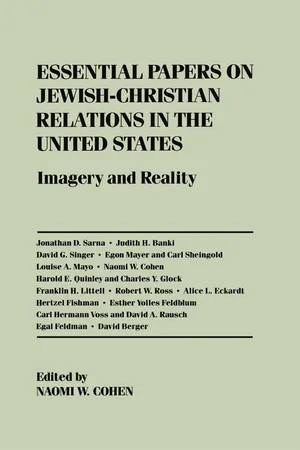
- 272 pages
- English
- ePUB (mobile friendly)
- Available on iOS & Android
eBook - ePub
About this book
Information
1
The Muzzled Rabbi
Ordained rabbis first arrived in the United States in the 1840s, and their initial encounters with their fellow Jews were frustrating if not downright painful. They found a group untutored in things Jewish and for the most part uninterested in religious observance. As Jews rapidly succumbed to the forces of assimilation and secularization, their knowledge of Hebrew was fast disappearing and the wherewithal for a Jewish education was virtually nil. Without colleagues, teachers, and libraries, the new rabbi often felt very much alone. Abraham Rice, the first rabbi in Baltimore, who could tolerate his position for only nine years, described his situation to a friend in Germany: “I dwell in complete darkness, without a teacher or companion. . . . The religious life in this land is on the lowest level, most people eat foul food and desecrate the Sabbath in public. . . . Thousands marry non-Jewish women. Under these circumstances my mind is perplexed and I wonder whether it is even permissible for a Jew to live in this land. . . . I often think of leaving.”1
Compounding their discomfort, rabbis who sought to meet the challenges of religious indifferentism through “edifying” or instructional sermons confronted serious congregational restraints that limited the freedom of the pulpit. To be sure, the preachers could discuss matters within the synagogue—the form of religious services, prayers and usages, educational problems2—and they could chide the congregants for their religious transgressions, but otherwise the restraints severely limited both the subjects and the substance of the rabbi’s sermons. Overall, what the average sermon discussed and, equally important, what it omitted reveals an unexpected aloofness from most contemporary events. True, early sermons talked about outstanding happenings, notably slavery and the Civil War,3 but for the most part rabbinic discourses, particularly those delivered before 1880, rarely considered the world of the non-Jewish majority or, for that matter, that of foreign Jews. Any attempt, therefore, to glean from the sermons the responses of the Jewish community and its rabbis to specific occurrences or to ongoing political and economic developments yields sparse results. Never did American Jews of the early nineteenth century produce a corpus of sermons like that of the first ministers of colonial New England which included religious interpretations and substantive guidance on secular as well as theological matters.4
A major reason explaining the limited scope of the early Jewish sermon was the contest for power between the members of a congregation and their spiritual leaders. Lay control of the American synagogue, like that which obtained in European Jewish communities, had been fixed long before the first rabbis arrived in the United States. In colonial days power rested with a small number of laymen who governed the kehillah. The earliest extant constitution of Shearith Israel, the first synagogue in New York, broadly defined the authority of the parnas (lay leader of the synagogue) and his two associates who comprised the ruling board: “That with the fear of God they may act as their Conscience shall dictate.”5 Even with the arrival after mid-century of university-trained intellectuals—men like David Einhorn, Samuel Hirsch, and Kaufmann Kohler—rabbis remained little more than hired help. Isaac Leeser of Philadelphia’s Mikveh Israel told the story of one religious leader (very likely Leeser himself) who complained to a congregant about an infringement of his, the rabbi’s, rights. The layman’s curt answer was to the point: “You, sir, have no rights, you have only duties to perform.”6 Some forty years later, a prominent member of the Union of American Hebrew Congregations (UAHC), a lay-led organization of Reform congregations, reaffirmed one aspect of lay control when he stated that “in no case should a [rabbi] have a voice in the counsels or practical administration of the Union.”7 The fact that Protestant churches similarly controlled the minister made the rabbi’s lot no easier.8
Circumstances favored the ongoing subjugation of rabbis to lay leadership. Economically mobile congregants, many uncouth and unlettered, could still boast that they, former peddlers or sons of peddlers, were the successful ones and that they and not their rabbis scored far higher in the American moneymaking race. Those laymen preferred that their spiritual leaders stick to safe subjects like love of God and country. A rabbi who discussed current sociopolitical events or expressed opinions at odds with those of his congregants threatened to disrupt the comfortable status quo or, even worse, arouse negative criticism from non-Jewish fellow Americans. Indeed, the rabbi may have even censored himself precisely to avoid such consequences. Gradually, as sermons gained wider acceptance, lay demands changed. By the end of the century laymen looked increasingly for rabbis who possessed oratorical skills and who cut a good figure in non-Jewish circles.
Lay-imposed restraints on the rabbis laid bare a deeper question: How absolute was the authority of a single rabbi or a group of rabbis? The matter came up at the 1892 meeting of Reform’s Central Conference of American Rabbis (CCAR) at which the rabbis considered the requirement of circumcision for proselytes. Rabbi Henry Berkowitz, who canvassed the opinions of his colleagues, assumed that authority belonged to “the rabbis of this land in whom is vested the authority to decide all such matters.” The president of the CCAR, Isaac Mayer Wise, agreed with Berkowitz, but others took an opposite stand. Chicago’s Bernhard Felsenthal maintained that although the rabbi occupied an exalted post, his opinions, or those of a group of rabbis, were not sacred; in no way did they transcend those of laymen qualified by education to interpret Jewish law: “If it should be the case that a man qualified and competent to be a teacher in Israel should not occupy a rabbinical chair . . . this man can have, and ought to have, nevertheless, the same authority as anyone who is a rabbi in office.” He argued that democracy guaranteed individual rights and freedom of conscience, matters that could not be decided by majority vote. Since American Jews revered Jeffersonian democratic principles, they could not recognize the power of any clerical body to legislate on religious doctrine. That would be both anti-Jewish and anti-American. Emil G. Hirsch agreed—“There is no distinction in Judaism between layman and clergyman”—but when the vote was taken the following year, only a partial compromise was reached.9
Preaching added to the duties of the nineteenth-century rabbi but failed to raise his status or increase his independence. As Rabbi Isaac Mayer Wise, the architect of Reform Judaism in America, later recalled, the early rabbi was a jack-of-all-trades, from teacher to gravedigger. His salary was low, his tenure uncertain, and the respect he commanded negligible. Wise campaigned early on for better conditions for the rabbi, whose lot apparently approximated that of many Christian ministers. In 1855 his weekly newspaper, the Israelite, reprinted an article from the Western Christian Advocate, which advised that if congregants attended services regularly and paid decent salaries, they would perhaps get better sermons.10 But poor sermons were not uncommon. A small item that also appeared in the American Israelite (the name had been changed in 1873) gave the following recipe for a bad sermon:
Take a small quantity of ideas, which everybody knows, paste them on a Bible text, put in two or three funny anecdotes, pour on them three or four quarts of filtered words, stir well with the quill of a spread eagle, spice well with patriotism, liberty and great nation pepper, throw the whole liquid upon paper, dry it in the moonshine of sentimentalities, then cut it in slices of equal size, and you have a sermon which will hurt nobody.11
Whatever their quality, sermons too were controlled by laymen, who judged whether the contents of the rabbi’s discourses were appropriate. Tempers ran high on the issue of a free pulpit, even resulting once in a physical brawl between Wise and some congregants during his early ministry in Albany.12 Indeed, some synagogues opposed the very inclusion of any sermon in religious services. Isaac Leeser had his own problems. Although he preached his first sermon in 1830, followed by a series of discourses published six years later, the early sermons first received the congregation’s approval in 1843. Some congregants, however, still opposed preaching, and the issue contributed to a serious rift some years later between the laity and the preacher. Effectively restraining the rabbi in the pulpit, laity also frowned on independent rabbinic voices outside the synagogue. The same Leeser reported that as a rule rabbis were not admitted to public meetings: “If they are, prudence teaches them not to touch upon any subject which might perchance be unpleasant to their flocks; for sad experience has proved to them how little they gain who have an independent opinion of their own.”13
Nor were the rabbis free to discuss political matters in their sermons. More than any other immigrant group, American Jews shied away from injecting their interests into the contemporary political arena. They thought that such behavior contradicted proper Americanism. Only when Jewish equality was at the heart of a problem, as in the case of Sunday laws or Thanksgiving Day proclamations in Christological form, did they speak out. Rather, they followed what may be called an informal code of political abstinence.14 The code was based on arguments voiced since Emancipation that Jews were part of the larger body politic—merely Frenchmen, Germans, or Englishmen who happened to be Jewish—and not a separate collectivity with its own concerns. In essence it was a code of political neutrality or even political invisibility. It proscribed Jewish political clubs and political rallies; it banned support for specific candidates who happened to be Jewish; it preferred that Jews stay aloof from public office; and, denying the existence of a Jewish vote, it warned religious and lay communal leaders against attempts to influence Jewish voters. Bifurcating Jewish behavior into two spheres, one private and Jewish and one public and political, it led to countless ambiguities and inconsistencies on the place of Jews, individually as well as collectively, in American politics. Nor did it impress Christian politicians who repeatedly appealed for Jewish political support. The fact that leading Anglo-Jewish periodicals reiterated the rules time and again indicates that Jews themselves often honored the code in the breach.15
The truth of the matter was that insistence on a politically invisible group was more un-American than minority politics. A political system that James Madison interpreted in The Federalist as a reflection of the special interests of contending factions expected voters to express their concerns through the ballot. An insistence that Jewish needs were less legitimate than those of merchants or farmers or workers was artificial and indeed self-defeating, especially for a group that was a minority both religiously and ethnically. Had Jews been less afraid of calling attention to themselves or less intent on currying favor with the native Protestants, they might have seen that hiding their political interests only sheared them of any strength that was rightfully theirs within the American system. Their posture operated neither to serve the interests of the Jewish group nor to convince the Christian majority that the Jews differed from them only in matters of faith. Nevertheless, Jewish leaders kept their silence and trusted that the Constitution and “enlightened public opinion” would protect their special interests. Meantime, political abstinence closed numerous sermons to issues of major public concern.
The riddle of Jewish identity first assumed major proportions in the Age of Emancipation. What was a Jew? Did Judaism preach Jewish distinctiveness or survival as Jews, or did it preach universalism? Nineteenth-century American Jews searched for a workable compromise that accommodated their identities both as Americans and as Jews. Their first priority was for unqualified acceptance as Americans, no matter how sincerely they may have resolved to abide by their religious heritage. If the United States in all good faith recognized them as equal citizens, it was incumbent upon them to respond by sharing and living up to American values. As a small minority, and one saddled with the baggage of age-old Christian suspicions and bigotry, Jews had to convince their compatriots that Jewish behavior was above reproach. More self-conscious now than in pre-Emancipation days, they sought to prove that they could comfortably balance their Judaism with Americanism. America had accepted religious differences from the beginning of the Republic, and thus in some ways the task was facilitated. The compromise they arrived at amounted to a quasi-“Marranoism.” Within the synagogue and their homes Jews could retain distinctive practices and beliefs, but publicly any opinions or actions on the part of the Jewish community regarding American political and social issues implied that Jews constituted an identifiable entity in areas other than religion.
If such restraints applied to all Jews, how much more so did they inhibit rabbis? Since American Jews gloried in the country’s fealty to the separation of church and state, they considered it un-American to tolerate “priestcraft” in politics. Jews deplored especially the influence of Christian ministers in the political arena, and consistency demanded that they fix the shackles of political invisibility on their own clergy. True, popular Protestant ministers like Wendell Phillips and Henry Ward Beecher held forth on political themes to admiring audiences,16 but because of such discourses they were discounted as proper models by their Jewish counterparts. Rabbis usually agreed with the divorce of religious from secular concerns, but even if they hadn’t, considerations of salary and job security would have kept them from injecting material into their sermons that could be interpreted as partisan Jewish interests. On the premise, therefore, that the synagogue and pulpit must steer clear of most contemporary matters, the code often resulted in muzzled rabbis and dull sermons.
In the 1850s Rabbi Isaac Wise, who piously preached that it was wrong to degrade the sanctity of religion by mixing it with low and corrupt politics, was scolded for going back on his own words. Since he took sides in the North/South conflict over the territory of Kansas, and since he publicly endorsed the Democratic Party, some critics aired their grievance in the municipal press. “We had supposed when we subscribed for his paper,” they said, “that it was his purpose to make it a religious paper, totally eschewing all political subjects; and . . . we have been deceived in this.” A few years later when Wise received the Democratic nomination for state senator, the board of his synagogue ordered him to turn it down. It also resolved to tell the rabbi that “the Board disapproves of all political allusions in his sermons and to discontinue same.” On the eve of the Civil War when a few rabbis entered the debate on slavery, they were similarly scolded by the lay boards of their synagogues.17
Criticism of rabbis who crossed the boundary between proper and improper remarks subsided only gradually. American Jews never indulged in heresy trials the way some Protestant churches did, but echoes of the shackled rabbi resonated even at the turn of the century. In the 1890s a prominent member of Temple Emanu-El publicly denounced a New York rabbi for “disgraceful and indecent” behavior because he had spoken at an anti-Tammany meeting against police harassment of Jewish food vendors in the urban ghettos. Since “Jews take no part in politics as Jews,” the layman said, the rabbi’s behavior was “disgraceful and indecent.” And, in the first decade of the twentieth century Stephen Wise’s insistence on freedom of the pulpit at Temple Emanu-El figured prominently in the board’s rejection of his candidacy for rabbi.18
By the end of the century more rabbis were disregarding the conventional lay-imposed restraints on their public statements and defending their right to free speech. Rapid acculturation made the first-generation immigrants increasingly secure in the American setting and less afraid of the image they projected. The rabbi too became more Americanized and bolder with respect to his congregants. Not every rabbi was blessed with the ego or charisma of outstanding independents like Stephen Wise or Emil G. Hirsch, but doubtless some by sheer dint of personality removed the gags and preached freely to their congregations. Others retained some measure of their independence by venting their opinions through books and articles, popular lectures to non-Jewish as well as Jewish audiences, and various philanthropic or educational institutions.19
Still others, admittedly only a small number, insisted publicly that rabbis could not avoid political issues. Since they regularly preached on morality, and since politics also involved morality, why was that subject taboo? Commenting on the increasingly liberated rabbi, Rabbi I. L. Leucht of New Orleans counseled his colleagues at the 1897 convention of Reform’s Central Conference of American Rabbis to take heart: “The position of ‘rabbi’ in most cases is now honorably independent and independently honorable. Even the...
Table of contents
- Cover Page
- Title Page
- Copyright Page
- Dedication
- Contents
- Acknowledgments
- Introduction
- 1 The Muzzled Rabbi
- 2 From the Words of Sabato Morais
- 3 Heroes and Villains
- 4 Meant for Children
- 5 Rabbi versus Rabbi
- 6 Restoration to Palestine
- 7 Rabbis under Attack
- 8 The New Antisemitism
- 9 The World’s Parliament of Religions
- 10 Building a Profession
- Notes
- Index
- About the Author
Trusted by 375,005 students
Access to over 1.5 million titles for a fair monthly price.
Study more efficiently using our study tools.
Frequently asked questions
Yes, you can cancel anytime from the Subscription tab in your account settings on the Perlego website. Your subscription will stay active until the end of your current billing period. Learn how to cancel your subscription
No, books cannot be downloaded as external files, such as PDFs, for use outside of Perlego. However, you can download books within the Perlego app for offline reading on mobile or tablet. Learn how to download books offline
Perlego offers two plans: Essential and Complete
- Essential is ideal for learners and professionals who enjoy exploring a wide range of subjects. Access the Essential Library with 800,000+ trusted titles and best-sellers across business, personal growth, and the humanities. Includes unlimited reading time and Standard Read Aloud voice.
- Complete: Perfect for advanced learners and researchers needing full, unrestricted access. Unlock 1.5M+ books across hundreds of subjects, including academic and specialized titles. The Complete Plan also includes advanced features like Premium Read Aloud and Research Assistant.
We are an online textbook subscription service, where you can get access to an entire online library for less than the price of a single book per month. With over 1.5 million books across 990+ topics, we’ve got you covered! Learn about our mission
Look out for the read-aloud symbol on your next book to see if you can listen to it. The read-aloud tool reads text aloud for you, highlighting the text as it is being read. You can pause it, speed it up and slow it down. Learn more about Read Aloud
Yes! You can use the Perlego app on both iOS and Android devices to read anytime, anywhere — even offline. Perfect for commutes or when you’re on the go.
Please note we cannot support devices running on iOS 13 and Android 7 or earlier. Learn more about using the app
Please note we cannot support devices running on iOS 13 and Android 7 or earlier. Learn more about using the app
Yes, you can access What the Rabbis Said by Naomi W. Cohen in PDF and/or ePUB format, as well as other popular books in History & North American History. We have over 1.5 million books available in our catalogue for you to explore.