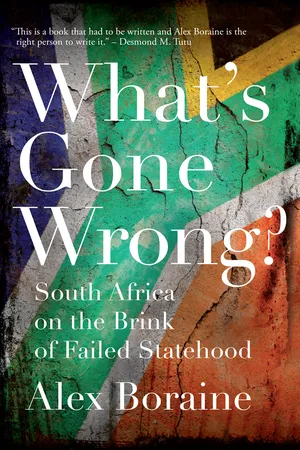
This is the book that Alex Boraine never wanted to write. As a native South African and a witness to the worst years of apartheid, he has known many of the leaders of the African National Congress in exile. He shared the jubilation of millions of South Africans when the ANC won the first democratic elections in 1994 and took up the reins of government under the presidency of Nelson Mandela.
Now, two decades later, he is forced to wonder what exactly has gone wrong in South Africa. Intolerance and corruption are the hallmarks of the governing party, while the worsening state of education, health, safety and security and employment strengthen the claim that South Africa is a failing state. Boraine explores this urgent and critical issue from the vantage point of wide experience as a minister, parliamentarian, co-founder of the Institute for Democracy in South Africa (IDASA) and Vice Chairperson of South Africa's Truth and Reconciliation Committee. He digs deep into the history of the ANC and concludes that both in exile and today, the ANC is slavishly committed to one party as the dominant ruling factor. All else – the Executive, Parliament, the Judiciary, civil society and the media – take second and third place. The ANC, Boraine claims, seeks to control every institution.
What's Gone Wrong? pulls no punches, but it also goes beyond strong criticism and offers a number of constructive proposals, including the re-alignment of politics as a way of preventing South Africa becoming a failed state. As South Africa mourns the loss of Mandela and embarks on another national election, with the ANC likely to begin a third decade of rule, this incisive, detailed critique is required reading for all who are interested in the fate of this young nation.
- 174 pages
- English
- ePUB (mobile friendly)
- Available on iOS & Android
eBook - ePub
About this book
Information
CHAPTER ONE
The ANC in Exile: Early Years
_________________________
There continued to be broad agreement on the ultimate objective, the seizure of power, and the necessity for armed struggle or military action to achieve this.
— THOMAS KARIS AND GAIL GERHART, FROM PROTEST TO CHALLENGE1
Forty-eight years after its founding, the African National Congress was banned in terms of the Unlawful Organisations Act of 1960. Its voice was effectively silenced but its determination to resist the harsh and all-pervading racial policies of the state hardened.
Since its inception in 1912 the ANC had campaigned for participation in the political system in South Africa, from which blacks had been excluded by a deal struck between the Boers and the British after the Anglo-Boer War.
For decades the ANC opposition to successive white governments was hardly revolutionary. Letters were written, delegations sought audiences here and in the UK, all to no avail. Whites were determined to hold on to power at all costs. Despite growing desperation and occasional work stoppages, nothing broke the deadlock of a white minority using increasingly tough legislation and a growing security force on the one hand and an increasingly impatient black majority on the other. It was the politics of oppression and exclusivity versus the politics of resistance. But it should be stressed that the resistance was largely benign.
There was a lull in the strong opposition by the ANC to the white government in the 1930s and 1940s, but the Communist Party of South Africa was growing in strength and many of its members were urged to join the ANC because of the fear of the CPSA being banned (which it was in 1950, under the Suppression of Communism Act).
In the meantime, the 1948 election which brought the National Party to power was a critical step in the shift towards the armed struggle. ANC president Albert Luthuli spoke of his frustration:
Who will deny that thirty years of my life have been spent knocking in vain, patiently, moderately and modestly at a closed and barred door? Has there been any reciprocal tolerance or moderation from the Government, be it Nationalist or United Party? No! On the contrary, the past thirty years have seen the greatest number of laws restricting our rights and progress until today we have reached a stage where we have almost no rights at all. It is with this background and with a full sense of responsibility that, under the auspices of the African National Congress, I have joined my people in the new spirit that revolts openly and boldly against injustice and expresses itself in a determined and nonviolent manner …2
April 1952 saw the beginning of the Defiance Campaign of peaceful protest against unjust laws and in 1955 the Freedom Charter was launched as the statement of the core principles of the South African Congress Alliance, which consisted of the African National Congress and its allies – the South African Indian Congress, the South African Congress of Democrats and the Coloured People’s Congress. Its opening statement was: ‘The People Shall Govern!’ But these actions only prompted the state to go onto the offensive and in 1956, 156 members of the Congress Alliance were indicted on charges of treason.
This was a huge tactical error on the part of the state. For years a group of anti-apartheid activists from all parts of South Africa were given the opportunity to sit together, to share views and plan strategy – and to be won over by the eloquence of ANC leaders like Mandela and Sisulu. In the end the charges were dismissed and the activists were free to return to their homes to continue their opposition to apartheid with renewed vigour.
For several years there were heated discussions on the need to change strategies and to become more militant, but it was in only in the 1960s that the debate became more charged. On 21 March 1960, police opened fire on a peaceful protest against the pass laws organised by the Pan Africanist Congress (PAC). Sixty-nine people died and this sparked off violent protests in many parts of the country. The tragic events in Sharpeville strongly influenced the abandonment of passive resistance. The government responded by declaring a state of emergency and banning the ANC and PAC. Mandela and the rest of the ANC leadership were forced to go underground.
In December 1961 the momentous decision was taken to shift towards a military solution. No one could have imagined that this would be the start of 30 years of struggle at home and abroad. It was a contentious decision; certainly Chief Albert Luthuli was opposed to the idea and continued to favour passive resistance. But there was a strong man in the person of Nelson Mandela who declared that enough was enough. He saw no alternative to the armed struggle to gain freedom and justice for the oppressed masses. This saw the birth of Umkhonto we Sizwe (MK).
If Mandela was central to the decision, so too was the SACP, as the Communist Party was known from its re-establishment in 1953; he was strongly influenced by their view that the time had come to shift towards an armed struggle. In a sense, it was the SACP that led the way to this new strategy. Its pressure helped to sway an uncertain ANC to opt for violence in response to the violence of the state.
Direct relations between the Communist Party of the Soviet Union and the underground SACP had been established in 1960, and in following years the Soviet Union took up the anti-apartheid cause in the United Nations General Assembly – which the National Party government took as confirmation that South Africa was at the centre of the USSR’s plans for communist world domination.3 The National Democratic Revolution – the Stalin-era Soviet theory on national liberation movements – is still part of ANC policy now.

The arrest of Mandela and the rest of the ANC leadership remaining in South Africa is history, as is the Rivonia trial of 1963. In a moving speech at a conference sponsored by the World Council of Churches in Kitwe (then Northern Rhodesia) in May 1964, a senior and much-loved ANC member, ZK Matthews, outlined the reasons why the ANC had decided to turn to the armed struggle:4
For many years the Africans reluctantly accepted the rule of the white man but endeavoured to fight for the amelioration of their lot and the removal of the disabilities under which they labour by the usual methods of persuasion and discussion. …[but] non-white groups are faced with a white population which is apparently impervious to the democratic processes of persuasion and discussion.
Matthews quotes from one of Mandela’s famous speeches:
At the beginning of 1961 … I and some colleagues came to the conclusion that as violence in this country was inevitable, it would be unrealistic and wrong for African leaders to continue preaching peace and non-violence when the government met our peaceful demands with force. Umkhonto was to perform sabotage and strict instructions were given to its members right from the start that on no account were they to injure or kill people in planning or carrying out operations.
Matthews concluded his speech with a question:
When the flower of African youth represented by men such as Mandela or Dr Alexander are being sentenced to long terms of imprisonment during peace time, for fighting for their legitimate rights in what they believe to be the only ways open to them, can we say that the Christian thing is to advise them to acquiesce in their present situation and wait, Micawber-like, for something to turn up?
It had been decided in 1960 to send Oliver Tambo out of the country to head up the ANC’s external mission. His mandate was to keep the movement alive and to be the voice of the ANC in Africa and the wider world. Tambo was a quiet, almost diffident person, noted for his belief in the importance of consensus, but often criticised for not being strong enough and not acting more swiftly in times of dissension and division within the ranks of the ANC. He battled to gain the support of those who joined him in exile.
Tambo served as acting president of the movement for many years and was only elected president in 1977. As a committed Christian and someone who had wanted to be an Anglican priest, there must have been considerable inner tension for the ANC leader. I confess that I was surprised when I dined with him for the first time in Lusaka and he said grace before the meal. However, despite his quiet demeanour he played a dominant role in holding a disparate group of people together for some 30 years. He was an excellent diplomat and managed to persuade many leaders in the East and later in the West of the rightness of the ANC’s cause.
In my view at least, Tambo has never received adequate acknowledgement for the role he played while the ANC was in exile. It was a tragedy that he suffered a stroke when victory was in sight and never lived to see his beloved party come to power in 1994.
If the movement in exile was struggling for survival against impossible odds, within South Africa throughout the 1960s the ANC was virtually moribund. The banning order in 1960 was serious enough, but the life sentences of Mandela, Walter Sisulu, Govan Mbeki and others were a body blow to the movement. Here and there small groups tried valiantly to keep the ANC visible but the Nationalist security forces cracked down relentlessly and any suggestion of opposition was swiftly squashed.
It is difficult to comprehend from a distance just how problematic exile was for the ANC during the first 10 years. They started with nothing but their wits and their determination to keep the movement alive. They watched with horror as events unfolded in South Africa and realised there was no point in looking for support from their comrades who faced imprisonment and harassment at every turn. They were on their own. Communication was difficult and dangerous.
The challenges facing Tambo and his compatriots were formidable. They were in a foreign land, money was tight, support from the African continent was lukewarm and housing was often temporary and inadequate. They were parted from families and friends, and loneliness was a daily companion. It is no wonder that in those first months and years there was considerable frustration and disillusionment. The movement from very early on seemed to be riddled with informers and this not only put it at risk but made it difficult to develop trust; instead suspicion became a hallmark. Some of the informers were former ANC cadres who were turned after torture by the security forces. The ANC became aware of this strategy at great cost to themselves and their paranoia concerning the infiltration of informers was understandable and almost excusable.
Professor Tom Lodge makes the valid point that ‘the terrain of exile is not wholly disadvantageous for the development of a political movement. It can provide protection, security, powerful forms of external support, factors and conditions which facilitate the development of a form and quality of organisation unattainable in the precarious circumstances of opposition parties within the homeland.’5 However, he acknowledges that the first decade was precarious and that a resurgence only took place after the Soweto uprising in 1976.
Fortunately for the ANC, the Communist Party was in far better shape. A number of its leaders – Joe Slovo, Yusuf Dadoo, Moses Kotane, and others – had gone into exile earlier. They were better organised, they had access to guns and money and had a well-developed strategy. They introduced the ANC leadership to the current government of the Soviet Union. Many ANC members went to the Soviet Union and East Germany for military training and the Soviets were their biggest supplier of arms and ammunition as well as financial support.
The slogan adopted very early on by the ANC in exile, and used consistently throughout this period, was ‘seizure of power’, but in many respects it was powerless and rhetoric trumped successful action. It was to the credit of Tambo and his lieutenants that the ANC existed at all in the first 10 years in exile. However, despite their efforts to hold the movement together there were deep divisions which came close to destroying it. Many of the cadres lived in squalid conditions and wanted nothing more than to return to South Africa and continue the fight against the regime. It was, however, proving very difficult for MK to gain any momentum, largely because of the strength of the South African security forces, the inexperience of the ANC military leaders and the large numbers of informers.
There was tremendous pressure on the ANC to prove that it was capable of leading the fight against apartheid, and this led to a decision to link up with the Zimbabwean liberation movement for an incursion across Rhodesia to establish a route into South Africa. The abortive Wankie mission resulted in great loss of life. But the pressure from dissatisfied cadres brought about the ANC’s first national consultative conference – the Morogoro Conference – in Tanzania in 1969.
For some time there had been a keenly felt frustration amongst the rank and file, who previously had not been consulted on policy matters as regards the lack of leadership or strategy to offer any genuine opposition to the apartheid regime. Wankie veteran Chris Hani was particularly critical, especially of the high life of the leadership – including the likes of Thabo Mbeki studying comfortably in Sussex while Hani and his comrades were risking death or imprisonment – and his Memorandum summing up the grievances of those living in camps was a flashpoint which found considerable support amongst his colleagues.
Hani was especially severe in his criticism of the MK military leadership following the abortive raid in Wankie, noting that ‘there had never been an attempt to send the leadership inside the country since the Rivonia arrests’ and that there was ‘an overconcentration of people in offices’. He also railed at ‘the careerism of the ANC leadership abroad who have, in every sense, become professional politicians’, at ‘the opening of mysterious business enterprises’ often run by ‘dubious characters with shady political backgrounds’, and ‘the glaring practice of nepotism where the leadership uses its positions to promote their kith and kin and put them in positions where they will not be any physical confrontation with the enemy’.6
Although Hani went on to be one of the best-loved members of the ANC, the leadership’s first reaction was to see the Memorandum as open rebellion. He and his seven co-signatories were suspended, and if a military tribunal had had its way, would have faced a firing squad.7
Despite the lack of an immediate response to the serious grievances and frustrations raised by the 70 delegates, Morogoro was in many ways a turning point. It was a consultative conference which enabled delegates to express their frustration and dissatisfaction with the leadership, the lack of communication and the lack of real progress in the struggle.
The conference also had to give attention to a serious setback, namely the Lusaka Manifesto, which had been adopted on 16 April 1969 by 14 African heads of state and was endorsed by the Organisation of African Unity (OAU) and the General Assembly of the United Nations. At its heart was a call for the ANC to work towards a negotiated settlement to end apartheid. This was a disheartening and severe blow to the ANC, which had less than 10 years earlier resolved that it had no alternative but to turn to the armed struggle because of the intransigence of the South African state. The Manifesto starkly demonstrated the continent’s lack of faith in the ANC’s ability to bring about the desired transformation. Perhaps this was the first planting of the seeds which finally led the ANC to accept that negotiating with the South African government was the only way to achieve its aims.
The ANC wisely made no attempt to criticise the Manifesto but it certainly concentrated the mind and made it easier to endorse the document entitled ‘Strategy and Tactics’, which was largely the work of Joe Slovo, MK chief of staff and SACP central committee member, and illustrated yet again the influence of the Communist Party on the ANC.8 Essentially, Slovo’s document stressed the need to hold political work in tension with the use of military force: ‘The primacy of the political leadership is unchallenged and supreme and all revolutionary formations and levels (whether armed or not) are subordinate to this leadership.’9 Therefore political mobilisation was of paramount importance. Despite his strong assertion the ANC in exile remained ambivalent about the primacy of political mobilisation over the armed struggle.
There were other important decisions taken: a streamlined executive was elected (from 23 down to 9 members), Tambo was re-elected as acting pre...
Table of contents
- Cover Page
- Title Page
- Copyright Page
- Dedication
- Contents
- Acronyms and Abbreviations
- Foreword by Desmond M Tutu, Archbishop Emeritus
- Introduction
- Chapter One The ANC in Exile: Early Years
- Chapter Two A Government in Waiting: Exile in the 1980s
- Chapter Three Parliament: Legislator or Lame Duck?
- Chapter Four People’s Parliament
- Chapter Five The Role of the Judiciary in a Failing State
- Chapter Six Corruption in a Failing State
- Chapter Seven The Role of Civil Society in a Failing State
- Chapter Eight Realignment and the Failing State
- Conclusion
- Notes
- Bibliography
- Acknowledgements
- Index
Trusted by 375,005 students
Access to over 1.5 million titles for a fair monthly price.
Study more efficiently using our study tools.
Frequently asked questions
Yes, you can cancel anytime from the Subscription tab in your account settings on the Perlego website. Your subscription will stay active until the end of your current billing period. Learn how to cancel your subscription
No, books cannot be downloaded as external files, such as PDFs, for use outside of Perlego. However, you can download books within the Perlego app for offline reading on mobile or tablet. Learn how to download books offline
Perlego offers two plans: Essential and Complete
- Essential is ideal for learners and professionals who enjoy exploring a wide range of subjects. Access the Essential Library with 800,000+ trusted titles and best-sellers across business, personal growth, and the humanities. Includes unlimited reading time and Standard Read Aloud voice.
- Complete: Perfect for advanced learners and researchers needing full, unrestricted access. Unlock 1.5M+ books across hundreds of subjects, including academic and specialized titles. The Complete Plan also includes advanced features like Premium Read Aloud and Research Assistant.
We are an online textbook subscription service, where you can get access to an entire online library for less than the price of a single book per month. With over 1.5 million books across 990+ topics, we’ve got you covered! Learn about our mission
Look out for the read-aloud symbol on your next book to see if you can listen to it. The read-aloud tool reads text aloud for you, highlighting the text as it is being read. You can pause it, speed it up and slow it down. Learn more about Read Aloud
Yes! You can use the Perlego app on both iOS and Android devices to read anytime, anywhere — even offline. Perfect for commutes or when you’re on the go.
Please note we cannot support devices running on iOS 13 and Android 7 or earlier. Learn more about using the app
Please note we cannot support devices running on iOS 13 and Android 7 or earlier. Learn more about using the app
Yes, you can access What's Gone Wrong? by Alex Boraine in PDF and/or ePUB format, as well as other popular books in Politics & International Relations & African History. We have over 1.5 million books available in our catalogue for you to explore.