Uncovers the truth behind the ideas, struggles, and eventually success of Black and Puerto Rican Nationalists regarding key feminist issues of the 1960s, 1970s, and 1980s
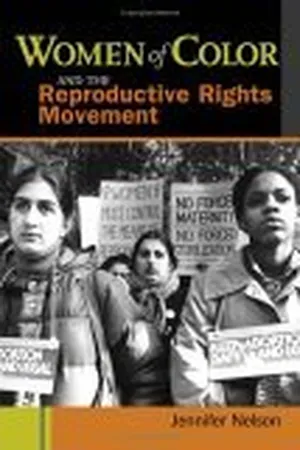
While most people believe that the movement to secure voluntary reproductive control for women centered solely on abortion rights, for many women abortion was not the only, or even primary, focus. Jennifer Nelson tells the story of the feminist struggle for legal abortion and reproductive rights in the 1960s, 1970s, and early 1980s through the particular contributions of women of color. She explores the relationship between second-wave feminists, who were concerned with a woman's right to choose, Black and Puerto Rican Nationalists, who were concerned that Black and Puerto Rican women have as many children as possible "for the revolution," and women of color themselves, who negotiated between them. Contrary to popular belief, Nelson shows that women of color were able to successfully remake the mainstream women's liberation and abortion rights movements by appropriating select aspects of Black Nationalist politics—including addressing sterilization abuse, access to affordable childcare and healthcare, and ways to raise children out of poverty—for feminist discourse.
- 225 pages
- English
- ePUB (mobile friendly)
- Available on iOS & Android
eBook - ePub
Women of Color and the Reproductive Rights Movement
About this book
Information
1
“Let’s hear it from the real experts” Feminism and the Early Abortion Rights Movement
On February 13, 1969, seven women from a radical feminist organization called Redstockings disrupted the first New York State legislative hearings on abortion law reform. The radical feminists were incensed to hear that 14 men but only one woman—a nun—were scheduled to testify before the legislative committee. During the disruption, Kathie Sarachild, one of the most provocative participants in the Redstockings’ action and a founder of the group, shouted, “It is wrong for men of great age to decide this matter [abortion law reform]. And if we have to, we will force doctors at gun point, and we might even hijack airplanes to get this.” Senator Seymour Thaler, a Queens Democrat, responded, “I would bet that all those ladies [the demonstrators] are mentally disturbed and shouldn’t be allowed to have a baby.” To which another radical feminist retorted, “The only way these people will listen to us is if we disrupt their meeting.”1
On this point, the Redstockings were probably correct. The New York State legislators had no plans to include women in the abortion law debate. Redstockings, however, intended to challenge a cultural and political structure that excluded their voices and opinions, particularly on topics that concerned women centrally. Fortunately, for the Redstockings, the New York media and much of the nation was listening, some, with rapt curiosity at the oddity that radical feminism posed, others, with a mind to further build women’s liberation nationwide. The disruption of the legislative hearings was just one feminist action among many that had grabbed media attention in recent months. By 1968, women’s liberation had become part of the explosive political turmoil that had begun to sweep the nation and gather attention in major newspapers, magazines, and on television: the civil rights movement, the anti-war movement, Black Power, and the student protests all were transforming the way Americans thought about society and themselves.
I focus on Redstockings in this chapter because more than any other New York women’s liberation organization they made the right to legal abortion central to their feminist struggle for women’s autonomy. Why did Redstockings identify abortion rights as the key to women’s emancipation? Certainly, other issues were important and were quickly taken up by other feminist groups: equality in the workplace, sexual harassment, sexism in educational institutions, and women’s representation in the media, just to name a few important second wave topics. Part of the answer to this question can be found in a better understanding of Red-stockings members’ self-definition as radical feminists. They were not interested in fighting sexism through traditional political and institutional channels. They left these tasks to what feminist theorists refer to as liberal feminists, represented by organizations such the National Organization for Women (NOW). Redstockings members believed that women’s most fundamental subordination occurred in what has often been conceived by women’s historians as the private sphere. Redstockings argued that only by addressing women’s oppression at its roots—in the family, in regards to women’s bodies, and in regards to women’s control over their reproduction—could feminists begin to eradicate sexism in the public sphere, the workplace, schools, the media, etc.2
The other part of the explanation for Redstockings’ focus on abortion and body politics has to do with their decision to make a clean break from what they considered to be the sexist white male New Left. By leaving the New Left, the activists who would eventually constitute Redstockings, chose to make women’s “personal” and “private” problems into political demands. They believed that women’s liberation should focus singularly on women—not on the Vietnam War, not on civil rights, and not on student power. Issues that concerned the female body quickly moved to the center of this political agenda.3
Second wave feminists captured their commitment to making women’s personal problems into public political issues in the banner phrase, “The personal is political.” This contention is one of the most important legacies of women’s liberation and second wave feminism. By making the personal political, women’s liberation activists radically changed American political culture. Issues once confined to the domestic sphere or concerning the body were redefined as subjects for political discussion. Feminists not only brought the domestic into politics, but they also brought politics into the home. Challenging the sexual division of labor in the household or negotiating power in the bedroom was considered a feminist political act.
Defining the personal as political raised a question, however, that Red-stockings and other women’s liberation activists did not immediately address during the period from the late 1960s to the early 1970s. Whose personal problems should be elevated into political concerns? Because Redstockings and most other second wave feminist groups were almost all white and of middle-class background, the concerns of white middle-class women were most quickly addressed by the women’s liberation movement. Redstockings took their personal experiences to represent the experiences of women, in general; they did not recognize that women of color and poor women had different experiences and, thus, different problems that needed to be addressed by another set of demands. This blind spot in women’s liberation politics, and how women (and men) of color remedied it, is the subject of this book. It is also the subject of a vast body of feminist theory and debate. For more than three decades, feminists have been asking how feminism can represent the needs of all women, when women are so different from one another.
Redstockings referred to the female body when claiming the authority to define all women’s reproductive rights demands. They adamantly contended that every woman must have complete control over her body’s potential for reproduction through the use of legal abortion because only women experience pregnancy. Yet, while it is true that only women have the potential to become pregnant, Redstockings did not ask how different women experience their reproductive potential differently.
Despite their political blind spot around women’s different perspectives on reproduction, Redstockings made essential contributions to the abortion rights movement of the 1960s. No one had yet put women at the center of a movement for reproductive empowerment, even though abortion rights had been a political issue of some importance since the early part of the decade. Women had been much more the objects of political discussion rather than primary subjects driving the movement for legal abortion. The idea that women needed to decide for themselves what to do with their reproductive bodies only gained preeminence in the abortion rights movement at the end of the 1960s as feminism and abortion rights became increasingly entwined. Soon thereafter, the Redstockings’ vital claim to a woman’s right to personal sovereignty over her body through the use of abortion became synonymous with a feminism that would forever change American women’s perspectives on work, family, and childbearing.
Two related goals shaped Redstockings’ determination to wrest authority over abortion and pregnancy from male legislators, who passed restrictive reform bills, and male doctors, who patronizingly handed out abortions to the most “deserving” women. First, they wanted to make legal abortion available to all women. They reasoned that the potential to become pregnant threatened to keep all women bound to traditional female social roles; thus, all women required access to legal abortion to free themselves from the confines of a sexist culture. Second, they criticized the “sexual revolution” as incomplete, as long as women lacked both reproductive control and social equality with men. The Redstockings maintained that the sexual revolution had given men easier access to heterosexual sex outside of marriage without forcing them to evaluate what that meant for the majority of women in a sexist society. Women had lost many of the traditional “guarantees” of commitment and economic security that accompanied a sexual relationship sanctioned by marriage. Yet, most women had not gained the economic autonomy that was necessary to free themselves from reliance on men and marriage. Redstockings feminists explained that women needed both economic power and access to reproductive control in order to begin to enjoy their sexuality fully.
Background
Redstockings evolved from New York Radical Women (NYRW), founded in 1967 by Pam Allen, who had been active in the civil rights movement with the Student Nonviolent Coordinating Committee (SNCC) and had subsequently established the San Francisco women’s liberation group Sudsofloppen, and Shulamith Firestone, who wrote the germinal 1970 feminist tract The Dialectic of Sex. Many influential players in the radical feminist movement participated in NYRW. They included Kathie Sarachild, a Harvard peace activist and veteran of the civil rights movement, Anne Koedt, previously of Students for a Democratic Society (SDS), Kate Millett, author of the famous Sexual Politics, Robin Morgan, who gained her experience in the anti-war movement and with the Yippies and subsequently published her essays in the collection Going Too Far, and Ellen Willis, the well-known feminist journalist and rock critic for the Village Voice. All these women would go on to incorporate their experiences with feminism into their careers in journalism, academia, or as life-long activists.
Historian Alice Echols has described NYRW as a feminist organization with loose ties to the New Left. It was far more than that, however. Many of the members acquired their political education in the civil rights movement as opposed to anti-war or other New Left struggles. Both Allen and Sarachild gained their political experience during the 1964 Mississippi Summer Voter Registration Project organized by SNCC. Carol Hanisch, another prominent member of NYRW, traveled south from Iowa in 1965 to help the Southern Conference Education Fund (SCEF) with their civil rights organizing. As a result of their civil rights experiences in the South, women active in NYRW modeled their feminism on Black Power ideologies, arguing that women needed to organize around their own oppression—in their case sex and gender.4 Like black activists who advocated Black Power, the NYRW believed that any truly effective movement would have to grow organically from the personal experiences of those involved. Another faction of women involved with NYRW, including Robin Morgan and Florika, who chained herself to a giant replica of Miss America dubbed the “Amerika Dollie” by feminists at NYRW’s protest against the 1968 beauty pageant in Atlantic City, rejected the emphasis on personal oppression, opting instead for Yippie-inspired guerilla-type actions. A conflict emerged between these two groups, with the civil rights–trained women criticizing the guerilla theatre actions as elitist and frivolous.5
In November 1968, NYRW split into three groups for several reasons, including the organization’s growing size, ideological differences among individuals, and personality conflicts within the group.6 One of the factions to spin out of NYRW was Women’s International Terrorist Conspiracy from Hell (WITCH), which included both Robin Morgan and Florika. The formation of WITCH from NYRW illustrates the ideological divide between feminists and politicos. This split occurred both among and within radical feminist organizations. The politicos relied heavily on the Marx-Engels supposition that women’s oppression originated with private property and capitalism. By most accounts, NYRW fell into the feminist camp because they viewed women’s oppression as separate from other political issues, and they saw sexism as the product of male dominance rather than as the direct result of capitalism. Yet, the lines between the factions tended to blur with people on both sides participating in NYRW. NYRW activists generally agreed that capitalism exacerbated women’s oppression even if it did not cause it. They pinned the balance of responsibility, however, on the individual men who perpetuated sexism.7
In January 1969, some of the women who eventually formed Redstockings—Willis, Firestone, Irene Peslikis, Barbara Susan, and Rosalyn Baxandall, who had strong connections with the D.C. anti-war movement—participated in the now notorious counterinaugural demonstration in Washington D.C.8 This demonstration was organized by the National Mobilization Committee to End the War in Vietnam (Mobe). The feminists decided to burn their voter-registration cards to symbolize that just as the draft was an affront to male political consciousness, so the franchise was inconsequential for women. Some women in the group suggested that men also burn their voter-registration cards to show their solidarity with women’s liberation. The inspiration to “give back the vote” by burning voter-registration cards came from the anti-war protest of burning draft cards. The gesture illustrates how, despite their determination to distinguish themselves, NYRW and Redstockings often aligned themselves with the New Left. It is also possible that the idea for burning voter registration cards sprung from feminist identification with civil rights and Black Power and that movement’s mid-1960s rejection of the vote as being ineffective toward empowering African Americans.9
Ultimately, events at the counterinaugural demonstration confirmed the suspicions of many feminists that a degree of political separation from the New Left would be necessary. During the demonstration a number of men in the audience shouted sexist epithets and heckled Marilyn Webb, then of D.C. Women’s Liberation and formerly of SDS. Webb spoke about the link between capitalism and women’s oppression—an analysis familiar to both men and women in the New Left at this point. Despite the cogency and familiarity of the argument, Webb had been added to the speakers list as an afterthought because most of the male organizers put the war and black liberation ahead of women’s liberation. Willis has memorialized the infamous behavior of New Left men in response to Webb’s speech: when Webb began her speech with a “moderate, pro-movement statement—men in the audience booed, laughed, catcalled and yelled enlightened remarks like ‘Take her off the stage and fuck her.’” Such degrading treatment by supposed political “brothers” outraged feminists and forced many female activists to question the sanctity of movement solidarity.10
After this incident, Willis and Firestone founded Redstockings. They feared that organizing women in conjunction with the male left, particularly a male left that behaved “like rednecks,” would hinder the development of a radical feminism truly committed to the liberation of women from domination by men.11 Willis declared: “We have come to see women’s liberation as an independent revolutionary movement, potentially representing half the population. We intend to make our own analysis of the system and put our interests first, whether or not it is convenient for the (male-dominated) left.”12
Redstockings distinguished themselves among New York radical feminist organizations by using consciousness raising as a method for the development of feminist theory and by promoting their “pro-woman line.” Both strategies emphasized a woman-centered and personal analysis of oppression. Consciousness raising gave each individual in a group of women a chance to speak on a specified topic with the hope that through this process the group would come to some general theoretical conclusions about women’s position in patriarchal society. For example, the group might choose to discuss heterosexual sexual relationships in order to identify the primary problems contributing to women’s oppression when women slept with men. Or they might discuss problems that arose when women lived with men, such as dividing housework and child-care.13 Often they discussed fears of unwanted pregnancy, illegal abortion, and problems with contraception. With the pro-woman line, Red-stockings feminists argued against the idea that women were brainwashed into acting in a feminine manner and thereby accepting their own oppression. Rather, women used their femininity to gain the only advantages allowed them by men.14
Through the consciousness-raising method, Redstockings brought second wave feminist attention to abortion. They found that as they discussed sexism in their small groups, problems of reproductive control recurred as fundamental issues contributing to these women’s sense of oppression. As Willis recalled, almost everyone who had not herself had an illegal abo...
Table of contents
- Cover Page
- Title Page
- Copyright Page
- Dedication
- Contents
- Acknowledgements
- Introduction: From Abortion to Reproductive Rights
- 1 Let’s hear it from the real experts: Feminism and the Early Abortion Rights Movement
- 2 An act of valor for a woman need not take place inside of her: Black Women, Feminism, and Reproductive Rights
- 3 An instrument of genocide: The Black Nationalist Campaign against Birth Control
- 4 Abortions under community control: Feminism, Nationalism, and the Politics of Reproduction among New York City’s Young Lords
- 5 Race, Class, and Sexuality: Reproductive Rights and the Campaign for an Inclusive Feminism
- Conclusion
- Notes
- Index
- About the Author
Trusted by 375,005 students
Access to over 1.5 million titles for a fair monthly price.
Study more efficiently using our study tools.
Frequently asked questions
Yes, you can cancel anytime from the Subscription tab in your account settings on the Perlego website. Your subscription will stay active until the end of your current billing period. Learn how to cancel your subscription
No, books cannot be downloaded as external files, such as PDFs, for use outside of Perlego. However, you can download books within the Perlego app for offline reading on mobile or tablet. Learn how to download books offline
Perlego offers two plans: Essential and Complete
- Essential is ideal for learners and professionals who enjoy exploring a wide range of subjects. Access the Essential Library with 800,000+ trusted titles and best-sellers across business, personal growth, and the humanities. Includes unlimited reading time and Standard Read Aloud voice.
- Complete: Perfect for advanced learners and researchers needing full, unrestricted access. Unlock 1.5M+ books across hundreds of subjects, including academic and specialized titles. The Complete Plan also includes advanced features like Premium Read Aloud and Research Assistant.
We are an online textbook subscription service, where you can get access to an entire online library for less than the price of a single book per month. With over 1.5 million books across 990+ topics, we’ve got you covered! Learn about our mission
Look out for the read-aloud symbol on your next book to see if you can listen to it. The read-aloud tool reads text aloud for you, highlighting the text as it is being read. You can pause it, speed it up and slow it down. Learn more about Read Aloud
Yes! You can use the Perlego app on both iOS and Android devices to read anytime, anywhere — even offline. Perfect for commutes or when you’re on the go.
Please note we cannot support devices running on iOS 13 and Android 7 or earlier. Learn more about using the app
Please note we cannot support devices running on iOS 13 and Android 7 or earlier. Learn more about using the app
Yes, you can access Women of Color and the Reproductive Rights Movement by Jennifer Nelson in PDF and/or ePUB format, as well as other popular books in Social Sciences & Gender Studies. We have over 1.5 million books available in our catalogue for you to explore.