The person with schizophrenia poses a formidable challenge even to the experienced clinician. Bizarre, unpredictable behavior, disordered thought patterns, peculiar, even unintelligible speech, and extreme distrust can drastically limit the clinician's ability to conduct therapy. It is often seemingly impossible to determine the cause of these behaviors: Are they a result of the disease, the side effects of drugs, or the patient's efforts to cope?
In this brilliant and insightful book, Dr. Michael Selzer and his colleagues offer a radical new perspective on understanding and treating the schizophrenic person. What is often lacking, they argue, is a clear understanding of the patient's own experience of his world. Without a realistic appraisal of the patient's physiological and psychological vulnerabilities, the effect of various stresses on him, and his own unique adaptation to these circumstances, no effective drug or psychotherapeutic treatment intervention is possible.
This thoughtful, intelligent, and acutely perceptive book is a major breakthrough for working with persons with schizophrenia. The authors have shown that therapy with the schizophrenic person is not only possible but highly rewarding.
- 412 pages
- English
- ePUB (mobile friendly)
- Available on iOS & Android
eBook - ePub
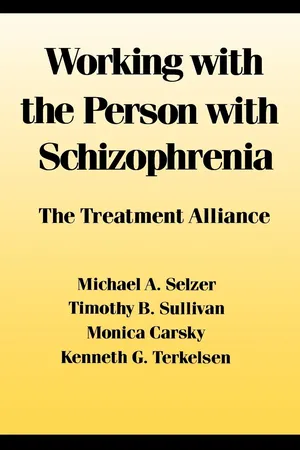
Working With the Person With Schizophrenia
About this book
Information
1
A Model for Understanding Schizophrenia
This book aims to provide clinicians with the means to understand their schizophrenic patients and the skills necessary to engage those patients in treatment. We do not intend to present a model for psychotherapy, although our views are based on work with chronic schizophrenic individuals in supportive psychotherapy, as well as in directing inpatient treatment programs. Our focus will be on the therapeutic relationship with the schizophrenic individual; its characteristics, vicissitudes, and idiosyncracies and its central importance to any therapy.
Because of the disorder’s effect on thinking and behavior, the affected individual experiences and manages relationships in ways that provoke frequent misunderstanding by and confusion in others. To avoid making inaccurate and misleading assumptions, the clinician must not only understand the disorder but also the individual’s reaction to it. The psychological response to schizophrenia must be studied in the patient’s manifest and also implied communication. This approach is crucial, for the subjective, psychological reaction to the illness best informs us of the patient’s capacity and motivation for treatment. The deciphering of the patient’s communications depends on our familiarity with the issues that typically concern schizophrenic individuals, our comfort with the intense feelings they arouse in us, and our willingness to recognize similar (as well as different) experiences in ourselves. To this end, the following chapters will explore characteristic themes encountered when working with schizophrenic patients and develop a framework for comprehending them.
Recent literature (1–2) has described the limitations of empirical descriptions of psychiatric disorders, including schizophrenia, and underlined the importance of identifying theoretical bias in any conceptual model. DSM III-R, as a kind of empirical model, while aiding in defining more distinct groups of phenomenologically similar individuals, has not brought clarity to the muddle of symptoms and signs associated with schizophrenia, and it is limited by its emphasis on empirical phenomenology. Such models have been unduly influenced by the diagnostic emphasis on the flagrant symptoms of the disorder—that is, delusions and hallucinations, initiated by Bleuler and perpetuated by Schneider and others. The attempts of Crow and others (3–6) to divide schizophrenic symptoms into two categories (“positive” or “negative”) and further to delineate two distinct schizophrenic syndromes, while able to claim empirical support, suffer from an excessively reductionistic spirit and as yet have not furthered the treatment of schizophrenia.
Investigators have tended to categorically describe the medication-unresponsive symptoms of schizophrenia as “negative symptoms” (7). (One notable exception is Wing, who has drawn attention to the role of the patient’s reaction to the illness [8].) It has often been suggested that these symptoms represent “deficits” in neurological functioning, perhaps associated with a neurologic syndrome, and dementia. This conceptual approach makes broad and unsubstantiated assumptions about the etiology of a complex syndrome, whose symptoms may be multidetermined. Though there is accumulating evidence of brain pathology associated with schizophrenia, the literature has not conclusively demonstrated that “psychological” factors are irrelevant to symptom pathogenesis (9–10). The complex behaviors represented in the “negative” symptom syndrome are too readily seen as mere expressions of frontal lobe pathology. Nevertheless, it is likely that disturbances in frontal lobe functioning are implicated in the phenomenology and, probably, etiology of schizophrenia, since most schizophrenia patients have some disturbance in cognitive performance (11–12). These areas of dysfunction, though significant, do not support the conclusion that broad, irreversible cognitive deterioration is the rule in treated schizophrenics nor that the varied and variable “negative symptom syndrome” is entirely the result of neurologic deficits. It is not even clear that the “negative symptom syndrome” is an entity.
Recent research (13–17) suggests a more reasonable view of the schizophrenic syndrome, where “positive symptoms” (hallucinations, paranoia, agitation) are seen as functionally and neuroanatomically distinct from discrete yet profound disturbances in subcortical, frontal, and prefrontal cortical brain activity. These latter “deficits,” which may conceivably vary in severity, can explain many of the symptomatic features of schizophrenia: impairment in task performance on problem-solving; becoming overwhelmed by excessive stimulation from the environment; difficulty processing the emotional complexities of interpersonal relationships; and ineffective use of learned patterns of coping with stress or challenges (18–20).
If this accumulating research is accurate, then it begins to explain part of what clinicians see in their work with schizophrenic patients. There still remain the perplexing problems of amotivation, apathy, avolition, and withdrawal, which are often such a prominent and discouraging aspect of the syndrome. Such symptoms may be revealed to be due to further, as yet undiscovered, discrete neurological deficits; in some patients they may be part of a depressive syndrome. Our thesis is that in many patients these “negative” symptoms are part of the psychological reaction to the illness process itself. Furthermore, denial and the often associated convictions stemming from delusional interpretations of events represent, in part, a psychological response to the illness. Although distorted ideation originates in physiologically provoked perceptual distortions, delusional symptoms are the consequence of a complex elabo-rative and integrative psychological process.
The essential hypothesis of our model is quite straightforward:
1. There is a complex biological basis to the schizophrenic disorder.
a. There are also secondary, physiologically determined phenomena (e.g., depressive syndromes).
2. Significant aspects of the “symptomatic picture” of schizophrenia are manifestations of psychological responses to the disorder or efforts to adapt to it (however well or ill), involving the innate resources of the mind and demanding of the clinician an understanding of cognitive mechanisms and “psycho-dynamics” (which we would consider an aspect of cognitive functioning).
a. Social behaviors, which include relationships with caregivers, are heavily influenced by these psychological reactions and are often a major barrier to effective engagement in and motivation for treatment.a
b. While all behavior, or mental activity, may ultimately have a biological basis (i.e., we are not attempting to “separate” psychological and biological processes), it is useful to think of some aspects of the schizophrenic patient’s mental life as part of the “normative” process of adaptation to stress.b
With this conceptualization of the disorder, we can devise a rational approach to the treatment of the schizophrenic individual with any modality:
1. Those symptoms that we know to be physiologically stimulated and for which we have somatic treatments (usually medications) are first treated appropriately and with respect for the complicated effects of these treatments.c
2. The symptoms or behaviors that “remain” after such treatment are addressed according to the following priorities:
a. Efforts are made to determine if symptoms or behaviors have a cognitive or psychodynamic basis and are worked with accordingly.
b. Those symptoms and behaviors that are persistent, not currently remediable with somatic treatments, and not available to work within a cognitive, behavioral, or psychodynamic paradigm are clarified and studied carefully, and efforts are then made to help the patient adapt to these limitations (e.g., prefrontal cognitive disturbances that impair instrumental role functioning).
The preeminent focus for all clinicians, however, must be to establish and maintain the treatment alliance. This is an ongoing task and often must precede other efforts, particularly in the case of the “noncom-pliant” patient. Among other goals, the treatment philosophy must communicate to the patient the idea that he or she can be understood; that the “illness” represents but a part of his or her mental experience (although a dominant and pervasive influence); that he or she is not utterly debilitated, helpless, or to blame for what has happened.
As clinicians, we must provide patients with a model of effective coping, which assumes their participation and contributes to their self-respect. Our treatment programs should help patients achieve an available, plausible understanding of themselves. At the same time, we must take into account that the patient’s view of his or her psychotic experiences has been heavily influenced by the intensity of those events and the patient’s perception that the hallucinations or feelings of suspicion are or were accurate. The “truth” is indeed never so simple as “our way” or “their way.” The patient’s rendition of reality must be respected as the most accurate representation of his or her inner experience, and, therefore, as a crucial source of data for teaching us about the patient’s frame of reference, which is a necessary first step in establishing an alliance.
Many treatment programs are limited in effect because they do not address these concerns. The schizophrenic patient is too often given prescriptions, whether for medication, rehabilitative treatments, or other therapies, without a concomitant effort to help him or her understand why or how the treatment will help and without placing the “prescription” within the context of the patient’s subjective experience. Clinicians are inhibited in this regard by their uncertainty of the most effective means of coping with the patient’s denial or delusional convictions. The matter is too often resolved by attempting to convince the patient that his or her perceptions or beliefs are simply wrong and that the clinician’s view must be accepted. Conflicts, noncompliance, or passive compliance characteristically arise from such confrontations. The treatment alliance is further strained when, in the face of serious impairment in some aspects of the patient’s cognitive functioning, as well as dejection, resentment, and consequent withdrawal, the clinician or therapeutic staff assume that the patient is globally impaired and beyond help. Therapeutic despair is then not uncommon and often unavoidably communicated to the patient through the clinician’s withdrawal or avoidance or through an expression of resentment toward the patient for rejecting his or her efforts.
In any treatment, as we attempt to establish a basis for collaboration and to educate the patient about himself or herself, we will encounter several obstacles. The patient may, under the influence of overwhelming paranoid attitudes, mistrust our intentions. What we are describing may represent an unacceptable narcissistic injury. To the degree that schizophrenic individuals are aware of their inability to control their mental life, our confronting them with this fact may occasion feelings of horror, humiliation, and hopelessness. Any treatment experience is potentially quite difficult for the schizophrenic individual, who may manifest distress through increased paranoia, oppositionality, or withdrawal rather than overt acknowledgment of sadness or fear of what is happening. It is also true that the patient may experience relief that someone appears willing to openly confront what he or she, and others, have sought to conceal or avoid.
Much of what we discuss will be relevant to the work of psychotherapists attempting to interest and maintain schizophrenic individuals in treatment. But we chose to write this book about treatment alliance because we felt it to be a crucial, yet often unappreciated, component of all treatment paradigms. Psychotherapy may have an important, even pivotal, role in the maintenance of the treatment alliance with the chronic schizophrenic individual, but all therapies require a treatment alliance, and clinicians of every discipline face the same stresses and obstacles in working with this patient group. Multidisciplinary treatment represents the only possible approach to the treatment of schizophrenia—no single therapy can address all of the problems posed by this illness. It is therefore critically important that practitioners have available a model of the disorder and of the treatment philosophy and goals and understand the basic workings of the treatment alliance so that consistent treatment efforts can be applied.
UNDERSTANDING THE CRISIS IN THE TREATMENT ALLIANCE
Treatment of the schizophrenic individual usually begins with the assessment and pharmacological amelioration of such symptoms as hallucinations, agitation, and disorganization. Later stages of treatment focus on the patient’s difficulties in social and occupational functioning. Poor outcome, or noncompliance, is usually seen to be the consequence of “positive” symptoms that are too-little responsive to medications or the debilitating effect of severe “negative” or “deficit” symptoms. While this formulation may, in some cases, be true, we have found in our own work that outcome and compliance are more dependent on the nature of the treatment alliance than on any other single variable. This is, to a degree, a conceptual distinction, because the nature of the treatment alliance is certainly influenced by the prevailing symptomatology and the severity of the illness’ manifestations; however, the distinction is not a facile one because disturbances in the treatment alliance implicate psychological mechanisms that are also distinct from “positive” or “negative” symptoms. In addition, although attention has recently, and appropriately, been focused on the “negative” symptom syndrome, failure to appreciate the importance of the treatment alliance will hamper clinicians’ attempts to engage these patients in rehabilitative or other treatment strategies.
The treatment alliance is especially troubled by the persistence of delusionality or irrational denial (which are often associated). Clinicians struggle to cope with these phenomena that often limit the effectiveness of the treatment process. What seems most troublesome is the difficulty in persuading patients to reconsider their firmly held views. Patients can often hold apparently contradictory positions (e.g., “My problems were caused by people who were torturing me because I was evil,” and “I’m afraid there’s no cure for me”), yet still resist acknowledging the utility of medications, the value of hospitalization, or of after-care treatments. One factor explaining the intensity with which delusional ideas are held may be the nature of the physiological-perceptual experience, such that the individual experiences these distorted “facts” and “events” as real. Irrational (sometimes delusional) denial, however, reflects not only distorted perception but the fear of profound narcissistic injury.
In our experience, virtually all patients who present with a delusional view of themselves and their experience or with dense, irrational denial are also unable to relinquish their convictions, to change their point of view, at the start of a treatment program. Some patients will persist in their distorted view of the world throughout their treatment; but such patients, though not all perhaps, can nonetheless develop a workable treatment alliance and participate effectively in treatment. To accomplish this, clinicians must be able to identify the obstacles to the treatment alliance and have in mind strategies for engaging the patient, either despite the obstacles or sometimes by using these apparent barriers to our and the patient’s advantage.d
Three broad patterns of maladaptation characterize troubled treatment alliances. These may represent an individual’s maladaptive responses to the illness rather than symptoms of the illness itself. We will note them here and discuss them in greater length:
1. Maladaptive Resentment or Grandiosity
a. need to blame others for plight, often coupled with rage and envy toward the world, which combine to successfully keep potential helpers at a distance; unrealistic estimation of ability to manage self and symptoms (e.g., ‘I can stop my symptoms if I want”; “I choose to retreat into fantasy”; or “I am above earthly matters”)
2. Delusional Conviction or Denial
a. persistent belief in a view of events that precludes, in whole or in part, participation in treatment [e.g., “I am already dead”]
3. Demoralization
a. apathy, amotivation, withdrawal
As we noted earlier, these represent responses to the symptoms of the illness, which have a direct and significant impact on the patient’s interpersonal functioning and on his or her attitude toward treatment efforts. Although each behavioral or cognitive pattern is influenced by the characteristics of the illness, these complex phenomena have significant psychodynamic components.
To facilitate our consideration of these concepts, we will present three vignettes of patients who manifest symptoms or behaviors that present challenges to th...
Table of contents
- Cover Page
- Title Page
- Copyright Page
- Contents
- Preface
- Acknowledgments
- Introduction
- 1 A Model for Understanding Schizophrenia
- 2 Understanding the Subjective Experience of the Person with Schizophrenia
- 3 From Understanding to Action: The Alliance and the Treatment Program
- 4 The Man with a Bug in His Brain: An Initial Interview
- 5 The Case of Sharon: A Hospital Stay Involving Noncompliance, Violence, and Staff Conflict
- 6 The Case of Maryann: Psychotherapy and Community Management, Rehabilitation, and Rehospitalization
- 7 The Case of Roger: Outpatient Psychotherapy—From Apathy to Community Involvement
- 8 Beyond Psychoeducation: Raising Family Consciousness About the Priorities of People with Schizophrenia
- Notes
- References and Suggested Readings
- Index
Trusted by 375,005 students
Access to over 1.5 million titles for a fair monthly price.
Study more efficiently using our study tools.
Frequently asked questions
Yes, you can cancel anytime from the Subscription tab in your account settings on the Perlego website. Your subscription will stay active until the end of your current billing period. Learn how to cancel your subscription
No, books cannot be downloaded as external files, such as PDFs, for use outside of Perlego. However, you can download books within the Perlego app for offline reading on mobile or tablet. Learn how to download books offline
Perlego offers two plans: Essential and Complete
- Essential is ideal for learners and professionals who enjoy exploring a wide range of subjects. Access the Essential Library with 800,000+ trusted titles and best-sellers across business, personal growth, and the humanities. Includes unlimited reading time and Standard Read Aloud voice.
- Complete: Perfect for advanced learners and researchers needing full, unrestricted access. Unlock 1.5M+ books across hundreds of subjects, including academic and specialized titles. The Complete Plan also includes advanced features like Premium Read Aloud and Research Assistant.
We are an online textbook subscription service, where you can get access to an entire online library for less than the price of a single book per month. With over 1.5 million books across 990+ topics, we’ve got you covered! Learn about our mission
Look out for the read-aloud symbol on your next book to see if you can listen to it. The read-aloud tool reads text aloud for you, highlighting the text as it is being read. You can pause it, speed it up and slow it down. Learn more about Read Aloud
Yes! You can use the Perlego app on both iOS and Android devices to read anytime, anywhere — even offline. Perfect for commutes or when you’re on the go.
Please note we cannot support devices running on iOS 13 and Android 7 or earlier. Learn more about using the app
Please note we cannot support devices running on iOS 13 and Android 7 or earlier. Learn more about using the app
Yes, you can access Working With the Person With Schizophrenia by Michael Selzer in PDF and/or ePUB format, as well as other popular books in Psychology & Abnormal Psychology. We have over 1.5 million books available in our catalogue for you to explore.