One of the most hotly debated issues in the historical study of race relations is the question of how the Civil War and Reconstruction affected social relations in the South. Did the War leave class and race hierarchies intact? Or did it mark the profound disruption of a long-standing social order?
Yankee Town, Southern City examines how the members of the southern community of Lynchburg, Virginia experienced four distinct but overlapping events--Secession, Civil War, Black Emancipation, and Reconstruction. By looking at life in the grog shop, at the military encampment, on the street corner, and on the shop floor, Steven Elliott Tripp illustrates the way in which ordinary people influenced the contours of race and class relations in their town.
eBook - ePub
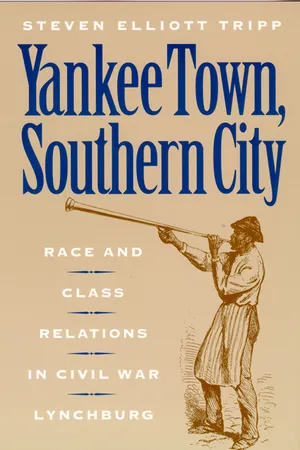
Yankee Town, Southern City
Race and Class Relations in Civil War Lynchburg
- 362 pages
- English
- ePUB (mobile friendly)
- Available on iOS & Android
eBook - ePub
About this book
Information
CHAPTER ONE
Yankee Town, Southern City
On the eve of the Civil War, Lynchburg, Virginia, enjoyed a national reputation as a progressive, enterprising city. Founded in the mid-eighteenth century by Charles Lynch as a trading depot on the southern bank of the James River, the town quickly gained prominence as a regional tobacco market. One hundred miles upstream from Richmond, local tobacco farmers found Lynchburg a convenient place to ship their tobacco, store it, and have it inspected by state agents before selling it at auction to eastern merchants. By 1840, Lynchburg tobacco accounted for nearly one-quarter (23.4 percent) of all tobacco inspected in Virginia. As early as 1830, English traveler Anne Royall visited the town because of its reputation as a “place of considerable business.” In 1851, a correspondent for the Richmond Enquirer stated that “there is not a town in Virginia more interesting than Lynchburg.” Its citizens were “alive to internal improvements” and evidenced “industry, emulation, and business success.” The editor of the nearby Bedford Sentinel was equally impressed, noting in 1858 that Lynchburg had become southwest Virginia’s “seat of learning, art, trade, and manufacture.” In time, the editor predicted, Lynchburg’s “industry, energy, and enterprise” would make the city “second to none” in the state. Future Reconstruction governor Francis H. Pierpoint’s tribute was less hyperbolic but even more pleasing to the town’s business leaders. In an 1858 visit to Lynchburg, Pierpoint told the editor of the Lynchburg Virginian, Charles Button, that Lynchburg had “more the appearance of a Yankee town than any other in Virginia.”1
In many respects, Pierpoint’s observation was apt. On the surface, antebellum Lynchburg looked very much like the emerging commercial and industrial centers of the North. When Pierpoint visited, Lynchburg had established a national reputation as a leading producer of one the era’s most popular manufactured commodities—“plug,” or chewing, tobacco. By all accounts, manufactured tobacco was the basis of the town’s economy. Lynchburg’s first factories appeared around the turn of the century; however, plug tobacco did not become a major commodity until the second quarter of the nineteenth century. By then, urbanization and industrialization had created a market for the product—the many laborers who chewed to relieve the tedium of their jobs and to exhibit their manhood. Yet it took considerable enterprise and economic acumen for the town to attain and secure its share of the market. Although Lynchburg’s hinterland boasted some of the best tobacco farms in the nation, the town was too isolated from the eastern seaboard to take full advantage of its resources. During the second quarter of the nineteenth century, however, the city made a concerted effort to compete with eastern trading centers. In 1840, the James River and Kanawha Valley Canal was completed, providing Lynchburg an easier and faster route to Richmond and the Atlantic seaboard. The canal dramatically improved the town’s economic fortunes. In 1830, Anne Royall counted fifteen tobacco factories in the town. In 1843, the Lynchburg Republican boasted that there were thirty factories and by 1850, the manufacturing census listed thirty-five factories in the city. These represented a capital investment of $600,300, a manufactured product valued at $1,183,000, and a labor force of 1,127. By 1860, there were forty-five factories in the city limits, representing an investment of $1,136,190, a product value of $1,907,882, and a total workforce of 1,054. In that year, Lynchburg factories accounted for 17 percent of the state’s revenue of manufactured tobacco sales.2
Although other cities manufactured more chewing tobacco than Lynchburg, no other city pursued the trade with such a singular interest. According to a recent study of the antebellum Virginia tobacco industry, Lynchburg produced more tobacco in proportion to its size than any other city in Virginia and North Carolina, the principal tobacco-growing states. Only one-sixth the size of Richmond and one-third the size of Petersburg, Lynchburg nonetheless produced tobacco valued at one-third that of Richmond and three-fourths that of Petersburg.3
Even more than of quantity, however, Lynchburg’s tobacco manufacturers boasted of the quality of their product. Despite competition from Richmond, Petersburg, and Danville, Lynchburgers claimed that their product was the best in the country and unabashedly asked that their rivals refer to the town as the “Tobacco City.” In July 1856, the editor of the Lynchburg Virginian tried to end all debate on the subject by triumphantly announcing that “it is a fact now settled beyond a doubt that Lynchburg is the best market for the sale of manufactured tobacco in the world.”4
Although such claims were typical of nineteenth-century urban boosters, they probably had some basis in fact. Alexander Patten, a correspondent for the New York Mercury who traveled the South extensively in the late antebellum period, stated that “those who indulge in the finer kinds of manufactured tobacco know that it comes rather from Lynchburg, than Richmond.” Although “away off” from the eastern seaboard, Patten noted, “Lynchburg has a renown that is universal.” Even the town’s rivals reluctantly agreed. After visiting a Lynchburg tobacco auction, a correspondent for the Petersburg Express admitted that Lynchburg attracted the “finest tobacco in the world.”5
Tobacco gave the town fortune as well as fame. Due largely to the profits generated from the tobacco trade, Lynchburg’s per capita valuation in 1859 was $1,262.31, making the town the second wealthiest city in the country. The tobacco manufacturers—or tobacconists, as they called themselves—led the way to Lynchburg’s prosperity. According to the census of 1860, the town’s sixty-three tobacconists accounted for about 29 percent of the town’s personal wealth, 25 percent of the town’s real estate wealth, and 2 7 percent of the town’s total wealth. The wealthiest tobacconists accumulated impressive fortunes. Five possessed over $100,000 in total wealth. By far the wealthiest of these was Jesse Hare. In 1860, he owned real estate valued at $110,000 and a personal estate, including thirty-five slaves, valued at $800,000. Others were not far behind. Thirty-two of the town’s sixty-eight tobacconists were among the town’s wealthiest decile.6
Tobacco gave Lynchburg wealth and fame, but it did not give the town economic security. Tobacco manufacturing was subject to the same volatile fluctuations as other antebellum commercial enterprises. Despite the fortunes of a few, most tobacconists found the trade to be exceedingly unstable. Thus, Lynchburg experienced a rapid turnover in tobacco firms. In 1850, forty-one men owned tobacco factories. Of these, only sixteen (39 percent) remained in the business ten years later—even though the total number of tobacconists grew to sixty-one.7
Several factors contributed to the instability of the trade. Nature was obviously one culprit. To receive a good price for their product, Lynchburg tobacconists preferred the finest grades of tobacco. When fine-grade tobacco was in low supply, tobacconists could either end the manufacturing season early or make an inferior—and thus, less financially rewarding—product. Yet to grow fine-grade tobacco required near-perfect weather, fertile soil, and constant cultivation.8
Even more than from nature, however, tobacconists suffered from the structure of the trade itself. Less-affluent tobacconists often complained that the product marketing system worked against them. Virginia tobacconists relied on Northern factors to buy their product, who then shipped it north to distribute for sale. Unfortunately for the tobacconists, these factors usually bought the tobacco on credit and paid off only after they sold the product. As a result, most tobacconists relied on bank loans to continue their business operations. In times of economic stability the system worked well, since banks were quick to extend liberal credit to most tobacconists. In times of economic dislocation, however, many tobacconists suffered. During the panic of 1857, most Northern factors defaulted on their payments. In the midst of the crisis, one Lynchburg tobacconist predicted that while those of “large means” would be able to recover even if conditions did not improve in a year or two, “the man of small means” would soon be “hopelessly ruined.”9
Fierce competition also made tobacco manufacturing a volatile enterprise. Much of the competition was local: Lynchburg tobacconists competed with one another to buy the best tobacco, concoct the best flavors, and obtain the most favorable agreements with factors. At the same time, however, Lynchburg tobacconists began to feel pressure from other quarters. Despite the town’s national reputation as the tobacco capital, Lynchburg tobacconists found themselves in an annual struggle to attract growers with the best produce to their warehouses. Although Lynchburg always competed with seaboard cities for the tobacco trade, the competition reached a new level of intensity when railroads from Richmond, Petersburg, Alexandria, and Baltimore began to reach the interior of the state during the late 1850s. With the arrival of the railroad in the Piedmont, Lynchburg found that it no longer possessed the advantage of geography. As a result, Lynchburg’s status as a tobacco market began to slip. In 1856, the same Petersburg correspondent who reluctantly praised Lynchburg tobacconists for their commitment to excellence also observed that Lynchburg no longer attracted the number of tobacco farmers it once had. He was an astute observer. From 1853 to 1858, the number of hogsheads inspected and sold at Lynchburg declined each year, so that by 1858, Lynchburg sold only 70 percent of its 1853 total. During the same period, Lynchburg’s percentage of state sales declined by half, from 20.2 percent to 10 percent. Ultimately, this increased competition among local tobacconists, who now found themselves paying exorbitant prices for whatever good weed they could find. As their costs rose, their margins of profits declined.10
Civic leaders responded to the burgeoning urban rivalry with the economic foresight that they believed set them apart from other Southern towns. During the 1850s, town fathers embarked on an ambitious program of internal improvements that they hoped would solidify the town’s place in the regional tobacco market, as well as enable the town to diversify its economic base. The result was a decade of almost frantic railroad construction, funded largely by local taxes and private subscriptions. By 1860, Lynchburg was the crossroads for three railroads. Lynchburg’s first line, the Virginia and Tennessee Railroad, built in 1850, enabled the town to surmount its eastern barrier, the Blue Ridge Mountains, to reach the fertile farmlands and rich mineral deposits of southwest Virginia and eastern Tennessee. The second line, the Southside Railroad, completed in 1856, linked the city to Petersburg, thus giving the tobacconists greater access to the eastern seaboard. The town’s final antebellum project, the Orange and Alexandria Railroad, promised even greater changes by connecting Lynchburg to northern Virginia and, ultimately, the urban North.11
Civic boosters anticipated a new era of economic prosperity from their investments. Charles Button, editor of the Lynchburg Virginian, predicted that Lynchburg would one day surpass Richmond in tobacco production by monopolizing the inland trade. Even more boldly, he suggested that the town might one day rival Wheeling for its iron foundries and Alexandria for its flour mills. Other business leaders were equally hopeful that the railroads would usher in an even greater era of economic prosperity born from expansion and diversification. According to the Board of Directors of the Virginia and Tennessee Railroad Company, the town’s emerging status as a rail center would make it an ideal location to manufacture and ship the rich salt, copper, iron, coal, and gypsum deposits of southwest Virginia. To promote the town’s interests within the state and beyond, civic boosters established a Board of Trade, a Mechanical Society, and an Agricultural Society.12
Although civic boosters never realized much of what they set out to do, by the end of the decade they did witness a new age of economic prosperity. Beginning in 1858, with the competition of the Orange and Alexandria Railroad, Lynchburg’s tobacco industry slowly rebounded. In 1860, the town exported 9,301 hogsheads of tobacco, roughly the same amount it exported during the flush times in the beginning of the decade. At the same time, the town regained some of its share of the state trade moving, from a decade-low 10 percent in 1858 to 12 percent in 1860.13
Other industries also profited from railroad construction. Although tobacco remained the dominant industry, Lynchburg’s status as an important crossroads to points east, west, and north attracted a number of new industries and encouraged a few older ones to expand their operations. On the eve of the Secession crisis, Lynchburg and vicinity were home to six foundries, including one that provided the passenger and freight cars for the Virginia and Tennessee Railroad; eleven grist mills; four coachmakers; two coppersmiths; and one fertilizer manufacturer. Although most of these businesses were relatively small, there were a few exceptions. John Bailey’s coachmaking establishment, housed in a cavernous, abandoned tobacco factory, employed fifty workers. Two of Lynchburg’s foundries were also relatively large establishments. Francis Deane, former proprietor of the Tredegear Iron Works in Richmond, operated an iron foundry that manufactured passenger and freight cars for the Virginia and Tennessee Railroad. In 1860, he employed twenty-five workers, and his product value was $52,800. A. G. Dabney’s Phoenix Foundry was only slightly smaller. In 1860, the foundry employed thirty-five workers and produced $40,000 worth of iron fixtures for the town’s tobacco factories.14
Button, for one, was impressed. In 1860, he observed that, because the number of new businesses had grown appreciably in the last few years, “now every suitable locality for business is occupied.”15 The scale and pace of economic activity allowed Lynchburg to reassert that it rivaled the North in business expertise and ingenuity. Visitors helped spread the word. In late 1859, David Forbes, newly arrived from the countryside, wrote his mother that he believed his economic prospects were excellent: “I believe I will like Lynchburg,” he told her. “This is a hardworking community and a very rich one.”16 A correspondent for the Bristol News agreed. During an 1858 visit, he observed that Lynchburg was once again “a prosperous and expanding city” with an extensive and diverse economic base. As future governor Pierpoint did, the writer alluded to the North as a way to explain Lynchburg’s economic dynamism: “Whatever truth there may be in the charge of our cute Yankee friends on the upper side of Mason & Dixon’s line that the Old Dominion is a century behind the age,” the correspondent suggested, “it would puzzle them to find any evidences of the fact in Lynchburg with its canal and railroads continually pouring into it the merchandise of the East and the produce of the West, to be exchanged and distributed throughout the country by energetic businesses.”17
Despite the capitalistic enterprise of its business leaders, Lynchburg was not a “Yankee town” for one reason—slavery. Compared to most other Southern cities, slaves comprised a large segment of the town’s population: in 1860, nearly 40 percent of Lynchburg’s population were slaves. Moreover, a large cross-section of white Lynchburg was personally involved in slavery; perhaps as many as 40 percent of all white household heads rented or owned at least one slave. Yet slavery’s importance to Lynchburg transcended mere ratios of slave ownership. Economically, socially, and politically, slavery made Lynchburg a Southern city.18
Most obviously, slaves created Lynchburg’s renowned wealth by their forced labor in the tobacco factories. The world of the tobacco factories was a world of black slavery. The factories employed over a thousand workers, virtually all of whom were black and most of whom were slaves. Probably close to half of Lynchburg’s slaves worked in the tobacco factories.19
Tobacconists’ reliance on slave labor suggests that the tobacconists were fundamentally products of Southern culture and not strict economic animals. Although tobacconists were able to adapt slavery to their factories, the system that emerged was labor-intensive and costly. In many respects, tobacco factory slaves were quasi-free laborers. Over half of the town’s factory slaves were hired by the year. Many of these negotiated their own contracts and were allowed to keep a share of their owner’s rent. In addition, most tobacconists offered their slaves cash incentives of $3 to $5 a week for “overw...
Table of contents
- Cover Page
- Title Page
- Copyright Page
- Dedication
- Contents
- Illustrations
- Acknowledgments
- Introduction
- CHAPTER ONE Yankee Town, Southern City
- CHAPTER TWO Religion, Rum, and Race: Lower-Class Life in Antebellum Lynchburg
- CHAPTER THREE The Many Battles of Lynchburg
- CHAPTER FOUR “These Troublesome Times”: Rebuilding Lynchburg after the War
- CHAPTER FIVE “To Crown Our Hearty Endeavors”: Religion, Race, and Class, 1865–1872
- CHAPTER SIX “The Mauling Science”: Black and White Violence and Vigilance, 1865–1872
- EPILOGUE Lynchburg’s Centennial and Beyond
- Appendixes
- Notes
- Selected Bibliography
- Index
Trusted by 375,005 students
Access to over 1.5 million titles for a fair monthly price.
Study more efficiently using our study tools.
Frequently asked questions
Yes, you can cancel anytime from the Subscription tab in your account settings on the Perlego website. Your subscription will stay active until the end of your current billing period. Learn how to cancel your subscription
No, books cannot be downloaded as external files, such as PDFs, for use outside of Perlego. However, you can download books within the Perlego app for offline reading on mobile or tablet. Learn how to download books offline
Perlego offers two plans: Essential and Complete
- Essential is ideal for learners and professionals who enjoy exploring a wide range of subjects. Access the Essential Library with 800,000+ trusted titles and best-sellers across business, personal growth, and the humanities. Includes unlimited reading time and Standard Read Aloud voice.
- Complete: Perfect for advanced learners and researchers needing full, unrestricted access. Unlock 1.5M+ books across hundreds of subjects, including academic and specialized titles. The Complete Plan also includes advanced features like Premium Read Aloud and Research Assistant.
We are an online textbook subscription service, where you can get access to an entire online library for less than the price of a single book per month. With over 1.5 million books across 990+ topics, we’ve got you covered! Learn about our mission
Look out for the read-aloud symbol on your next book to see if you can listen to it. The read-aloud tool reads text aloud for you, highlighting the text as it is being read. You can pause it, speed it up and slow it down. Learn more about Read Aloud
Yes! You can use the Perlego app on both iOS and Android devices to read anytime, anywhere — even offline. Perfect for commutes or when you’re on the go.
Please note we cannot support devices running on iOS 13 and Android 7 or earlier. Learn more about using the app
Please note we cannot support devices running on iOS 13 and Android 7 or earlier. Learn more about using the app
Yes, you can access Yankee Town, Southern City by Steven Elliot Tripp in PDF and/or ePUB format, as well as other popular books in History & North American History. We have over 1.5 million books available in our catalogue for you to explore.