A pioneering study tracing the growth of Americans' bad habits
The vast majority of Americans have, at one point or another gotten drunk, smoked, dabbled with drugs, gambled, sworn or engaged in adultery. During the 1800s, respectable people struggled to control these behaviors, labeling them bad and the people who indulged in them unrespectable. In the twentieth century, however, these minor vices were transformed into a societal complex of enormous and pervasive influence. Yet the general belief persists that these activities remain merely harmless bad habits, individual transgressions more than social problems. Not so, argues distinguished historian John C. Burnham, in this pioneering study.In Bad Habits, Burnham traces the growth of a veritable minor vice-industrial complex. As it grew, activities that might have been harmless, natural, and sociable fun resulted in fundamental social change. When Burnham set out to explore the influence of these bad habits on American society, he sought to discover why so many good people engaged in activities that many, including they themselves, considered bad. What he found, however, was a coalition of economic and social interests in which the single-minded quest for profit allied with the values of the Victorian saloon underworld and bohemian rebelliousness. This combination radically inverted common American standards of personal conduct.Bad Habits, then, describes, in words and pictures, how more and more Americans learned to value hedonism and self-gratification—to smoke and swear during World War I, to admire cabaret night life, and to reject schoolmarmish standards in the age of Prohibition. Tracing the evolution of each of the bad habits, Burnham tells how liquor control boards encouraged the consumption of alcohol; how alcoholic beverage producers got their workers deferred from the draft during World War II; how convenience stores and accounting firms pursued profits by pushing legalized gambling; how swinging Playboy bankrolled a drug advocacy group; how advertising and television made the Marlboro Man a national hero; how drug paraphernalia was promoted by national advertisers; how a practical joker/drug addict caused a shortage of kitty litter on Long Island; and how the evolution of an entire sex therapy industry helped turn sexual experience into a new kind of commodity. Altogether, a lot of people made a lot of money. But what, the author asks, did these changes cost American society?This illustrated tour de force by one of the most distinctive and important voices in social history reveals John C. Burnham at his provocative and controversial best.
eBook - ePub
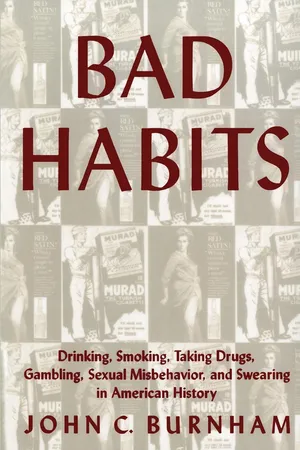
Bad Habits
Drinking, Smoking, Taking Drugs, Gambling, Sexual Misbehavior and Swearing in American History
- 378 pages
- English
- ePUB (mobile friendly)
- Available on iOS & Android
eBook - ePub
Bad Habits
Drinking, Smoking, Taking Drugs, Gambling, Sexual Misbehavior and Swearing in American History
About this book
Information
Preface
This book is a history of drinking, smoking, taking drugs, gambling, sexual misbehavior, and swearing in the United States. Early in the nineteenth century, each one was a common social misdemeanor in American society, a personal “bad habit” subject to various local and mostly informal social restraints. At different times in the late nineteenth century or early in the twentieth, these “minor vices” interacted with regional and then large-scale national business enterprise. In the process of becoming commercialized, the rituals of indulging in some simple misdemeanors became transformed and acquired important historical power. Ultimately, they converged and played a large part in shaping American society and culture. By late in the twentieth century, it had become inappropriate to continue to conceptualize this group of commonplace misbehaviors in nineteenth-century terms. Instead, they were best viewed as components of a social and business complex of enormous influence.
But this book, it is only candid to say, is something else also. In the course of assembling my material, I was forced to adopt a perspective on American history somewhat different from that which is customary.
I did not intend to write a book with a shifted historical orientation. I started out instead with a different purpose, but as I reviewed the evidence, the new perspective emerged inexorably from the material. My own view of the history of American society will never be the same again, and I hope that my account will permit others to see how the evidence fell into place. Indeed, I hope that it will show why I was surprised and constrained by the evidence once I was willing to open myself to a new vantage point. The evidence in fact contradicts much of late-twentieth-century common wisdom and media portrayals of the place of the “bad habits” in American society.
My original purpose in writing this book, and one to which I still adhere, was to try to explain to the four young adults whose names appear on the dedication page how it came to be that they grew up in a society in which so many “good” people would do—and even advocate—things that they knew, and everybody else knew, were conventionally “bad.” (As late as 1970, for example, a substantial majority of Americans, even those who were heavy drinkers, believed that “drinking does more harm than good.”1) The quest for explanations for that paradox took me to the historical record. I have therefore written this book primarily to tell at least four Americans how their world came to be as it was and is.
As the reference notes indicate, my shifted perspective is based on conventional scholarly evidence. In some cases, the notes serve merely to document materials that are generally known and to confirm common wisdom. But in other cases, the notes should reassure readers as they may find parts of the narrative that are fresh and perhaps startling. Sometimes I have had to correct my own evaluation of assertions dismissed years ago. In the context of my new perspective, many contentions have presumptive validity that I would not have accorded them earlier.
My intention in this book is to establish profiles and general patterns and give illustrative examples, rather than to provide exhaustive histories. The notes therefore indicate also that many more details are available than I have included in my account. Because the notes serve as a guide to further reading, in lieu of a formal bibliography or bibliographical essay, I have sometimes commented in the notes on both sources and technical historical problems. Using the index and the notes together should furnish a literature guide for anyone interested.
Finally, as the book came together, I became aware of another dimension: what this account might mean beyond my immediate intentions.
Many of the people who today and in the past have opposed drinking, smoking, taking drugs, gambling, sexual misbehavior, and swearing have done so as a matter of unreasoned faith, or even simple prejudice explained as “the way I grew up.” My book turns out in effect to constitute an inquiry as to whether or not historical evidence might justify those who disapproved of the so-called bad habits, at the very least showing that historical understanding does not justify supporting the “bad habits”—not even, perhaps, just tolerating them. Much of my surprise came from the realization that such a case can be made. It can be made, I found, in substantial measure by tracing how the opposite assumption grew: that everyday, pleasurable “misdemeanors” are (within very broad extremes) harmless, natural, spontaneous, sociable, and without significance.
People have strong feelings about their own personal rituals and beliefs in the realms of drinking, smoking, gambling, drug taking, swearing, and especially sexual practices. These rituals are even more potent in generating emotions when a person’s family and family traditions are involved. In approaching these subjects in a way that sometimes casts doubt upon customary and common rationalizations, I have therefore found that the material in this book elicits substantial personal reactions, both negative and positive. Such personal reactions are complicated by the fact that most people maintain a mix of personal identifications concerning the various “bad habits.” I do myself. A horror of drugs but devotion to beer and swearing would be a common combination, but others are obviously possible, such as an abstemious household who happened to be dedicated to sexual activities or arrangements that their neighbors might not approve of. Problems arise particularly because people rationalize their own behaviors with myths, and in the area of the “bad habits,” many myths do not, in fact, wholly square with the record of what actually happened. Such news can be unwelcome. Even worse, as I think my findings demonstrate, disturbing moralistic assertions that people have confidently discredited in their own minds on the basis of what happened in the past may turn out to have some level of secular validity. Against reactions of personal discomfiture to the narrative that follows, I can appeal only to intellectual curiosity and candor. My hope is at least to open up discussion.
Many people will nevertheless insist on reading this history in terms of personal choices, and often moral choices. That is their privilege. My intention, however, is not to suggest that drinking or smoking or any of the other actions is in and of itself “bad.” Generations of Americans found that some ordinary rebelliousness or personal misbehavior or violation of the strictest standards was not necessarily subversive of society or values.
But in the United States, at least, the “bad habits” became more than personal matters. As I shall explain, they came to constitute a social phenomenon. As a consequence, they became not just matters of personal choice or prejudice but matters for social decision and social responsibility. My focus in what follows, therefore, will be the history of the social aspect of moral choices—values that various groups of Americans held, as shown in what they said were their standards of behavior and in their actual conduct.
The conclusion that I set forth in this book is therefore this: it is a common belief that earlier Americans paid too much attention to the “bad habits” and invested in them too much emotion and concern. The truth is, the descendants of those Americans, by moving attention and concern away from the way each of these minor vices interacted with other aspects of society, for generations lost awareness of one of the major determinants of their lives.
CHAPTER ONE
Introduction
My narrative is largely about the struggle between what emerged in the nineteenth century as “respectability” and “unrespecta-bility”—a struggle that focused on the conventional minor vices of my title. But what I shall describe was not a simple clash between the forces representing two cultural standards. In the twentieth century, un-respectability began to take on special attributes. It drew upon transformations in commerce and demography and interacted with many other important social and cultural changes, with the result that by the late twentieth century, unrespectability overwhelmed traditional respectability in American society.
In a social context, the “bad habits” were anything but simple. Not least curious, as it turned out, was the way in which they constituted a cultural unit. This introductory chapter provides the reader with definitions, strategies, and themes in the narrative that make possible discussion of this peculiar unit of minor personal vices. After identifying a critical change in standards in the period around the 1920s, I shall introduce the core countercultural force, the Victorian underworld, and the respectability against which the people in the underworld contended. I shall then alert the reader to the salient motives that animated a very complex social change—motives that I shall identify as greed, parochialism, and rebelliousness.
The Subject of the Bad Habits
Drinking, smoking, sexual misbehavior (mostly activity outside of marriage), taking drugs, gambling, and swearing are vices that have the label vice and yet traditionally have been attractive, indeed, have been recreational and gratifying activities. Moreover, for generations, virtually everyone knew what the “bad habits” were and knew that parts of the population labeled them vices or bad habits. As vices, each one often involved not only some level of malicious intent but, above all, a quality that engendered and still engenders reactions that are ambivalent.1 (Because the nineteenth-century category of “bad habits” and the more recent description of them as “minor vices” are clear as to content, I am employing them as non-pejorative, substantive terms.)
The bad habits also possessed and possess another fundamental attribute: they have ritualistic aspects. Users of tobacco, for example, from the beginning tended to consume it in the same, repetitive way, over and over. From the middle of the twentieth century, there have existed prescriptions for permissible and impermissible actions in organized group sex activities, including, in some organizations, the way the furniture was to be arranged. More than other personal habits, such “rituals of transgression,” as anthropologists have designated them, signified that the actions had substantial cultural significance. The bad habits, from the nineteenth century on, were ritual transgressions subject to moral judgments. But as will appear in this book, in the twentieth century, indulging in those minor vices produced profound social effects that endowed them with another kind of cultural significance. Indeed, when I first began my research on this subject, I tended to view the bad habits as essentially laughable misdemeanors. By the time I had traced them into the twentieth century and realized the power of the social forces that they generated, I had stopped laughing.2
When historians have written about drinking, smoking, taking drugs, gambling, sexual misbehavior, and swearing, almost invariably the focus has been on attempts to control and repress these bad habits. I have found few works focusing on efforts to spread and expand such commonplace behaviors, much less to explain the social momentum that they developed. And that is no wonder, because, until recently, proponents of the bad habits rarely left records. Seldom did an agenda or a platform for a bad habit surface. Moreover, when advocates did speak up, they usually offered not a reasoned defense and civilized discourse, but distraction or defiance. In the mid twentieth century, a publisher who was criticized for what appeared at that time to be the provocatively erotic content of his comic books replied insolently: “I don’t see a child getting sexual stimulation out of it. Looking at those enlarged mammary glands, he’d remember that not long ago he was nursing at his mother’s breast.”3
Because hardly any scholars have focused on the proponents of the bad habits, I am in this volume, it should be frankly recognized, pioneering. I had to ask new questions, and I have followed the evidence to conclusions that are unusual.4 People who over a period of decades have kept up with reports of consumer groups and a certain type of journalistic exposé and social criticism will be familiar in a different context with a substantial fraction of the examples that I cite, if not with some of the argument. Yet no one before has laid out the histories of the minor vices parallel to one another. My contribution is, then, to call attention to the direction in which the various types of evidence point so that the outlines of major social change appear.5 And one major aspect of my findings is that combining the subject of the constellation of the attractive minor vices with the historical record produces a striking pattern.
An Inversion of Values
My own reorientation to this subject matter took place particularly as I eventually adopted two strategies. The first was to follow the agents and proponents of the minor vices as if they were protagonists in a story. Tracing a point of view is, after all, a venerable narrative device. In this case, it is a very enlightening one. The second strategy was to use this focus in an unpretentious way in the framework that sociologists have offered for at least a generation, deviance theory.
What I discovered was that American values had turned upside down in the twentieth century, and, moreover, that many observers had long been aware of the reversal. Some writers, for example, have quoted Willa Cather’s succinct observation: uThe world broke in two in 1922 or thereabouts….” To more recent witnesses, the larger part of the change appeared to have taken place only after midcentury. A University of Michigan researcher noted in 1979 that “norms about marriage and parenthood have changed dramatically over the last twenty years. Today marriage and parenthood are rarely viewed as necessary, and people who do not choose these roles are no longer considered socially deviant.” But the beginnings of the transformation tended to show up, as Cather suggested, around the 1920s.6
The change was so great that in public discourse people began well before World War II to speak of the conduct that had previously appeared “bad” as “good.” More specifically, activities such as gambling and public swearing that previously had been labeled deviant frequently came to enjoy positive valuing. Conversely, to a greater and greater extent, the practitioners and advocates of commonplace virtues began to appear to other Americans to be the social deviants, indeed sometimes serving as a negative reference group who set a bad, rather than a good, example. Moral righteousness went out of style. A standard of no restraints—particularly in indulging in the bad habits—came into vogue. This book, then, is an effort to show in developmental terms when, how, and why this inversion of values and attitudes toward the bad habits came about.7
Reformers and the Constellation of Minor Vices
Historians of the United States have traditionally followed as a major theme, if not the organizing theme, the rise and fall of reformers. For generations, various investigators have asked why the reformers were repeatedly frustrated in their efforts to reap the promise of American life. My inquiry suggests that the best understanding of American society comes from searching out not the weaknesses of the reformers but, rather, the strengths of the forces against which reformers contended. And, no doubt, any cautious person should at least consider that when talented people of the past were frustrated in their finest efforts, the primary explanation for events was not the deficiency of the uplifters but rather the power of the groups, formal and implicit alike, arrayed against those reformers.8
I continue to find it astonishing that historians have so far not identified and analyzed the opponents of reformers. Corrupters of some political and social institutions—such as Boss Tweed in New York and other city bosses—and to some extent blatant exploiters like the robber barons have received at least desultory attention. But the forces of traditional moral dissent and misbehavior have not had even that much attention except under the headings of violence and crime—or, perversely, as “reform.”9
In the nineteenth and early twentieth centuries, the Americans who worked against conventional misdoings and for “morality” knew what they opposed. They tied urban disorder to the obvious, recognizable, and familiar minor vices. In the nineteenth century, disorder was a real and constant problem in the developing cities, and reformers’ efforts, negative and positive, to impose social control involved both personal behavior and attempts to shape public demeanor.10 Everyone knew that saloons were centers of crime and vice in most communities, sites from which disorder spread. Brothels were called “disorderly houses,” a euphemism embodying true social significance. This book focuses on the constellation of those disorderly bad habits that everyone knew and talked about for many generations.
Virtually all commentators agreed that a number of common vices (questionable habitual behaviors) embodied some level of sinfulness (but, of course, again, not all sin), and they identified in the nineteenth century, if not before, that single social constellation that included drinking, smoking, gambling, sexual misbehavior (again, generally understood for centuries as activities outside of strictly monogamous marriage), swearing, and taking drugs, plus some subordinate conventional misdeeds, such as, in an earlier day, Sabbath-breaking. This constellation, moreover, was at the heart of the conduct and standards that so many Americans believed had been transformed in the twentieth century—“the average American’s value scale—turned inside out,” as a journalist put it in 1958.11 Even though they did not agree about whether or not the change in public attitudes toward the minor vices was or is desirable, a wide range of observers has confirmed that the change occurred.
The constellation is even today so commonplace as to need little explication except to observe that it was a commonplace in the nineteenth as well as the twentieth century...
Table of contents
- Cover Page
- Preface
- Title Page
- Copyright Page
- Dedication Page
- Contents
- Illustrations
- Preface 1
- One: Introduction
- Two: The Turning Point: Repealing Prohibition
- Three: Drinking
- Four: Smoking
- Five: Taking Drugs
- Six: Gambling
- Seven: Sexual Misbehavior
- Eight: Swearing
- Nine: The Coopting Process
- Ten: Patterns of Convergence in a Complex Society
- Epilogue
- Notes
- Acknowledgments
- Index
Trusted by 375,005 students
Access to over 1.5 million titles for a fair monthly price.
Study more efficiently using our study tools.
Frequently asked questions
Yes, you can cancel anytime from the Subscription tab in your account settings on the Perlego website. Your subscription will stay active until the end of your current billing period. Learn how to cancel your subscription
No, books cannot be downloaded as external files, such as PDFs, for use outside of Perlego. However, you can download books within the Perlego app for offline reading on mobile or tablet. Learn how to download books offline
We are an online textbook subscription service, where you can get access to an entire online library for less than the price of a single book per month. With over 1.5 million books across 990+ topics, we’ve got you covered! Learn about our mission
Look out for the read-aloud symbol on your next book to see if you can listen to it. The read-aloud tool reads text aloud for you, highlighting the text as it is being read. You can pause it, speed it up and slow it down. Learn more about Read Aloud
Yes! You can use the Perlego app on both iOS and Android devices to read anytime, anywhere — even offline. Perfect for commutes or when you’re on the go.
Please note we cannot support devices running on iOS 13 and Android 7 or earlier. Learn more about using the app
Please note we cannot support devices running on iOS 13 and Android 7 or earlier. Learn more about using the app
Yes, you can access Bad Habits by John C. Burnham in PDF and/or ePUB format, as well as other popular books in History & North American History. We have over 1.5 million books available in our catalogue for you to explore.