"Extremely informative. . . deserves a wide readership, both inside and outside police departments."
—Publishers Weekly
"An imaginative and insightful account of the day-to-day life of the black police officer in a large urban environment. A must read for all police officers, white as well as black."
—Marvin Blue
President, Guardians Association
New York City Police Department
". . . well written and achieves its purpose. It will be of interest to specialists and students of race relations, urban problems, and criminal justice issues."br>—Library Journal
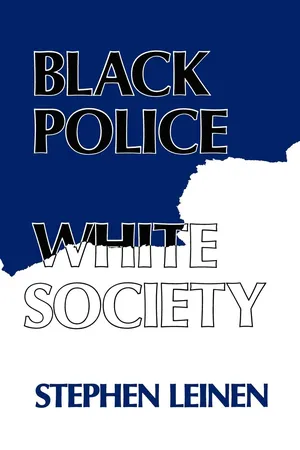
This book is about the world of black police in New York City: who they are, how they work with the department, how they are recruited by whites, how they are treated in turn by their fellow blacks, and how they operate day by day in the richest as well as the poorest parts of the city.
Leinen provides direct quotations from police, citizens, city administrators, and street hustlers, as well as detailed assessments of encounters in the everyday relations between police and the public.
- 290 pages
- English
- ePUB (mobile friendly)
- Available on iOS & Android
eBook - ePub
Black Police, White Society
About this book
Information
1
DISCRIMINATION AND THE BLACK OFFICER
I’m out there covering some white cop’s butt, and I hear over the [police] radio, “Nigger this, Nigger that.” Remarks like this you would hear all the time and nobody would say anything. If you happened to be with a white guy riding, you would pretend you didn’t hear the remark. . . . I mean, what could a black cop say, where was he going to go?
FROM the time blacks first joined the New York City police force until fairly recently, whites have maintained a position of dominance, relegating blacks to subordinate roles and denying them access to job opportunities and advancement. Thus the first blacks to enter the New York City police department at the turn of the century were assigned exclusively as “doormen.” It was not until some years later that they began to receive assignments more in keeping with what police actually do. But, by then, other forms of discrimination had emerged within the department which effectively excluded blacks from all but routine foot patrol assignments in black precincts and districts. The first promotion of a black to the permanent rank of sergeant, for example, was not made until 1926, even though, some six years earlier, this same patrolman had scored high on the civil service promotional exam. The police commissioner at the time, it was reported, simply refused to promote him. The officer had to wait six years until a new commissioner took office. Although his eventual promotion set a “legal” precedent regarding the rights of black policemen in New York City, another quarter of a century would pass before a black in the department would succeed to the civil service rank of captain.1 Of course, New York City did not stand alone in its application of different standards for black and white police officers; blacks throughout the country faced systematic discrimination and separation along racial lines. However, only within the past decade has any sustained effort been made in our nation’s major urban police departments to remove racial barriers to full job equality.
Park I of this book presents a brief historical overview of the accomplishments (and failures) of black police officers in light of these recent efforts. We begin with a general discussion of police race relations, focusing on those problems that have been, and in some instances still are, of concern to black officers everywhere. Next, we consider those social, political, and legal events of the 1960s and early 1970s that have shaped the present character of American race relations in general and police race relations in particular. Data are then presented documenting the attempts made by organized black police groups and the courts to redress the racial problems confronting black officers. Particular attention is paid to the persistent efforts of the Guardians Association in New York City to establish through the Federal courts a racial quota system in hiring and promotion. Finally, we examine the views and opinions of the 46 black police officers participating in this study; how these men feel, the gains they have made over the past few years, and the problems that remain unresolved or ignored. The intention here and throughout this book is to present an inside view of police race relations and to show that the attitudes, beliefs, and behavior of black policemen in New York City are integrally related to changing conditions both within the police department and within the larger society.
Chapter One
Patterns of Discrimination
I was in Brooklyn in TPF [Tactical Patrol Force] and an old black man walked up to me and showed me a retired police officer’s shield. And in my conversation with him it was brought out that he was either the second or third black officer hired by the department. And he stated during those times, when he was an active police officer, that black officers could only be assigned to black areas. ... It was actually stated to him that the only place blacks were good enough to work was in a black neighborhood.
DISCRIMINATION against black police in this country, legitimated by traditional police norms and supported to a large extent by a pervasive racial ideology, was perhaps nowhere more evidently demonstrated than in the common practice in the past of denying black cops any opportunity to work in white communities. Several studies have noted that in most cities across the country black officers, prior to the mid-1960s, were not only concentrated in precincts populated heavily by members of their own race, but quite often excluded altogether from duties in white areas. The practice of confining black police to black precincts or districts was not restricted, as one might have expected, to Southern or border cities. Evidence obtained from a number of related surveys shows that until the mid-1960s it was an accepted practice in Northern cities.2 In both parts of the country, the rationale behind segregated assignment practices was that black police knew their own people better, that they could command greater respect from them and, that, in many instances, they were stricter with blacks than were white police.
Not only restricted to black districts, black police were, it seems, constrained further to routine foot patrol assignments either alone or with black partners. Again, this type of forced segregation was evident not only in Southern cities where one might, given the existence of segregation laws, expect to find discrimination in assignment and resistance to integrated patrol but also in Northern cities as well. A seminal study of the Philadelphia police department, for example, has shown that the practice of assigning black cops to foot patrol rather than to radio motor patrol or desk jobs was common in most of the city’s districts at least until 1956.3 In Chicago, until 1960, blacks rarely were assigned to patrol cars, and in at least one precinct if no white officers were available for assignment, some radio cars were not dispatched.4 Similarly, in another study, Martin Alan Greenberg found that prior to the 1943 Harlem riots in New York City, black police had been systematically denied radio motor-patrol duty.5 Even as late as 1965 black cops in New York City were protesting departmental practices which they claimed restricted them to low-status foot-patrol assignments in black precincts.6
Discrimination against black police in assigning special duties also has been reported to be widespread in the past. A study of racial practices in the South, for example, showed that there were only “56 Negro detectives in 1954 . . . , 87 in 1959, among the 146 agencies responding . . . , and 101 among 98 agencies in 1961.”7 Outside the South, patterns of occupational mobility among black police were little better. Until 1961, Newark had only one black detective assigned to the police department, as did Boston.8 In New York City, black cops complained of the difficulties they encountered when attempting to enter the detective bureau in the early 1960s and in attaining positions in other plainclothes commands. These officers alleged that blacks were automatically excluded from such choice assignments as the Homicide Squad, Safe and Loft, and so forth.9
Police agencies across the country also have been charged with practicing discrimination against black officers concerning policies other than task and area assignment. For example, in 1967 the President’s Crime Commission discovered that in some cities the legal authority of an officer to arrest a white suspect depended heavily on whether the cop was white or black. Drawing upon findings contained in other studies, the commission noted that in 18 of the 28 police departments surveyed, black officers could do no more than hold a white felony suspect until a white policeman showed up on the scene, unless, of course, there were no white officers available. In ten others, the black officer could not arrest the white suspect at all; in most cases he could only keep him under surveillance. The report went on to state that in cases of misdemeanor offenses, the power of the black officer was even more limited. Not surprising, perhaps, was the additional discovery that these practices extended into several Northern cities where black deputies were allowed to arrest white felony suspects only if white deputies were not immediately available.10
Racial discrimination also was believed to prevail in the area of performance evaluations. In a number of recent studies black police were found to be victims of a biased rating system.11 Eugene Beard, for example, reporting on a variety of issues directly involving black police officers in Washington, D.C., discovered that the great majority of black officers in that city felt victimized with regard to how they were evaluated by white police superiors and attributed differences in job performance ratings given black and white officers to racial discrimination. In addition, Beard noted a widespread belief among members of his study population that the rules and regulations of the police department were applied inequitably. Eighty-four percent (of his 947 black police respondents) reported that white officers were less likely to receive disciplinary charges than black officers.12
Finally, it appears that until fairly recently blacks have been virtually excluded from leadership and supervisory positions in most of the nation’s police agencies, especially in Southern and border states.13 But even in the Northern cities for which data were available, black police were only somewhat more successful in gaining entry into higher ranking positions than their Southern counterparts. For example, a 1962 survey reviewed by the President’s Commission on law enforcement disclosed that among the 106 Northern cities responding, six had black captains, 17 had black lieutenants and only 48 had black sergeants.14 Suprisingly, by the mid-1960s this situation had deteriorated even further. Only 22 law enforcement agencies in the entire country had black officers above the rank of patrolman.15 In sum, it can be argued that the problems confronting black police in the 1950s and early 1960s were substantial in themselves but were not substantially different from those experienced by blacks in other institutional areas of American life.
As the decade of the sixties began to unfold, public attention became increasingly concentrated on the problems of urban blacks. Major changes in the country’s social, political, and legal institutions had begun to make themselves felt and efforts were being made nationaly and locally to resolve the nation’s racial problems. In the section that follows we discuss a number of these changes from an historical perspective. Particular emphasis is given to those social forces believed to have shaped the present orientation of the New York City police department toward racial minority groups. Finally, we consider the emergence and growth of black sociopolitical organizations whose efforts throughout the country to secure a more favorable position for black policemen have recently been documented.
The Challenge to White Domination
A sustained, organized, and ultimately successful challenge to exclusive white domination in the United States had its origins in the early 1950s. It was triggered then by a combination of factors, including an apprehension about adverse world opinion concerning America’s racial practices, a growing competitiveness between the United States and the Soviet Union for the allegiances of the newly emerging African nations, and by a growing black political activism within this country. It was given a great boost by the landmark decisions of the United States Supreme Court rulings in 1954 and 1956 outlawing racial segregation in public schools and on public transportation. Congress, in turn, through legislation, demonstrated (hesitatingly, perhaps) that the Federal government viewed discrimination and separation along racial lines not only as wrong but as illegal. Although Court decisions and legislative reform succeeded in bringing about change in some areas (and also in raising the expectations of American blacks) they failed significantly to alter the actual conditions under which the vast majority of blacks in this country lived.
Then, in the early 1960s, the challenge to white domination was beginning to shift from the courts to the streets and public accommodations. Largely under the leadership of its then chief spokesman Martin Luther King, Jr., black protest began to take the form of marches, sit-ins, boycotts, rent strikes, and other face-to-face confrontations with established authority. But continued resistance to demands for change throughout the country as well as the growing disparity between black expectations and the rate of “real” economic, social, and political progress eventually was to force many black groups to reconsider their ideological positions. Increasingly, militant tactics were adopted, with some black leaders beginning openly to espouse revolutionary solutions to America’s racial problems. Although clear differences existed among the leaders, militant groups were united at least in the belief that racial inequality was widespread in this country and that its institutions were in need of rapid, not gradual, transformation. During this period established civil rights groups which had emphasized legal and nonviolent direct action were openly challenged by the more militant black leaders for their failure to respond adequately to the deeply rooted problems of the masses of blacks in the country. An earlier emphasis on full integration into mainstream American society was supplemented by an emphasis on black pride, nationalism, independence, and the acquisition of power and freedom by radical means. With this, the nonviolent phase of the civil rights struggle had for all practical purposes come to an end. Violent reaction directed against a seemingly unresponsive system appeared to many ghetto blacks the only solution to a long history of exploitation, discrimination, and subjugation.
In the summer of 1964 the nation’s first major civil disorder of the decade erupted in New York City’s Harlem ghetto. Each summer thereafter for four successive years, urban ghetto riots took their toll in deaths, injuries, and destruction of property. In 1967, for example, racial uprisings in some 56 cities across the country accounted for at least 84 deaths, over 3800 injuries, and hundreds of millions of dollars in property damage.16 While it is true that the more destructive forms of urban violence were essentially a “black” response to severe social problems that had been mounting over the years, these disorders were triggered in almost every instance by the actions or alleged actions of the police in dealing with ghetto residents, such as the shooting of an unarmed black or the rumor of such a shooting. Whether these disorders turned into random demostrations of violence or into full-scale collective actions against established authority often depended upon the degree to which police officials on the scene were able to exert effective control over their own men. When order broke down within the police ranks, as it so often did, police became subject to the same principles of crowd behavior that motivated their adversaries. Deep-seated racial prejudices surfaced and the desire to vent hostility and to reestablish dominance in the streets frequently became compelling motives for retaliation.17 In many instances local police became totally ineffective and city administrators had to rely upon outside forces to restore order.
Government Response and the Move Toward Police Reform
Toward the latter part of the 1960s it was becoming increasingly evident that more effective strategies were needed to deal with the problems and general unrest in America’s urban slums. In a sense, the riots and disorders which swept through this nation served to “wake up” white America to the conditions and feelings of blacks in this country and to focus attention on the behavior of police who dealt with large disaffected and powerless groups within the society. Early in 1968, after the most extensive outbreaks of rioting had ceased, the National Advisory Commission on Civil Disorders, headed by former Illinois Governor Otto Kerner, “announced the completion of one of the most comprehensive and significant reports ever to be issued by a government-sponsored commission. The Kerner Report placed the major portion of the blame for the socioeconomic conditions of black people on the total society, specifically on white racism. It warned of potential catastrophe if the nation did not commit more resources to solving the problems of the urban ghettoes.”18 Largely as an outgrowth of this report and other studies carried out on behalf of the President’s Commission, agencies in the public sector found themselves under increasing pressure to reduce the likelihood of further violence and to address themselves more directly to the changing needs of America’s urban populations. Police departments in particular were encouraged to reexamine their internal operations, community-relat...
Table of contents
- Cover Page
- Title Page
- Copyright Page
- Dedication
- Contents
- Acknowledgments
- Introduction
- Part I Discrimination and the Black Officer
- Part II Working Relations Between Black and White Police Officers
- Part III The Police and the Black Community
- Conclusions
- Index
Trusted by 375,005 students
Access to over 1.5 million titles for a fair monthly price.
Study more efficiently using our study tools.
Frequently asked questions
Yes, you can cancel anytime from the Subscription tab in your account settings on the Perlego website. Your subscription will stay active until the end of your current billing period. Learn how to cancel your subscription
No, books cannot be downloaded as external files, such as PDFs, for use outside of Perlego. However, you can download books within the Perlego app for offline reading on mobile or tablet. Learn how to download books offline
Perlego offers two plans: Essential and Complete
- Essential is ideal for learners and professionals who enjoy exploring a wide range of subjects. Access the Essential Library with 800,000+ trusted titles and best-sellers across business, personal growth, and the humanities. Includes unlimited reading time and Standard Read Aloud voice.
- Complete: Perfect for advanced learners and researchers needing full, unrestricted access. Unlock 1.5M+ books across hundreds of subjects, including academic and specialized titles. The Complete Plan also includes advanced features like Premium Read Aloud and Research Assistant.
We are an online textbook subscription service, where you can get access to an entire online library for less than the price of a single book per month. With over 1.5 million books across 990+ topics, we’ve got you covered! Learn about our mission
Look out for the read-aloud symbol on your next book to see if you can listen to it. The read-aloud tool reads text aloud for you, highlighting the text as it is being read. You can pause it, speed it up and slow it down. Learn more about Read Aloud
Yes! You can use the Perlego app on both iOS and Android devices to read anytime, anywhere — even offline. Perfect for commutes or when you’re on the go.
Please note we cannot support devices running on iOS 13 and Android 7 or earlier. Learn more about using the app
Please note we cannot support devices running on iOS 13 and Android 7 or earlier. Learn more about using the app
Yes, you can access Black Police, White Society by Steven Leinen in PDF and/or ePUB format, as well as other popular books in Sciences sociales & Discrimination et relations raciales. We have over 1.5 million books available in our catalogue for you to explore.