A new intellectual community came together in the United States in the 1910s and 1920s, a community outside the universities, the professions and, in general, the established centers of intellectual life. A generation of young intellectuals was increasingly challenging both the genteel tradition and the growing division of intellectual labor. Adversarial and anti-professional, they exhibited a hostility to boundaries and specialization that compelled them toward an ambitious and self-conscious generalism and made them a force in the American political, literary, and artistic landscape.
This book is a cultural history of this community of free-lance critics and an exploration of their collective effort to construct a viable public intellectual life in America. Steven Biel illustrates the diversity of the body of writings produced by these critics, whose subjects ranged from literature and fine arts to politics, economics, history, urban planning, and national character. Conceding that significant differences and conflicts did exist in the works of individual thinkers, Biel nonetheless maintains that a broader picture of this vibrant culture has been obscured by attempts to classify intellectuals according to political or ideological persuasions.
His book brings to life the ways in which this community sought out alternative ways of making a living, devised strategies for reaching and engaging the public, debated the involvement of women in the intellectual community and incorporated Marxism into its evolving search for a decisive intellectual presence in American life. Examined in this lively study are the role and contributions of such figures as Randolph Bourne, Max Eastman, Crystal Eastman, Walter Lippmann, Margaret Sanger, Van Wyck Brooks, Floyd Dell, Edmund Wilson, Mable Dodge, Paul Rosenfeld, H. L. Mencken, Lewis Mumford, Malcolm Cowley, Matthew Josephson, John Reed, Waldo Frank, Gilbert Seldes, and Harold Stearns.
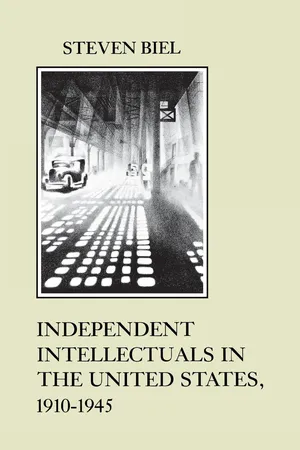
- 310 pages
- English
- ePUB (mobile friendly)
- Available on iOS & Android
eBook - ePub
Independent Intellectuals in the United States, 1910-1945
About this book
Information
CHAPTER 1
The Repudiation of the University
America in the progressive period offered unprecedented opportunities to scholars. By the turn of the century, social and economic interdependence had gone far toward undermining older faiths in common sense and an omnicompetent citizenry and toward producing a demand for expert knowledge. As the ability to identify the causes of social problems, economic changes, physical, political, and historical events receded further and further into the distance, those who possessed the tools for discovering esoteric truths won new prestige and respect. To meet the demand for expertise, to foster authoritative thinking, scholars forged institutions that defined disciplines, established methodologies, set professional standards, and allowed for intradisciplinary communication. Beginning with the American Historical Association in 1884 and the American Economics Association in 1885, professional organizations proliferated around the turn of the century and gradually screened out quacks and charlatans in the quest to establish mastery over a specific field of knowledge. The difficulty in tracing causation in the modern world necessitated an intellectual division of labor, not only between disciplines but within them. Professionalization had as its goal what Charles Sanders Peirce called a “community of the competent” and what Thomas Haskell has renamed a “community of inquiry” in which truth became the product of cooperative effort rather than common sense or individual investigation. Working under standards and expectations established by professional peers, individual scholars sacrificed a degree of personal autonomy, while the profession as a whole gained significant group autonomy by casting itself as the authoritative voice on those matters that came within its investigative domain. Membership in professional communities conferred upon scholars the exclusive right to interpret a particular sphere of life, subject in theory only to the control of their colleagues and free from the interference of laymen.1
The assertion of professional authority coincided with changes in the complexion of American higher education. While professional organizations admitted amateur scholars to bolster their membership and absorb potential adversaries, they were dominated from the start by academic men. Academic professionals looked to the universities for additional legitimization, which came in the form of new departments. Universities strengthened their commitment to specialized research by creating the basic structures necessary for sustained investigation: sabbaticals, teaching assistantships, and other means of reducing teaching loads; new facilities, additional books and equipment; research institutes and funds specifically earmarked for research projects. Though the “Golden Age” of the American research university did not come until the 1920s, the emphasis on productive scholarship became more and more pronounced after 1890, and scholars could look with growing confidence to the universities as the home of intellectual inquiry and authority. Claims of authority, meanwhile, helped scholars inclined toward public service find a place for themselves in progressive governments. Drafting regulations and legislation, and serving on investigative commissions, professors assumed what Richard Hofstadter recognized as the new role of “the serviceable expert.”2 Whether or not they chose to translate their knowledge into public policy, scholars in this age of professionalization and specialization had good reason to believe that they and their abilities were valued now as never before. The reputation of the professor had reached an alltime peak.
Yet the preferred path toward intellectual authority—the path of organization, division of labor, esoteric knowledge, and intradisciplinary communication—did not go unchallenged. For some thoughtful irreconcilables within the universities, and for the intellectual offspring who followed their teachers’ critique to its logical conclusion, the costs of this path to authority were prohibitive. The innovations that most scholars saw as inevitable and welcomed optimistically, these irreconcilables received critically and with a sense of foreboding. What seemed to the majority the only way to adapt the scholarly life to modern circumstances and to elevate thinkers to their deserved status in American society struck critical minds as an adaptation that could easily lead to extinction; in pursuing this course, scholars were altering the life of the mind to the point where it was no longer recognizable as such. As they developed and articulated their criticism, those who did not share the pervasive sense of promise and satisfaction held to a different image of the intellectual life in America. It was out of this criticism and out of this alternative vision that an independent intellectual community was born.
1.
In the greatest autobiographical account of an American intellectual’s search for place, Henry Adams described the experience of marginalization. Adams’ expectation that his mind and his lineage guaranteed a position of social and political leadership foundered upon the reality of an academic career. When he recalled his years from 1871 to 1877 as a Harvard professor, Adams judged himself a “failure.” Not only did he doubt his abilities as a teacher, he also questioned the legitimacy of the university as a nurturer of intellect. The routine of teaching interfered with the more important work of thinking, as he “exhausted all his strength in trying to keep one day ahead of his duties.” Nor could Harvard satisfy his longings for influence in the world of affairs. The university, he wrote in the Education, “produced at great waste of time and money results not worth reaching.”3
Adams’ disillusionment came at a time when many scholars were looking to the universities as the great hope for the life of the mind in America, when reform and expansion promised to raise the higher learning to a new position of importance and respect. Charles William Eliot became Harvard’s president and began the task of reclaiming the university only two years before Adams joined the faculty. “The college had pleaded guilty” to uselessness, according to Adams, “and tried to reform.” Shortly before Adams quit his teaching career, Johns Hopkins opened its doors and under Daniel Coit Gilman commenced to revolutionize the American university system. Adams sensed that in his misery at Harvard, as in most things, he was out of touch with his times. He confessed that he “never knew whether his colleagues shared his doubts about their own utility.”4 The enthusiasm with which his contemporaries greeted the new and improved universities suggests that Adams was isolated, even if prophetic, in his despair. For many, the development of the modern university represented a realization of the centrality of independent thought in confronting the problems and opportunities of the Gilded Age.
While university reformers did not share Henry Adams’ sense of futility, they did recognize a crisis in American intellectual life. Scholars committed to freedom of thought and concerned with constructing a meaningful social role for themselves found the colleges moribund in the period following the Civil War. “The college,” one historian has written, “became a seat of useless theory, cut off from the world of practice; the college quietly contemplated ideas, while other men busied themselves in the arena of action in politics or in business.” In a culture which celebrated material progress and the active life, defending the college as a spiritual retreat was increasingly difficult and pointless. A younger generation of scholars chafed at the “images of uselessness, impracticality and scholasticism” associated with academic careers.5 No less disconcerting than this removal from the hard realities of American life was the colleges’ dogmatic approach to knowledge. Moral philosophy and religious doctrine, the curricular barriers to contact with the material world, obstructed the disinterested pursuit of truth essential to an age of science and progress. Rescuing the intellect from narrowness and marginality demanded the recasting of academic institutions and a redefinition of the scholarly life.
The new university presidents, often in competition with one another over appointments and at odds over specific policies, agreed that the reformed universities must forge a social role for themselves and their faculties. In an address marking the ninth anniversary of Johns Hopkins in 1885, Gilman enumerated the academic disciplines—new and old—and insisted upon their practical value as an “influence upon civilization.” The universities, he said, possess “innumerable… opportunities of conveying their benefits to the outside world.” Woodrow Wilson, then a professor of jurisprudence and political economy and soon to be president of Princeton, reflected in an 1896 Forum article that Princeton’s separation from society in the post-Civil War period had been an anomaly. “It has never been natural,” Wilson argued, “it has seldom been possible, in this country for learning to seek a place apart and hold aloof from affairs.” In place of “spirit,” the new presidents substituted the word “service.” The “true university,” proclaimed William Rainey Harper of the University of Chicago, “the university of the future, is one the motto of which will be: service for mankind wherever mankind is, whether within scholastic walls or without those walls and in the world at large.”6
This rhetoric of service fulfilled several purposes. In quest of philanthropic support, presidents such as Harper and Gilman needed to justify their institutions to capitalist benefactors who ranked culture second to practical affairs. To counter charges of elitism, university publicists emphasized the democratic character of scholarship and its potential benefits for society at large. Gilman stressed this public role when he spoke at the Columbian Exposition in Chicago in 1893: “The results of scholarly thought and acquisition are not to be treasured as secrets of a craft; they are not esoteric mysteries known only to the initiated; they are not to be recorded in cryptograms or perpetuated in private notebooks. They are to be given to the world.”7 External pressures from a society with little tolerance for cloistered elites and idle contemplation doubtless came to bear on spokesmen for American higher education. The frequency with which these spokesmen insisted upon what Charles W. Eliot called “the modern democratic spirit of serviceableness” and David Starr Jordan of Stanford described as a movement “toward reality and practicality” suggests a genuine concern about public opinion.8
There were also internal pressures for the universities to search out a place of greater involvement in outside affairs. Scholars themselves demanded a role at the center rather than at the periphery of American life. John Dewey, as a young philosopher at the University of Michigan, rejected all scholarship lacking a social orientation as “scraps and fragments” without “a unity in the human, in the social.” Dewey defended “the democratic idea in education… the idea that higher education, as well as the three R’s, is of and for the people, and not for some cultivated classes” against the bankrupt concept of “university education as a sort of sacred scholarship to be preserved, at all hazards, from the contaminating touch of the masses.” Not content to dwell in “barren isolation,” Dewey and his contemporaries vowed to thrust the intellect into “[relationship to man, to his interests and purposes,” to “throw its fund out again into the stress of life,” and to redeem the scholarly pursuits from the margins of American civilization.9 Ideally, the university would bridge the worlds of affairs and contemplation, protecting independent thought while fostering the application of knowledge to social, economic, and political problems. As Woodrow Wilson envisioned it, the university would be
the home of sagacious men, hard-headed and with a will to know, debaters of the world’s questions every day and used to the rough ways of democracy; and yet a place removed—calm Science seated there, recluse, ascetic, like a nun, not knowing that the world passes, not caring, if the truth but come in answer to her prayer; and Literature, walking within her open doors, in quiet chambers, with men of olden time, storied walls about her, and calm voices infinitely sweet; her “magic casements, opening on the foam of perilous seas, in fairy lands forlorn,” to which you may withdraw and use your youth for pleasure; there windows open straight upon the street, where many stand and talk, intent upon the world of men and business.10
Dewey’s pursuit of a socialized intellect would have implications for his philosophical development as early as the 1880s. His embrace of Hegelianism under the guidance of George S. Morris was a rejection of Kantian dualism and its separation of the mind from the external world. Hegel’s idealism made the mind and reality one; in the Hegelian scheme, subject and object were reconciled, and ideas became motive forces in history. “Here,” as J. O. C. Phillips has stated it, “was an ideology which was able to provide Dewey with the comforting reassurance that in following his own desire to become a philosopher, he was also serving his society and his God.”
By the time he left Michigan for the University of Chicago in 1894, however, Dewey had discovered inadequacies in philosophical idealism. Hegel’s concept of individual thought as a passive, incomplete component of a universal consciousness left the human mind with little or no creative influence. Idealism implied that individual ideas were always imitative of the Absolute, and once again Dewey found the intellect too far removed from reality. At Chicago, he began to develop a new philosophy that would rescue the mind from isolation and impotence. William James’ and George Herbert Mead’s biological analogies allowed Dewey to recast the mind in evolutionary terms as existing for purposes of adaptation, competition, survival, and action. Ideas “became plans of action, working hypotheses. Ideas were a function of a particular mind in a particular dynamic situation.”11 Dewey’s instrumentalism, with James’ pragmatism, provided new philosophical justifications for the intellectual life. In Dewey’s system, thoughts could not have an independent existence; intellect was naturally poised for action. He had succeeded in crafting a philosophy that would reassure scholars of their social value.
Yet philosophical reassurances were not sufficient even for Dewey. Scholars needed more visible means of linking their academic labors to the movement of events outside the universities, and in the process of university modernization in the last quarter of the nineteenth century, administrators and faculties attempted to forge direct connections between their institutions and a larger American public. The urge to communicate, to reach beyond the classrooms and laboratories, accounts for the tremendous enthusiasm with which scholars greeted such innovations as university extensions, university presses, and scholarly journals.
Harper’s plans for the University of Chicago included an extension program which would serve, he declared, to bring the university “into direct contact with human life and activity.” Similarly, “publication” would be the “indispensable extension” of knowledge to an audience outside the university proper. For Harper, “the extension and the press” were “phases of a single work” through which “the University comes in contact with the outside world.” Gilman, in his celebration of higher education’s public functions at the Columbian Exposition, also touted university extension and learned publications. The older conception of knowledge as private and obscure, Gilman indicated, was yielding to a new belief in dissemination. The new scholar knew that he “must not merely print; he must publish.” Dewey, too, wrote of the tendency “towards the distribution of… ideas” and hailed university extension as evidence of such a tendency. From 1889 to 1892, Dewey unsuccessfully conspired with the New York City journalist Franklin Ford to create a magazine called Thought News to help popularize current developments in American philosophy. Gilman also exhorted scholars to contribute to the popular press, confident that the university’s image could only be enhanced as a result. In the exhilaration of university reform, nobody anticipated that rising expectations and the invitation to write for a larger public would give professors the impetus to attack the same institutions that had urged them to reach out in the first place.12
2.
The shared sense of possibility among scholars and university reformers, never universal (as the dissent of Henry Adams suggests), eroded in the first years of the twentieth century. By 1900, critical voices within the universities were growing stronger, aware that the promise of a general audience for scholarship had not materialized. The assumptions behind the innovations of the 1870s, 1880s, and 1890s began to appear naive. University extension programs, presses, and journals failed to meet expectations almost immediately and, from the critics’ perspective, produced results far different from what their advocates had anticipated.
Almost immediately, extension lecturers discovered that their audiences were smaller and less receptive than extension advocates had anticipated. Jane Addams, still calling for “socialized education” and still convinced of the merits of the Hull House Shakespeare Club in 1910, had long since recognized the problem of attracting working-class listeners to lectures on “the spectrum analyses of star dust, or the latest theory concerning the milky way.” Scholars immersed in the “habit of research” and driven by “the desire to say the latest word upon any subject” failed to arouse “the sympathetic understanding” of their audiences; too often the extension lecturer fell “into the dull terminology of the classroom.” With the knowledge “that the educational efforts of a Settlement should not be directed primarily to reproduce the college type of culture,” Addams and her associates moved toward replacing lectures with instruction in manual skills. Frederick Jackson Turner, an active supporter of the extension program at the University of Wisconsin, quickly perceived problems in the “character of the audiences” an...
Table of contents
- Cover Page
- Title Page
- Copyright Page
- Dedication
- Contents
- Acknowledgments
- Introduction
- 1. The Repudiation of the University
- 2. Making a Living
- 3. From Expression to Influence
- 4. The Geography of the Intellectual Life
- 5. Women and the Critical Community
- 6. Education and the New Basis for Community
- 7. An Alternative Morality
- 8. Uses of the Past
- 9. Versions of Marx
- Epilogue: Defending the Intellectual Life
- Notes
- Bibliography
- Index
Trusted by 375,005 students
Access to over 1.5 million titles for a fair monthly price.
Study more efficiently using our study tools.
Frequently asked questions
Yes, you can cancel anytime from the Subscription tab in your account settings on the Perlego website. Your subscription will stay active until the end of your current billing period. Learn how to cancel your subscription
No, books cannot be downloaded as external files, such as PDFs, for use outside of Perlego. However, you can download books within the Perlego app for offline reading on mobile or tablet. Learn how to download books offline
Perlego offers two plans: Essential and Complete
- Essential is ideal for learners and professionals who enjoy exploring a wide range of subjects. Access the Essential Library with 800,000+ trusted titles and best-sellers across business, personal growth, and the humanities. Includes unlimited reading time and Standard Read Aloud voice.
- Complete: Perfect for advanced learners and researchers needing full, unrestricted access. Unlock 1.5M+ books across hundreds of subjects, including academic and specialized titles. The Complete Plan also includes advanced features like Premium Read Aloud and Research Assistant.
We are an online textbook subscription service, where you can get access to an entire online library for less than the price of a single book per month. With over 1.5 million books across 990+ topics, we’ve got you covered! Learn about our mission
Look out for the read-aloud symbol on your next book to see if you can listen to it. The read-aloud tool reads text aloud for you, highlighting the text as it is being read. You can pause it, speed it up and slow it down. Learn more about Read Aloud
Yes! You can use the Perlego app on both iOS and Android devices to read anytime, anywhere — even offline. Perfect for commutes or when you’re on the go.
Please note we cannot support devices running on iOS 13 and Android 7 or earlier. Learn more about using the app
Please note we cannot support devices running on iOS 13 and Android 7 or earlier. Learn more about using the app
Yes, you can access Independent Intellectuals in the United States, 1910-1945 by Steven Biel in PDF and/or ePUB format, as well as other popular books in History & North American History. We have over 1.5 million books available in our catalogue for you to explore.