"A courageous analysis of Arab writers, addressing the connections between masculinity, violence, and nationalism."
—Robin Morgan, Ms..
"Rarely have sexuality and war been treated with such poignancy and historical concreteness .... The force of these often intertwined phenomena endemic to the human condition are considered with incisive and wrenching specificity from within one of the most baneful convergences of sexuality and war in recent history."
—Djelal Kadir, editor, World Literature Today.
"Personal, powerful, passionate, uncensored."
—Fedwa Malti-Douglas, The Journal of Women's History.
A welcome departure from stereotypical nationalist conceptions from which no solutions to the current impasse can possibly emerge."
—Joel Benin, The Middle East Report.
Accad's extraordinary pacifism is deeply compelling to women as it is deeply challenging to men."
—Andrea Dworkin.
A splendid book. Drawing on interviews with Lebanon's village women and her close readings of Lebanon's contemporary novelists, Accad manages to pull back the veil that has shrouded so many conventional nationalisms, revealing their roots in men's effort to control women's sexuality."
—Cynthia Enloe, author of Does Khaki Become You?
"Extraordinary in weaving together literature, feminist theory, and theories of war and violence. Her analysis of the relationships between sexuality, war, and nationalism is stunning in its frankness and importance."
—Berenice A. Carroll, Purdue University.
"It is in the women's writings on the Lebanese civil war that Accad discerns alternative visions that could shape a non- violent reality."
—Miriam Cooke, The Middle East Studies.
This book should remind us how patriarchies can operate similarly in societies we most often define through difference .... [Accad's] forthright, critically respectful, caring treatment of Lebanese lives and worlds resonates as we engage with the longterm repercussions of the Gulf War.
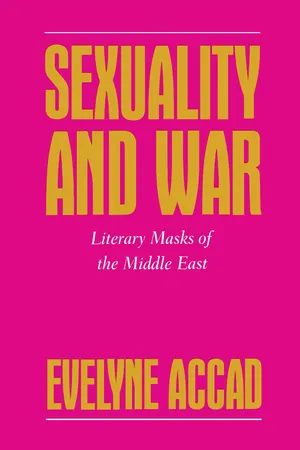
—Marilyn Booth, Women's Review of Books.This compelling book offers an exploration of the indissoluble link between war and sexuality based on over twelve years of interviews by the well-known Lebanese expatriate teacher, critic, and writer.
Evelyne Accad explores what she calls the indissoluble link between war and sexualtiy. She refers to sexuality as the physical and psychological relations of men and women, and examines Middle Eastern customs involved in defining such relationships. She argues that many of the problems faced by societies at war stem from the way male sexuality is viewed and imposed and from the oppression of women within cultural parameters.
For twelve years Professor Accad interviewed women throughout the Middle East about their sexuality and relationships with men. On the basis of these interviews and a close study of six novels written by both men and women on the subject of the Lebanese war, she explores the connection between sexualtity and war and contrasts the reactions of male authors with those of their female counterparts. Each author views war as having roots in sexuality.
Evelyne Accad concludes that "there is a need for a new rapport between men and women, women and women, and men and men: there is a ned for relationshops based on trust, recognition of the other, tenderness, equal sharing, and love devoid of jealousy and possession. Since the personal is the political, changes in relationshops traditionally based on domination, oppression, and power games will inevitably rebound in other spheres of life.
- 214 pages
- English
- ePUB (mobile friendly)
- Available on iOS & Android
eBook - ePub
About this book
Information
PART I
Unveiling Sexuality in War
The connection between admired masculinity and violent response to threat is a resource that governments can use to mobilise support for war. It has become a matter of urgency for humans as a group to undo the tangle of relationships that sustains the nuclear arms race. Masculinity is part of this tangle. It will not be easy to alter. The pattern of an arms race, i.e. mutual threat, itself helps sustain an aggressive masculinity.
Bob Connell, “Masculinity, Violence and War”
ONE
Sexuality and Sexual Politics: Conflicts and Contradictions for Contemporary Women
But the only hunger I have ever known was the hunger for sex and the hunger for freedom and somehow, in my mind and heart, they were related and certainly not mutually exclusive. If I could not use the source of my hunger as the source of my activism, how then was I to be politically effective?
Cherrie Moraga, Loving in the War Years
Sexuality seems to have a revolutionary potential so strong that many political women and men are afraid of it. They prefer to dismiss its importance by arguing that it is not as central as the economic and political factors that are easily recognizable as involving the major contradictions—such as class inequalities, hunger, poverty, lack of job opportunities—that produce revolutions. But sexuality is linked to all these other factors and to get at the roots of the important issues confronting us today, it can no longer be ignored.
I would like to suggest the importance of sexuality and sexual relations and the centrality of sexuality and male domination to the political and national struggles occurring in the Middle East. To illustrate these concepts, I will examine the recent sociological, anthropological, and political studies dealing with aggression, violence, war, and the role of women in the Middle East. I will analyze aspects of nationalism and how they relate to sexuality and to women’s traditional roles in society. Finally, I will show how feminist movements are often weakened and threatened by internal dissensions and by subordination to national struggles, the oppressed turning their anger against themselves instead of against the oppressor, in a process described at great length by Frantz Fanon in Les damnés de la terre.
Many authors have started looking at these connections, because they realize their importance. Miranda Davies’ compilation of articles in Third World—Second Sex: Women’s Struggles and National Liberation is a good example. In her preface, she states: “As they begin to recognize and identify the specific nature of their double oppression, many women in the Third World realize that, when needed, they may join guerrilla movements, participate in the economy, enter politics and organize trade unions, but at the end of the day they are still seen as women, second-class citizens, inferior to men, bearers of children, and domestic servants” (p. iii). In “Femmes: Une oppression millénaire,” Anne-Marie de Vilaine argues that history is founded on a masculine logic, masking the economic and sexual exploitation of women behind political, scientific, or ethical arguments (p. 17). And Jean-William Lapierre, coauthor of the same work, goes along with her analysis, noting: “It is undeniable that half the population of the human race, namely women, have often been neglected by historical knowledge” (p. 18). Such statements emphasize the secondary importance given to sexuality and to women’s issues. They indicate how urgent it has become to deal with them as major dilemmas.
Sexuality is much more fundamental in social and political problems than previously thought, and unless a sexual revolution is incorporated into political revolution, there will be no real transformation of social relations. As Andrea Dworkin puts it: “To transform the world we must transform the very substance of our erotic sensibilities and we must do so as consciously and as conscientiously as we do any act which involves our whole lives” (Marx and Gandhi Were Liberals, p. 6).
By sexual revolution I mean a revolution that starts at the personal level, with a transformation of attitudes toward one’s mate, family, sexuality, and society and, specifically, a transformation of the traditional relations of domination and subordination that permeate interpersonal relationships, particularly those of sexual and familial intimacy. Developing an exchange of love, tenderness, equal sharing, and recognition among people would create a more secure and solid basis for change in other spheres of life—political, economic, social, religious, and national—for these are often characterized by similar rapports of domination. As Elisabeth Badinter insightfully expresses:
Equality, which is taking place, gives birth to likeness, which stops war. Each protagonist wanting to be the “whole” of humanity can better understand the Other who has become his or her double. The feelings that unite this couple of mutants can only change in nature. Strangeness disappears, replaced by “familiarity.” We may lose some passion and desire, but gain tenderness and complicity, the feelings that unite members of the same family: a mother to her child, a brother to his sister. … At last, all those who have dropped their weapons. (P. 245)
By political revolution, I mean a revolution primarily motivated by nationalism, in the context of colonialism or neocolonialism. If all of the various political parties trying to dominate a small piece of territory in Lebanon and impose their vision of what Lebanon ought to be were to unite and believe in their country as an entity not to be possessed and used but to be loved and respected without domination, we could work more positively towards resolution, and much of the internal violence, destruction, and conflict would cease. Nationalism—belief and love of one’s country—in this context, seems a necessity. This affirmation may sound simplistic, overly optimistic, and naïve given the political forces at stake and the foreign interferences in Lebanon. Nevertheless, I wish to state it and emphasize it throughout this study because I believe it is valid and a real hope for Lebanon’s survival, as should become clearer as the study progresses.
I use the term nationalism within the perspective stated above and in a way I will elaborate further. Nationalism is a difficult notion about which much is written, much of it conflicting. In both East and West, in old and new concepts of the term, nationalism is a complex component of revolutionary discourse. It can be deployed in all the various facets of political power. For example, nationalism in one extreme form can be fascism. In “Fascisme et mystification misogyne,” Thérèse Vial-Mannessier gives a summary of Maria-Antonietta Macciocchi’s analysis of fascist ideology in Italy from and throughout the feminine universe. For her, although the collective irrational is at work in all human groups, and although conscious and unconscious forces led the masses from a transcendance of the individual ego into total allegiance to the Italian Nation—to fascism—women, the first victims of this process, adhered to fascist ideology through a masochism ready for all possible sacrifices. According to Macciocchi:
Fascism from its very beginning tried to bring women to an adherence I would describe as masochistic: acceptance, in a death wish [Freud], of all possible solutions. In the name of an immutable ritual, the cult of the dead, widows celebrated their own chastity—expiation in the middle of sculls that the fascists had chosen as their emblem. … From this renunciation of life, joy as negation of the self was born, joy in the relationship of women with Power; sacrifice, subordination, domestic slavery, in return for an abstract, wordy, demagogical love of the Chief, the Duce. (P. 156)
Vial-Mannessier’s reading of Macciocchi leads her to ask if these forces are not also at work in any social formation. And if so, couldn’t this emotional, primitive, and collective power, freed from its mystifying shield, become the necessary element of any political project? She ends with a quotation from Macciocchi’s Les femmes et leurs maîtres suggesting that, thanks to a new rapport between men and women, a “new continent in history” is being opened up.
While nationalism has been necessary for the young Arab states gaining their autonomy from colonialism, it nevertheless, like fascism, “reclaimed many of the most patriarchal values of Islamic traditionalism as integral to Arab cultural identity as such” as Mai Ghousoub puts it in “Feminism—or the Eternal Masculine—in the Arab World.” She states that “the political rights of women, nominally granted by the national state, are in practice a dead letter, since these are military dictatorships of one kind or another, in which the suffrage has no meaning.” Her analysis explains how:
Colonialism was lived by the Arabs not simply as a domination or oppression, but as a usurpation of power. The principal victims of this complex were to be Arab women. For the cult of a grandiose past, and the ‘superiority of our values to those of the West’, inevitably led to a suffocating rigidity of family structures and civil codes. Everywhere, under the supposedly modernizing regimes of ‘national revolution’, the laws governing the domestic and private sphere—marriage, divorce, children—continue to be based on the Shari‘a. The justification of this relentlessly retrogade nexus is always the same. (P. 8)
She adds a very significant remark, one that affected me personally because I, too, have been threatened with it several times in my life: “How many times every Arab feminist had to listen to men’s arrogant refrain: ‘Do you want to become like Western women, copying the degenerate society that is our enemy?’” (p. 11). Such comments are meant to make Arab women’s criticism of their society weaker, by playing with the political forces at stake, setting them against each other in a tactic of “divide and conquer” East against West, oppressed against oppressor, colonized against colonizer. It is not that these issues are without importance or should not be discussed seriously, but in this context, such remarks show the weakness of the men who make them, their using such questions to divert the real issue because they are unwilling to look at the problems of their society.
Several definitions of nationalism have recently been given by women writing about war. They often see it in contrast to patriotism. Jean Bethke Elshtain in Women and War sees patriotism as attached more to the sense of a political and moral community than to a state and as therefore able to bring out the best in us; nationalism, on the other hand, like the language of war, oversimplifies and can arouse the worse. Miriam Cooke, in War’s Other Voices, goes along with this definition and sees patriotism as intertwined with female and male images—patria as mother earth to whom loyalty is a congenital duty, pater as the father who commands loyalty at once gentle and appropriate—while nationalism is a kind of imperialist ideology that imposes uniformity on geographic areas that may be infinitely extended. I would challenge these definitions on the grounds that patriotism refers more to father than to mother, its roots going to patriarchy—rule of the fathers—a concept I hardly want to be loyal to. Even if we could trace it back to the mother, how can such loyalty preserve us from war? A humanist like Camus, when confronted with conflicting loyalties between France and Algeria’s independence, declared that between justice and his mother he would choose his mother, France.
Specifically in the case of Lebanon, a country mosaic in ethnic groups and religions, what political entity could help bring it unity? Patriotism? Matriotism? Nationalism? A mixture of many elements? For Georges Corm: “Lebanese culture is a pluralistic, universal one, rich in the best religious traditions of freedom, tolerance and understanding between the various tenants of the Christian and Moslem patrimony. … Future generations will be able to have a national culture only if, wanting it, they take good care of this Lebanese patrimony in its true authenticity, meaning its universal pluralism, which each Lebanese ought to know and be proud of” (Géopolitique du conflit libanais,, p. 245). Here also, patrimony refers to pater, father. If language has significance beyond the conscious levels of our understanding, should we not be careful with the words we choose? Said differently, is Corm aware that patrimony refers to a whole patriarchal structure that needs to be revolutionized?
Other more recent analyses of nationalism see it as closely connected to national economy, which, in the context of today’s domination by multinational corporations, transforms the concept into transnationalism. A whole issue of Peuples méditerranéens is devoted to these relations, asking in its title whether we are witnessing “The End of the National?”1 Are we going into the era of the transnational? What is the connection among development and consumption as a new way of relating to the world, the urban as a universal form for life, the increase in migrant workers and boundaries of the national? What do the state, the nation, and their specific articulation of the previous capitalist period become? Is a world polity conceivable? Isn’t a new bipartition of the world, between those included in production and consumerism and those excluded, occurring, crossing all social formations, substituting for the old center-periphery division between industrialized and Third World countries? Several authors consider these questions and bring to light some important aspects of the national. In “Du transnational au politique-monde,” Paul Vieille sees the nation—a solidarity group led by a state aiming at defending the interests of its members against other nation-states—being replaced by transborder solidarities, such as those of Muslims, the disinherited, the poor, the urban masses. This transnational solidarity is not yet structured but works in the feeling and imagination of the masses and transforms the role of the state. Historically, nation-states were constituted against one another. Each state made a nation through a mixture of consensus and violence. The state was defined by a national economy and its redistribution within its borders; its rule was national selfishness. Today, the link between nation and state is being broken. The state is being transnationalized and becoming the place of the political articulation of the space it controls. In a transnational economy, the state no longer functions within national boundaries but on a world scale. The nation enters a crisis; the feeling of belonging falls back on infranational groups, or becomes universalized, or transforms the notion of nation itself—which is no longer a political institution, but a cultural choice. The revival and growth of religious identities can be better understood in light of nation-states’ failure to fulfill people’s needs of belonging to a “national” culture, which, having developed at the time of nation-states, has had little impact on these populations.
Hele Beji in “La métatamorphose nationale: De l’indépendance à l’aliénation,” sees the national in constant dramatic roles vying between attraction and rejection of the European model. It is a conflict between nationalism and colonialism still going on today because nationalism has not really established firm foundations. And René Gallissot in “Transnationalisation et renforcement de l’ordre étatique,” argues that religious nationalism offers false hopes to the masses who have lost confidence in the nation-state. The state now defines the people as opposed to nationalities that are shared, dispersed (in diasporas), or given minority status. “Transnationalization” or “denationalization” may have to do with this transformation of national feelings on behalf of the interests of the state.
Fouad Ajami, in “The Silence in Arab Culture,” analyzes Arab nationalism as a project of the intellectuals. From its very beginning in the late nineteenth century, it is “an idea flung in the face of a political order that was always torn by all sorts of conflicts” (p. 30). Interestingly, he sees Arab nationalism overwhelmed by a “ferocious rebellion dubbed as Islamic fundamentalism.” Arab nationalism “never really had a theory of practical action, having inherited the remains of the Ottoman Empire that collapsed during World War I; its principal social glue was the political and cultural ascendancy of urban, orthodox (Sunni) Islam, and for the last four decades, its most frequently proclaimed cause was Palestine” (p. 30). Significantly, the movement originated not in the Arab world but in Iran, showing, according to Ajami, the paralysis of Arab politics.
In light of the more recent developments of nation-states, are we correct in raising this issue in the context of Lebanon? If transnational rules the world, what impact can the national have? Is it not precisely transnationalism that brought the confrontation to its peak in Lebanon, feeding the inside animosities of the various clans from the outside? And if this analysis is correct, can we hope for a solution only from the outside? For me, this inside/outside opposition is closely related to the private/public one as well as to conflicts between professional realms, sexual and political ones, in a way that will become clear throughout this book. I would argue that if we do not work on both, trying to integrate the two in the main struggle for liberation, we are not likely to see tangible results.
In its political organization, Lebanon was not a real nation-state. There was a tribal layer between the state and the families. A culture going beyond ethnic borders grew. Even though the Lebanese state was not a nation-state as such, pluralism—acceptance of others’ differences—developed. This is particularly remarkable in view of the political institutions that maintained differences among various communities, reinforced domination of one over others, and institutionalized these relations through a “national agreement.” Lebanon became fragile because its political institutions did not represent its people. The domination of ethnic groups became unacceptable when international configurations were changing. Lebanese national identity is linked to the notion of pluralism, acceptance of the other. This is the real hope at the core of the Lebanese tragedy. In Lebanon, both the outside forces—the Syrian and Israeli occupations, the big powers’ interferences, the Palestinian desperate struggles—and the inside tribal wars have equally brought the crisis to its peak. It is therefore necessary to work at solving both aspects of the conflict in order to reach results. The resolution of opposition between these two sides can be compared to the feminist association of the otherwise opposed personal and political realms, an association that has acquired even greater meaning in the present Lebanese situation.
In the Middle East, nationalism and feminism have never mixed very well. Women were used in national liberation struggles—in Algeria, Iran, Palestine, to name only a few—only to be sent back to their kitchens after ‘“independence” had been gained.2 As Monique Gadant expresses in her introduction to Women of the Mediterranean:
Nationalism asked of women a participation that they were quick to give, they fought and were caught in the trap. For nationalism is frequently conservative, even though it appears to be an inevitable moment of political liberation and economic progress which women need to advance along the path to their own liberation. … What does it mean for women to be active in political organizations? The example of Algerian women is there to remind all women that participation does not necessarily win them rights. From the point of view of those women contributors who have grown up after a war of liberation, everything is still to be done. (P. 2)
To those who believe that it is utopia to think that feminism and nationalism can ever blend, I would like to first suggest, that it has never been tried, since sexuality has never been conceptualized as being at the center of the problem in the Middle East, and, second, that if an analysis of sexuality and sexual relations were truly incorporated into revolutionary struggle in Lebanon, nationalism could be transformed into a more revolutionary strategy. If women were to demand their rights and a transformation of values and roles in the family at t...
Table of contents
- Cover Page
- Title Page
- Copyright Page
- Contents
- Foreword by Kathleen Barry
- Acknowledgments
- Introduction
- Part I Unveiling Sexuality in War
- Part II Women Unmask War
- Part III War Unveils Men
- Bibliography
- Index
Trusted by 375,005 students
Access to over 1.5 million titles for a fair monthly price.
Study more efficiently using our study tools.
Frequently asked questions
Yes, you can cancel anytime from the Subscription tab in your account settings on the Perlego website. Your subscription will stay active until the end of your current billing period. Learn how to cancel your subscription
No, books cannot be downloaded as external files, such as PDFs, for use outside of Perlego. However, you can download books within the Perlego app for offline reading on mobile or tablet. Learn how to download books offline
Perlego offers two plans: Essential and Complete
- Essential is ideal for learners and professionals who enjoy exploring a wide range of subjects. Access the Essential Library with 800,000+ trusted titles and best-sellers across business, personal growth, and the humanities. Includes unlimited reading time and Standard Read Aloud voice.
- Complete: Perfect for advanced learners and researchers needing full, unrestricted access. Unlock 1.5M+ books across hundreds of subjects, including academic and specialized titles. The Complete Plan also includes advanced features like Premium Read Aloud and Research Assistant.
We are an online textbook subscription service, where you can get access to an entire online library for less than the price of a single book per month. With over 1.5 million books across 990+ topics, we’ve got you covered! Learn about our mission
Look out for the read-aloud symbol on your next book to see if you can listen to it. The read-aloud tool reads text aloud for you, highlighting the text as it is being read. You can pause it, speed it up and slow it down. Learn more about Read Aloud
Yes! You can use the Perlego app on both iOS and Android devices to read anytime, anywhere — even offline. Perfect for commutes or when you’re on the go.
Please note we cannot support devices running on iOS 13 and Android 7 or earlier. Learn more about using the app
Please note we cannot support devices running on iOS 13 and Android 7 or earlier. Learn more about using the app
Yes, you can access Sexuality and War by Evelyne Accad in PDF and/or ePUB format, as well as other popular books in Social Sciences & Gender Studies. We have over 1.5 million books available in our catalogue for you to explore.