"Seeing ourselves through others' eyes is often instructive...[Prime Minister Giulio] Andreotti, a fixture of postwar Italian government, brings [to this examination of U.S. politics] a keen mind and the perspective of a political system in which charisma is suspect..."
—Foreign Affairs
"Rich, not only in the usual anecdotes of the author's encounters with famous Americans, but also in reflections on the moments that molded the extraordinary relationship between Italy and the U.S... [Andreotti] will be judged by historians to be, warts and all, one of Italy's, and Europe's, truly remarkable statesmen."
—Choice
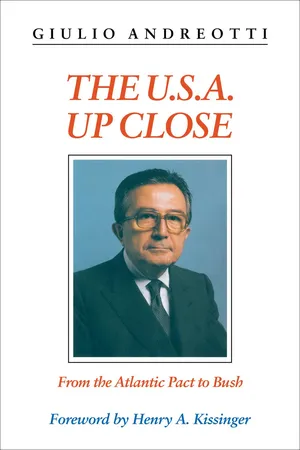
- 288 pages
- English
- ePUB (mobile friendly)
- Available on iOS & Android
eBook - ePub
About this book
Information
1
That Difficult “Ph”
My first contact with America dates back to my childhood and was a rather unusual experience. Our concierge, Laurina Volpi, was a good-natured woman from the Marche region who hadn’t been subject to the rigors of compulsory education as a child and every so often she would come upstairs to have my mother read her the letters she received from relatives who had emigrated to Pennsylvania. By way of compensation for my mother’s good deed I was given the envelopes and was very happy to have the foreign stamps. And yet those envelopes fanned my unquenchable curiosity: why did Philadelphia have to be spelled with a double “ph”? I also listened most attentively to the contents of those letters full of ordinary news about the daily life of a working family whose standard of living, certainly higher than what it had been originally, left me practically spellbound. Both reader and listener became ecstatic, involving me as well in their feelings of admiration, when they learned, for example that the laundry over there was washed in machines which eliminated those cracks inflicted upon the hands of my mother and of the kind doorkeeper by the European way of doing the “wash.” Fifty years later when I heard people criticize consumerism and household appliances in general I was careful to remain aloof precisely on account of my childhood memories. America for me was the civilization of physical respect for housewives.
I wouldn’t say they taught me very much about America in elementary school. Especially in the fourth and fifth grades our teacher was so imbued with self-sufficient nationalism that everything non-Italian was worth little or nothing in his eyes. He used to tell us quite often that Christopher Columbus had happened upon the new continent by mistake and only recently had the efforts of Europeans over there been crowned with success in their fight to abolish slavery. The only person he really had anything good to say about was President Lincoln, and perhaps even that was done out of malice since he used to stress the point of his violent death at the hands of one of his own fellow citizens.
When in high school I received some more direct information at the playground built by the Knights of Columbus on the outskirts of Rome and kept in excellent condition for use by the city’s children. It was there that I first met an American and his name was Fr. Francis Spellman. Always courteous and with a ready smile, he was treated with utmost deference by the playground attendants. Apparently nothing more than an occasional encounter, it was actually the beginning of something very important in my life.
Another memory from my youth. Just as in the case of the flight to South America in 1931, I was intrigued by all the news about the flight to Chicago and New York by Italo Balbo and his officers two years later. Most striking of all were the pictures of festive groups of Italian immigrants with vivid descriptions of their patriotic enthusiasm over the daring feat. What was not made public, however, was what I heard in my local parish. The Italian postal authorities had issued a special stamp entitled “Return Flight” which couldn’t be used and was therefore destined to become, as it was “improperly” called, a prefab rarity.
With the onset of the war I was declared physically unfit for admission to the Officers Candidate School and served my time in the armed forces in the Office of Legal Medicine, a turn of events that had three advantages: I was able to attend lectures at the university and received my degree; I had a half day free each week to dedicate to my work in the offices of the Federation of Catholic University Students with Aldo Moro; and I got to know many renowned physicians who had been called up from their respective clinics or hospitals. These officers, perhaps because of their professional background, harbored the greatest admiration for their American colleagues and their scientific discoveries. They were not shy about their feelings since in no way were they conditioned by what they called a “temporary wartime parenthesis.” From the point of view of this general outlook, I am very thankful for that period of my life as well.
When the landing took place at Anzio on 22 January 1944, without the slightest German counterattack by land or air, we all thought our liberation was only hours away. However, almost five months went by and during those months our admiration for the Allied troops experienced moments of disappointed irritation. It took years for us to understand the strategy behind keeping the Germans tied down in Italy and preventing them from retreating northward before the definitive landing in Normandy, and I received confirmation of this from Dwight D. Eisenhower himself.
During the long waiting period, the parties in the National Liberation Committee had prepared detailed plans for the exercise of power after the war. As we say, however, they counted their chickens before they hatched because they overlooked the fact that any effective authority would be in the hands of the Allied military government. Despite the participation of the Italian armed forces alongside the Allies immediately after the armistice, the government of Salerno was in the same position as titular bishops in the Catholic Church who exercise authority over ancient dioceses which have disappeared and whose exact location is known unto God alone. When Badoglio and his ministers came to Rome to transfer the powers of government to the political parties, they had very little to hand over. In addition, the ceremony was held in a secluded alcove of the Grand Hotel which was packed with English and American officers who were the very center of every attention on the part of the hotel staff. Ivanoe Bonomi and the ministers didn’t even receive permission to remain in Rome and had to make their own difficult way back down south.
The Palace of the Corporations on Via Veneto was the headquarters of the Allied officers in charge of press relations, which entailed the supply of printing paper to newspapers and the exercise of policy controls. At times there were some rather strange episodes. One day I saw a person in uniform moving around the place as if he owned it. The Fascist authorities had sent him off to a concentration camp on charges of dealing in drugs and it was rumored that he had sent the Japanese minister of foreign affairs Matsuoka on such a “trip” that his audience with Mussolini had been delayed by 48 hours. Since the Allies had found him in a place of Fascist punishment they had set him free with all possible honors and given him the keys to the medicinal drug locker of the Fifth Army because there was a reference to drugs in his personnel file. In brief, that is the story of his triumphal return into the city. His name was Max Mugnani and his official occupation involved importing champagne from France.
At a lower level, the relations with our liberators were quite varied in nature. There were those who received candy bars and K-rations, and those who experienced close encounters with tipsy GIs on the streets, especially at night. When we finished making up Il Popolo, the daily newspaper of the Christian Democratic Party, at the printing press in Palazzo Sciarra at 2:00 A.M., it was always an adventure getting home . . . on foot, naturally. However, everyone was still imbued with the euphoria of the liberation and even some of the eccentric things done by the governor, Charles Poletti (who had announced his intention to introduce Romans to the existence of soap) were accepted good-naturedly by the population.
The problems of “the day after” began with the return of the civilian government to Rome (with strenuous negotiations to wrestle even an iota of authority from the man at the top of the Allied hierarchy, Admiral Ellery W. Stone) and that period was quite different from the dreams on the eve of armistice. The city of Rome was literally overflowing with refugees who had to be fed, no matter whether the direct responsibility lay with Bonomi or Stone. Legendary is the outcome of a late evening telephone call from De Gasperi to the mayor of New York, Fiorello La Guardia; some ships already on their way to other destinations were rerouted to Italy and the people in Rome and Naples didn’t have to go without the few ounces of bread they could get with their ration cards. A truly disgraceful propaganda move on the part of the Allies helped make the widespread pangs of hunger all the more acute. For two days after the liberation they had distributed white bread made out of real flour and people thought that the horrible stuff we were used to eating was gone for good. I raised this point with the officer in charge of the Psychological Welfare Department, but he dismissed my objections by saying everything had been planned by centers of research on human behavior which “back home” were much more advanced than anything we fanciful Latins had.
Living side-by-side with De Gasperi I was able to share his daily concerns over the big problems to be solved as well as his anxiety in striving to cope with the much more important issue of the day-to-day food supplies. I began to appreciate the Western solidarity which warded off even worse perils on the Eastern front where Marshal Tito’s troops, in perfect harmony with the Soviets at that time, made more than one move against the city of Trieste. In an interview some time later, Secretary of State Dean Acheson said De Gasperi never gave him a moment’s respite because of “his” Trieste.
In order to help the younger generations understand what the situation was like for fledgling democratic Italy, I would venture to mention a photograph circulated in the international press showing Secretary of State James Byrnes shaking hands with De Gasperi at the Peace Conference. Together with a sort of weak smile from the Brazilian minister of foreign affairs, Jan Neves de Fontoura, that was the only friendly gesture on a very cold day in Paris. Everyone else considered the representative from Italy as a loser who had to be punished.
With the defeat and demise of both Hitler and Mussolini it was immediately evident that the curtain had also been drawn on the understanding between the Soviets and the other Allies. I obtained confirmation of this fact through the Vatican. During the height of the war Roosevelt had asked the pope to substantiate the thesis that nazism was more dangerous than communism because, while the former based its expansion on military occupation, the Soviets were just (!) propagating their ideas. Drafted by Msgr. Domenico Tardini, the Vatican’s reply was as sharp as a knife.
The pontiff was very prudent in his pronouncements in order not to confuse principles with wartime activity, yet there was no way to condone a conceptual attenuation of persecuting and atheistic communism, and the same applied to the condemnation of the Germans’ racial paganism. I would also mention the numerous reservations voiced at the U.S. State Department over Roosevelt’s decision to send a personal representative of the president of the United States to the Vatican. It was looked upon as a domestic electoral ploy to win the votes of the Catholics, while the Protestants were told it was a temporary and very informal measure. As Msgr. Tardini noted: “It was the American President who had approached the constant teaching of the Pontiff in explicit terms and not the Pope who was siding with the Wall Street bankers.”
Once each ally had returned to his own natural way of doing things, the White House—counterorders, my friends—asked the pope to accentuate the reprobation of communism. The reply to President Truman, once again written by Msgr. Tardini, was as follows: “The Church is not at all interested in a new ideological crusade, but rather in reiterating those principles which are fundamental and unchangeable in defense of the human being and civil society as Christianity has always conceived them. . . . The Pope wanted to stress the need to eliminate the many social, racial, and religious aberrations existing precisely among those peoples and those groups who boast about being Christian.” When the director of the Osservatore Romano, Dalla Torre, wrote an editorial calling for a deeper understanding of certain aspects and requirements, Msgr. Tardini clarified that for the State Department the condemnation did not concern Russia as such, but rather communism “wherever it may be, no matter whether in power or striving to get there.”
With a true sense of responsibility and despite certain outbursts of nationalism displayed by Vittorio Emanuele Orlando, the Constituent Assembly ratified the signing of the peace diktat drawn up in Paris by the twenty-one winners. Neither a government nor even a regime can permit conditional forms of acceptance in such cases since, for better or worse, they do represent the continuity of the nation.
We were comforted by the American assurances that the United States would not claim reparation, while the Soviets demanded the dismantling of our fleet right down to the very last ship. This news, delivered by Ambassador Clement Dunn, was not unexpected to De Gasperi because I had been able to inform him ahead of time, thanks to confidential information from Francis Cardinal Spellman who had gone to Washington a number of times to plead the Italian cause. There may not be any traces in diplomatic archives of the work done by the archbishop of New York, but it was most valuable for us on more than one occasion.
Italy’s political future still depended upon us at that time, however. We, too, bore the full brunt of the world’s bitter division into two blocs. Our western propensity has been ascribed to a financial and economic need which could only be resolved by moving in one direction. This, however, is a very partial explanation. The crux of dissent was objective freedom, with an aggravating factor in the sense that a Communist victory would have sacrificed freedom without alleviating the material difficulties. What might have been open to question at that time turned out to be true as the collectivistic models evolved and fell to pieces. Nowadays not even Stalin’s relatives try to defend him or his system. Even though we cannot exclude the fact that Italian leaders would have opposed resistance to “Stalinization” if the Red front had won the day, there is no way of knowing if they could have safeguarded the national identity other countries are only now striving to attain in the wake of changes in the USSR.
De Gasperi went to the United States in February 1947 and made a very favorable impression, not only on the politicians, with a very dignified and realistic presentation of the prospects for Italy. He obtained an initial loan for the reconstruction work and plenty of encouragement to keep thinking positively in the midst of the enormous difficulties faced by a destroyed and divided country. With a poor sense of timing explainable only by subservient obedience, at that same time Togliatti, founder of the Italian Communist party and its leader until his death in 1970, wrote an anti-American editorial entitled “How Stupid They Are.”
This turned out to be the proverbial straw that broke the camel’s back with such devastating effects. The government of the National Liberation Committee came apart at the seams. However, there could have been a split between Socialists and Communists, since three years earlier Togliatti’s party had broken the joint-action pact and had joined the second Bonomi government, while Nenni and his friends had adopted a contentious position and remained on the outside. In 1947–48, however, Nenni and the vast majority of his party set their sights on forming an alliance with the Popular Front in the belief that together they could beat the Christian Democrats and their allies in the first elections after the founding of the Constituent Assembly, aiming first and foremost at the Social Democrats who had based their split from the Socialist camp on the sides formed on the international scene.
The electoral battle of April 18, 1948, was a decisive one. America sent a kind of capillary-action assistance in the form of hundreds of thousands of letters from past emigrants to their relatives and friends in Italy with an appeal to safeguard the democratic institutions. In more specifically political terms, on March 20, England, France, and the United States issued a solemn declaration restoring Trieste to Italy. In contrast to these forms of support, the Soviets disclaimed the rumor spread by the Italian Communist party that they were prepared to forgo reparation from Italy for wartime damages. Moreover, Moscow and the other “socialist” capitals looked with a rather wary eye upon the Italian Communists who were actually being tried under charges of having allowed themselves to be thrown out of the government.
The great Democratic victory of April 18, 1948, has become part of history. The American press reported it in a rather interested and friendly way, exalting the figure of De Gasperi. What came across between the lines, however, was a certain degree of coolness toward the Christian Democratic party; maybe because over there Christianity is something supposed and not confessed or because of a recurrent vein of antipapal feelings. Nor would I exclude the rebound effect of Italian influences on the part of those who did not deny the determining importance of the Christian Democratic party but, with a deep sigh, considered it a necessary evil.
The defeat of the communists and their bedfellows also helped to dispel some rather curious suspicions about Count Carlo Sforza. As a political exile in the United States he was expected to underwrite a pledge of neutrality on institutional issues in order to return home after the fall of fascism. The unlawful request for such a pledge was lawfully disregarded and this aroused the spite of certain American circles where the Republic—in Italy—was tantamount to a dangerous left-wing adventure. Those same circles also harbored numerous reservations on an issue where Sforza and De Gasperi had adopted a very resolute stance: in order to avoid giving rise to Teutonic revanchism anew, perhaps this time with a shirt of a different color, Germany was not to be humiliated. The Americans still had vivid memories of the anti-Nazi reaction fanned by years of propaganda to support the human and financial effort to prevent Hitler’s conquest of Europe. Luckily at that time they didn’t even dream that the two losers, Germany and Japan, would become the economic and industrial driving powers in the world.
What prevailed in the end was the involvement of the Federal Republic of Germany in any and all planning for our old continent, and I’m sorry Adenauer, who was well aware of the facts, didn’t extend due recognition to the Italian government in his memoirs.
Those were the golden years of the Marshall Plan and the Atlantic Pact. With just as much energy, however, De Gasperi launched a domestic policy of real reform with the distribution of underutilized land or parts of large estates and a development plan for southern Italy. At a later stage we will see how this innovative insight triggered the reactions of the prosperous property owners who had supported the democratic coalition in the elections out of fear of the Popular Front but were not prepared to make sacrifices in the name of justice. Since these classes had more opportunities than others for frequent contacts with Americans, a climate of mistrust on the staying power of the Christian Democrats crossed over to the other shore of the Atlantic. The disgruntled people quite naturally refrained from expressing their hostility by speaking openly about their own affected interests (also because reforms and social justice were encouraged in the United States) and just insinuated we were not doing enough to combat communism in Italy.
The outcome had no effect on our “blue chip” rating relative to the clarity of our international policy, but De Gasperi’s prestige lost ground following claims about his supposedly lukewarm stance against communism. McCarthy with his witch-hunt was not the only one to get entangled in this reactionary spiral. In various ways and without even realizing it, also involved were many convinced believers in democracy.
2
Eisenhower
I never had any personal relations with Presidents Roosevelt or Truman and in the latter’s case my only recollections are limited to De Gasperi’s favorable impressions after his return from the White House. He had told me that President Truman, customarily defined as commonplace to distinguish him from the striking qualities—in social policy as well—of his predecessor, in fact had a very resolute personality and a willpower well known to his cabinet and staff. While the New Deal had earned a place in the history of mankind for Franklin Delano Roosevelt, the courageous decision by Truman to unleash the atomic bombs in order to subdue Japan and bring the war to an end is not one of those decisions that leaves no traces in history.
The field is obviously divided between those who approve the decision and those who condemn it. The fact is that public opinion in the United States was behind the president, and perhaps this was due to the underlying rancor over the surprise attack on Pearl Harbor. In addition, and looking at the figures, the two years experts considered it would take to end the war would have cost many more human lives. Then there was the likely risk that German scientists would have come up with the bomb somewhere else in the world. Moreover, the American nuclear potential helped to dissuade the Soviet bloc from taking advantage of its marked “conventional” superiority in Europe during the period of postwar Stalinism.
The first president of the United States I met in person was Dwight D. Eisenhower when he came to Italy on a state visit. Our paths had crossed briefly during an earlier trip he made to Italy as NATO commander in chief and I had really been impressed. On that occasion De Gasperi had referred to him as a “humanistic general.”
The arrival of a president of the United States was a major event and not even the inclement weather conditions were able to put a damper on it. My memories of Eisenhower’s visit border on a nightmare, heightened by the added element of a downpour rare for our capital cit...
Table of contents
- Cover Page
- Title Page
- Copyright Page
- Contents
- Foreword by Henry A. Kissinger
- Preface
- Introduction
- 1 That Difficult “Ph”
- 2 Eisenhower
- 3 August 1954: The First Trip
- 4 The Ambassador’s Slipup
- 5 Four Encounters as Minister of Finance
- 6 McNamara and Rusk
- 7 The Years in the Ministry of Defense
- 8 The Kennedy Star
- 9 Johnson the Dancer
- 10 Vacation in the U.S.A.
- 11 Nixon’s Turn
- 12 Costantino Brumidi
- 13 A Tribute to Ford
- 14 Carter
- 15 Reagan Arrives
- 16 A Disappointed Bishop
- 17 Arafat
- 18 Craxi’s Trip
- 19 The Olympic Games
- 20 A Degree in Indiana
- 21 The Achille Lauro Affair
- 22 Paper and File Cards
- 23 George’s Easter
- 24 Visiting the Jews in New York
- 25 The NATO Train
- 26 Pro-Perestroika
- Index
Trusted by 375,005 students
Access to over 1.5 million titles for a fair monthly price.
Study more efficiently using our study tools.
Frequently asked questions
Yes, you can cancel anytime from the Subscription tab in your account settings on the Perlego website. Your subscription will stay active until the end of your current billing period. Learn how to cancel your subscription
No, books cannot be downloaded as external files, such as PDFs, for use outside of Perlego. However, you can download books within the Perlego app for offline reading on mobile or tablet. Learn how to download books offline
Perlego offers two plans: Essential and Complete
- Essential is ideal for learners and professionals who enjoy exploring a wide range of subjects. Access the Essential Library with 800,000+ trusted titles and best-sellers across business, personal growth, and the humanities. Includes unlimited reading time and Standard Read Aloud voice.
- Complete: Perfect for advanced learners and researchers needing full, unrestricted access. Unlock 1.5M+ books across hundreds of subjects, including academic and specialized titles. The Complete Plan also includes advanced features like Premium Read Aloud and Research Assistant.
We are an online textbook subscription service, where you can get access to an entire online library for less than the price of a single book per month. With over 1.5 million books across 990+ topics, we’ve got you covered! Learn about our mission
Look out for the read-aloud symbol on your next book to see if you can listen to it. The read-aloud tool reads text aloud for you, highlighting the text as it is being read. You can pause it, speed it up and slow it down. Learn more about Read Aloud
Yes! You can use the Perlego app on both iOS and Android devices to read anytime, anywhere — even offline. Perfect for commutes or when you’re on the go.
Please note we cannot support devices running on iOS 13 and Android 7 or earlier. Learn more about using the app
Please note we cannot support devices running on iOS 13 and Android 7 or earlier. Learn more about using the app
Yes, you can access The USA Up Close by Giulio Andreotti in PDF and/or ePUB format, as well as other popular books in Politics & International Relations & Politics. We have over 1.5 million books available in our catalogue for you to explore.