Traditionally, security has been the realm of the state and its uniformed police. However, in the last two decades, many actors and agencies, including schools, clubs, housing corporations, hospitals, shopkeepers, insurers, energy suppliers and even private citizens, have enforced some form of security, effectively changing its delivery, and overall role.
In The Securitization of Society, Marc Schuilenburg establishes a new critical perspective for examining the dynamic nature of security and its governance. Rooted in the works of the French philosophers Michel Foucault, Gilles Deleuze and Gabriel Tarde, this book explores the ongoing structural and cultural changes that have impacted security in Western society from the 19th century to the present. By analyzing the new hybrid of public-private security, this volume provides deep insight into the processes of securitization and modern risk management for the police and judicial authorities as well as other emerging parties. Schuilenburg draws upon four case studies of increased securitization in Europe – monitoring marijuana cultivation, urban intervention teams, road transport crime, and the collective shop ban – in order to raise important questions about citizenship, social order, and the law within this expanding new paradigm. An innovative, interdisciplinary approach to criminological theory that incorporates philosophy, sociology, and political science, The Securitization of Society reveals how security is understood and enacted in urban environments today.
eBook - ePub
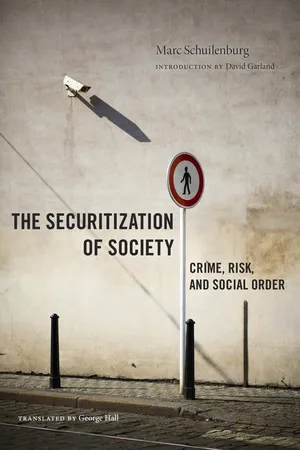
The Securitization of Society
Crime, Risk, and Social Order
- 368 pages
- English
- ePUB (mobile friendly)
- Available on iOS & Android
eBook - ePub
About this book
Information
1
The Problem
Security is an ordering concept. We order our lives in the hope of ensuring a safe existence. The last two decades have witnessed radical changes in the way in which this occurs. Traditionally, the government was the entity responsible for our security. But now, an increasing number of other players have assumed tasks and responsibilities relating to our safety and security. In some cases, they have taken over these duties completely. Private guards at airports and in shopping malls are a well-known example. But schools, sports clubs, and housing organizations have also embedded the concern for safety and security in their policy. To paraphrase Mike Presdee (2000), a loud and exuberant carnival of detectives and security guards has burst loose. One consequence of this is that the concern for safety has begun to direct its efforts toward affairs of a personal nature. In the Netherlands, intervention teams have been given the task of improving security and livability in the cities. They come visiting, spontaneously, to discuss income, health care, and children’s education with various residents. This is referred to as getting “behind-the-front-door.” And it is also the case that increasingly invasive security measures are being taken when rules are violated. For example, shopkeepers in The Hague can issue a shop-access ban to offenders for a period of one year. This ban then applies to all shops that participate in the Collective Shop Ban agreement, a new, self-generated initiative of cooperating businesses designed to combat crime and disorder. In addition, the newspapers are reporting on similar sanctions that are now being introduced in other cities, through denials of access to tram, catering, or cinema facilities.
Although security is regarded as an important ordering principle of society, the ordering power of security is anything but a uniform and simple process. The concern for safety and security is much less homogeneous and static than we tend to think. The ascribed developments in the field of safety and security—(1) new parties, (2) increased attention to domains such as education and health, and (3) the introduction of exceptional sanctions—which are covered here only briefly although present for a much longer time, are not drawing to a close soon. Therefore, it is important to look more closely at the complexity of the safety and security issue and to gain insight into the changes that are happening in this field.
Security as an ordering principle
Rapid perusal of criminological literature indicates that theory forming with regard to the ordering power of security is still in its infancy. Although research in this field has a relatively short history, the findings of most scientists do not diverge to a great extent (see, for example, Crawford 1999; Bayley and Shearing 2001; Johnston and Shearing 2003). What links these studies despite their mutual disparity is the ascertainment that many public tasks and responsibilities in the field of security are performed by parties other than the government. In the last few decades, new initiatives have arisen in which not only the government—and the police as an extension of government—fulfills a duty in this field, but various national and international players are also active to such a degree that it has become self-evident that they, too, take responsibility for security issues and develop and implement security measures autonomously. In this framework, there is mention of collaboration with the government to a greater or lesser extent.
The “responsibilization” (Garland 1996; 2001: 124–27) of parties other than the police is an important strategy: it creates a new distribution of responsibility for security. In this way, the approach to insecurity in many countries is no longer a matter for the judicial apparatus alone, but also for schools, football clubs, housing corporations, hospitals, care and welfare institutions, job agencies, shopkeepers’ associations, insurers, energy suppliers, and citizens. The responsibilization of these parties emanates from the insight that the traditional judicial slant is too restricted to allow for an effective approach to the current security issue. The underlying thought is that crime levels are and will probably remain high in an open and prosperous society, and that the government has only limited possibilities to deal with this situation. Tasks in this domain are increasingly being transferred to other parties who tackle them in their own particular way. On the one hand, social organizations close to the population are made responsible for the security problem. On the other, commercial parties are increasingly being assigned “police-type” duties, such as the monitoring of shopping malls, airports, and gated communities (Shearing and Stenning 1983; Rigakos and Greener 2000; Wakefield 2003). In the most ideal circumstance, successful responsibilization leads to the generation of a degree of self-reliance among the parties that have been made accountable for security concerns.
The consequence of all this is that solutions to security issues are increasingly being sought in a multidisciplinary approach in which players other than just the government are involved. In many cases this requires a joint effort by the government, businesses, and civilians to tackle urgent security issues. This approach may have a relatively simple structure, as is the case with the Dutch Civilian Net (Burgernet) project, which has the aim of enhancing safety in the living and working environment of ordinary citizens. People who have enrolled for this project receive a message from the police when a child is reported missing or when a burglar is active in that neighborhood, for example. These messages are sent to participants who are situated within a certain radius of the incident. When the participants see anything that appears to be relevant to the matter at hand, they can call the general police number and convey what they have seen. But the collaboration among the various parties may be more complicated than the “two-party” Civilian Net system. The composition of anti-marijuana-cultivation teams is a good example of this. In addition to the police and civil servants from the municipality, the team also contains personnel from housing corporations and energy suppliers, and is engaged in the detection and dismantling of illegal marijuana plantations in Dutch cities.
The examples of Civilian Net and anti-marijuana-cultivation teams appear to be very different, but they also have much in common. Whereas the enforcement of safety and security was once a primarily vertical affair in which the government enjoyed a monopoly, public and private parties now seem to have gained equal standing. This being the case, the collaboration in network-like structures between public and private parties has significantly stimulated the horizontalization of mutual relations. Various terms have been introduced to describe this horizontalization: “gray policing” (Hoogenboom 1991), “multilateralization” (Bayley and Shearing 2001), “preventative partnerships” (Garland 2001), “third-party policing” (Mazerolle and Ransley 2005), “pluralization” (Loader 2000; Jones and Newburn 2006), and the like. Although each of these terms involves a slightly different emphasis, they correspond in the observation that the implementation of policing is no longer exclusively reserved for the police. Other organizational forms have arrived in their stead. In administrative terms, this is referred to as a transition from “government” to “governance” (Crawford 1999; Pierre 2000; Newman 2001). This shift has been accompanied by new regulatory institutions, mentalities, and techniques. The implementation of security measures, for example, is increasingly taking place in networks or arrangements among the government, companies, and citizens. The formalization of the collaboration occurs by means of contracts or similar agreements such as protocols and covenants. A covenant is a much-used means to record the most important tasks and responsibilities of the participating parties, such as the aims to be pursued and the results to be achieved, as well as the way in which information should be exchanged among the parties. The argument is that the agreements made will be more closely observed in this type of contract than they would otherwise be in unilaterally imposed obligations (“commanding power”). This is reinforced by the idea that such an agreement leaves no leeway for informality.
In general, these developments appear to evoke few questions. Most studies on the central role of security in society mainly cover the judicial system and its most prominent actors: the police, the Public Prosecutor’s Office, the Department of Justice, the prison system, and rehabilitative programs. In this framework, most attention is paid to the activities of the government and the effectiveness of judicial intervention—that is, the Penal Code as the ideal means to make society safer, and to protect the general public against crime and disorder. Although change has gradually crept in over the past few years, much less attention has been given to the role of housing corporations, shopkeepers, insurers, and energy suppliers, and research into the cooperation of the same parties with the government is rather scant, to say the least. There is a substantial lack of scientific insight and knowledge about how new parties are actually dealing with their responsibilities and about the way in which cooperation functions in everyday reality. How do the new parties acquit their tasks, which punishments do they mete out, which truths do they propagate?
How
This book, too, covers the ordering principle of security. It wishes, however, to broaden existing analyses by adding the aspect of how changes in security take place. I deliberately use the word “how” to overcome the restrictions of a “causal approach.” I return to this topic in more detail later; at present it is most important to establish that, in the literature on security, the issue of how changes occur is seldom discussed or conceptualized and questioned in a creative way. Changes are simply observed. My idea is that this leads to obscurity with regard to the processes that actually enact the observed changes. On this point, the literature on security displays a lacuna, and consequently requires supplementation. The conclusion that the security problem has changed is rather obvious. A much more thorny question concerns the way in which changes take place and what the consequences of this may be for safety and security. With this question, I do not sweep the complexity of the security issue under the carpet—in contrast, I place it at the center of my analysis. Change, as I would like to logically argue, is not a temporary or transient phenomenon, something that suddenly ceases to function, or something that policymakers and politicians can set aside, but is rather a basic fact of human societies. Change is inextricably linked to social reality and, accordingly, is inherent to the ordering of society.1 Regardless of whether we are concerned with security in a spatial, programmatical, institutional, or other sense, changes will constantly occur. This being the case, it would appear to be logical to start from change itself when examining social reality and the implementation of security measures.
In this book, I shall focus on the changeable character of safety and security. I believe that this is necessary because the analysis of security threatens to become static and sterile. Concentrating exclusively on those changes that have led to the new situation in security systematically deprives the latter of the opportunity to be changeable in itself. The existing situation is affirmed, without consideration for the processes that could perhaps neutralize those same changes. Accordingly, rather than determining which changes form the foundation of the current security situation, I aim to uncover the processes that are inherent to those same changes. This means that an investigation into the basis of the appearance and disappearance of modifications in security must be made at a more fundamental level. Instead of attempting to demonstrate that the explanations in the relevant literature are inaccurate with regard to the new situation, I wish rather to place them in a more general perspective on change. In this way I hope to relocate the emphasis on some aspects of security as outlined in the literature, and to demonstrate that the issue of change has not, as yet, been fully investigated.
What I am not going to do in this book is to examine why the security issue has changed. At first glance, the difference between how and why would seem to be a semantic matter, with little practical significance. That is not the case. The question why is mainly related to broader social developments such as individualization, globalization, and the rise of new information and communication technologies that have changed the economic, political, and cultural context. In this way, these developments have consequences for the position of the government and the approach to problems of insecurity, whether this involves diminished confidence among the population with regard to the capacity of the government to resolve problems or populist discussions on the severity of punishments meted out. Although analyses of such developments provide fruitful insights into changes in security, and the way in which security is currently embedded in our society, I wish to approach matters in a slightly different way by investigating how changes in security actually occur. A more process-orientated explanation is necessary in order to obtain a good understanding of the changes in security that we are currently experiencing (under the influence of individualization, globalization, and information technology). In other words, my suggestion is that we shift our attention—for the time being—away from the broad range of transformations in social ecology that led to the current situation in security management, and instead concentrate more narrowly on the dynamic processes that directly produce specific outcomes in the management of security (see also Valverde 2011). In order to explain these outcomes, it is essential to zoom in on the issue of change itself, without having to fall back on broader social developments.
Classic antitheses
The world never stops. “Nothing can ever happen twice,” wrote the Polish poet and Nobel Prize winner Wisława Szymborska in Calling Out to Yeti (1998: 20). Tomorrow will welcome new changes, as it always does. It is for this reason that I wish to develop a general explanation of processes of change in relation to security. In doing so, I shall question—at the very least—the numerous static concepts embedded in the literature on security. Many static concepts or ready-made structures are deployed by security experts in order to form a view of reality. This happens by, for example, creating conceptual pairs such as “micro-macro,” “subject-object,” and “public-private.” These concepts are mutually opposed as each other’s negation, and a number of fixed features are attributed to each pole of the opposition. In the case of “public-private,” these features coincide with a specific form of law enforcement. When the choice between public and private is whipped up to extreme proportions, elements such as government, criminal law, guilt, repression, population, and nonprofit organizations come into play with regard to public enforcement. Private enforcement, on the other hand, is characterized by contract, risk, prevention, group, and profit aims.
This dichotomy can be seriously questioned. One disadvantage of this opposition is its narrowness and absence of nuance. For instance, the one synopsis directly ratifies the features of the other synopsis. In general, people do acknowledge that these antitheses are not always equally applicable but claim that they are nevertheless useful for sketching the latest developments in security with a few loose brush strokes. In real-life practice, however, the distinction between public and private is often difficult to apply. Most diverse partnerships between the government and the business world are much too complex to describe in terms of public and private. Indeed, the distinction between public and private seems to be fading in the current security landscape, to make way for “hybrid” connections in which the involvement and responsibility of the participating parties are reinvented, reformulated, and relegitimated. As a consequence, it is all the more confusing and inaccurate to continue to use such dichotomies when the facts cast doubt upon the characteristics of these terms.
A second objection that can be raised about this kind of antithesis is that an important problem regarding the security issue—namely, the process preceding every order and by means of which it is formed—is adroitly but disappointingly avoided. It is a formalistic distinction that does little justice to social reality, which is a good deal more complicated. For example, the distinction between “public” and “private” can say something about the features of both poles, but it provides no insight into how these characteristics actually arose. The discussion is based on a fixed point or already-constituted category, so that people tend to dismiss the idea that social reality in itself is never stable or static. Alfred North Whitehead (1964) referred to this as the “fallacy of bifurcation.” To him, this term signified the human tendency to divide the process-oriented and changeable aspects of reality into—viewed conceptually—strict distinctions or previously demarcated principles. One shortcoming of this type of approach is that it cannot clarify how a certain ordering has arisen, or has acquired exactly these properties and not other ones. An important question is, then, how can we investigate changes in reality without beginning at a fixed point that is always applicable as an invariable?
By posing this type of question, I wish to draw attention to the fact that very few theories have been formulated with regard to this domain. After all, the general characterization of security as an ordering principle takes no account of the continual changes that occur within that domain. In fact, the constant factor of change is not taken as the starting point of analysis. And precisely because people cling tightly to fixed and ready-made structures, changes in security will never be examined thoroughly or be sufficiently recognized. The issue will remain one of loose observations, such as “security is a complex and internally conflicting notion” or “governing through security is difficult to organize in an open society.” Accordingly, analytical instruments are needed to identify and elucidate changes, while the previously mentioned disadvantages are neutralized. To be more specific, a dynamic perspective that can give a better understanding of the complexity of current security issues is needed, one that can provide instruments with which to investigate the most relevant changes that occur within that framework. From such a perspective, we should be able to draw conclusions about “how” security is being constituted in a variety of realms.
Theory and practice
In this book, I wish to build up, step by step, a dynamic perspective on the issue of security. I have already mentioned that security is an elastic concept. The geometry of the concept is so variable that everything can be dropped into its flexible confines. Everything that is even slightly related to security, ranging from food production to climate change, can be classified under that heading. Although a host of meanings is attached to the notion of “security” and there are many types of “security” to examine, I shall primarily deal with the situation in which the classic nation-state is relinquishing its responsibility in the field of crime fighting and settling differences among citizens, companies, and the government. Security control covers, then, the assortment and use of goods and services that are intended to prevent and punish crime and disorder and to limit the damage these cause (Manunta 1999; Zedner 2003). Whereas tackling these forms of insecurity is mainly seen as one of the duties of the state, the clear demarcation of governmental tasks and tasks of other parties is coming under increasing pressure. The previously sketched social developments have resulted in a situation in which the organization of security has been spread across many parties. This problem not only has consequences for the concrete execution of security tasks but also impinges upon more abstract concepts such as citizenship and the spatial infrastructure of the city.
In order to acquire a clear picture of what has changed with respect to such issues, I believe it is necessary to perform more research into the background of our current society and into the issue of security within this society. To this end, the following chapter first covers the most relevant changes in secu...
Table of contents
- Cover
- Title Page
- Copyright Page
- Contents
- Introduction
- 1.The Problem
- Part I. A Politics of Fragmentation
- Part II. From Panopticon to Patchwork Quilt
- Part III. Among People
- Part IV. The Era of Invisible Fissures
- Acknowledgments
- Notes
- References
- Index
- About the Author
Trusted by 375,005 students
Access to over 1.5 million titles for a fair monthly price.
Study more efficiently using our study tools.
Frequently asked questions
Yes, you can cancel anytime from the Subscription tab in your account settings on the Perlego website. Your subscription will stay active until the end of your current billing period. Learn how to cancel your subscription
No, books cannot be downloaded as external files, such as PDFs, for use outside of Perlego. However, you can download books within the Perlego app for offline reading on mobile or tablet. Learn how to download books offline
Perlego offers two plans: Essential and Complete
- Essential is ideal for learners and professionals who enjoy exploring a wide range of subjects. Access the Essential Library with 800,000+ trusted titles and best-sellers across business, personal growth, and the humanities. Includes unlimited reading time and Standard Read Aloud voice.
- Complete: Perfect for advanced learners and researchers needing full, unrestricted access. Unlock 1.5M+ books across hundreds of subjects, including academic and specialized titles. The Complete Plan also includes advanced features like Premium Read Aloud and Research Assistant.
We are an online textbook subscription service, where you can get access to an entire online library for less than the price of a single book per month. With over 1.5 million books across 990+ topics, we’ve got you covered! Learn about our mission
Look out for the read-aloud symbol on your next book to see if you can listen to it. The read-aloud tool reads text aloud for you, highlighting the text as it is being read. You can pause it, speed it up and slow it down. Learn more about Read Aloud
Yes! You can use the Perlego app on both iOS and Android devices to read anytime, anywhere — even offline. Perfect for commutes or when you’re on the go.
Please note we cannot support devices running on iOS 13 and Android 7 or earlier. Learn more about using the app
Please note we cannot support devices running on iOS 13 and Android 7 or earlier. Learn more about using the app
Yes, you can access The Securitization of Society by Marc Schuilenburg, George Hall in PDF and/or ePUB format, as well as other popular books in Social Sciences & National Security. We have over 1.5 million books available in our catalogue for you to explore.