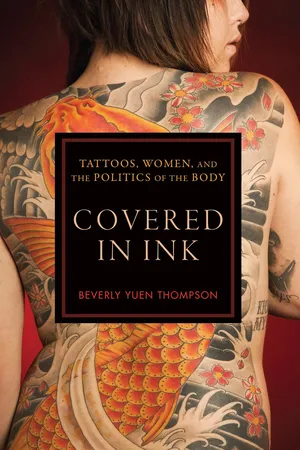
A small dolphin on the ankle, a black line on the lower back, a flower on the hip, or a child’s name on the shoulder blade—among the women who make up the twenty percent of all adults in the USA who have tattoos, these are by far the most popular choices. Tattoos like these are cute, small, and can be easily hidden, and they fit right in with society’s preconceived notions about what is ‘gender appropriate’ for women. But what about women who are heavily tattooed? Or women who visibly wear imagery, like skulls, that can be perceived as masculine or ugly when inked on their skin?
Drawing on autoethnography, and extensive interviews with heavily tattooed women, Covered in Ink provides insight into the increasingly visible subculture of women with tattoos. Author Beverly Thompson visits tattoos parlors, talking to female tattoo artists and the women they ink, and she attends tattoo conventions and Miss Tattoo pageants where heavily tattooed women congregate to share their mutual love for the art form. Along the way, she brings to life women’s love of ink, their very personal choices of tattoo art, and the meaning tattooing has come to carry in their lives, as well as their struggles with gender norms, employment discrimination, and family rejection. Thompson finds that, despite the stigma and social opposition heavily tattooed women face, many feel empowered by their tattoos and strongly believe they are creating a space for self-expression that also presents a positive body image. A riveting and unique study, Covered in Ink provides important insight into the often unseen world of women and tattooing.
- 224 pages
- English
- ePUB (mobile friendly)
- Available on iOS & Android
eBook - ePub
About this book
Information
1
Sailors, Criminals, and Prostitutes
The History of a Lingering Tattoo Stigma
When European mariners began exploring the seas and encountering people from distant lands in the 1700s and 1800s, they were exposed to various tattooing practices. They recorded their interactions with the indigenous people in notebooks, along with drawings of their unfamiliar surroundings, the people, and depictions of the tattoos. The Europeans learned that these tattoos were cultural practices that marked significant stages of life development. Some of these voyagers became interested in these practices and began becoming tattooed themselves.1 For sailors, these were mementos of places where they had been. When these voyagers returned home to Europe and exposed their tattoos, however, their peers considered this behavior inappropriate. In short, it was taken as a visible rejection of their own cultural values.2
Some of the places where these voyagers and missionaries encountered indigenous tattooing included Micro Polynesia, Fiji, and the Samoan Islands. In Micro Polynesia, tattooing was a central art form and was considered “decorative, protective (as a kind of wrapping or armor), erotic and social.”3 In Micro Polynesia, as well as Fiji, women were the tattooing experts, and tattoos on women were considered beautifully ornate. In Samoa, male tattooing was considered the counterpart to female childbirth, “as expressed in the saying: ‘The man grows up and is tattooed / The woman grows up and she gives birth.’”4 The “tatau” in Samoan culture was utilized to express “a very local (albeit transnational/diasporic) set of identities and experiences.”5 These tattoos were hand tapped into the skin with a hoe-like utensil called an ausogi’aso, made from the incisor teeth of a wild boar, which were affixed to a piece of turtle shell. The tattoo for men, called a pe’a, consisted of a black ink design that covered the skin above the waist, over the thighs, and ending around the knees, so densely colored it appeared that the man was wearing shorts. Getting the tattoo was a ritualized process taking weeks to complete, if not longer. Some men took years to complete their tattoo, as they also had to exchange valuables, such as woven blankets, which could also take time to earn, in this barter exchange of items for tattooing. However, it was considered undignified to have an incomplete pe’a, so they were strongly motivated to complete this significant cultural marker. Women also received tattoos, called a malu, over their thighs, though of a lighter design than that of the men, as their child-birthing practices balanced out their proof of pain tolerance.
When the religious missionaries later followed in the footsteps of the first Western voyagers, they were scornful of these indigenous practices as they clashed with their own religious perspectives. As outsiders, unfamiliar with these lands or people, the missionaries attempted to control the population and obliterate their behaviors—with violence.6 They imposed their religion and biblical interpretations upon the populations they encountered, encouraging the indigenous people to adopt Christianity, with the threat of death if they resisted. Using Leviticus 19:26–28 from the Old Testament of the Bible as justification, the missionaries condemned tattooing: “Ye shall not eat any thing with the blood: neither shall ye use enchantment, nor observe times. . . . You shall not make any cuttings in your flesh for the dead, nor print any marks on you.”7 In 1814, Samuel Marsden of the Church Missionary Society was one of the first to actively condemn the practice of ta moko, the Maori practice of tattooing.8 As the colonies were further established, the practices of tattooing became targets for suppression. The White missionaries were violently aggressive in stamping out indigenous practices and forcing their own religious practices of Christianity upon the native people. By the 1830s, Tahitian tattooing had been largely abandoned.9 Samoan tattooing persisted for a while, in spite of the foreign-imposed prohibitions, but it eventually faded as well, though never completely.10 By the time Darwin circumnavigated the globe on the Beagle in 1836, tattooing customs had nearly disappeared.11 In Alaska, the wearing of labrets (ornaments piercing the lip and below the bottom lip) and nose ornaments, as well as tattooing, disappeared from Eskimo life after encounters with missionaries.12 It was not until the 1980s that native tattooing practices began to reemerge. Both locals as well as foreigners with some connection to Samoan culture have taken on the traditional pe’a and malu tattoos.13 In Tahiti, a network of tattooists developed to fill the demands for traditional ink from locals as well as tourists.14 Thus the ethnic reclaiming of lost cultural practices emerged alongside the 1990s White “modern primitive” movement.
Sideshow of Human Oddities and Electric Tattooing
In 1876, for the first time, indigenous people were put on display for an American audience at the Centennial Exhibition in Philadelphia.15 Entire villages were constructed that supposedly represented how the indigenous actually lived—all created for the entertainment of White audiences. Such expositions of indigenous villages became increasingly common, eventually leading to world fairs, carnivals, and sideshows. These practices became immensely popular forms of entertainment for many decades. Such expositions were the predecessors to circuses and sideshows, which emerged as significant markets for the entertainment business. It was P. T. Barnum, in particular, who developed sideshows featuring human “oddities,” such as disabled people, the morbidly obese, bearded ladies, and tattooed men and women.
Olive Oatman was the first known tattooed woman displayed for entertainment purposes. Most of her family was killed in Arizona in 1851 by an unknown Native American tribe while they were part of a Mormon caravan making its way across the country. The tribe, which could have been the Tolkepayas, of the western Yavapai Tribe, captured Olive and her sister Mary Ann and held them as slaves for years before selling them to the Mohave Indians. It was the Mohave who gave the two women the traditional chin tattoo, a blue ink design with four vertical lines from the mouth to the bottom of the chin, with two horizontal lines on either side. Years later, after her sister Mary Ann died in captivity, Olive was reclaimed at Fort Yuma in California and reintegrated into the White world.16 Her story made headlines across the West, and it wasn’t long before she was offered opportunities to capitalize on her wild misfortune. In 1857 the pastor Royal B. Stratton wrote a book about Olive and Mary Ann called Life among the Indians.17 To promote the book, Olive—a demure-looking woman who wore her straight brown hair tucked away in a bun and the traditional conservative clothing of her Mormon community—went on tour, and the book eventually sold thirty thousand copies, a significant number for the time. From the royalty money, Olive and her brother Lorenzo, who had been left for dead after the attack but survived, were able to obtain a college education at the University of the Pacific. After her book tour, she eventually married a man and faded into obscurity. But the success of her story began the trend of displaying heavily tattooed women in expositions and carnivals. These women invented compelling stories of being captured by Native American tribes and tattooed against their will. However, unlike Olive Oatman, with her traditional Mohave tattoo, these women were not tattooed with traditional native designs. Rather, their tattoos were crudely hand poked images of U.S. patriotic or Christian themes. Their wild tales both explained their tattooed state and negated their agency—as victims they were freed from blame for their unusual appearance—but allowed them to capitalize on their experience for an audience.18
The first human oddities show was in 1901 at the Buffalo World’s Fair, thus “solidifying the association between tattoos and carnivals in North America.”19 Some of the pioneer tattooed ladies at the turn of the century included Nora Hildebrandt, Irene “La Belle” Woodward, Anna Mae Gibbons, Betty Broadbent, Artfullete, Serpentina, Pictura, Lady Viola, and Artoria among others. The tattooed women (and men) had their full bodies covered with the blue ink imagery, crudely drawn tattoo designs often of religious or patriotic themes, with only their hands, necks, and faces free of ink. But their designs and performances could be impressive; for example, “Sideshow frau Annette Nerona, wore an assembly of German statesman, artists and intellectuals including Bismarck, Wagner, and Goethe, and she also performed as a snake charmer and magician.”20 Since electric tattoos had not yet been invented, these tattoos were primitively inked by using a needle applied by hand or by using tools that held several needles together at once to be applied by hand force. These inks, offered in limited, primary colors, would often fade to blue, green, or black. In addition to their tattooed body display and tales of abduction, the performers would sell booklets that recounted their stories, complete with photographs, for supplemental income.21 By the 1920s, over three hundred tattooed people were employed in circus sideshows, thus instigating a glut in the business.22 Tattooed ladies stole the show from the men, as they came to wear revealing costumes and created a sense of exoticism and eroticism as part of their performance.23 For women in the audience, the tattooed ladies could represent their fantasy of “freedom—the freedom to choose what to do with their bodies, the freedom to live an unusual life not limited to the narrow selection of choices that were presented to them.”24
As the three hundred tattooed men and women toured with expositions and circuses, tattoo shops were only beginning to be established in the United States. Some of the tattooists worked with the circuses and would tattoo patrons, as well as performers, while in town. Tattoo shops began to open in port cities to offer services to sailors in town for R&R. Martin Hildebrandt, a German immigrant who tattooed servicemen, established the first tattoo shop in the United States in New York City in 1846.25 Hildebrandt was later joined by Charles Wagner, considered the most talented and prolific American tattoo artist of those early years.26
In 1875, Samuel O’Reilly opened his tattoo shop on the Bowery. Soon after, in 1891, O’Reilly patented the first electric tattoo machine. Before this invention, tattooists would hand poke crudely drawn and uneven designs into the skin. While these early performers’ tattoos resembled children’s drawings, the advent of the electric tattoo machine made tattoos look better. The operator had more control of the flow and pacing of the ink injection and could create a finer line and shading than with the traditional hand poke method. This machine was based on the perforating pen, invented by Thomas Edison, a motorized pen designed as an offshoot of the telegraph machine. It dictated a new style, based on using multiple needles to form lines, creating thick lines, with solid shading, and a splash of color, including red, black, blue, and green. Soon, tattooist “Lew-the-Jew” Alberts—a former sailor who had tattooed his shipmates—brought about another important invention that would change the face of American tattooing. Appalled by the crude designs that were being hand poked into his fellow enlistees, he utilized his background in wallpaper design to develop what are now called “flash sheets.” These wallpaper-like sheets were covered with simple designs and placed on the walls of tattoo parlors. The client could pick designs off the wall, which were often military patriotic images such as flags and eagles, and the tattooist could create an acetate stencil replicating the outline image onto the skin. From there, he could trace the outline and create a more uniform image onto the skin, and create a production line of these simple designs, covering sailors in them all day long. Tattooists soon developed their own flash sheets and sold them, but they were easy enough to plagiarize. Some tattooists hid errors in the designs, so that careless copiers would reveal their plagiarism at the expense of their customers’ permanent designs. With sailors lined up and flowing out the door during their short breaks, tattooists’ skill was in their ability to keep up the fast pace of putting uniform designs on the recruits. Some tattooists would offer only one or two designs a day, so much the better for quick turnaround. As tattooed sideshow performers faded in popularity, sailors, as well as criminals and “undesirables,” increasingly came to occupy the tattoo shop. By 1900, tattoo shops were spreading from their costal, sailor-serving beginnings into most major American cities.
Criminality and Tattoos
Both military personnel and inmates live in total institutions, in which their personal identities are erased by the imposition of a uniform appearance. Both enlistees and inmates attempt to individualize themselves and identify their group membership by acquiring tattoos. While military regulations against tattoos fluctuate as the need for new recruits ebb and flow, acquiring new tattoos in jail or prison is strictly prohibited. Thus tattooing is underground and conducted in unsanitary conditions, without proper equipment and, often, improper artistic ability (although the world of prison tattooing can also produce impressive artistic renderings, considering the limitations). Other inmate tattoos are collected on the outside. For military enlistees, their tattoo designs often reflect their particular branch of the military, especially for male members (women enlistees often collect more personal and less militaristic imagery). For inmates, their tattoos often reflect their gang or group affiliation, their identity as a prisoner, or other personal imagery.27 For both enlistees and inmates, tattoos can also provide a tougher appearance, which is useful in such hyper-masculine spaces.28
One of the most historically well known criminologists is the Italian Cesare Lombroso, born in 1835. He was also a physician and an early contributor to the philosophies of eugenics, psychiatry, and Social Darwinism. One of his primary claims was that criminal...
Table of contents
- Cover
- Title Page
- Copyright Page
- Contents
- Acknowledgments
- Introduction: Becoming Covered
- 1. Sailors, Criminals, and Prostitutes: The History of a Lingering Tattoo Stigma
- 2. “I Want to Be Covered”: Heavily Tattooed Women Challenge the Dominant Beauty Culture
- 3. “I ♥ Mom”: Family Responses toward Tattooed Women
- 4. “Covering” Work: Dress Code Policies, Tattoos, and the Law
- 5. “Is the Tattoo Guy Here?”: Women Tattoo Artists’ Experience Working in a Male-Dominated Profession
- 6. Tattoos Are Not for Touching: Public Space, Stigma, and Social Sanctions
- Conclusion: Toward a Tattoo Etiquette
- Notes
- Index
- About the Author
Trusted by 375,005 students
Access to over 1.5 million titles for a fair monthly price.
Study more efficiently using our study tools.
Frequently asked questions
Yes, you can cancel anytime from the Subscription tab in your account settings on the Perlego website. Your subscription will stay active until the end of your current billing period. Learn how to cancel your subscription
No, books cannot be downloaded as external files, such as PDFs, for use outside of Perlego. However, you can download books within the Perlego app for offline reading on mobile or tablet. Learn how to download books offline
Perlego offers two plans: Essential and Complete
- Essential is ideal for learners and professionals who enjoy exploring a wide range of subjects. Access the Essential Library with 800,000+ trusted titles and best-sellers across business, personal growth, and the humanities. Includes unlimited reading time and Standard Read Aloud voice.
- Complete: Perfect for advanced learners and researchers needing full, unrestricted access. Unlock 1.5M+ books across hundreds of subjects, including academic and specialized titles. The Complete Plan also includes advanced features like Premium Read Aloud and Research Assistant.
We are an online textbook subscription service, where you can get access to an entire online library for less than the price of a single book per month. With over 1.5 million books across 990+ topics, we’ve got you covered! Learn about our mission
Look out for the read-aloud symbol on your next book to see if you can listen to it. The read-aloud tool reads text aloud for you, highlighting the text as it is being read. You can pause it, speed it up and slow it down. Learn more about Read Aloud
Yes! You can use the Perlego app on both iOS and Android devices to read anytime, anywhere — even offline. Perfect for commutes or when you’re on the go.
Please note we cannot support devices running on iOS 13 and Android 7 or earlier. Learn more about using the app
Please note we cannot support devices running on iOS 13 and Android 7 or earlier. Learn more about using the app
Yes, you can access Covered in Ink by Beverly Yuen Thompson in PDF and/or ePUB format, as well as other popular books in Social Sciences & Criminology. We have over 1.5 million books available in our catalogue for you to explore.