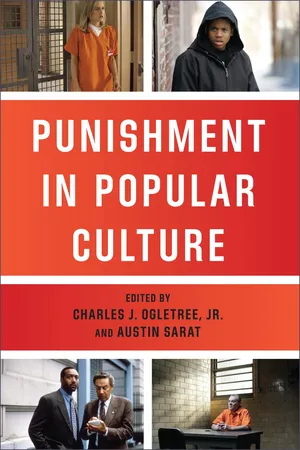
The way a society punishes demonstrates its commitment to standards of judgment and justice, its distinctive views of blame and responsibility, and its particular way of responding to evil. Punishment in Popular Culture examines the cultural presuppositions that undergird America's distinctive approach to punishment and analyzes punishment as a set of images, a spectacle of condemnation. It recognizes that the semiotics of punishment is all around us, not just in the architecture of the prison, or the speech made by a judge as she sends someone to the penal colony, but in both "high" and "popular" culture iconography, in novels, television, and film. This book brings together distinguished scholars of punishment and experts in media studies in an unusual juxtaposition of disciplines and perspectives.
Americans continue to lock up more people for longer periods of time than most other nations, to use the death penalty, and to racialize punishment in remarkable ways. How are these facts of American penal life reflected in the portraits of punishment that Americans regularly encounter on television and in film? What are the conventions of genre which help to familiarize those portraits and connect them to broader political and cultural themes? Do television and film help to undermine punishment's moral claims? And how are developments in the boarder political economy reflected in the ways punishment appears in mass culture? Finally, how are images of punishment received by their audiences? It is to these questions that Punishment in Popular Culture is addressed.
eBook - ePub
Punishment in Popular Culture
- 320 pages
- English
- ePUB (mobile friendly)
- Available on iOS & Android
eBook - ePub
Punishment in Popular Culture
About this book
Information
PART I
The Popularity of Punishment
1
Redeeming the Lost War
Backlash Films and the Rise of the Punitive State
LARY MAY
There’s nothing wrong with killing people so long as they’re the right people.
—Clint Eastwood as “Dirty Harry” in Magnum Force (1974)
We do in my movies what everyone wants done against evil.
—Chuck Norris (1986)
The end of the twentieth century marked an unprecedented development. After an era of liberal dominance followed by the rise of conservatism, more people were incarcerated in the United States than in any other country, and capital punishment—which appeared to be ending in the Western world—returned as state policy.1 By focusing on the popular arts, this chapter will offer a fresh perspective on why this policy shift occurred. As the sociologist David Garland pointed out, the public formed opinions not on the basis of crime statistics, but rather on how the media represented crime, “and the collective representations those media made over time.”2 In this chapter I concentrate on a body of crime films that emerged in the early 1970s and lasted, in one form or another, until the early 1990s. In many ways these films gave vivid expression to the political backlash unfolding at the time against the social movements and cultural upheavals of the 1960s. They reflected a new political culture with an ideology, symbols, and language that assaulted the liberal state and its laws and policies. Although this new political culture cut across party lines, most of the writers, featured players, and directors of these backlash films were promoters of the Republican Party and its right wing. Their films included Clint Eastwood’s five Dirty Harry productions, Charles Bronson’s five Death Wish movies, and Chuck Norris’s Good Guys Wear Black, Missing in Action, and Code of Silence. Each expressed a narrative at once hostile to liberalism and tough on crime, while promising the rebirth of security and traditional cultural authority.
Each of these films depicts the liberal state, with its ethos of social welfare and its humane protection of criminals’ “rights,” as responsible for the breakdown of law and order. They feature a protagonist who is usually a dissatisfied professional, such as a member of the police or military force, who has a drive to create justice by purging institutions of their soft liberal rules. The hero, as portrayed in the trend-setting Dirty Harry movies, embodies a revived masculine power symbolized by his powerful Magnum 44 pistol with which he violently kills an enemy or criminals. Though constrained by the authorities and laws such as the “Miranda” decision, the fact that the protagonist rebels in order to capture or kill criminals makes him a public hero who in the end receives state sanction. Unlike earlier crime or detective films, such as Angels with Dirty Faces (1938), Dead End (1937), Public Enemy (1931), Double Indemnity (1944), Crisscross (1949), or The Killers (1946), in which the central characters emerge as sympathetic if deeply flawed outlaws, backlash films express a different mood, reflected in public opinion polls, that the people no longer have faith in authority. Driven by the desire to restore “law and order,” the hero will purge liberals and jail or kill lawbreakers. When seen in relation to the rise of right-wing populism and the popularity of President Ronald Reagan, the backlash productions promote the purge of those who are taken to have caused the loss in Vietnam: liberal institutions and the criminals who personify in one form or another those who undermined support at home, including war protestors, hippies, and “deviants” identified with the upheaval of the 1960s.
Taken as a whole, these backlash films provide a rich source for answering questions that have eluded scholars. What caused the “law and order” politics that led to increased incarceration rates? How did this shift in belief interact with the larger conservative political turn and the rise of the penal state? The film narratives reveal that the rise of a punitive state is not solely due to white racism, though no doubt racism and African American civil disturbances did play a role. Instead, the backlash films seen by millions of viewers reveal that the punitive turn gained unprecedented power because of a reaction to what the historian Wolfgang Schivelbusch terms a “culture of defeat.”3 As he shows in stark, convincing detail, modern nations defeated in war undergo three related reactions over time: fear, followed by purges of those assumed to be responsible for defeat, followed by the emergence of redemptive politics that promise a fresh culture of victory.
The post-1960s crime films dramatized the contours of an Americanized culture of defeat in two phases. In the first phase, heroes identified crime with liberals, hippies, homosexuals, and racial minorities who personified the disorder that led to disaster in Vietnam. These heroes perceived that the “criminals” undermined unity and they, like the Japanese incarcerated in World War II or alleged Communist agents in the McCarthy era, had to be purged. As a close aide to President Nixon explained at the time, to permit the “life-style and ideas of the ’60s movement to achieve power and become the official way of life of the United States was a thought as offensive . . . as was the thought of surrender to a career Japanese soldier in 1945.”4 If the first backlash films feature criminals who assume the animalistic quality of the enemy in World War II war films, the later Rambo trilogy dramatized a new ideology of victory, rooted in visions of neoliberalism.
When seen in relation to the rise of the punitive state, backlash films provide a lens for revising our understanding of postwar history. Over the last two decades historians have shown that along with policies to contain the Soviets, policies to contain labor unions, radicals, homosexuals, racial minorities, and women emerged at home.5 Yet the tendency of scholars to divide their subjects into discrete themes and decades means that when containment shattered in the 1960s, historians drop the theme of war as a concept to explain the rise of the punitive state and of conservative policies to restore order, to deregulate the economy, and to reinstate the death penalty. In contrast, this chapter will demonstrate how backlash films operated in tandem with conservative politics to reanimate the containment ethos of the 1950s now rebranded to forge order and victory in the 1970s and beyond.
Typically historians use the arts as illustrations of ideas derived from traditional sources, ranging from political rhetoric to rituals and demographic trends. In this understanding popular art “reflects” evidence gathered from other materials. In contrast, I explore the backlash narratives and their visual tropes as original sources to reveal what scholars have not answered: how and why did right-wing and neoliberal ideas spread from the margins to the center of public life? Why was this development accompanied by a quest to punish criminals and reestablish the death penalty? The making of these films reveal that with the defeat in Vietnam, urban riots, and antiwar movements, the country experienced a deep crisis of legitimacy that was restored with a new ethos of law and order, of containment regenerated.
Containment in Foreign Affairs and Domestic Affairs
The crisis that the populace experienced in the wake of the Vietnam War and the upheavals of the 1960s and 1970s fractured the Cold War containment ethos constructed in the decades after World War II. Commenting on that crisis, a Nixon aide reflected in 1980 that “the experience of the last ten years leave no doubt . . . that the United States was at war externally as well as internally.”6 At the center of that dual trauma lay the relationship between foreign and domestic life forged in World War II and undergirded by a fear-of-defeat and aim-for-victory narrative that continued into the Cold War years. During the 1930s, filmmaking converged with New Deal politics rooted in citizens’ activity and mass movements hostile to monopoly capitalism and inequality.7 After the Japanese attack on Pearl Harbor, American leaders saw that the nation had to purge isolationism as well as grassroots disruptions to attain unity to win the war. That purge led to the internment of Japanese Americans and the silencing of isolationist advocates, as well as calls to end labor strikes and anti-capitalist rhetoric. In the wake of victory in 1945, leaders saw that the task for the future revolved around building global institutions to avoid another war and economic depression. As President Truman’s close advisor Clark Clifford explained, “When the Second World War was over, we were the great power in the world. . . . We had the greatest fleet in the world. We had come through the war economically sound. In addition to feeling a sense of superiority we also had a sense of a world power that could possibly control the future of the world.”8 Rebuilding Japan and Germany converged with forging new global financial and economic institutions to fulfill the promise of a popular wartime song, featured in the 1943 film musical This Is the Army, to make the world “free” so that unlike after the First World War we “won’t have to do it again.”9 Great expectations rode high.
Yet the great expectations that Americans could “control the future” unraveled, sparking the rise of anti-Communism in foreign and domestic affairs. It began when the nation’s wartime ally, the Soviet Union, refused to relinquish the military occupation of Eastern Europe. In response, American leaders instituted foreign policies to contain the Soviets abroad and subversives at home deemed responsible for the disaster. Where the fear of Bolshevism had been limited to a brief period after World War I, spurring the Palmer raids to deport radicals and immigrant dissidents, the post-1945 scare assumed far more emotional power and longevity. Instead of focusing on immigrant working-class radicals alone, the postwar Red Scare permeated every major institution, creating policies that would dominate national life for the rest of the century.
It began after the Soviets attained the atomic bomb, sparking in peacetime a revival of the wartime fear of defeat narrative. It grew when a young congressman from California, Richard Nixon, gained fame by charging that Alger Hiss, an aide to President Franklin Roosevelt at the Yalta conference with Joseph Stalin, was a secret Communist agent who helped “sell out” Eastern Europe. Though Hiss denied the charge, he went to jail for perjury. Fear of defeat rhetoric accelerated when China fell to Communists and the country entered the Korean War. Seeking to purge those responsible for these foreign policy disasters, federal agents arrested Julius and Ethel Rosenberg as spies. After a trial that ended with the Rosenbergs receiving the death penalty, the presiding trial judge framed his sentence in terms of fear of defeat, noting,
It is so difficult to make people realize that the country is engaged in a life and death struggle with a different system. . . . Never at any time in our history were we ever confronted to the same degree that we are today with such a challenge to our existence. . . . I believe your conduct in putting into the hands of the Russians the atomic bomb before our best scientists predicted the Russians would perfect the bomb has already caused, in my opinion, the Communist aggression in Korea with our causalities exceeding 50,000. Who knows how many more people may pay the price of your treason. Indeed, by your betrayal you have altered the course of history to the disadvantage of our country.
With history running off track, the politician who gave the era its name, Senator Josep...
Table of contents
- Cover
- Title Page
- Copyright Page
- Dedication
- Contents
- Acknowledgments
- Imaging Punishment: An Introduction
- Part I. The Popularity of Punishment
- Part II. Popular Culture’s Critique of Punishment
- Part III. The Reception and Impact of Punishment in Popular Culture
- About the Contributors
- Index
Trusted by 375,005 students
Access to over 1.5 million titles for a fair monthly price.
Study more efficiently using our study tools.
Frequently asked questions
Yes, you can cancel anytime from the Subscription tab in your account settings on the Perlego website. Your subscription will stay active until the end of your current billing period. Learn how to cancel your subscription
No, books cannot be downloaded as external files, such as PDFs, for use outside of Perlego. However, you can download books within the Perlego app for offline reading on mobile or tablet. Learn how to download books offline
Perlego offers two plans: Essential and Complete
- Essential is ideal for learners and professionals who enjoy exploring a wide range of subjects. Access the Essential Library with 800,000+ trusted titles and best-sellers across business, personal growth, and the humanities. Includes unlimited reading time and Standard Read Aloud voice.
- Complete: Perfect for advanced learners and researchers needing full, unrestricted access. Unlock 1.5M+ books across hundreds of subjects, including academic and specialized titles. The Complete Plan also includes advanced features like Premium Read Aloud and Research Assistant.
We are an online textbook subscription service, where you can get access to an entire online library for less than the price of a single book per month. With over 1.5 million books across 990+ topics, we’ve got you covered! Learn about our mission
Look out for the read-aloud symbol on your next book to see if you can listen to it. The read-aloud tool reads text aloud for you, highlighting the text as it is being read. You can pause it, speed it up and slow it down. Learn more about Read Aloud
Yes! You can use the Perlego app on both iOS and Android devices to read anytime, anywhere — even offline. Perfect for commutes or when you’re on the go.
Please note we cannot support devices running on iOS 13 and Android 7 or earlier. Learn more about using the app
Please note we cannot support devices running on iOS 13 and Android 7 or earlier. Learn more about using the app
Yes, you can access Punishment in Popular Culture by Austin Sarat, Charles J. Ogletree, Jr.,Austin Sarat, Charles J. Ogletree, Jr. in PDF and/or ePUB format, as well as other popular books in Law & Criminal Law. We have over 1.5 million books available in our catalogue for you to explore.