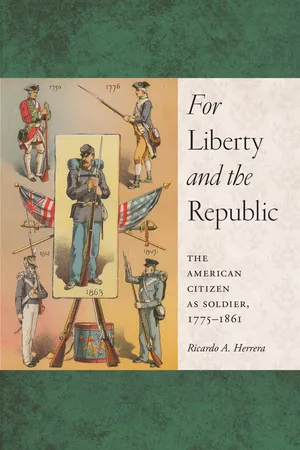
In the early decades of the American Republic, American soldiers demonstrated and defined their beliefs about the nature of American republicanism and how they, as citizens and soldiers, were participants in the republican experiment through their service. In For Liberty and the Republic, Ricardo A. Herrera examines the relationship between soldier and citizen from the War of Independence through the first year of the Civil War.
The work analyzes an idealized republican ideology as a component of soldiering in both peace and war. Herrera argues that American soldiers’ belief system—the military ethos of republicanism—drew from the larger body of American political thought. This ethos illustrated and informed soldiers’ faith in an inseparable connection between bearing arms on behalf of the republic, and earning and holding citizenship in it. Despite the undeniable existence of customs, organizations, and behaviors that were uniquely military, the officers and enlisted men of the regular army, states’ militias, and wartime volunteers were the products of their society, and they imparted what they understood as important elements of American thought into their service.
Drawing from military and personal correspondence, journals, orderly books, militia constitutions, and other documents in over forty archives in twenty-three states, Herrera maps five broad, interrelated, and mutually reinforcing threads of thought constituting soldiers’ beliefs: Virtue; Legitimacy; Self-governance; Glory, Honor, and Fame; and the National Mission. Spanning periods of war and peace, these five themes constituted a coherent and long-lived body of ideas that informed American soldiers’ sense of identity for generations.
eBook - ePub
For Liberty and the Republic
The American Citizen as Soldier, 1775-1861
- 272 pages
- English
- ePUB (mobile friendly)
- Available on iOS & Android
eBook - ePub
For Liberty and the Republic
The American Citizen as Soldier, 1775-1861
About this book
Information
1
Service, Sacrifice, and Duty
The Call of Virtue
Virtue’s impress upon the ideal of the American citizen as soldier was a vital element in the military ethos of republicanism. The belief in the citizen’s duty to bear arms on behalf of the common weal reinforced the citizen-soldier’s conviction that he was a full member and participant in and of the “government and country” he served. His was a “unique character,” imbued with an idealized vision of the nation, its promise, and of course its soldiery. Writing after the Civil War, John A. Logan, an Illinois major general of volunteers, contended that in battle, the volunteer soldier’s “arm is raised for a principle, for right, for justice, for a government in which he has a personal interest and of which he is an integral part.” Indeed, the soldier’s character was of such importance that as early as 1775 commanders enjoined their recruiting officers to “be Very Carefull not to inlist any person Suspected of being unfriendly to the Liberties of America or any Vagabond to whom all cause are equally alike.” If recruiters exercised discretion and enlisted only virtuous men to fight for the “Rights of Mankind and the Freedom of america,” the republic would prosper without having had to “Resort to such Wretches” as those who served George III. Truly, it was better to “let those who wish to put Shackles on Freemen fill their Ranks and place there Confidence on Such Miscreants.”1
Before the first shots had been exchanged between the king’s troops and Massachusetts militiamen at Lexington and Concord in 1775, Americans believed, according to historian Robert Shalhope, “that what made republics great (or what ultimately destroyed them) was not force of arms but the character and spirit of the people.” The people’s character, their virtue on display in the public sphere, manifested itself through their restraint, public spiritedness, unadorned manners, and lack of affectations. Citizens’ willing practice of these traits, their conduct in private carried over into the public arena, was the animating spirit of the republic. Virtue’s ascetic and communitarian essence was thus vital in ensuring the health of the republic and in securing the common weal, which was the purpose of government. As for the citizen-soldier, following a “life of service” and sacrifice to the republic, the “patriot and Citizen,” according to Charleston, South Carolina’s Washington Light Infantry, could reflect upon his “fortune” with great satisfaction as he enjoyed the “trophies won from the enemies of his country.”2
Americans incorporated virtue into their vision of themselves and accorded it a special place in the mythology that developed around military service. If myths are the tools by which a people order, perceive, and make sense of reality, they are also the cultural lenses through which a people view the world, and there is no myth “more precious to a republic . . . than the notion of the people in arms springing to the defense of their homeland.” In the United States, republican mythology took on an especially powerful significance. Americans had to create a new nationality without any traditional references to monarchy or religion. A people whose national identity had sprung from revolution thus purposefully rejected the colonial past and looked to the future for self-affirmation, for the myth that would confirm the United States’ place and mission in the world. What better symbol then, of the republic in arms than the American citizen as soldier. No longer a subject, but a citizen, a participant in the country’s political life, the citizen-soldier “transcend[ed] mere military functionalism” and was instead a “fundamental judgment about the foundation of the state.” Because of the citizen-soldier’s special place in American culture, military service took on almost sacred overtones and reinforced a belief in the special nature of American citizenship.3
American soldiers placed great stock in their public demonstration of virtue as proof of their purity of heart and of their sincerity as republicans. In a 1777 letter to Samuel Adams, Colonel Joseph Ward deplored American soldiers’ “profaneness” and ruled it to be a “growing evil in our Army” that might ultimately prove “hurtful to the Commonwealth.” Britain’s eighteenth-century regulars were notorious for their profanity and colorful oaths. Ward feared “if there is not more effectual care taken to prevent it we shall equal the Infidels we oppose in profanity. And in my humble opinion,” he noted, “we are in more danger from our vices than from the Arms of Britain.” The men, “it is a melancholy truth,” followed the “impious example” set by “many Officers of rank.” It was through the officers’ examples of “profane language, by which vice is countenanced and virtue discouraged” in the army. Ward believed that “if no one in the future was to be honoured with promotion, of an impious character, men would take care to acquire such a character as would be most honorable and profitable; and perhaps good characters might become as plenty as bad ones now are.” Rhode Island chaplain Enos Hitchcock echoed Ward when decrying the “vice and sensuality” of the troops, who were “lost not only to a sense of virtue, but of common modesty and decency, giving themselves up to the foulest blasphemies.” Hitchcock appealed to his congregation militant “to add the more distinguished character of a virtuous, good, man” to their military character, for only “then” would they be able to “quit this stage in the full blaze of honor and receive a crown of glory.”4
Much as the broader American society had incorporated the concept of virtue into its vision of itself well before the outbreak of war, so too had the soldiers of the republic. Military service was the provenance of the virtuous militiaman in the republican tradition. Arms, property, the franchise, social order, and political independence could not be separated without endangering the life of the republic. Armed citizens who fought for and served the interests of society would not, in all likelihood, subvert the social and political system of which they were a part. Recognizing that republics were fragile and could survive only if the people exercised constant vigilance and personal responsibility, American society broadly subscribed to the belief that the cheerful and willing shouldering of arms constituted part of a citizen’s responsibility to society and to himself.
The unwillingness of citizens to share in the burdens of self-defense and in the preservation of order was an indication of moral rot and social decay. Quite naturally, therefore, American soldiers placed great stock in the public and private demonstrations of virtue as proofs of their purity of heart and of their sincerity as republicans. Soldiering was so central to early Americans’ vision of themselves that historian Maarten Ultee has suggested that some members of the founding generation viewed war as a “moral test” of virtue, for the country’s independence depended upon whether citizens willingly would “arm themselves and rally to the cause.” If this was the case, the “recourse to arms” was the surest guarantor of public virtue. At the heart of this consideration was the virtuous militiaman or volunteer who served for no more than the simple thanks of his countrymen.5
Gratitude, no matter how sincere or heartfelt, was not a sufficiency. It did not pay a man, nor did it enable the United States to field an army for extended operations or even policing the coasts or frontier in times of peace. The hard reality of nationhood seemingly conspired against the idealized, virtuous republican militiaman and volunteer when the Second Continental Congress adopted New England militiamen as the Continental army and then proceeded to raise and maintain it as a regular force. The Continental army, and later United States Army, was a cause for concern for Americans. Much of the citizenry’s aversion to regulars and to the institution of a standing army was premised on the conviction that regulars were antithetical to republican virtue and liberty. According to this philosophy a regular army was a potential machine for oppression. Professional soldiers “were riotous, expensive, and morally corrupt” beings serving for pay alone. Merely by existing, a regular army gave witness to “a corrupted populace and unbalanced constitution” and of a people too self-interested to defend themselves or their liberty.6
“A Late Captain of Infantry” understood this connection between citizenship and soldiering, and he recognized that “our good republican people” took a narrow understanding of the connection and its implications. When Americans “look[ed] down on the regular as a pariah,” he argued, they failed to recognize that the regular’s service was as important to the republic as that of the militiaman or volunteer. The professional soldier was not a loafer or a threat to liberty; he was, instead, the “faithful, humble servant of the country, of at least standard honesty as the world goes; who from love of excitement, the default of sharp wits, or inclination to lead a life of selfish aggrandisement, gives his stalwart frame, the prime of his life, and often the blood of his brave heart, in return for a contract with the government, wherein he obtains the privilege of passing a life of toil, exile, [and] privation.” If that were not enough, the professional soldier risked “premature decay, at eleven dollars a month,” hardly a comfortable sinecure. As citizens and soldiers, the captain argued, regulars’ service was one of virtuous self-sacrifice for the greater good of the nation.7
Detractors of the regular army failed to see that soldiers who made a life in the army were a minority, and that those who did so understood the meaning of their service within the boundaries of the broader ethos. Fewer than half of the regular officers from 1784 through 1861, including graduates of the military academy, made the army a career. This is even lower if one takes into account the Continental army, a wartime force whose existence lasted just eight years and eight months. Most soldiers served only one or two enlistments before returning to their former occupations or starting new ones as they established their economic and political independence. Ideology and culture aside, the United States could afford its near-amateurish military establishment because there was no viable threat to the country’s existence. As a result, enlisted military service was merely another job to be held before moving on to a different and more lucrative life’s work. The rhetoric of republicanism fit well with short-term sacrifice.8
Providing for the “defense and security” of the community entailed the potential risk of one’s life and endowed soldiers with tremendous physical and moral responsibility and authority. The precepts of faithful service attracted and required “altruistic men” who placed the interests of society ahead of all other considerations. They were men “concerned with serving in the best possible manner.” Speaking in Mexico in 1847 on the occasion of George Washington’s birthday, Lieutenant Colonel Henry S. Lane of the First Indiana Volunteer Infantry Regiment deemed that the “citizen who withholds his aid, and stops coldly to calculate the causes and chances” of his survival in “war, whatever his professions may be,” surely had to be, “in his heart, a traitor.” Presaging Lane’s thoughts by a decade, Lieutenant Benjamin Alvord noted in 1837, that “Genuine military virtue” could not be separated “from all other kinds of moral duty.” In order “to dignify and enhance the conduct of the warrior,” Alvord thought all forms of military service “should be based upon the eternal foundations of justice and truth.” Alvord’s suggestion recognized the special ethical connection between service and republicanism.9
American soldiers saw a “moral significance” in the contest of arms, noted Charles Royster. Combat was the opportunity for a people to display its “character” through the voluntary shouldering of arms and willingness to sacrifice lives while expressing “national vigilance in defense of liberty.” Warfare thus idealized was an “intrinsic American virtue” that announced the special nature of the republican soldier’s service. Even in 1861, the sacred nature of military virtue led Captain John Scott of the Second Virginia Cavalry to declare that the “Sabbath had now been consecrated to Liberty as well as Religion” by the sacrifices of Confederate soldiers along the banks of Bull Run in Virginia. Thomas Jewett Goree, an aide-de-camp to Confederate general James Longstreet, understood his service as “I would in a religious duty, and I am not only willing, but hope that I am prepared if necessary to be sacrificed upon the altar of my country.”10
Nineteenth-century volunteer companies set great store by the proper and virtuous conduct of their members, who willingly agreed to follow prescribed codes of conduct. Company bylaws incorporated the “virtues of citizen soldiers” acting “in a bourgeois role” as the protectors of order, society, and property. Common prohibitions against swearing and the use of alcohol reflected a reformist impulse among the members. A group of young South Carolinians “agreed to form a corps in which we could perform the duties required by our country without being exposed to the temptations arising from the use of intoxicating drinks at convivial meetings, and having our ears pained by profanity, and which alas has proved the ruin of too many” men. These men of the Moultrie Guard selected a commander who was “willing to break ground in the work of reform.” One member, Thomas R. Vardell characterized temperance in drink and speech as “great principles” and the company as a “body of men endeavouring to promote these great ends” by their public example. Vardell and his compeers were not alone.11
Elmer E. Ellsworth’s United States Zouave Cadets was one of the most popular, imitated, and restrictive volunteer companies in the late 1850s. “Principal requirements” for the cadets included “Abstinence from Drinking Saloons, Houses of Ill-Fame, Gambling Halls, and all disreputable places, under penalty of expulsion, publication in the city Papers of the offender’s name, and forfeiture of uniform, etc., to the company.” In a fraternal touch, the men were “required to treat all members of the company as brothers,” and in “return for this you will be looked upon and treated as a brother” who will be “aided, when necessary, in sickness and misfortune, and allowed the use of the Cadets’ Assembly Rooms, continuing Gymnasium, Reading and Chess Room, Piano, etc., etc., as long as your conduct proves you worthy of these advantages.” Like those of other companies, Ellsworth’s rules were intended to shape individual and group behavior and identities. The clublike atmosphere of the volunteer companies conferred “status and identity” on their members and their self-governing organization and rules allowed young men to “feel patriotic, and therefore democratic, and yet elevated into a romantic-genteel realm where one might talk without embarrassment of nobility, honor, chivalry,” and “gallantry.” Demanding and uncompromising, Ellsworth’s Code of Conduct “anticipated” what Marcus Cunliffe called the “penitential national mood” of 1861.12
American soldiers, whether professionals or amateurs, were citizens first and foremost. Holding to the belief that “the character of a soldier is not incompatible with that of a citizen; that they may and should be blended, and the martial training and discipline of the one is a duty as sacred and indispensable as is the exercise of more pacific duties,” an American soldier’s military conduct was a public extension of his private persona and values. Every generation assumed the responsibility of service and sacrifice for the republic. Iowa volunteer Caleb J. Allen understood as much in 1861, when he wrote that “we can no longer live upon the deeds of our Fathers. We too must pay a price for the blessings we enjoy.” Allen rejected the “idea that obtains to such an extent, that we are too enlightened a people to have necessity for resort to arms.” He found that notion “absurd,” for “as long as the moral sense of man permits him to do injustice it is folly to appeal to that sense for reparation.”13
The writings of American soldiers highlight the extent to which duty and sacrifice were two inseparable components of virtue. The typical soldier “understood” his duty as a “binding moral obligation,” one of “reciprocity” to his society in an unwritten contract. By attending to his duty, the soldier served a cause greater than himself. Importantly, he did so in an act of free will. From 1775 to 1783, the “American soldier, unlike British derelicts and Hessian mercenaries, faced the invaders by an act of free choice and beat them.” By acting disinterestedly for the benefit of society, his service became an act of benevolence, of “unselfish love, of active concern for others,” and of “eager work for the welfare of all” in society. If society was an organic whole, then that which was good for society was good for the individual.14
When Lieutenant George Smith Avery helped raise a company of cavalry in 1861, he told his fiancée, “I did not undertake the business with the expectation of securing an office, but for the good of the cause.” Virtuous duty was not the performance of the quotidian military tasks necessary to keep an army functioning. Accomplishing these functions was but a small part of a much larger idea. By doing his duty, the soldier fulfilled expectations that had been implicitly or explicitly agreed upon by both himself and his community. He served a larger body.15
Sacrifice worked hand in glove with duty. It entailed the ...
Table of contents
- Cover
- Title Page
- Copyright Page
- Dedication
- Contents
- Preface
- Acknowledgments
- Introduction: The American Citizen as Soldier and the Military Ethos of Republicanism
- 1. Service, Sacrifice, and Duty: The Call of Virtue
- 2. Preserving, Defending, and Creating the Political Order: Legitimacy
- 3. Free Men in Uniform: Soldierly Self-Governance
- 4. A Providentially Ordained Republic: God’s Will and the National Mission
- 5. Questing for Personal Distinction: Glory, Honor, and Fame
- Epilogue: Disunion, Civil War, and Shared Ideals
- Notes
- Bibliography
- Index
- About the Author
Trusted by 375,005 students
Access to over 1.5 million titles for a fair monthly price.
Study more efficiently using our study tools.
Frequently asked questions
Yes, you can cancel anytime from the Subscription tab in your account settings on the Perlego website. Your subscription will stay active until the end of your current billing period. Learn how to cancel your subscription
No, books cannot be downloaded as external files, such as PDFs, for use outside of Perlego. However, you can download books within the Perlego app for offline reading on mobile or tablet. Learn how to download books offline
Perlego offers two plans: Essential and Complete
- Essential is ideal for learners and professionals who enjoy exploring a wide range of subjects. Access the Essential Library with 800,000+ trusted titles and best-sellers across business, personal growth, and the humanities. Includes unlimited reading time and Standard Read Aloud voice.
- Complete: Perfect for advanced learners and researchers needing full, unrestricted access. Unlock 1.5M+ books across hundreds of subjects, including academic and specialized titles. The Complete Plan also includes advanced features like Premium Read Aloud and Research Assistant.
We are an online textbook subscription service, where you can get access to an entire online library for less than the price of a single book per month. With over 1.5 million books across 990+ topics, we’ve got you covered! Learn about our mission
Look out for the read-aloud symbol on your next book to see if you can listen to it. The read-aloud tool reads text aloud for you, highlighting the text as it is being read. You can pause it, speed it up and slow it down. Learn more about Read Aloud
Yes! You can use the Perlego app on both iOS and Android devices to read anytime, anywhere — even offline. Perfect for commutes or when you’re on the go.
Please note we cannot support devices running on iOS 13 and Android 7 or earlier. Learn more about using the app
Please note we cannot support devices running on iOS 13 and Android 7 or earlier. Learn more about using the app
Yes, you can access For Liberty and the Republic by Ricardo A Herrera,Ricardo A. Herrera in PDF and/or ePUB format, as well as other popular books in History & Military & Maritime History. We have over 1.5 million books available in our catalogue for you to explore.