The Sounds of Latinidad explores the Latino music scene as a lens through which to understand changing ideas about latinidad in the New South. Focusing on Latino immigrant musicians and their fans in Charlotte, North Carolina, the volume shows how limited economic mobility, social marginalization, and restrictive immigration policies have stymied immigrants’ access to the American dream and musicians’ dreams of success. Instead, Latin music has become a way to form community, debate political questions, and claim cultural citizenship.
The volume illuminates the complexity of Latina/o musicians’ lives. They find themselves at the intersection of culture and politics, often pushed to define a vision of what it means to be Latino in a globalizing city in the Nuevo South. At the same time, they often avoid overt political statements and do not participate in immigrants’ rights struggles, instead holding a cautious view of political engagement. Yet despite this politics of ambivalence, Latina/o musicians do assert intellectual agency and engage in a politics that is embedded in their musical community, debating aesthetics, forging collective solidarity with their audiences, and protesting poor working conditions.
Challenging scholarship on popular music that focuses on famous artists or on one particular genre, this volume demonstrates how exploring the everyday lives of ordinary musicians can lead to a deeper understanding of musicians’ role in society. It argues that the often overlooked population of Latina/o musicians should be central to our understanding of what it means to live in a southern U.S. city today.
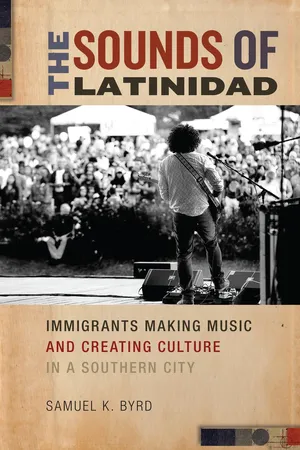
eBook - ePub
The Sounds of Latinidad
Immigrants Making Music and Creating Culture in a Southern City
- 304 pages
- English
- ePUB (mobile friendly)
- Available on iOS & Android
eBook - ePub
The Sounds of Latinidad
Immigrants Making Music and Creating Culture in a Southern City
About this book
Information
1
Charlotte, a Globalizing City
Charlotte, North Carolina, is not a “global city.” It is, however, a globalizing one.
—William Graves and Heather A. Smith (2010)
Es sólo Carlotan Rock, pero me gusta. (It’s only Carlotan Rock, but I like it.)
—Ricardo de Los Cobos (2009a)
This study is about musicians and their communities, but it is also about a city, Charlotte, North Carolina. Why Charlotte? Often during my time in Charlotte, people would ask me that question, wondering why I had come to study music in the “Queen City,” with the subtext of befuddlement that it could be worthy of serious contemplation. Perhaps Charlotte (or its residents) has an inferiority complex, although this question may stem from struggles to define what Charlotte really is. Is it a southern city, a “progressive” city, a rising center of finance, a city obsessed with out-competing other cities, a site of suburban sprawl, a new urban, gentrifying, mixed-use, condominium boomtown, a NASCAR- and football-loving sports center, a music-loving and foodie town, a new gateway city for immigration, or the most populous city in a swing state? Charlotte contains elements of all these descriptions; its diversity of forms and location within a region experiencing globalizing processes make it a city of complex and contradictory transformation.
This chapter will outline why Charlotte is an important city to consider for urban anthropology. First, I will situate Charlotte in the literature on global cities and discuss its role as a “globalizing” and “musical” city in the U.S. South. Second, I will briefly summarize the labor history of Charlotte and its development to the present. Third, I will discuss the diversity of today’s Charlotte, focusing on the Central Avenue corridor, a thoroughfare that passes through several Latino neighborhoods and a place of concentrated ethnic businesses, including music venues. Fourth, I will outline the development of notions of southern latinidad and how Latino identity and cultural production operate in a globalizing city in the U.S. South. The contemporary southern U.S. city must be understood in terms of struggles over immigration and the “right to the city” that have come to the forefront of current politics, the vulnerability of immigrant populations within this setting, and the momentous economic shifts that have occurred over the past decades resulting in Charlotte’s rise as a center of financial industry. But it also must be understood in terms of a social and cultural transformation in which newcomers try on some elements of southern identity while staking a claim to belonging as urban citizens of Charlotte.
Globalizing City
In an edited volume focusing on Charlotte, the geographers William Graves and Heather Smith summarize recent scholarship that examines how “the external forces of globalization combine with the city’s internal dynamics and history to reshape local structures, landscapes, and identities of a once quintessentially southern place” (Graves and Smith 2010, 3). They stress the importance of studying the process of places becoming global, not just researching places that have already become global. By inserting process into the study of globalization, my analysis connects the “globalizing city” to how music as a commodity and music making are becoming global; in Charlotte’s case in the same place, but in different and segregated social spheres. This is a move that questions the focus of previous studies of “global cities” that have tended to focus on prominent places like New York, London, and Tokyo, while still adhering to the main theoretical tenets that underpin an analysis of globalization and urban life in the late twentieth and early twenty-first centuries. Graves and Smith are quick to admit, as the epigraph states, that Charlotte is not a “global city”; they hold no delusions of the city’s grandeur. However, they make a strong case, which I would like to piggyback on, that Charlotte is worth studying precisely because it is neither center nor periphery, that it is undergoing a chaotic process of globalizing while retaining its unique regional, southern identity.
In fact, by marketing the city’s southernness, city boosters hope to benefit from the distinctiveness of place (in terms of “southern charm,” low real estate prices, and the region’s anti-union labor laws). Turning the chauvinism of the global city on its head, Graves and Smith conclude that “in many cases the driving question for our authors is how the global fits into the Southern and not the other way around” (3).
The literature on the “global city” has focused on several themes important to this study and the recent history of the city of Charlotte. First, global capital flows and the development of a culture of international finance have surfaced in Charlotte through the rise of two major banks and several other financial institutions that make their headquarters in the city. The Charlotte banking industry played a major part in two banking/financial innovations of the past thirty years—the rise of the automatic teller machine (ATM) and the deregulation of interstate banking that allowed the merger of smaller regional banks into conglomerates such as Bank of America (see below). Second, as the sociologist Saskia Sassen theorized, the development of a financial sector is accompanied by a parallel low-wage service sector that supports high-wage finance managers (Sassen 1988, 1991). In Charlotte, this has spurred increased migration of college-educated bankers from northern cities as well as immigration from Latin America of service workers—the janitors, restaurant employees, landscapers, construction workers, couriers, and domestics that make the city’s upper-middle-class lives run smoothly. A third labor migration, of middle-class African Americans from northern cities, has provided midlevel employees for banks and government agencies. Third, a globalizing Charlotte has meant changes in the city’s culture and ambience. There are pressures: from the city’s elite to form a “world-class” center city; from poor residents to provide better social services, housing, and public transportation; from newcomers to create a sense of community; from established residents and environmentalists to curb the city’s outward growth; and from Latino immigrants for recognition, access, and a stop to police profiling and deportations. These pressures, and the conflicts and negotiations that result, reveal that Charlotte still has an unclear identity in formation; and the basic crossroads, as already mentioned, is the intersection of global and southern cultures.
What makes a city a city? Scholarship on cities has often discussed typologies of cities that describe physical structures, zones, and architectural styles, while situating cities within the social, economic, and political structures of historical epochs (Mumford 1961; Drake and Cayton 1993; Garreau 1992; Low 1996; Sawers and Tabb 1984). Other authors have defined cities in terms of the inequality and crises that shape how urban life is made and remade (Schneider and Susser 2003; O’Connor 1973; Davis 2006; Caldeira 1999). Still others have attempted to unmask the surface reality of cities to reveal the underlying drama of daily urban life (Benjamin 1999; Harvey 2006; Jacobs 1992). My study of Charlotte builds upon these works, but also accounts for the ways a city can be a “musical city.” By “musical city,” I refer to how the city becomes a site for music and shapes and directs how music making occurs among its residents (Graf 2007). All cities have a cacophony of everyday sounds, yet these sounds do not always produce music. Musicians make the “musical city” not just because they make pleasant sounds—a subjective judgment for fans of particular types of music—but because they attempt to form community around music making. The “musical city” is a process that builds (and sometimes dismembers) the brick-and-mortar places, demographics, social relationships, consumption and production patterns, and popular practices that make music possible. These processes, to a degree, happen in every city, but the specificity of the Latin music scene in Charlotte emerged out of an influx of Latino immigrants, opening of bars and clubs, friendships established between musicians, learned leisure habits of dancing, drinking, listening to music, and “going out,” and a need to belong to a musically framed community of peers.
Charlotte presents an important case study for understanding how immigrants interact with the city through music. The general processes of globalization happening in Charlotte have a specific impact on how Latina/o immigrants make music; for example, the diversity of immigrants from across Latin America and the recent history of immigration have meant that Charlotte’s Latin music scene does not have one genre or nationality that dominates music making (unlike other centers of Latin music in the United States). Latino immigrants interact with Charlotte, but also bring their knowledge of urban life in Mexico City, Guayaquil, Santo Domingo, Caracas, and New York to bear on how they build social ties through music. They remain in constant contact with these other cities and their music scenes, while also branching out to nearby southern cities to position Charlotte in a continuum of musical cities.
In my theorization of the “musical city,” I draw on the ethnomusicologist Aaron Fox’s discussion of musical communities that engage in “popular practice” (Fox 2004) that are separate from the music industry’s fields of production and consumption. Everyday practices of music making can be essential to establishing and maintaining class and social identity. In the U.S. South, this notion of a musical city has special meaning, whether it is New Orleans, Memphis, Nashville, or Atlanta, or “southern” cities in the North, like Chicago (Berry, Foose, and Jones 1986; Sublette 2004; Touchet and Bagneris 1998; Regis 1999; Smith 1994; Booth 1993; Helm and Davis 2000; Malone 1979; Pecknold 2007; Sarig 2007). A discussion of musical cities in the U.S. South should be paired with mention of Latin American musical cities, including Havana (Sublette 2004), Mexico City (Zolov 1999), and Rio de Janeiro (McCann 2004), and Latin American cities in the United States—Los Angeles (Simonett 2001; Loza 1993), Miami, and New York (Washburne 2008; Roberts 1979; Flores 2000).
Charlotte is a musical city (although obviously not as well-known as some others) that merges some of the attributes of southern and Latin American musical cities. Although Charlotte also hosts a thriving rock scene and has important historical ties to gospel and bluegrass music, Charlotte’s Latin music scene presents the most compelling assemblage of musical acts that span genres and instrumentation. Charlotte’s Latino musicians are well aware of the U.S. South’s regional musical history and the part they now play in redefining its boundaries. As an article in the Spanish-language newspaper Mi Gente celebrating the reunion concert of the rock band La Rúa in the 2009 Carlotan Rock festival emphatically stated, channeling the Rolling Stones (1974) in Spanish, “Es sólo Carlotan Rock, pero me gusta” (It’s only Carlotan Rock, but I like it) (De los Cobos 2009a).
Early History of Charlotte
Charlotte began as an outpost of European settlers on the intersection of two Native American trading paths during the mid-eighteenth century. The city was named after Queen Charlotte, the German-born wife of King George III. After the American Revolution, gold was found nearby, and the subsequent gold rush led to an influx of prospectors and eventually the establishment of a U.S. Mint in 1837. Charlotte was mainly bypassed by the Civil War, and it was after the war, when new railroads were built, that Charlotte had its first boom as a cotton processing center (Hanchett 1996). Cotton farmers from nearby counties in North and South Carolina would bring their crop by wagon into town, where it would be shipped to the coast by rail.
The post–Civil War era, particularly after the end of the Reconstruction period, was a time of urbanization and industrialization in the U.S. South. The piedmont region of the Carolinas and Georgia, stretching from just north of Charlotte southwest to Atlanta, became home to a thriving textile industry, as northern industrialists and their southern partners realized that cheap labor costs and proximity to raw materials (namely, cotton) made for favorable conditions for industry in the region. As several scholars have noted, the establishment of mill towns in the region marked a shift in the cultural and economic trajectory for places like Charlotte (Hall et al. 1987; Cobb 1988; Pope 1942). While during slavery and after emancipation, much of the South remained dependent on agriculture and what the historian James Cobb (1988) calls “plantation industries”—namely, lumber, turpentine, mining, and other extractive pursuits—the establishment of textile mills signaled a rearrangement of labor and capital. This rearrangement corresponded with the general movement toward what Henry Grady famously coined the “New South,” outlined as the diversification of the region’s economy, the rise of a new political class distinct from antebellum plantation owners, and, ever hopeful, a fresh image to replace the tarnish of the disastrous Civil War and tumultuous Reconstruction period. Of course, this vision of the New South was quickly undermined, perhaps because it was in many ways complicit with the reestablishment of a system of white supremacy throughout the region. During the 1870s, the reversal of many of the political gains made by African Americans was paired with a campaign of terror to reestablish social segregation and the erosion of economic access promised to freed slaves at the end of the Civil War.
This period of “Redemption” (Woodward 1971) extended to places like Charlotte, whose poor soil and relative isolation had limited the proliferation of large slaveholding plantations. Newly built textile factories, where black men labored in limited capacity as cleaners and haulers, for less pay and usually in areas of the factory separate and apart from white workers, formulated a racial order that extended to the housing segregation of newly built company mill towns. For some southern cities like Charlotte, the New South order of racially delineated neighborhoods represented a departure from antebellum city life, where whites, free blacks, and slaves lived in close proximity (Hanchett 1996; Jones 2008).
While bustling mill towns proved strong symbols for the region’s boosters to promote their New South vision, the transformation to an industrial labor force was more gradual. In-migrating workers, often from economically depressed areas of Appalachia, while working in factories often retained ties to rural farms, returning seasonally to plant or pick crops. As several scholars have documented, Appalachian migrants brought rural practices, conceptions of time, and social attitudes to the workplace and their home life, often upsetting the regimentation desired by factory owners and managers (Hall et al. 1987; Pope 1942). Whether it was “Blue Mondays,” evangelical religious beliefs, or backyard vegetable gardens, these grains of sand in the machine slowed the transition to an urban, industrialized workforce (Flynt 1979; Anglin 2002; Miller 1974). By the same token, factory managers implemented regimes of discipline, timekeeping, and education campaigns to attempt to stymie behavior they saw as harmful to production and unbecoming of proper citizens (Cobb 1988; Tullos 1989).
Out of this transition to factory work emerged new social classes and political struggles. A wealthy social group, composed of textile mill owners, railroad and transportation developers, electrical power plant investors, and financiers rose to rival old agricultural and extractive industry elites who had reasserted themselves at the end of the Civil War (Woodward 1971; Doyle 1990). These new elites, made up of striving southerners and northerners gone south, held a sometimes allied and otherwise conflicted relationship with the old guard. While opposed to electoral structures that favored rural areas over cities and embarrassed by the horrific racial violence embodied in lynchings, these new elites were quick to realize advantage in the southern labor system, built upon racial and class inequalities and paternalistic relationships.
In the factories, another class of increasingly proletarianized workers emerged in the 1910s and 1920s. Work that had started off as seasonal and an endeavor for the entire family—where husband, wife, and children worked in the same factory—became year-round, more mechanized, off-limits to children (with child labor laws), and more compartmentalized. Developments such as Ford’s moving assembly line and Taylor’s measured management of factory floor tasks led to a more standardized and regimented textile mill, with higher productivity and less downtime for workers. These changes, coupled with stagnant wages in the face of inflation, led to labor unrest in the late 1920s.
The “Great Strike” of 1927 was the culmination of years of smaller strikes by workers in southern textile factories (Pope 1942; Miller 1974). While the Roaring Twenties signaled economic recovery for most of the nation after the post–World War I recession of 1919, factory workers (and most of the working class in the South) did not benefit from this boom economy. After slowly building strength and organizing mills, labor unions undertook a series of strikes in the late 1920s and early 1930s, perhaps the most famous being the Communist-led Loray strike in Gastonia, North Carolina, a few miles west of Charlotte (Pope 1942). Many of these strikes were met with military and police violence, and a strategy of isolation of strikers from the larger working-class community led to the breakup of strikes. Although the Roosevelt administration attempted to shore up unions in the region during the 1930s, this period of organizing and strikes marked the high tide for labor unionism in the piedmont South (Schulman 1991).
Beginning in the 1910s and continuing in the decades after, the Great Migration of African Americans from the rural U.S. South to cities in the North and Midwest had a major impact on politics, labor, and race relations (Grossman 1991; Lemann 1991). Many black sharecroppers and tenant farmers moved north to escape debt schemes and racial codes that prevented them from making a living in agriculture. Labor recruiters canvassed the South, risking the ire of white landowners and law enforcement, to entice blacks to come work in factory jobs, steel and rubber plants, and meatpacking houses. The entrance of the United States into World War I meant the enlistment of many northern factory workers in the military and the ramping up of industrial production; black southerners filled these vacancies. As large communities of African Americans settled in northern cities, neighborhoods such as Harlem in Manhattan, Bedford-Stuyvesant in Brooklyn, and Chicago’s South Side became centers of black cultural production and even today retain links to the South through a constant influx of southern migrants. The Great Depression, World War II, and the mechanization of cotton picking all contributed to the continuation of this migration, as did factors such as intensification of racial violence, including a series of lynchings in the 1920s (Wilkerson 2010).
The post–World War II South saw a continuation of segregation and a retrenchment of anti-unionism, but also increasing urbanization and industrialization. But by the late 1950s, the Civil Rights movement began to put pressure on the established racial order in the region. Winning gains in civil rights and labor law, particularly in the 1960s, African Americans began to integrate the factory floor and corporate offices, moving into jobs previously reserved for whites. Labor organizers began to reinvigorate strategies of cross-racial organizing among workers, scoring some victories, but also encountering fierce resistance from pro-business forces in the region (Miller 1974). Women workers played vital roles in many of these resurgent movements, lending a militancy and enthusiasm that helped turn momentary strikes or job actions into lasting struggles (Sacks and Remy 1984; Kingsolver 1991; Kopple 1976). City boosters in Charlotte and nearby urban areas, like Greenville-Spartanburg (South Carolina), usually led by politicians and chambers of commerce, often paired their promotion of a city’s bright points with an aggressive anti-unionism, so much so that corporations less hostile to unions were dissuaded from relocating to the area (Miller 1974).
By the 1980s and 1990s, the rural South had been transformed as farmers shifted from long-dominant crops like cotton and tobacco to new mass-marketed products like Vidalia onions, Christmas trees, cucumbers, and tomatoes. Agriculture industrialized as poultry and hog producers consolidated into larger and vertically integrated corporations (Striffler 2005). New farm labor relations emerged as many African American and white re...
Table of contents
- Cover
- Title Page
- Copyright Page
- Contents
- Preface
- Acknowledgments
- Introduction
- 1. Charlotte, a Globalizing City
- 2. The Latin Music Scene in Charlotte
- 3. Bands Making Musical Communities
- 4. “Thursday Is Bakalao’s Day!” Bands at Work and Play
- 5. The “Collective Circle”: Music and Ambivalent Politics in Charlotte
- 6. Shifting Urban Genres
- 7. Race and the Expanding Borderlands Condition
- 8. The Festival: Marketing Latinidad
- 9. Musicians’ Ethics and Aesthetics
- Conclusion
- Notes
- Bibliography
- Index
- About the Author
Trusted by 375,005 students
Access to over 1.5 million titles for a fair monthly price.
Study more efficiently using our study tools.
Frequently asked questions
Yes, you can cancel anytime from the Subscription tab in your account settings on the Perlego website. Your subscription will stay active until the end of your current billing period. Learn how to cancel your subscription
No, books cannot be downloaded as external files, such as PDFs, for use outside of Perlego. However, you can download books within the Perlego app for offline reading on mobile or tablet. Learn how to download books offline
Perlego offers two plans: Essential and Complete
- Essential is ideal for learners and professionals who enjoy exploring a wide range of subjects. Access the Essential Library with 800,000+ trusted titles and best-sellers across business, personal growth, and the humanities. Includes unlimited reading time and Standard Read Aloud voice.
- Complete: Perfect for advanced learners and researchers needing full, unrestricted access. Unlock 1.5M+ books across hundreds of subjects, including academic and specialized titles. The Complete Plan also includes advanced features like Premium Read Aloud and Research Assistant.
We are an online textbook subscription service, where you can get access to an entire online library for less than the price of a single book per month. With over 1.5 million books across 990+ topics, we’ve got you covered! Learn about our mission
Look out for the read-aloud symbol on your next book to see if you can listen to it. The read-aloud tool reads text aloud for you, highlighting the text as it is being read. You can pause it, speed it up and slow it down. Learn more about Read Aloud
Yes! You can use the Perlego app on both iOS and Android devices to read anytime, anywhere — even offline. Perfect for commutes or when you’re on the go.
Please note we cannot support devices running on iOS 13 and Android 7 or earlier. Learn more about using the app
Please note we cannot support devices running on iOS 13 and Android 7 or earlier. Learn more about using the app
Yes, you can access The Sounds of Latinidad by Samuel K. Byrd in PDF and/or ePUB format, as well as other popular books in Social Sciences & Cultural & Social Anthropology. We have over 1.5 million books available in our catalogue for you to explore.