The decision to have a child is seldom a simple one, often fraught with complexities regarding emotional readiness, finances, marital status, and compatibility with life and career goals. Rarely, though, do individuals consider the role of the law in facilitating or inhibiting their ability to have a child or to parent. For LGBT individuals, however, parenting is saturated with legality – including the initial decision of whether to have a child, how to have a child, whether one’s relationship with their child will be recognized, and everyday acts of parenting like completing forms or picking up children from school.
Through in-depth interviews with 137 LGBT parents, Amanda K. Baumle and D’Lane R. Compton examine the role of the law in the lives of LGBT parents and how individuals use the law when making decisions about family formation or parenting. Baumle and Compton explore the ways in which LGBT parents participate in the process of constructing legality through accepting, modifying, or rejecting legal meanings about their families. Few groups encounter as much variation in access to everyday legal rights pertaining to the family as do LGBT parents. This complexity and variation in legal environments provides a rather unique opportunity to examine the manner in which legal context affects the ways in which individuals come to understand the meaning and utility of the law for their lives. The authors conclude that legality is constructed through a complex interplay of legal context, social networks, individual characteristics, and familial desires. Ultimately, the stories of LGBT parents in this book reflect a rich and varied relationship between the law, the state, and the private family goals of individuals.
eBook - ePub
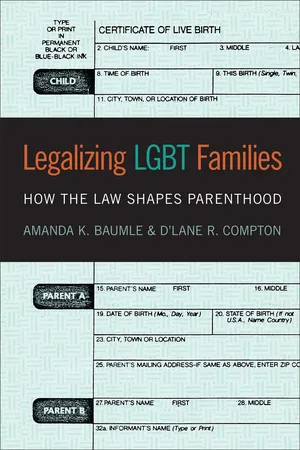
Legalizing LGBT Families
How the Law Shapes Parenthood
- 320 pages
- English
- ePUB (mobile friendly)
- Available on iOS & Android
eBook - ePub
About this book
Information
1
The State of the Law for LGBT Parents
It really doesn’t matter what [the laws] say. It is not going to keep people from having children. If it was a straight situation, the law isn’t going to keep people from having sex, they are still going to get married, they are still going to live together even if they don’t get married. If it was a racial issue, back in the day, interracial couples still got together, they still had children, whether other people saw it as legal or not. I mean, life is going to go on. Whether they say we can do it or not.
—Traci
When proposing and enacting formal laws and regulations, there is an assumption that the law matters—that the law will, ultimately, affect our decisions and behaviors. But, as many of our participants noted, the law does not “matter” in the same way across all aspects of our lives. As pointed out by Traci, a married, Native American lesbian in her forties who lives in a legally neutral state, “life is going to go on,” and many LGBT individuals will find a way to have children despite legal constraints on family formation. For others, however, legal restrictions might play a more powerful role when making decisions about parenthood. This is the case both in terms of actual obstacles to forming a family (e.g., adoption or insemination restrictions), as well as laws limiting the rights that one or both parents might have over any child that enters the family. Given the degree of variation that exists in formal laws across states, the question of whether law matters does not have a singular answer for LGBT parents.
Throughout this book, we argue that a fundamental aspect of one’s legal consciousness is derived from contextual factors, including the legal and sociopolitical climate in which one resides. This makes for a complex and dynamic landscape to be navigated for LGBT parents, who are nested within a variety of legal, social, and political environments across the United States. Our research is focused on examining this rather unique variation in legal context for LGBT parents to explore how context, and its interactions with group and individual goals and characteristics, plays a role in the construction of legality. Given our interest in legal context, we focus in this chapter on providing a framework for our project by introducing a few key topics related to state-level family laws. We begin by describing the legal obstacles that existed at the time of this study for LGBT parents or would-be parents and by discussing the manner in which these obstacles vary across legal contexts in the United States, as well as how these variations might be expected to affect the parenting experiences of LGBT individuals.
We then provide a brief overview of key findings from two of our prior quantitative studies that analyzed whether state-level laws affected the presence of children in same-sex households or the type of parent-child relationship in same-sex households. These quantitative analyses, which utilized large, nationally representative datasets on same-sex partners, provide indications that legal context matters for LGBT parents—but not always in the ways in which one might expect. Our quantitative findings raise additional questions regarding the mechanisms by which LGBT parents come to learn about, interpret, and utilize the law.
In the following chapters we build upon these analyses by drawing on our interviews with LGBT parents to more directly examine the manner in which legal context plays a role in shaping legal consciousness. Accordingly, we conclude this chapter by discussing how we classified states by legal context for our study, including the challenges posed by measuring legal environments and their effects during a time of fluctuating laws and public opinion on LGBT parenting.
LGBT Families and Legality
Traditionally, law and society scholars have often focused on the ways in which formal law (e.g., legislation and judicial decisions) affects outcomes for individuals, including considerations of how formal law might be interpreted by various actors within the legal system. In describing how formal law plays a role in the construction of legal consciousness for LGBT parents, we reiterate that formal law is but one facet of legality; as discussed in the introduction, individuals encounter the law in everyday interactions, as well as through more direct dealings with formal law. Accordingly, our focus on formal law in this discussion is intended to provide an overview of variation in legal climates, rather than to summarize the entirety of LGBT parents’ possible interactions with the law.
Formal law has the potential to affect family formation and parenting for both heterosexual and LGBT families in that these laws provide a set of terms for marriage, adoption, fostering, and surrogacy. Although formal law, as well as informal legalities, regulate many familial interactions and outcomes, individuals are often less cognizant of the role of the law in their family lives. Rather, the family is viewed as a private endeavor, often understood to be sheltered from external legality (Mather, McEwen, and Maiman 2001; Jacob 1992; Ellickson 1991). LGBT individuals, however, confront formal law more regularly than do heterosexual individuals as a part of their family formation and parenting, and are more likely to experience conflicts between their desired outcomes and the law.
In most states, what constitutes a family differs for LGBT persons as compared to heterosexual persons (Powell et al. 2010), affected by restrictions on same-sex marriage and adoption. As Badgett (2001, 163) observed, since laws “determine who is considered a parent in allocating legal parental rights and obligations,” then “the legal institution of parenthood seems likely to influence lesbian, gay, and bisexual people’s decisions about becoming a parent.” At the time of this writing, nineteen states and the District of Columbia grant marriage to same-sex couples.1 For those not residing in one of these states, the lack of access to relationship recognition would be expected to color the experiences of couples who are seeking to have children together. Legal marriage, rather than simply legal recognition, appears to be important for same-sex couples, with prior research indicating that same-sex couples largely preferred marriage to civil unions or domestic partnerships (Badgett 2013). Marriage is sought after not just for specific legal rights conferred but also for the social and emotional recognition that accompanies the institution. For couples considering having children, these social and emotional benefits could prove just as, if not more, important for their parenting experience as are the legal rights granted (Cahill, Ellen, and Tobias 2002; Demo, Allen, and Fine 2000).
In addition to marriage, laws in many states directly regulate whether LGBT individuals are permitted to adopt, foster, or enter into surrogacy agreements. Much as with marriage, these laws do more than define a set of rights, such as the ability to engage in adoption. Parenting laws also carry social and emotional implications, including serving as guidance as to which individuals are defined as a “real” parent. For example, Yngvesson (1997) described the manner in which adoption renders the adoptive party the parent and leaves the biological parent without legal nomenclature, even in the case of open adoptions. The implications of these definitions for the individuals’ own understandings of their relationships, as well as for how they are perceived by others, indicate the powerful role that laws can play for LGBT parents in defining their familial relationships (see also Baumle and Compton 2014).
In some instances, state laws have prohibited gay men and lesbians from adopting children jointly or individually, even the children of their partners. This is done both directly, when the law prohibits gay individuals from adopting (see, e.g., Florida Adoption Act 2003, but also Florida Department of Children and Families v. In re: Matter of Adoption of X.X.G. and N.R.G. [2010] for decision ruling the Florida Adoption Act unconstitutional), or indirectly, when unmarried or cohabiting individuals are barred from adopting (e.g., Michigan). In other cases, states have outlawed surrogacy agreements entirely (e.g., North Dakota) or for unmarried individuals (e.g., Nebraska), or have provided limitations on insemination (e.g., Louisiana). Such measures provide additional obstacles for LGBT individuals who wish to use assisted reproduction in order to have a child.
Even in the absence of restrictive laws, uncertainty about the legal system—including legal rights, definitions, and processes—affects parenting outcomes for LGBT individuals (Badgett 2001). There are many states where neither the legislature nor the courts have made determinations regarding the status of parental rights for LGBT individuals. For example, in Louisiana “a single person, eighteen years or older” is permitted to petition to adopt (Louisiana Adoption Act 2004). As of the time of writing, there has been no indication from the legislature or the courts in Louisiana as to whether sexual orientation would bar an individual from adopting.
In states like Louisiana where the law is uncertain, LGBT individuals might be hesitant to interact with formal law as part of the parenthood process due to its perceived unpredictability. A rocky legal history of battling for legal rights and recognition for LGBT persons contributes toward a sense that, at any moment, presumed legal rights might be ruled unavailable. Such was the case for adoption law in Michigan. Like Louisiana, the adoption statute simply permitted any “person” to adopt (Michigan Adoption Act 1998). Michigan courts, however, had previously issued custody-related rulings suggesting the state might oppose adoption by same-sex couples (see Boot v. Boot [2001], ruling that sexual orientation could be a factor in a custody decision, and Irish v. Irish [1980], ruling permitting visitation to a lesbian mother only if her partner was not in the house). These rulings were followed by decisions in 2002 and 2004 regarding same-sex adoption and second-parent adoption that resulted in same-sex couples in Michigan being unable to adopt, and effectively curtailed all petitions for second-parent adoptions by LGBT individuals.2 Legal ambiguity, thus, can have a chilling effect on parenthood decisions because of the implications of what “silence” in a negative sociopolitical climate might mean for future legal rights over children.
Up to this point, we have focused on formal law that suggests a negative or unsettled stance with regard to LGBT family rights. Some states, however, have taken affirmative steps toward providing legal rights to LGBT families. As of June 2014, twenty-four states and the District of Colombia permitted second-parent adoptions wherein individuals were able to adopt the biological or adopted child of their partner (Human Rights Campaign 2014).3 For example, Vermont’s statute provides: “If a family unit consists of a parent and the parent’s partner, and adoption is in the best interest of the child, the partner of a parent may adopt a child of the parent” (Vermont Adoption Act 2003). Although “partner” is not necessarily equivalent with same-sex partner, the Vermont Supreme Court has ruled that this statute expressly authorizes second-parent adoption by LGBT partners (Baker v. State of Vermont 1999).
As in the case of negative laws, the creation of affirmative legal rights for LGBT individuals can influence family outcomes. In states where the legislature or the courts have provided positive familial rights for same-sex partners, the way LGBT individuals understand their legal obstacles and the means of overcoming those barriers likely differ from those in other states. Their unique contextual situation, therefore, can shape the manner in which they form their families and the ways in which they parent.
Given these variations in legal climate for LGBT parents, it is clear that legal context has the potential to affect interactions with the law, through both direct limitations on available paths to parenthood, as well as through shaping individuals’ understandings of the law and its uses. For example, living in a state with negative LGBT family laws can generate obstacles to becoming a legal parent, and can also affect whether LGBT individuals in those states will approach formal or informal law as something antagonistic or helpful for their families. To further examine this issue, the next section provides an overview of findings from our prior quantitative studies which laid the groundwork for gaining an understanding of how legal context might shape the parenting experiences of LGBT individuals.
Legal Context and Family Formation
While our book draws upon interviews from a nonrandom sample of LGBT parents in the United States, our inquiries were guided by findings from quantitative analyses of large-scale, nationally representative data from the US Census Bureau. Through these studies, we sought to provide an initial glimpse into the manner in which legal context might influence family formation for LGBT individuals. Although the Census Bureau data cannot reveal complexities regarding how legal consciousness affects paths to parenthood for same-sex couples, we were able to assess whether variation appears in the presence of children in same-sex households across legal contexts, as well as in the types of parent-child relationships that are identified across legal contexts. The Census Bureau data produce a complicated picture of the ways in which laws sometimes appear to affect, and sometimes appear to fail to affect, the parenting outcomes for same-sex couples.
The Law and Children in Same-Sex Households
Drawing on the US census data of 2000, we first examined the manner in which variations in legal restrictions or protections might modify whether members of same-sex unmarried partners became parents. We employed multilevel modeling to examine the effect of positive and negative state-level family laws on the presence of children in same-sex unmarried partner households (Baumle and Compton 2011).4 The full details of our methodology and the full results from these analyses are presented in a prior publication (Baumle and Compton 2011). We focus in this chapter on identifying the ways in which these analyses suggest that state-level laws are related to the presence of children in same-sex households.
In terms of prohibitive laws, we found that laws involved with bringing children into a household—including fostering, adoption, and surrogacy—did not have a statistically significant effect on the presence of children in the household (i.e., whether any child eighteen or under was in the household).5 However, we found that laws limiting second-parent adoption did have a statistically significant, negative effect on the presence of children in the household. Specifically, the odds of children being present in same-sex households decreased by 12 percent in states that prohibited second-parent adoption, compared to those that did not do so. These findings suggest that individuals might pay more attention to restrictive formal laws when considering establishing a flow of legal rights between parent and child, such as with second-parent adoption, but less so as part of family formation, such as with laws related to surrogacy, insemination, or adoption. Thus, our results provided little support for the notion that prohibitive laws regarding LGBT individuals adopting or fostering children actually reduce the likelihood of children being present in same-sex unmarried partner households. In other words, these laws appear to be largely ineffective.
We also examined whether laws that prohibited discrimination based on sexual orientation (i.e., positive laws) for gay and lesbian parents had an effect on whether children were in same-sex households.6 We considered a consolidated measure of positive family laws that included laws that prohibited discrimination in adoption and in second-parent adoption; the same set of states had laws that prohibited discrimination on these two practices as of the census of 2000.7 We found that these positive family laws had a statistically significant, positive effect on the presence of children in the household. Our results indicated that the odds of children being present in same-sex households increased by 15 percent in states with positive family laws compared to states without these protective laws. Given that the same states had protective laws related to adoption and to second-parent adoption, we were unable to disentangle their effects to determine which played a greater role in increasing the likelihood of children being present in the household. Based upon our findings from the negative law models, we suggested that it is possible that the pro–second-parent adoption laws could be generating the greatest contribution to this statistically significant effect. Such an interpretation would be compatible with literature suggesting that individuals become informed about the law, and are more likely to rely on formal law, for family outcomes involving property transference or gaining legal rights (Mather, McEwen, and Maiman 2001; Jacob 1992; Ellickson 1991; Merry 1990). In addition, a desire for formal legal recognition of the family via second-parent adoption could motivate a reliance on formal law. Decisions regarding pathways to becoming parents, however, might be more likely to be viewed as individualized, personal family matters that are less influenced by either positive or negative family laws.
Although we were able to suggest several possible explanations for why certain types of family law might play little role in family formation outcomes (Baumle and Compton 2011), the census data permit only an examination of outcomes rather than the decision-making processes. As a result, our findings could not reflect whether same-sex partners are consciously opting out of formal law when forming their families or whether they are unaware of state laws regarding family formation. State laws might also have little effect on family formation if many of the children in same-sex households are children from prior heterosexual marriages. Census data indicate that the odds of having a child in a same-sex household are almost 2.5 times higher for individuals who identify their marital statu...
Table of contents
- Cover
- Title Page
- Copyright Page
- Dedication
- Contents
- Preface
- Acknowledgments
- Introduction
- 1. The State of the Law for LGBT Parents
- 2. Routes to Parenthood
- 3. Locating Legality
- 4. Parenting before the Law
- 5. Parenting with the Law
- 6. Parenting against the Law
- Conclusion: LGBT Parents Constructing Legality
- Appendix: Methodology
- Notes
- References
- Index
- About the Authors
Trusted by 375,005 students
Access to over 1.5 million titles for a fair monthly price.
Study more efficiently using our study tools.
Frequently asked questions
Yes, you can cancel anytime from the Subscription tab in your account settings on the Perlego website. Your subscription will stay active until the end of your current billing period. Learn how to cancel your subscription
No, books cannot be downloaded as external files, such as PDFs, for use outside of Perlego. However, you can download books within the Perlego app for offline reading on mobile or tablet. Learn how to download books offline
Perlego offers two plans: Essential and Complete
- Essential is ideal for learners and professionals who enjoy exploring a wide range of subjects. Access the Essential Library with 800,000+ trusted titles and best-sellers across business, personal growth, and the humanities. Includes unlimited reading time and Standard Read Aloud voice.
- Complete: Perfect for advanced learners and researchers needing full, unrestricted access. Unlock 1.5M+ books across hundreds of subjects, including academic and specialized titles. The Complete Plan also includes advanced features like Premium Read Aloud and Research Assistant.
We are an online textbook subscription service, where you can get access to an entire online library for less than the price of a single book per month. With over 1.5 million books across 990+ topics, we’ve got you covered! Learn about our mission
Look out for the read-aloud symbol on your next book to see if you can listen to it. The read-aloud tool reads text aloud for you, highlighting the text as it is being read. You can pause it, speed it up and slow it down. Learn more about Read Aloud
Yes! You can use the Perlego app on both iOS and Android devices to read anytime, anywhere — even offline. Perfect for commutes or when you’re on the go.
Please note we cannot support devices running on iOS 13 and Android 7 or earlier. Learn more about using the app
Please note we cannot support devices running on iOS 13 and Android 7 or earlier. Learn more about using the app
Yes, you can access Legalizing LGBT Families by Amanda K. Baumle,D'Lane R. Compton in PDF and/or ePUB format, as well as other popular books in Social Sciences & LGBT Studies. We have over 1.5 million books available in our catalogue for you to explore.