The work of academics can matter and be influential on a public level, but the path to becoming a public intellectual, influential policy advisor, valued community resource or go-to person on an issue is not one that most scholars are trained for. The Public Professor offers scholars ways to use their ideas, research and knowledge to change the world. The book gives practical strategies for scholars to become more engaged with the public on a variety of fronts: online, in print, at council hearings, even with national legislation.
Lee Badgett, a veteran policy analyst and public intellectual with over 25 years of experience connecting cutting edge research with policymakers and the public, offers clear and practical advice to scholars looking to engage with the world outside of academia. She shows scholars how to see the big picture, master communicating with new audiences, and build strategic professional networks.
Learn how to find and develop relationships with the people who can take your research and ideas into places scholars rarely go, and who can get you into Congressional hearings, on NPR, or into the pages of The New York Times. Turn your knowledge into clear and compelling messages to use in interviews, blog posts, tweets and op-eds. Written for both new and experienced scholars and drawing on examples and advice from the lives of influential academics, the book provides the skills, resources, and tools to put ideas into action.
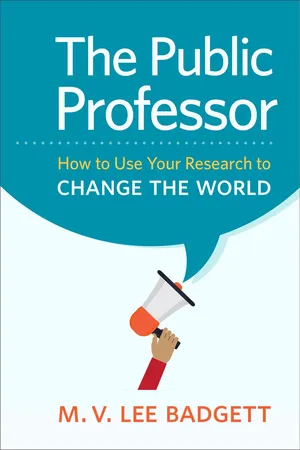
eBook - ePub
The Public Professor
How to Use Your Research to Change the World
- 256 pages
- English
- ePUB (mobile friendly)
- Available on iOS & Android
eBook - ePub
The Public Professor
How to Use Your Research to Change the World
About this book
Information
Topic
EducationSubtopic
Education General1
Speaking Truth to Empower
As a kid, Gary Orfield read avidly about civil rights, a subject that seemed distant from his hometown of Minneapolis, which had few people of color in those days. When he was an undergraduate at the University of Minnesota in the early 1960s, university officials came to him with an unexpected request. “They asked me to figure out how to kind of orient and bring into college the American Indian students who were coming to our campus,” Orfield recalled. He didn’t know anything about American Indian students, though, other than that northern Minnesota had Indian reservations. So he organized a visit to those reservations, and eventually organized more trips for students to do projects. Those visits made a lasting impression on Orfield: “It made me realize how deep racism was, and how devastating it was.”1
His interest in fighting racial injustice led Orfield to seek a career of research and action as a political scientist.2 While in graduate school at the University of Chicago, he started going to school board meetings, and he eventually wrote a dissertation on the efforts to desegregate education and equalize opportunities in the South.
Over the five decades since then, Orfield has worked to make access to a high-quality education equal for all students. His research has explored a range of hotly contested means to that end: busing, school choice, No Child Left Behind, affirmative action, diversity, and fair housing. Orfield’s research, as well as his understanding of politics and the educational system, landed him on commissions and in the expert witness box. Today he co-directs UCLA’s Civil Rights Project, and his work is central to ongoing debates about the desegregation of school systems and to the Supreme Court’s decisions on affirmative action in higher education.
Economist Teresa Ghilarducci never expected to be a policy entrepreneur. Her academic work and technical expertise in the obscure details of pensions landed her on many public and private pension and health care boards during a conventional academic career. However, now she finds herself promoting her idea for a new retirement plan for American workers to policymakers and the media.3 “My identity was always as an academic bringing ideas to a mountain, to Congress,” she explains. “What made me a policy entrepreneur is Rush Limbaugh and the right wing, when they started attacking me for being a communist.”
Her third book put her on Limbaugh’s radar. When I’m Sixty-Four: The Plot against Pensions and the Plan to Save Them laid out the plan for the Guaranteed Retirement Accounts (GRA) program. Workers would put 5% of their salary into their GRA, and they would get a tax credit of $600 (for example) to help pay for it. A public agency would manage the funds and guarantee a 2–4% return on savings after inflation, creating a new source of retirement income to add to Social Security. Limbaugh labeled this idea as socialist, but the New York Times recognized the GRA as one of the most innovative ideas of 2008. Today her idea is catching on with state legislators, as Ghilarducci explains to them about the crisis in retirement plans and how her GRA idea can make the lives of millions of older Americans more secure.
Historian Stephanie Coontz confesses that her transformation from scholar to public intellectual was largely accidental. Her first book took thirteen years to write and was as academic as it sounds: The Social Origins of Private Life: A History of American Families. “I was so concerned to prove myself to other academics that I wrote this ponderous book that often overwhelmed my storyline with data just to prove I had it and never used a dime word if I could dig a dollar one out of my pocket!” she laughingly admits now. By the time she finished the book, she noticed there was a new need for her knowledge: “I could take the research I had done and use it to counteract some of the myths that I was hearing, mostly from conservatives but also from liberals, about the past of the family.”
Then she got lucky. In 1992, Coontz published a book on families for a popular audience called The Way We Never Were. Just as it came out, then vice president Dan Quayle ignited a raging public debate on “family values.” Quayle criticized Murphy Brown, a fictional TV character played by Candice Bergen, for deciding to become a single mother, or as Quayle put it, “mocking the importance of fathers by bearing a child alone and calling it just another lifestyle choice.”4 The public uproar over family values might have been bad for society, Coontz points out, but it was timely for her, and she and her book publicists were ready: “That transformed me into the go-to person about whether it was really true that if we lived like the 1950s, we’d be better off.”
Lisa D. Moore’s best friend was diagnosed with AIDS in the 1980s, about the time she entered UC Berkeley’s public health doctoral program. The HIV epidemic got more personal, and Moore’s commitment to research on HIV prevention intensified. For a course project, she studied San Francisco’s Prevention Point, one of the nation’s first needle exchange programs. In an act of civil disobedience, a group of anarchists, drug users, and other activists had set up the illegal program to reduce HIV transmission by allowing injection drug users to trade used needles for clean ones. Moore had to convince the anarchists that a researcher had something to contribute to the cause. Her study eventually demonstrated the value of Prevention Point and the commitment of the drug users in the program to preventing HIV.
After her course was over, Moore continued to work with the group to educate skeptical local policymakers and the African American community about the need to adopt a legal, better-funded program. Would this program work? Would it increase drug use? Moore’s role was to translate findings from her own research and that of other scholars to show that needle exchange programs could reduce HIV transmission without exacerbating drug use. A few years later, the city decided to fund the program, and it eventually became legal.
The work Moore did with needle exchanges after that first study was central to her development as a teacher, scholar, and community activist. She began to view drug users as agents in their own lives and, as she puts it, “to see how they are actively in their own way trying to make things better.” Having such street knowledge is important when her scholarly role gives her a privileged position in policy discussions. “No people in policy debates are poor street-based drug users,” Moore points out. “But that’s why it’s important to have some representation of what [street-based drug users] need.”
I’ve been lucky to encounter these four very different scholars—call them public intellectuals, scholar activists, “pracademics,” or engaged scholars—either in person or on the page. Their stories line up with my own trajectory as an academic: seeing an injustice, studying that problem, wanting to make a difference, injecting scholarship into important public debates, taking advantage of good timing, being willing to handle disagreement, and enjoying the engagement with policymakers, activists, and the public outside of the university. We’ve learned more about the worlds we study as our engagement has taken us into unfamiliar settings and brought us unexpected challenges.
I will never forget the first time I testified before Congress. The impressive looking invitation that I received from a congressional committee chair included a polite but firm request that oral testimony be limited to five minutes. A little box on the witness table flashes green, yellow, and red lights to give committee witnesses a familiar reminder when their time is almost up.
Reducing years of detailed economic research into five minutes of respectfully persuasive and informative content was a daunting task. Looking up into the eyes of distinguished lawmakers as I spoke the words that I had rehearsed made the work worthwhile, though. The opportunity to speak directly to them was both a great privilege and a daunting responsibility that I had been eagerly seeking for fifteen years.
One of my earliest research studies convincingly (in my view) debunked the myth of gay affluence. Opponents of gay civil rights laws routinely point to the allegedly privileged economic position of lesbian, gay, and bisexual people to argue they don’t need legal protections against discrimination. My research shows that view is wrong—they are not a high-earning elite, and gay and bisexual men actually earn less than similarly qualified heterosexual men. Discrimination characterizes gay workers’ experiences, not privilege.
The moment I read my first statistical printouts with these findings I was ready to speak this new truth to our nation’s lawmakers. For a long time, though, I watched from the sidelines as advocates on one side skillfully used the worst economic stereotypes of gay people, while advocates on the other side did little to counter them. How could I directly transmit my important knowledge to powerful decision makers, who surely just needed to hear the facts so they could pass the right policy?
Once the first call finally came, I learned more about how I got there. I started to see how other scholars might get to the point of speaking truth to power—or speaking the truth to empower—just as Orfield, Ghilarducci, Coontz, and Moore have.
My job for more than two decades has been to be an economics and public policy professor, so I’ve had an insider’s view of how professors see our role, which rarely extends beyond academia. As scholars, we live and die (professionally, anyway) through our capacity to reason and persuade our colleagues. We have professional norms and customs to guide our research. We have our students to take our wisdom and insights from the classroom into the “real world.” University evaluation procedures keep us on a professionally productive path of research and publications. We get rewards of status, sabbaticals, and raises for staying professionally active. All of these features of academic life focus our attention on one key audience—ourselves.
And that all works for us, at least until the day comes that we want someone outside of our academic worlds to listen to us because we know something important:
- • We’ve discovered some new problem that no one has been paying much attention to.
- • We see an injustice that can be righted.
- • We’ve got a good idea for how to address or even solve some social problem.
- • We hear about a policymaker or public figure who’s just gotten a fact or judgment terribly wrong.
- • We think a public debate is missing the point on some issue of the day.
- • We’ve got good advice for individuals about how to improve their mental health, physical well-being, or economic status.
I have many smart colleagues who’ve got something to teach the world outside the university but don’t know the answer to a key question: How do we get policymakers, the media, and community members to pay attention to us?
It’s not just our own personal sense of social usefulness or professional pride that’s at stake here. We live in an era of declining public support for higher education and increasing public doubts about the value of scientific knowledge. If we can grab the public’s attention and make research relevant and accessible, we might increase their enthusiasm for supporting public higher education.
Most of us are ourselves products of the publicly supported higher education system, so we have even more of a responsibility to connect knowledge to the public interest. Many of us borrowed money, got parental support, or received public funding that put us through college and graduate school. I would argue that we have our own debt to society to pay.
The good news is that paying that debt back by sharing our knowledge with the broader world is also personally and professionally rewarding. It’s not just about feeling useful, since we can learn much more about the world we study when we play a broader part in it. Many other professors have gotten new research questions, new perspectives, new ideas, new sources of data, and occasionally even new funding opportunities by interacting with the broader public. That can all add up to better research as well as even more engagement.
The bad news? There really isn’t any, but figuring out how to be effective in public discussions as academics requires a little more knowledge, some commitment of time, and a few additional skills. Most of us aren’t equipped to move from dissertation writer to public intellectual or publicly engaged scholar without learning about how to do that.
Sure, you can probably name a scholar in your field whose academic work attracted the attention of some powerful person who pulled that professor out of scholarly obscurity and into a prominent public position. But my educated guess is that in 99% of those situations, that academic overnight sensation had already developed both a personal network that included important people and a set of communication skills that set him or her up for success and influence. Academics don’t end up on NPR or the PBS NewsHour, at the White House, or in front of lawmakers by accident or blind luck.
Making a difference by engaging in the public conversation or debate about the issues that your work addresses isn’t a matter of stumbling onto fame and fortune—it’s a matter of being effective and strategic, and this book is designed to help you develop the strategy and skills you need.
My own road to the congressional witness chair began with the education in policymaking that I got as a student activist in high school and college, working on local politicians’ campaigns and other causes. I decided to get a Ph.D. in economics so that I could better understand and influence policies that addressed problems like discrimination and unemployment. As a graduate student, I got practice by using my writing and analytical skills in campus debates about graduate student unions, affirmative action in education, and equal access to faculty jobs for women and people of color.
With a completed dissertation in hand, my first job at a school of public policy in the Washington, D.C., area opened up new types of engagement and expanded my personal network of people who are professionally engaged in the policy process. Policymakers, lawyers, community groups, employers, and others involved in the political process who learned about my research encouraged me to weigh in with an “expert’s” view on employment discrimination in the open hearings in state legislatures and other contexts.
I eventually learned that congressional hearings have not only more gravitas, but also a carefully choreographed lineup of witnesses, determined mostly by the majority party. Unlike more open processes in state legislatures, for Congress it’s “No invitation, no in-person testimony.” When the time came for me, the real invitation was not in a letter, but in the phone call from a committee staffer to vet me for my availability, accessibility, and appropriateness. That staffer in turn, had tapped into his network, speaking with knowledgeable insiders, advocacy organization staffs, and other experts to come up with my name as someone who could provide useful testimony.
Of course, the academic research and analysis that I had conducted over many years clearly had something to do with the invitation. Equally important was the other work I have done to create and feed that professional network that extends beyond my fellow academics and includes the people making decisions about hearing witnesses.
Over the last two decades, I’ve answered reporters’ phone calls, consulted with attorneys and policymakers’ staffs, followed up on businesses’ requests for information, written op-eds, attended community meetings, talked with activists, listened to the arguments of participants in debates, provided memos and briefings to different stakeholders, provided summaries of academic work on different topics, been an expert witness i...
Table of contents
- Cover
- Title Page
- Copyright Page
- Dedication
- Contents
- Acknowledgments
- 1. Speaking Truth to Empower
- 2. Seeing the Big Picture, Part 1: Understanding the Debate
- 3. Seeing the Big Picture, Part 2: Mastering the Rules of the Game
- 4. Effective Networking
- 5. Communicating outside of the Academy
- 6. Using Traditional Media Outlets to Connect with the World
- 7. Using Social Media to Connect with the World (Co-authored with Scott Swenson)
- 8. In the Heat of the Moment: Managing Public Conflict
- 9. Sustainable Engagement: How to Stay Productive
- Notes
- Index
- About the Author
Trusted by 375,005 students
Access to over 1.5 million titles for a fair monthly price.
Study more efficiently using our study tools.
Frequently asked questions
Yes, you can cancel anytime from the Subscription tab in your account settings on the Perlego website. Your subscription will stay active until the end of your current billing period. Learn how to cancel your subscription
No, books cannot be downloaded as external files, such as PDFs, for use outside of Perlego. However, you can download books within the Perlego app for offline reading on mobile or tablet. Learn how to download books offline
Perlego offers two plans: Essential and Complete
- Essential is ideal for learners and professionals who enjoy exploring a wide range of subjects. Access the Essential Library with 800,000+ trusted titles and best-sellers across business, personal growth, and the humanities. Includes unlimited reading time and Standard Read Aloud voice.
- Complete: Perfect for advanced learners and researchers needing full, unrestricted access. Unlock 1.5M+ books across hundreds of subjects, including academic and specialized titles. The Complete Plan also includes advanced features like Premium Read Aloud and Research Assistant.
We are an online textbook subscription service, where you can get access to an entire online library for less than the price of a single book per month. With over 1.5 million books across 990+ topics, we’ve got you covered! Learn about our mission
Look out for the read-aloud symbol on your next book to see if you can listen to it. The read-aloud tool reads text aloud for you, highlighting the text as it is being read. You can pause it, speed it up and slow it down. Learn more about Read Aloud
Yes! You can use the Perlego app on both iOS and Android devices to read anytime, anywhere — even offline. Perfect for commutes or when you’re on the go.
Please note we cannot support devices running on iOS 13 and Android 7 or earlier. Learn more about using the app
Please note we cannot support devices running on iOS 13 and Android 7 or earlier. Learn more about using the app
Yes, you can access The Public Professor by M. V. Lee Badgett,M. V. Lee Badgett in PDF and/or ePUB format, as well as other popular books in Education & Education General. We have over 1.5 million books available in our catalogue for you to explore.