Choice Outstanding Academic Title of 2016
Rural queer experience is often hidden or ignored, and presumed to be alienating, lacking, and incomplete without connections to a gay culture that exists in an urban elsewhere. Queering the Countryside offers the first comprehensive look at queer desires found in rural America from a genuinely multi-disciplinary perspective. This collection of original essays confronts the assumption that queer desires depend upon urban life for meaning.
By considering rural queer life, the contributors challenge readers to explore queer experiences in ways that give greater context and texture to modern practices of identity formation. The book’s focus on understudied rural spaces throws into relief the overemphasis of urban locations and structures in the current political and theoretical work on queer sexualities and genders. Queering the Countryside highlights the need to rethink notions of “the closet” and “coming out” and the characterizations of non-urban sexualities and genders as “isolated” and in need of “outreach.” Contributors focus on a range of topics—some obvious, some delightfully unexpected—from the legacy of Matthew Shepard, to how heterosexuality is reproduced at the 4-H Club, to a look at sexual encounters at a truck stop, to a queer reading of TheWizard of Oz.
A journey into an unexplored slice of life in rural America, Queering the Countryside offers a unique perspective on queer experience in the modern United States and Canada.
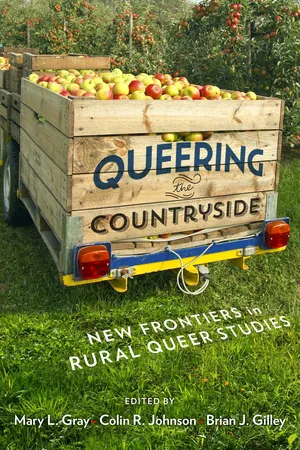
eBook - ePub
Queering the Countryside
New Frontiers in Rural Queer Studies
- 416 pages
- English
- ePUB (mobile friendly)
- Available on iOS & Android
eBook - ePub
Queering the Countryside
New Frontiers in Rural Queer Studies
About this book
Information
Part I
New Archives, New Epistemologies
1
Out Back Home
An Exploration of LGBT Identities and Community in Rural Nova Scotia, Canada
Kelly Baker
For some of us you can take the homo out of the country but you can’t take the country out of the homo, and like a flock of geese in fall we eventually find our way back home.
—“A Rural Point of View,” Wayves Magazine, Halifax, December 2008
This essay explores the identities and experiences of community among lesbians, gays, and transgendered people living in rural Nova Scotia, Eastern Canada. Based on fourteen interviews and participant observation, I consider how sexual identity is spatially constructed outside of the urban center, and uncover some of the ways in which rural LGBT identities and communities are experienced. Because academic and popular representations of rural areas often portray them as “backward” or “traditional”—and thus heterosexual—I look at participants’ reasons for living outside the city. How do rural settings influence the ways rural LGBT individuals identify? Do those who decide to stay in, or return to, their rural hometowns feel integrated within their communities? Do they experience a sense of commonality with other people in their area? Is community actively sought? In examining such questions, I challenge the prevalent assumption that LGBT communities are inherently urban. I also circumvent the widespread depictions of rural areas as being ultimately homophobic and hostile to LGBT difference. Lastly, I highlight the ways rural nonheterosexuality works to challenge dominant notions of sexual identity, community, and rural space.
Rural Nova Scotia as a Case Study
As Nova Scotian historian Robin Metcalfe points out, Halifax has had a prominent history of gay and lesbian community organizing and activism in Canada.1 But as a small city located in the Maritime provinces, Halifax’s LGBT community has had to struggle to get its particular issues raised and its voice heard within the wider LGBT movement.2 These issues have been even more difficult for LGBT communities in rural areas. Indeed, many of the problems faced by rural LGBT people are similar to the problems those in cities faced almost two decades prior; many rural LGBT communities are still relatively isolated and are struggling to establish networks and create spaces within which LGBT people feel safe.3 And unlike many other Canadian provinces, Nova Scotia also continues to have a high percentage of rural dwellers: with a rural population of nearly 75 percent, Nova Scotia has the third highest rural population in the country.4
The socioeconomic status of rural Nova Scotia appears below the national, as well as provincial, urban average in a number of areas. The education level of rural Nova Scotians, for instance, is substantially lower than that of urban residents;5 at the same time, unemployment rates in rural Nova Scotia are substantially higher than the national average for rural areas.6 Incomes in Nova Scotia are also lower than the national average, and the gap between urban and rural incomes is larger than in any other province.7 Fisheries and agriculture, two prominent industries for the region, have both experienced a sharp decline in recent years; while the number of people employed in fisheries has been decreasing, farm debt has, for the past thirteen years, been greater than farm receipts—and this gap is widening. And while total wages and salaries in the mining, oil, and gas industries have been increasing, the number of people employed in these industries has decreased. In recent years, however, multiple research initiatives have taken place to help bolster the development of healthy, sustainable communities throughout rural Nova Scotia. The Coastal Communities Network (CCN), along with the Rural Communities Impacting Policy project (RCIP), has been active in helping to “promot[e] the survival and enhancement” of the province’s rural communities.8 Official reports borne from such initiatives have lauded such Nova Scotian communities as having a strong sense of community spirit and community values, as well as a deep appreciation for those who work to strengthen them.9
During the summer of 2008, however, tensions emerged among a number of northern Nova Scotian counties when the mayor of Truro started what some have called a “rural trend” of refusing to raise the pride flag during Nova Scotia’s gay pride week celebrations. Despite the fact that same-sex marriages have been legally recognized in Nova Scotia since September 24, 2004, the mayor, citing his religious convictions, stated that “God says ‘I’m not in favor [of gay pride]’ . . . and I have to look at it and say, I guess I’m not either.”10 Both Pictou and Cumberland counties followed, implementing policies that would prevent nongovernment flags from being flown on municipal poles. While the mayor’s position may have confirmed for many the stereotyped beliefs surrounding small-town backwardness and oppressiveness, this incident, which received national attention, allowed the issues and experiences of rural LGBT Nova Scotians to gain visibility and recognition throughout Canada. It illuminated the fact that Nova Scotia contains a number of rural LGBT communities that are actively promoting acceptance and equality within their wider rural communities.
* * *
During the summer of 2008, I conducted fourteen interviews with individuals ranging from twenty-one to seventy-one years old. Of these, eight self-identified as lesbians, five self-identified as gay males, and one self-identified as transsexual. My sample was primarily within a working- and middle-class range. While seven of my participants were born and raised in rural Nova Scotia, two grew up in Halifax County and moved to rural Nova Scotia as young adults. Two others grew up in other provinces (rural Prince Edward Island and suburban Quebec), and the remaining three grew up in other countries (England, the United States, and the Netherlands).
Reflecting the fact that many communities throughout rural Nova Scotia are predominately white,11 thirteen of my informants were white, while one was native. As Kennedy and Davis note, race and class have a crucial impact on individuals’ perceptions and experiences of LGBT community.12 Similarly, Creed and Ching explain that rural identity inflects, and is inflected by, other dimensions such as race, class, and gender.13 Containing only one non-white participant, my sample does not represent those rural LGBT individuals whose experiences and sexual identifications are inflected by nondominant racial and ethnic identities.
Since LGBT people in rural Nova Scotia are, to a certain extent, invisible and scattered, my method of recruitment was snowball sampling, which involved eliciting the assistance of my initial research participants and their acquaintances in order to build up my sample group. As Kennedy and Davis point out, this technique is often used among hidden populations, who are difficult for researchers to access.14 This method proved particularly useful, as it allowed me to examine the interconnections and experiences of community that exist, on varying levels, among individuals dispersed throughout the province. Because my sample was small, it cannot be considered representative of rural LGBT people in Nova Scotia. However, anthropological studies based on individual cases routinely rely more heavily upon depth than breadth.15 Often utilizing a variety of methods such as in-depth interviews, group interviews, and participant observation, anthropologists consider sample extensiveness to be less applicable to qualitative research; rather, sample size is considered adequate when repetitiveness in data occurs.16
My research was also multi-sited. While eight of my participants resided along various parts of the South Shore, six resided in more northern parts of Nova Scotia. Multi-sited research methods have emerged in response to both “empirical changes in the world” as well as new understandings of “the field.”17 Indeed, Green argues that “the field” must be understood not as something that is “effected once and for all” but as “an emerging process . . . made of social encounters.”18 As such, strategies of following various connections, associations, and relationships are at the “very heart” of multi-sited research.19 Such methods therefore allowed me to investigate the social encounters which constituted rural Nova Scotia as “the field.” Witnessing and engaging the various interconnections and networks among my participants, who are geographically dispersed, yet socially connected, was essential to my understanding of identity and community among LGBT individuals scattered throughout rural Nova Scotia.
Locating LGBT People in Rural Space
The notion of space has become a useful lens through which to understand identity and community, as well as relations of power and oppression.20 No longer seen as a backdrop or container for social relations, space is deemed crucial to the constitution and reproduction of social relations and identities.21 The queering22 of both public and private spaces is therefore understood as being crucial to the historical formation of early gay politics and collective identities.23 Indeed, throughout the twentieth century, gay spaces such as bars, clubs, and cruising grounds created the possibility for collective consciousness, struggle, and activity.24 The establishment of gay spaces, such as parades, cafes, centres, and neighborhoods, made it possible for political consciousness and movements for public recognition to emerge. They provided safety, visibility, and a sense of commonality,25 eventually leading to a grassroots liberation movement and becoming the essential means of combating homophobia and maintaining a sense of collectivity.26
Work on LGBT identities and space has, however, been criticized for neglecting the important distinction between urban and rural space.27 As Creed and Ching point out, work on space and identity “unquestionably posits an urbanized subject” without considering the vital role of its opposition—the rural or rustic.28 This “cultural hierarchy” has overshadowed the significance of rural-based identities and has devalued, and sometimes erased, rural space.29 For anthropologist Kath Weston, this hierarchy has also falsely located all LGBT people within the city and has overlooked their presence outside of it.30
Certainly, the social and economic conditions within many North American cities after World War II provided a space within which gay identity, collectivity, and politics could emerge.31 The city, with its anonymity and heterogeneity, as well as its population size and density, has been theorized as a beacon of tolerance and the ideal arena for sexual outsiders.32 The city may wel...
Table of contents
- Cover
- Title Page
- Copyright Page
- Contents
- Acknowledgments
- Introduction
- Part I. New Archives, New Epistemologies
- Part II. The Rural Turn: Considering Cartographies of Race and Class
- Part III. Back and Forth: Rural Queer Life in Circulation and Transition
- Part IV. Bodies of Evidence: Methodologies and their Discontents
- Bibliography
- About the Contributors
- Index
Trusted by 375,005 students
Access to over 1.5 million titles for a fair monthly price.
Study more efficiently using our study tools.
Frequently asked questions
Yes, you can cancel anytime from the Subscription tab in your account settings on the Perlego website. Your subscription will stay active until the end of your current billing period. Learn how to cancel your subscription
No, books cannot be downloaded as external files, such as PDFs, for use outside of Perlego. However, you can download books within the Perlego app for offline reading on mobile or tablet. Learn how to download books offline
Perlego offers two plans: Essential and Complete
- Essential is ideal for learners and professionals who enjoy exploring a wide range of subjects. Access the Essential Library with 800,000+ trusted titles and best-sellers across business, personal growth, and the humanities. Includes unlimited reading time and Standard Read Aloud voice.
- Complete: Perfect for advanced learners and researchers needing full, unrestricted access. Unlock 1.5M+ books across hundreds of subjects, including academic and specialized titles. The Complete Plan also includes advanced features like Premium Read Aloud and Research Assistant.
We are an online textbook subscription service, where you can get access to an entire online library for less than the price of a single book per month. With over 1.5 million books across 990+ topics, we’ve got you covered! Learn about our mission
Look out for the read-aloud symbol on your next book to see if you can listen to it. The read-aloud tool reads text aloud for you, highlighting the text as it is being read. You can pause it, speed it up and slow it down. Learn more about Read Aloud
Yes! You can use the Perlego app on both iOS and Android devices to read anytime, anywhere — even offline. Perfect for commutes or when you’re on the go.
Please note we cannot support devices running on iOS 13 and Android 7 or earlier. Learn more about using the app
Please note we cannot support devices running on iOS 13 and Android 7 or earlier. Learn more about using the app
Yes, you can access Queering the Countryside by Mary L. Gray,Colin R. Johnson,Brian J. Gilley, Mary L. Gray, Colin R. Johnson, Brian J. Gilley in PDF and/or ePUB format, as well as other popular books in Social Sciences & LGBT Studies. We have over 1.5 million books available in our catalogue for you to explore.