An exploration of the production and reception of nature and spirituality in America's national park system
America's national parks are some of the most powerful, beautiful, and inspiring spots on the earth. They are often considered "spiritual" places in which one can connect to oneself and to nature. But it takes a lot of work to make nature appear natural. To maintain the apparently pristine landscapes of our parks, the National Park Service must engage in traffic management, landscape design, crowd-diffusing techniques, viewpoint construction, behavioral management, and more—and to preserve the "spiritual" experience of the park, they have to keep this labor invisible.
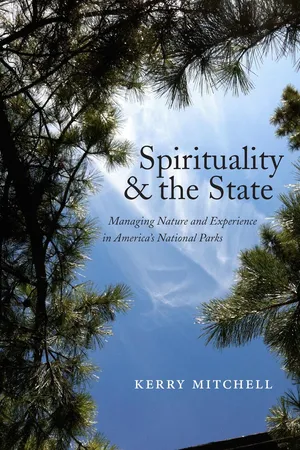
Spirituality and the State analyzes the way that the state manages spirituality in the parks through subtle, sophisticated, unspoken, and powerful techniques. Following the demands of a secular ethos, park officials have developed strategies that slide under the church/state barrier to facilitate deep connections between visitors and the space, connections that visitors often express as spiritual. Through indirect communication, the design of trails, roads, and vista points, and the management of land, bodies and sense perception, the state invests visitors in a certain way of experiencing reality that is perceived as natural, individual, and authentic. This construction of experience naturalizes the exercise of authority and the historical, social, and political interests that lie behind it. In this way a personal, individual, nature spirituality becomes a public religion of a particularly liberal stripe. Drawing on surveys and interviews with visitors and rangers as well as analyses of park spaces, Spirituality and the State investigates the production and reception of nature and spirituality in America's national park system.
eBook - ePub
Spirituality and the State
Managing Nature and Experience in America's National Parks
- 272 pages
- English
- ePUB (mobile friendly)
- Available on iOS & Android
eBook - ePub
About this book
Information
Topic
Theology & ReligionSubtopic
Religion, Politics & State1
Establishing National Parks
From Ideal to Institution
John Muir, writing of his 1869 experience in the California wilderness of the Sierra Nevada mountain range, described the effects of nature:
We are now in the mountains and they are in us, kindling enthusiasm, making every nerve quiver, filling every pore and cell of us. Our flesh-and-bone tabernacle seems transparent as glass to the beauty about us, as if truly an inseparable part of it, thrilling with the air and trees, streams and rocks, in the waves of the sun,—a part of all nature, neither old nor young, sick nor well, but immortal. . . . How glorious a conversion, so complete and wholesome it is, scarce memory enough of old bondage days left as a standpoint to view it from!1
One may wonder what friends and family from Muir’s “bondage days” would have made of the “conversion” that invigorated his bodily “tabernacle.” Muir had grown up on a Wisconsin farm in the 1850s under the Calvinist rule of his father, a Scottish immigrant who demanded hard labor and strict obedience on the part of his children. While Muir showed little rebellion as a child, his assumption of a nomadic lifestyle after college began a departure from the religious vision that dominated his youth. As an amateur naturalist, Muir began to develop his own spirituality, one that saw a fusion of body and spirit in nature. While initially his writing dealt largely with scientific questions, his appreciation for the sanctity of nature eventually led him to address broader issues of political life. Conveying his spiritual sentiments in some of the most influential periodicals of his time, Muir helped to gain support for the public preservation of wilderness, an effort that bore fruit with the establishment of the first national parks in the late nineteenth century.
What kind of preservation did Muir envision? His writings suggest that in promoting wilderness, he wished to preserve not simply space, but the opportunity to experience nature in a particular way. Muir’s way was typically Romantic: the lone wanderer coming face to face with grand scenes of natural beauty, enjoying tranquil repose, joining in ecstatic union with the divinity of nature. His experience depended much upon solitude, risk, adventure, and prolonged, profound reflection. Such an experience, and the spiritual wisdom and love that Muir felt nature could provide to all people, could not abide crowds. Civilization and commercial development were inimical to the revelations he sought. For Muir, the divinity of nature came through personal, intimate encounter. To be sure, this encounter was fed by a broad social and cultural world and was fed to a wide public through his writings. But at its core, such communication of divinity required privacy, and this was what wilderness provided.
Of course, Muir recognized that preserving the opportunity for such personal, intimate experience required more than individual effort. But one notes with irony that to preserve wilderness as a private experience, Muir turned to a definitively public organ: the state. As founder and president of the Sierra Club, he personally lobbied President Theodore Roosevelt and other political and economic elites and thus came to embrace what might otherwise have been viewed as a paradox: retaining the possibilities for intimate, personal connection with wilderness required public control and restriction. Wilderness needed to become public to remain private.
Linking private experience with public interest lies at the core of the National Park Service mission to the present day. Obviously, the complex historical process of the creation of national parks brought with it a whole range of circumstances that Muir could not have anticipated. Historian Alfred Runte has noted how the establishment of Yosemite as a national park gained crucial support from corporate interests that saw Yosemite’s snow pack as a reservoir for their agricultural concerns in California’s central valley.2 Later, the language of resource management would encompass the aesthetic and even spiritual aspects of the park. As this chapter shows, park officials would come to view nature in the parks as a good that could be appropriated in a unique way by each visitor, thereby creating a sense of personal investment in the public space of the park. Spiritual experience was seen as one of the strongest expressions of this kind of investment.
In this way Park Service efforts to provide the public with a personal encounter with nature has followed an agenda similar to Muir’s, but with a different emphasis. For the Park Service, Muir’s vision of a personal, private encounter fits within the structures of public authority and national identity. Visitors are to feel the freedom and enrichment of a personal encounter with nature as their public, national heritage. Furthermore, both echoing and distorting Muir, prominent park officials have seen the spiritual connection between the individual and nature as an investment in the state. To the degree that individuals “find themselves” spiritually in the parks, so the logic goes, they find themselves in the state that sets the conditions for their experience.
Over a period extending roughly from the mid-nineteenth century to the beginning of the twenty-first, the national park ideal found expression in management paradigms that gave rise to the concrete shape of the parks in terms of the number and placement of roads, buildings, and trails, the set of rules governing various activities, and the education that visitors were to receive in the parks. My analysis of three paradigms—recreation, heritage, and systems—shows how Park Service officials sought to integrate private, individual encounters with nature into public, collective enterprises of national identity and state allegiance. Officials occasionally drew on religious language and logic to express this relationship, especially within the heritage paradigm. In their increasing sophistication throughout the history of the parks, these paradigms provide the framework for managing spiritual experience as part of the parks’ public mission.
Recreation
Runte has noted how the establishment of national parks was motivated in part by what he called “scenic nationalism,” an effort to claim the parks as natural and national cathedrals that would rival and surpass the architectural wonders of Europe.3 But the management of national parks, and the question of what parks were supposed to “do” for visitors, was also influenced by more mundane social factors. Particularly important among these was the recreation movement, a broad set of social initiatives arising in the second half of the nineteenth century that included, in addition to the promotion of national, state, and municipal parks, the playground movement, the adult education-oriented lyceum movement, and the establishment of a number of voluntary organizations providing, among other services, recreational opportunities to youth and the poor.4 The recreation movement addressed itself to the increasing industrialization of American society characterized by mass production, repetitive labor, specialization of tasks, and all the resulting stresses and divisions. Out of this context, the recreation movement grew as a way to provide the population with opportunities for rejuvenating and relaxing experiences as well as stimulating and educational ones.
This concern for recreation as a matter of public welfare decisively informed the national park ideal. In the early history of the parks, one figure, Frederick Law Olmsted, Sr., stands out and provides a useful illustration of recreation as a management paradigm.5 A prominent landscape architect, he advised state officials on park policy as early as 1865 with regard to the creation of Yosemite as a public park, and was one of the first to theorize the relation of private experience and collective identity in national parks. Specifically, Olmsted’s 1865 report to the governor of California, a document that is treated in detail in this section, drew a connection between the individual health benefits provided by natural recreation and the health of the collective “body of the people.” Through this metaphor of the body, Olmsted argued that publicly accessible natural areas would build the strength of America as a democratic nation.
Writing as chair of the commission established to develop guidelines for the administration of Yosemite, Olmsted noted the health benefits resulting from the “contemplation of natural scenes.”6 Such recreation yielded increased vigor, productivity, and longevity, while its absence could entail “mental or nervous excitability, moroseness, melancholy or irascibility, incapacitating the subject for the proper exercise of the intellectual or moral forces,” and in more extreme cases may have included “mental disability . . . softening of the brain, paralysis, palsy, monomania or insanity.”7 Olmsted’s understanding of health centered on harmony, as applying both to psycho-physiological faculties and the temporal rhythm of work and rest. The ill effects of a lack of natural recreation resulted from the constant and unrelieved repetition of everyday activities in both business and household. The weight of habit and repetition brought both the body and the mind out of balance, over-exercising certain faculties while letting others atrophy.
Olmsted drew out the implications of natural recreation for national identity through a comparison with Britain. The invigorating effect of the enjoyment of nature was already well recognized, Olmsted wrote, by the governing elite of the British Empire, who had made it customary to spend time each year in an Alpine sojourn. Such a practice was not simply a perquisite of the ministerial office, but rather, Olmsted asserted, a vital factor in increasing the effectiveness of such officials in their service to the state. Furthermore, Olmsted connected the participation in natural recreation to the much longer “active business life” of the British elite who took up the custom of regular sojourns in nature.
What the British Empire lacked, however, and what Yosemite was to provide America as a nation, was natural recreation for the public at large. Given the opportunity to encounter natural beauty, park visitors would become not only happier people, but more civilized, cultured, and productive citizens: “It is the folly of laws which have permitted and favored the monopoly by privileged classes of many of the means supplied in nature for the gratification, exercise and education of the esthetic faculties that has caused the dullness and weakness and disease of these faculties in the mass of the subjects of kings. And it is against the limitation of the means of such education to the rich that the wise legislation of free governments must be directed.”8 Olmsted alleged that citizens under a monarchy lack aesthetic refinement because, under such a form of government, the natural means of producing such refinement remained the privilege of an elite few. Olmsted argued that this was not simply an injustice. For just as an individual body benefited from the even development of its faculties, so too did a society function as a more whole, harmonious, and balanced body when its components (individual citizens) had been developed to a relatively equal degree. Thus the even distribution of the benefits of nature concerned not just a “free” government but a “wise” and, by implication, “natural” one as well.
Olmsted cited the words of Andrew Jackson Downing, one of the founding figures of landscape architecture in the nineteenth century, in support of this perspective: “The dread of the ignorant exclusive, who has no faith in the refinement of a republic, will stand abashed in the next century, before a whole people whose system of voluntary education embraces (combined with perfect individual freedom) not only schools of rudimentary knowledge, but common enjoyments for all classes in the higher realms of art, letters, science, social recreations and enjoyments.”9 From this perspective, a republic provided a healthier, more vigorous civilization than more hierarchized systems of government, an advance that would impress not simply through its greater justice but also through its cultural richness. The republican education that would stimulate such an advance, Downing suggested, consisted of two essential parts: private agency (“individual freedom”) and public equality (common access to high culture). Olmsted mirrored this two-fold emphasis on the individual and the collective, the private and the public, in his commentary on Downing’s words: “It was in accordance with these views of the destiny of the New World and the duty of the republican government that Congress enacted that the Yosemite should be held, guarded and managed for the free use of the whole body of the people forever.”10 “Free use” referred to private or individual agency while “whole body of the people” referred to the public or collective aspect of republican enjoyment of nature. By integrating this duality of public and private into a metaphor of the body, Olmsted suggested a synthesis of the two with health as a normative principle. The development of the physical and mental faculties of the bodies of individual citizens was to coincide with the increased health of the “body of the people” as a democratic whole.
Interestingly, what stood in the way of a democratic, republican, and individual enjoyment of nature was not any dictatorial or monarchical state. Rather, private property itself provided the threat. Referring to views of Yosemite, Olmsted wrote of “the danger that such scenes might become private property and through the false taste, the caprice, or the requirements of some industrial speculation of their holders, their value to posterity be injured.”11 Private enjoyment of natural scenes needed to be protected from private ownership of the means of access to those scenes. The public sphere was called to enter into the tensions among private interests in order to preserve a certain kind of personal, individual experience of nature. This addresses the curious phrasing of “free use” of lands “held, guarded, and managed” by the state. Individual freedom, according to this perspective, required management and restriction on the part of the government. Here public interest did not simply negate private interest, but rather codified a certain mode of the private: an individual, health-oriented, aesthetic, and recreational approach to nature.
In his vision of public space nurturing the body of the American people, Olmsted provided some of the earliest considerations of the significance of public nature for communal health and identity. And while other politicians and park managers may not have voiced the metaphysical concern for the “body of the people” that Olmsted did, they did share his emphasis on recreation as the main purpose of these public nature parks. This can be seen in the Yellowstone Park Act of 1872, which established the first national park proper as “a public park or pleasuring ground for the benefit and enjoyment of the people.”12 The act assumed the public utility of recreation, of “enjoyment” of nature as a “pleasuring ground.” And in terms of policy, successive designation of national parks occurred without any change to this recreational emphasis. For more than fifty years from the time of Olmsted’s report, the public function of national parks was dominated, at least in terms of the principles of park management, by the provision of recreational opportunities to the public.
While the recreational paradigm proved vital for park management, this philosophy was not accompanied by a large increase in the number of national parks. At the time of Olmsted’s writing, Yosemite was not yet a national park: the federal government had ceded Yosemite Valley and the Mariposa Grove of sequoias to the state of California with instructions to maintain these areas as a public park. With the Yellowstone Park Act of 1872, the idea of national parks had touched ground, it is true, but the growth of national parks as a political phenomenon proceeded quite slowly. In the latter half of the nineteenth century, national parks were, for the federal government but also for the populace more broadly, an item of restricted national significance requiring little sacrifice and providing little substantial benefit. The western half of the United States, where the bulk of national parks would come into existence, saw the height of the Indian wars during the late nineteenth century. In this regard, too, nature took on the character of a public, national space, but here one of conquest, eradication, and/or eviction of Native Americans. The ongoing wars, distance from major population centers, and difficulties of travel restricted visitation to national parks during this period. In view of these considerations, it is not surprising that only four large national parks were created in the nineteenth century.13
Steady growth of the national park movement occurred in the early twentieth century, coinciding with the end of the Indian wars and population increase in the West. Fourteen parks and national monuments were established by 1916, the year Congress created the National Park Service to ma...
Table of contents
- Cover
- Title Page
- Dedication
- Contents
- Acknowledgments
- Introduction
- 1. Establishing National Parks: From Ideal to Institution
- 2. The John Muir Trail: The Properties of Wilderness
- 3. Yosemite National Park: The Spirit of Complexity
- 4. Muir Woods: The Living Cathedral
- 5. Theorizing Religious Individualism
- Conclusion
- Appendix: Research Methods
- Notes
- Bibliography
- Index
- About the Author
Trusted by 375,005 students
Access to over 1.5 million titles for a fair monthly price.
Study more efficiently using our study tools.
Frequently asked questions
Yes, you can cancel anytime from the Subscription tab in your account settings on the Perlego website. Your subscription will stay active until the end of your current billing period. Learn how to cancel your subscription
No, books cannot be downloaded as external files, such as PDFs, for use outside of Perlego. However, you can download books within the Perlego app for offline reading on mobile or tablet. Learn how to download books offline
Perlego offers two plans: Essential and Complete
- Essential is ideal for learners and professionals who enjoy exploring a wide range of subjects. Access the Essential Library with 800,000+ trusted titles and best-sellers across business, personal growth, and the humanities. Includes unlimited reading time and Standard Read Aloud voice.
- Complete: Perfect for advanced learners and researchers needing full, unrestricted access. Unlock 1.5M+ books across hundreds of subjects, including academic and specialized titles. The Complete Plan also includes advanced features like Premium Read Aloud and Research Assistant.
We are an online textbook subscription service, where you can get access to an entire online library for less than the price of a single book per month. With over 1.5 million books across 990+ topics, we’ve got you covered! Learn about our mission
Look out for the read-aloud symbol on your next book to see if you can listen to it. The read-aloud tool reads text aloud for you, highlighting the text as it is being read. You can pause it, speed it up and slow it down. Learn more about Read Aloud
Yes! You can use the Perlego app on both iOS and Android devices to read anytime, anywhere — even offline. Perfect for commutes or when you’re on the go.
Please note we cannot support devices running on iOS 13 and Android 7 or earlier. Learn more about using the app
Please note we cannot support devices running on iOS 13 and Android 7 or earlier. Learn more about using the app
Yes, you can access Spirituality and the State by Kerry Mitchell in PDF and/or ePUB format, as well as other popular books in Theology & Religion & Religion, Politics & State. We have over 1.5 million books available in our catalogue for you to explore.