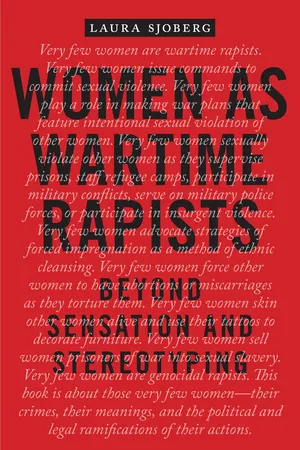
Women as Wartime Rapists reveals the stories of female perpetrators of sexual violence and their place in wartime conflict, legal policy, and the punishment of sexual violence.
Very few women are wartime rapists. Very few women issue commands to commit sexual violence. Very few women play a role in making war plans that feature the intentional sexual violation of other women. This book is about those very few women. More broadly, Laura Sjoberg asks, what do the actions and perceptions of female perpetrators of sexual violence reveal about our broader conceptions of war, violence, sexual assault, and gender?
This book explores specific historical case studies, such as Nazi Germany, Serbia, the contemporary case of ISIS, and others, to understand how and why women participate in rape during war and conflict. Sjoberg examines the contrast between the visibility of female victims and the invisibility of female perpetrators, as well as the distinction between rape and genocidal rape, which is used as a weapon against a particular ethnic or national group. Further, she explores women's engagement with genocidal rape and how some orchestrated the ethnic cleansing of entire regions. A provocative approach to a sensationalized topic, Women as Wartime Rapists offers important insights into not only the topic of female perpetrators of wartime sexual violence, but to larger notions of gender and violence with crucial cultural, legal, and political implications.
- 320 pages
- English
- ePUB (mobile friendly)
- Available on iOS & Android
eBook - ePub
About this book
Information
1
Conditions That Drove Them to the Brink of Death
Gender, War, Genocide, and Sexual Violence
Women were raped. . . . [The rapes] weren’t an expression of sexuality or sexual need or sexual gratification. It was an attempt to demonstrate the sexual act as an expression of violence . . . tarnishing the honour of any family. . . . A woman forced by day to clean up the blood of beaten prisoners and by night repeatedly raped; prisoners forced to commit sexual acts or even sexual mutilations upon other prisoners. . . . The lucky ones in camp, those who were not forced to participate in a loved one’s murder, or sexually mutilated, or beaten to death over a period of agonizing days, or subject to other torments, nevertheless endured conditions that drove them to the brink of death.1
—Excerpt from a Sentencing Hearing at the International Criminal Tribunal for the Former Yugoslavia
The old adage that “war is hell”2 rings true in ways even those who first popularized the phrase might not have intended—because war, as this chapter’s epigraph exemplifies, is a special kind of hell for its civilian victims, most of whom are targeted for a cause they did not choose, or just for being a certain race, ethnicity, or religion. The passage, from a war crimes sentencing hearing, discusses the terrible tortures of rape and sexual violence in the conflict in the former Yugoslavia, and the (gendered) hell that the perpetrators’ victims experienced. This chapter argues that war and genocide are gendered hell, and that the gendered part of that phrase is crucial to understand fully the events themselves.
This chapter explores the relationships between gender, war, genocide, and sexual violence to lay the foundation for the argument that war, genocide, and sexual violence therein are gendered, and need to be analyzed as such for the fullest understanding of what they are, how they happen, how they can be stopped, and how they should be dealt with jurisprudentially. It begins by introducing the concept of gender in more depth, discussing the relationships between sex, gender, and gendered expectations and readings of people and event in global politics. A second section uses gender analysis to theorize war and conflict, suggesting that there are gendered dimensions to war generally and ethnic conflict specifically. A third section turns to the analysis of sexual violence in war and conflict, suggesting that it is a systematic part of gendered war and gendered genocide, and appropriately theorized as such. The chapter concludes by situating this within the book’s analysis of rape among women.
Gender
As mentioned in the introduction, popular misconceptions of gender characterize it as reducible to biological maleness or femaleness and/or the traits that are seen to go with those biological configurations. Male bodies and female bodies are expected to contain masculine and feminine people who fill gender roles in orderly ways. This does not mean that expectations about what women are and what men are constant over time, place, and culture—instead, it means that, across all of those differences, there are expectations of what women are and what men are. Gender roles both differ and change, but the existence of gender roles as an ordering principle of social and political life seems to endure.
Gender role expectations seem to endure despite the mounting evidence that people do not fit into the categories of biologically male and biologically female,3 that the retreat to biology as fundamental is conceptually and empirically flawed,4 that bodies can be and are socially constructed,5 and that sex, gender, and sexuality are social orders rather than natural orders. In other words, not only is there nothing essential about being a woman or about being a man that makes a person fundamentally one way or another, the very ideas of being a woman and being a man are inseparable from the social contexts in which they are read and interpreted.
It might at first glance appear that the argument in this chapter is internally contradictory—that there is nothing natural,6 essential, or biological about gender but that war and genocide are gendered. A brief discussion of what it means to be gendered in this context shows that the argument is not internally inconsistent, however, and that both parts of it are necessary to understanding the complexities of gendered war(s) and gendered genocide(s).
First, it is important to note, as many feminist scholars have pointed out before, that gender being performative, socially constructed, and non-essential does not make the experience of gender any less real in the lives of people who live global politics (or even in the lives of people who both live and research global politics). Given that, expectations about the ways gender influences what people do and how they do it are almost overwhelmingly present in social and political life—from the different treatment of male children and female children to the suggestion that men and women who are in politics do (and should) behave differently.7 Initially, then, it looks like gender can be accounted for in the expectations of people understood as men and people understood as women, and the difference among them. The (different) expectations of people understood as men and people understood as women can be called gender normativity—the expectation that gender rules can be used to predict, explain, and indeed order behavior. Under gender-normative social and political structures, maleness and femaleness, masculinities and femininities, serve as organizing principles for social and political life, by which people and behaviors are categorized, and with which people and behaviors are read.
A brief explication might be helpful en route to unpacking that account: the passage that starts out this chapter, about the rapes in the Bosnian genocide, begins with the observation that “women” were raped. Here, “women” is the literal subject of the sentence (women are the victims of the rape). But it is also a signifier of a number of different understandings of women/gender—some universal(izable), others specific to the reader and/or interpreter. The first sentence implies that women are disproportionately victimized. The passage implies that it is especially bad to abuse a woman (“a woman forced by day . . .” is more specific than “a person forced by day . . .” because the sex of the victim is an aggravating condition of the victimhood). It characterizes rape not only as a sex-specific experience to and for women, but as an expression of gendered power rather than as an act of sex and sexuality. It relates women’s sexuality to familial honor (implying strongly that this relation is local to Bosnian Muslim culture in the omitted part of the text).
In other words, taking the sexed terms out of the passage would impact its meanings and significations. Replacing the words “women” and “woman” with “people” and “person” would make the passage still descriptive of the war crimes of torture, rape, and even genocidal rape. The passage would still account for terrible human rights abuses which are both normatively shameful and subject to prosecution in international law. While it would mean the same thing in those senses, it would also mean something very different: the feminine as the subject and the signifier here matters to the implications about what the crime is and how it is committed. While no one would disagree that doing those things to a man would be a terrible thing to do, them being done to a woman is at once a different kind of offense (against those presumed innocent, in need of protection, and protected) and somewhat normal (given that sexual violence in war and conflict against women has become a feature of most if not all wars, conflicts, and genocides).
So, in a sense, gender has both everything and nothing to do with understanding the act/crime/experience being described. On the one hand, the person’s perceived sex, gender, gendering, and sexuality has nothing to do with the occurrence of the event; on the other hand, it has everything to do with its perpetration, its reading, its experience, its reporting, and even its punishment. Gendered orders produced by and reinforced by gender-normative understandings of how people do (and should) live and act cannot be divorced from how life is read and even experienced.8 In this way, as Laura Shepherd describes, gender is “a noun, a verb, and a logic that is product/productive of performances of violences and security.”9 As Judith Butler explains, this makes sex “a regulatory ideal” whose materialization is forced, where “what constitutes the fixity of the body, its movements, will be fully material, but the materiality will be rethought of an effective of power.”10
In other words, gender becomes manifest in “a series of demands, taboos, sanctions, injunctions, prohibitions, impossible idealizations, and threats.”11 These demands and threats affect the behavior, behavioral expectations, and living conditions of people understood to be men and people understood to be women, both structurally and in everyday life. While the process by which gender normativity and gender orders are enforced affect people similarly, the content and result of those orders differs. If, in Butler’s words, “the boundary, forming and deforming of sexed bodies is animated by a set of founding prohibitions, a set of enforced criteria of intelligibility,”12 the standards of intelligibility set different criteria for people understood to be men and people understood to be women. Gender is not just derived behavioral standards and derived difference, then—it is derived inequality. Gender normativity includes the distribution of not only roles but power, regard, and privilege based on perceived associations with sex-based characteristics.
Scholars of gender identify perceived associations with sex-based characteristics using the terms “masculinities” and “femininities.” These are pluralized for two main reasons. First, as discussed above, masculinities and femininities vary over time, place, and culture, though their existence seems relatively stable. Second, and perhaps more importantly for the discussion in this book, “masculinity” and “femininity” in social and political life is not a dichotomy, but a spectrum. R. W. Connell’s description of the existence of “hegemonic masculinities” twenty years ago sets the stage for the analysis of multiple gender tropes; Connell suggests that there are dominant masculinities (e.g., particular understandings of physique, career, behavior, and the like) which are held as ideal, and other masculinities that are subordinated to the ideal-typical hegemonic masculinities.13 An easy example of this relationship that Connell uses is the subordination of nonheterosexual masculinities to heterosexual masculinities. Connell suggests that it remains true in many societies that the notion that the ideal man is straight, and that other masculinities are less ideal.14 As a result, “straight” is a standard to which men are expected to aspire, and by which they are measured. The ideal-typical, or hegemonic, masculinity in any given society at any given time stands at the top of (often otherwise multidimensional) gender hierarchies and gendered orders. Other masculinities, and femininities, are (to varying degrees and in varying ways) subordinated to those ideal-typical masculinities.
Placement along those hierarchies has then been described as masculinization and feminization. This is the association of people (and states and other actors) with traits associated with masculinities and femininities, men and women. To masculinize is to associate with masculinities, and to feminize is to associate with femininities. These two words function in many similar ways in terms of the processes of genderings and the manifestation of gendered performances, but thinking about them in terms of gendered power relations shows their differences. Masculinization is associated with affirmation, valorization, upward mobility, potential, and success; feminization is associated with rejection, devalorization, immobility, and limits. As Cynthia Enloe has argued, “patriarchal systems are notable for marginalizing the feminine,” acting to “infantilize, ignore, trivialize, or even actively cast scorn upon what is thought to be feminized.”15 As V. Spike Peterson explains, the effect of this...
Table of contents
- Cover
- Title Page
- Copyright Page
- Dedication
- Contents
- Acknowledgments
- Introduction: The Importance of Women Wartime Rapists
- 1. Conditions That Drove Them to the Brink of Death: Gender, War, Genocide, and Sexual Violence
- 2. Man-to-Man Communication: The Impossible Existence of Rape among Women
- 3. The Unforgettable Wound: Seeing Rape among Women in Conflict
- 4. There’s No Evidence Women Are Any Worse at Rape Than Men Are: Understanding Women, War, and Rape
- 5. The Wrong of Rape: How Women Rapists Change Criminal Jurisprudence
- 6. One of the Most Abiding Myths of Our Time: Re-visioning Women, War, and Rape
- Notes
- Index
- About the Author
Trusted by 375,005 students
Access to over 1.5 million titles for a fair monthly price.
Study more efficiently using our study tools.
Frequently asked questions
Yes, you can cancel anytime from the Subscription tab in your account settings on the Perlego website. Your subscription will stay active until the end of your current billing period. Learn how to cancel your subscription
No, books cannot be downloaded as external files, such as PDFs, for use outside of Perlego. However, you can download books within the Perlego app for offline reading on mobile or tablet. Learn how to download books offline
Perlego offers two plans: Essential and Complete
- Essential is ideal for learners and professionals who enjoy exploring a wide range of subjects. Access the Essential Library with 800,000+ trusted titles and best-sellers across business, personal growth, and the humanities. Includes unlimited reading time and Standard Read Aloud voice.
- Complete: Perfect for advanced learners and researchers needing full, unrestricted access. Unlock 1.5M+ books across hundreds of subjects, including academic and specialized titles. The Complete Plan also includes advanced features like Premium Read Aloud and Research Assistant.
We are an online textbook subscription service, where you can get access to an entire online library for less than the price of a single book per month. With over 1.5 million books across 990+ topics, we’ve got you covered! Learn about our mission
Look out for the read-aloud symbol on your next book to see if you can listen to it. The read-aloud tool reads text aloud for you, highlighting the text as it is being read. You can pause it, speed it up and slow it down. Learn more about Read Aloud
Yes! You can use the Perlego app on both iOS and Android devices to read anytime, anywhere — even offline. Perfect for commutes or when you’re on the go.
Please note we cannot support devices running on iOS 13 and Android 7 or earlier. Learn more about using the app
Please note we cannot support devices running on iOS 13 and Android 7 or earlier. Learn more about using the app
Yes, you can access Women as Wartime Rapists by Laura Sjoberg in PDF and/or ePUB format, as well as other popular books in Law & International Law. We have over 1.5 million books available in our catalogue for you to explore.