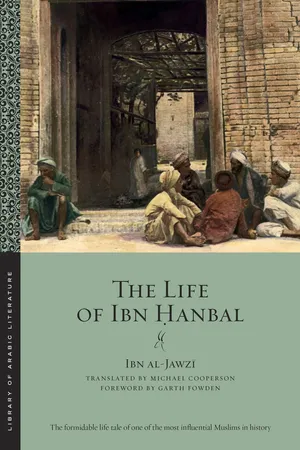
The Life of Ibn ?anbal is a translation of the biography of Ibn Hanbal by the Baghdad preacher, scholar, and storyteller Ibn al-Jawz? (d. 597/1200), newly abridged for a paperback readership by translator Michael Cooperson.
A?mad ibn ?anbal (d. 241/855), renowned for his profound knowledge of hadiths—the reports of the Prophet's sayings and deeds—is a major figure in the history of Islam. He was famous for living according to his own strict interpretation of the Prophetic model and for denying himself the most basic comforts, even though his family was prominent and his city, Baghdad, was then one of the wealthiest in the world. Ibn ?anbal's piety and austerity made him a folk hero, especially after he resisted the attempts of two caliphs to force him to accept rationalist doctrine. His subsequent imprisonment and flogging is one of the most dramatic episodes of medieval Islamic history, and his principled resistance influenced the course of Islamic law, the rise of Sunnism, and the legislative authority of the caliphate.
Set against the background of fierce debates over the role of reason and the basis of legitimate government, The Life of Ibn ?anbal tells the formidable life tale of one of the most influential Muslims in history.
An English-only edition.
- 480 pages
- English
- ePUB (mobile friendly)
- Available on iOS & Android
eBook - ePub
The Life of Ibn Ḥanbal
About this book
Information
Topic
HistoireSubtopic
Histoire du Moyen-Orient
IBN ḤANBAL’S BIRTH AND FAMILY BACKGROUND
We cite ʿAbd al-Malik ibn Abī l-Qāsim al-Karūkhī, who cites ʿAbd Allāh ibn Muḥammad al-Anṣārī, who cites Abū Yaʿqūb al-Ḥāfiẓ, who cites Abū Bakr ibn Abī l-Faḍl al-Muʿaddal,2 who learned it from Muḥammad ibn Ibrāhīm al-Ṣarrām; and3 we cite ʿAbd al-Malik, who cites ʿAbd Allāh ibn Muḥammad, who cites Aḥmad ibn Muḥammad ibn Ismāʿīl al-Mihrawī,4 who learned it from Muḥammad ibn Muḥammad ibn Yaʿqūb, the notary-witness of Būshanj, who learned it from Muḥammad ibn al-Ṭayyib ibn al-ʿAbbās, who [along with al-Ṣarrām] cites Ibrāhīm ibn Isḥāq al-Ghasīlī as saying: 1.1
[Al-Ghasīlī:] I heard Aḥmad’s son Ṣāliḥ say that he—meaning his father—was born in Rabīʿ I 164 [November–December 780], having left Marv5 carried in his mother’s womb.
[Aḥmad:] I was born in Rabīʿ I 164. 1.2
[Aḥmad:] I was born in the year 164. 1.3
[Al-ʿIjlī:] Aḥmad son of Muḥammad son of Ḥanbal, called Abū ʿAbd Allāh (the father of ʿAbd Allāh), was a full-blooded member of the clan of Sadūs.6 The family had settled first in Basra and later in Khurasan,7 but Aḥmad was born and raised in Baghdad. He was trustworthy and reliable as a transmitter of Hadith reports, and was skilled in using them as a source of law. He sought out reports about the early Muslims and lived according to their example. He was a good and honorable man. 1.4
[Aḥmad:] My mother was pregnant with me when she came from Khurasan.8 I was born in 164. 1.5
[Abū Zurʿah:] Aḥmad ibn Ḥanbal’s family came from Basra but their district of settlement was Marv. 1.6
[Ṣāliḥ:] I heard my father say that he was born in 164, toward the beginning of the year, in Rabīʿ I. He was brought from Marv in his mother’s womb. His father died when he was thirty and the task of caring for him fell upon his mother.
[The author:] By this Ṣāliḥ means that Aḥmad’s father died at the age of thirty, when Aḥmad was a child. So much is clear from the following report:
[Aḥmad:] I was brought from Khurasan as an unborn child, and I was born here in Baghdad. I never knew my father or my grandfather.
[Ibn Ḥātim:] Aḥmad ibn Muḥammad ibn Ḥanbal was from Marv. He left Marv as a child in his mother’s womb. His grandfather, Ḥanbal ibn Hilāl, was governor of Sarakhs9 and a descendant of the men who fought for the Abbasids during the revolution.10 1.7
[Aḥmad:] Al-Ḥasan ibn Yaḥyā, who was from Marv, reported to me that he heard Aws ibn ʿAbd Allāh ibn Buraydah report that his brother Sahl ibn ʿAbd Allāh ibn Buraydah reported, citing his father, who reported it citing the grandfather, Buraydah: “I heard the Emissary, God bless and keep him, say, ‘After I die many expeditions will be sent forth. Join the one sent to Khurasan and settle in the city of Marv. It was built by Dhū l-Qarnayn, who asked God to bless it, and no harm befalls its inhabitants.’”11 1.8
HIS LINEAGE12
[ʿAbd Allāh:] We heard reports from my father, Aḥmad son of Muḥammad son of Ḥanbal son of Hilāl son of Asad son of Idrīs son of ʿAbd Allāh son of Ḥayyān son of ʿAbd Allāh son of Anas son of ʿAwf son of Qāsiṭ son of Māzin son of Shaybān son of Dhuhl son of Thaʿlabah son of ʿUkābah son of Ṣaʿb son of ʿAlī son of Bakr son of Wāʾil son of Qāsiṭ son of Hinb son of Afṣā son of Duʿmī son of Jadīlah son of Asad son of Rabīʿah son of Nizār son of Maʿadd son of ʿAdnān son of Udd son of Udad son of al-Hamaysaʿ son of Ḥamal son of al-Nabt son of Qaydhār son of Ismāʿīl son of Ibrāhīm the Friend of God,13 on whom eternal peace. 2.1
[Ibn Baṭṭah:] Aḥmad’s mother was of Shaybān. Her name was Ṣafiyyah, daughter of Maymūnah, daughter of ʿAbd al-Malik al-Shaybānī of the clan of ʿĀmir. Aḥmad’s father had come to stay as a guest of her clan and then married her. Her grandfather, ʿAbd al-Malik ibn Sawādah ibn Hind al-Shaybānī, was a leader among his people. The Arab tribesmen would camp nearby and she would offer them hospitality.14 2.14
HIS CHILDHOOD
Our exemplar Aḥmad was born in Baghdad, as we have mentioned, and grew up there. After studying with the teachers and Hadith scholars of the city, he set out to seek learning elsewhere as well. 3.1
[Ibn Kurdī:] Aḥmad ibn Ḥanbal’s house had the One-Eyed Tigris15 directly behind it. 3.2
[Abū ʿAfīf:] Aḥmad was with us in Qurʾan school when he was just a little boy. Even then he stood out. At that time, the caliph was living in al-Raqqah and the courtiers who joined him there began writing letters to their families in Baghdad. When they wanted to reply to a letter, their womenfolk would ask our schoolmaster to send Aḥmad ibn Ḥanbal to their homes. The teacher would send him out and off he’d go, looking carefully at the ground. The women often dictated obscene words but he wouldn’t write them down. 3.3
[Abū Sirāj:] When we were in Qurʾan school with Aḥmad, women would send messages to the schoolmaster saying, “Send Ibn Ḥanbal to write for us so we can reply to the letters we’ve received.” Whenever he went in to where the women were, he would keep his head down so as not to look at them.
[Al-Marrūdhī:] Abū Sirāj also said that his father, whose name he gave, was impressed by how well Aḥmad conducted himself: “One day my father said to us, ‘I spend money to hire tutors for my children hoping they’ll learn to behave properly, but it doesn’t seem to do any good. Then take Aḥmad ibn Ḥanbal: he’s an orphan, but look how well he’s turned out!’16 He went on marveling for some time.” 3.4
[Al-Marrūdhī:] Aḥmad told me, “When I was a boy, I would go to the Qurʾan school, and then when I was fourteen I took up duties.”17 3.5
[Abū l-Munabbih:] The first we heard of Aḥmad ibn Ḥanbal was when his uncle received a letter from the authorities. He wrote a reply which he gave to Aḥmad, who was supposed to pass it on to a courier who was waiting for it. But instead of handing it over, Aḥmad put it inside an alcove18 they had in the house. When the courier asked for it, the uncle replied that he had already sent it out. He then asked Aḥmad, “Where’s the letter I asked you to give the man at the door?” 3.6
“He was wearing a long-sleeved gown,”19 he replied. “You’ll find your letter in the alcove.”20
[Al-ʿAbbās:] Dāwūd ibn Bisṭām told me: “Once when the briefing from Baghdad was delayed, I sent word to Aḥmad’s uncle telling him I was hoping to write up all the dispatches to forward to the caliph but his still hadn’t arrived. He replied that he had sent his nephew to deliver it. Then he sent for Aḥmad, who was only a boy at the time. 3.7
“‘Didn’t I tell you to deliver my report?’ he asked.
“‘Yes,’ replied Aḥmad.
“‘Why didn’t you, then?’
“‘I used to carry those reports but not any more.21 I threw it into the water.’”
Ibn Bisṭām then recited «We are of God, and to Him we return!»22 adding: “When a boy has such scruples, where does that leave us?”23
[Yūnus al-Muʾaddib:] I saw Aḥmad ibn Ḥanbal while Hushaym was still alive, and ev...
Table of contents
- Cover
- Title Page
- Copyright
- Contents
- Letter from the General Editor
- About this Paperback
- Foreword
- Acknowledgments
- Introduction
- Notes to the Introduction
- The Life of ibn Ḥanbal
- Chapter 1: Ibn Ḥanbal’s Birth and Family Background
- Chapter 2: His Lineage
- Chapter 3: His Childhood
- Chapter 4: The Beginning of His Search for Knowledge and the Journey He Undertook for That Purpose
- Chapter 5: The Major Men of Learning Whom He Met and on Whose Authority He Recited Hadith
- Chapter 6: His Deference to His Teachers and His Respect for Learning
- Chapter 7: His Eagerness to Learn and His Single-Minded Pursuit of Knowledge
- Chapter 8: His Powers of Retention and the Number of Reports He Knew by Heart
- Chapter 9: His Learning, His Intelligence, and His Religious Understanding
- Chapter 10: Praise of Him by His Teachers
- Chapter 11: Teachers and Senior Men of Learning Who Cite Him
- Chapter 12: All the Men of Learning Who Cite Him
- Chapter 13: Praise of Him by His Peers, His Contemporaries, and Those Close to Him in Age
- Chapter 14: Praise of Him by Prominent Successors Who Knew Him Well
- Chapter 15: A Report That the Prophet Elijah Sent Him Greetings
- Chapter 16: Reports That al-Khaḍir Spoke in His Praise
- Chapter 17: Praise of Him by Pious Strangers and Allies of God
- Chapter 18: Allies of God Who Visited Him to Seek His Blessing
- Chapter 19: His Fame
- Chapter 20: His Creed
- Chapter 21: His Insistence on Maintaining the Practices of the Early Muslims
- Chapter 22: His Reverence for Hadith Transmitters and Adherents of the Sunnah
- Chapter 23: His Shunning and Reviling of Innovators and His Forbidding Others to Listen to Them
- Chapter 24: His Seeking of Blessings and Cures Using the Qurʾan and Water from the Well of Zamzam, as Well as Some Hair and a Bowl That Belonged to the Prophet
- Chapter 25: His Age When He Began Teaching Hadith and Giving Legal Opinions
- Chapter 26: His Devotion to Learning and the Attitudes That Informed His Teaching
- Chapter 27: His Works
- Chapter 28: His Aversion to Writing Books Containing Opinions Reached through the Exercise of Independent Judgment at the Expense of Transmitted Knowledge
- Chapter 29: His Forbidding Others to Write Down or Transmit His Words
- Chapter 30: His Remarks on Sincerity, on Acting for the Sake of Appearances, and on Concealing One’s Pious Austerities
- Chapter 31: His Statements about Renunciation and Spiritual Weakness
- Chapter 32: His Remarks on Different Subjects
- Chapter 33: Poems He Recited or Had Attributed to Him
- Chapter 34: His Correspondence
- Chapter 35: His Appearance and Bearing
- Chapter 36: His Imposing Presence
- Chapter 37: His Cleanliness and Ritual Purity
- Chapter 38: His Kindness and His Consideration for Others
- Chapter 39: His Forbearance and His Readiness to Forgive
- Chapter 40: His Property and Means of Subsistence
- Chapter 41: His Refusal to Accept Help Even in Distress
- Chapter 42: His Generosity
- Chapter 43: His Accepting Gifts and Giving Gifts in Return
- Chapter 44: His Renunciation
- Chapter 45: His House and Furniture
- Chapter 46: His Diet
- Chapter 47: His Indulgences
- Chapter 48: His Clothing
- Chapter 49: His Scrupulosity
- Chapter 50: His Shunning Appointment to Positions of Authority
- Chapter 51: His Love of Poverty and His Affection for the Poor
- Chapter 52: His Humility
- Chapter 53: His Accepting Invitations and His Withdrawal upon Seeing Things He Disapproved Of
- Chapter 54: His Preference for Solitude
- Chapter 55: His Wish to Live in Obscurity and His Efforts to Remain Unnoticed
- Chapter 56: His Fear of God
- Chapter 57: His Preoccupation and Absentmindedness
- Chapter 58: His Devotions
- Chapter 59: His Performances of the Pilgrimage
- Chapter 60: His Extemporaneous Prayers and Supplications
- Chapter 61: His Manifestations of Grace and the Effectiveness of His Prayers
- Chapter 62: The Number of Wives He Had
- Chapter 63: His Concubines
- Chapter 64: The Number of His Children
- Chapter 65: The Lives of His Children and Descendants
- Chapter 66: How and Why the Inquisition Began
- Chapter 67: His Experience with al-Maʾmūn
- Chapter 68: What Happened after the Death of al-Maʾmūn
- Chapter 69: His Experience with al-Muʿtaṣim
- Chapter 70: His Reception by the Elders after His Release, and Their Prayers for Him
- Chapter 71: His Teaching of Hadith after the Death of al-Muʿtaṣim
- Chapter 72: His Experience with al-Wāthiq
- Chapter 73: His Experience with al-Mutawakkil
- Chapter 74: His Refusing Ibn Ṭāhir’s Request to Visit Him
- Chapter 75: What Happened When His Two Sons and His Uncle Accepted Gifts from the Authorities
- Chapter 76: Some Major Figures Who Capitulated to the Inquisition
- Chapter 77: His Comments on Those Who Capitulated
- Chapter 78: Those Who Defied the Inquisition
- Chapter 79: His Final Illness
- Chapter 80: His Date of Death and His Age When He Died
- Chapter 81: How His Body Was Washed and Shrouded
- Chapter 82: On Who Sought to Pray over Him
- Chapter 83: The Number of People Who Prayed over Him
- Chapter 84: The Praising of the Sunnah and the Decrying of Innovation That Took Place during His Funeral Procession
- Chapter 85: The Crowds That Gathered around His Grave
- Chapter 86: His Estate
- Chapter 87: Reactions to His Death
- Chapter 88: Reaction to His Death on the Part of the Jinns
- Chapter 89: On the Condolences Offered to His Family
- Chapter 90: A Selection of the Verses Spoken in Praise of Him in Life and in Commemoration of Him in Death
- Chapter 91: His Dreams
- Chapter 92: Dreams in Which He Appeared to Others
- Chapter 93: Dreams in Which He Was Mentioned
- Chapter 94: The Benefit of Visiting His Grave
- Chapter 95: The Benefit of Being Buried Near Him
- Chapter 96: The Punishments That Befall Anyone Who Attacks Him
- Chapter 97: What to Think about Anyone Who Speaks Ill of Him
- Chapter 98: Why We Chose His Legal School over the Others
- Chapter 99: On the Excellence of His Associates and Successors
- Chapter 100: His Most Prominent Associates and Their Successors from His Time to Our Own
- [Colophons]
- Notes
- Glossary of Names and Terms
- Bibliography
- Further Reading
- Index
- About the NYU Abu Dhabi Institute
- About the Translator
- The Library of Arabic Literature
Trusted by 375,005 students
Access to over 1.5 million titles for a fair monthly price.
Study more efficiently using our study tools.
Frequently asked questions
Yes, you can cancel anytime from the Subscription tab in your account settings on the Perlego website. Your subscription will stay active until the end of your current billing period. Learn how to cancel your subscription
No, books cannot be downloaded as external files, such as PDFs, for use outside of Perlego. However, you can download books within the Perlego app for offline reading on mobile or tablet. Learn how to download books offline
Perlego offers two plans: Essential and Complete
- Essential is ideal for learners and professionals who enjoy exploring a wide range of subjects. Access the Essential Library with 800,000+ trusted titles and best-sellers across business, personal growth, and the humanities. Includes unlimited reading time and Standard Read Aloud voice.
- Complete: Perfect for advanced learners and researchers needing full, unrestricted access. Unlock 1.5M+ books across hundreds of subjects, including academic and specialized titles. The Complete Plan also includes advanced features like Premium Read Aloud and Research Assistant.
We are an online textbook subscription service, where you can get access to an entire online library for less than the price of a single book per month. With over 1.5 million books across 990+ topics, we’ve got you covered! Learn about our mission
Look out for the read-aloud symbol on your next book to see if you can listen to it. The read-aloud tool reads text aloud for you, highlighting the text as it is being read. You can pause it, speed it up and slow it down. Learn more about Read Aloud
Yes! You can use the Perlego app on both iOS and Android devices to read anytime, anywhere — even offline. Perfect for commutes or when you’re on the go.
Please note we cannot support devices running on iOS 13 and Android 7 or earlier. Learn more about using the app
Please note we cannot support devices running on iOS 13 and Android 7 or earlier. Learn more about using the app
Yes, you can access The Life of Ibn Ḥanbal by Ibn al-Jawzī, Michael Cooperson in PDF and/or ePUB format, as well as other popular books in Histoire & Histoire du Moyen-Orient. We have over 1.5 million books available in our catalogue for you to explore.