Distinguished experts explain the economic trends and varied political goals at work in Southeast Asia.
With China’s emergence as a powerful entity in Southeast Asia, the region has become an unlikely site of conflict between two of the world’s great powers. The United States, historically regarded as the protector of Pacific Southeast Asia—consisting of nations such as Vietnam, the Philippines, Myanmar, and Malaysia—is now called upon to respond to what many would consider bullying on the part of the Chinese. These and other countries have become the economic and political engine of China.
While certainly inclined to help the country’s former allies, the United States has grown undeniably closer to China in the recent decades of global interconnected economic growth. China, the United States, and the Future of Southeast Asia uncovers and delves into the complicated dynamics of this situation. Covering topics such as the controversial response to human rights violations, the effects of global economic interconnectedness, and contested sovereignty over resource-rich islands, this volume provides a modern and nuanced perspective on the state of the region.
For anyone interested in understanding the evolving global balance of power, China, the United States, and the Future of Southeast Asia illuminates how countries as different as Thailand and Indonesia see the growing competition between Beijing and Washington.
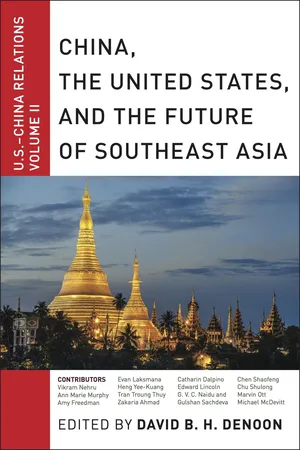
eBook - ePub
China, The United States, and the Future of Southeast Asia
U.S.-China Relations, Volume II
- 512 pages
- English
- ePUB (mobile friendly)
- Available on iOS & Android
eBook - ePub
China, The United States, and the Future of Southeast Asia
U.S.-China Relations, Volume II
About this book
Trusted by 375,005 students
Access to over 1.5 million titles for a fair monthly price.
Study more efficiently using our study tools.
Information
PART I
Overview
1
Southeast Asia
Thriving in the Shadow of Giants
VIKRAM NEHRU
Introduction
At first glance, the countries of Southeast Asia appear a diverse lot. The region includes a small, rich oil kingdom (Brunei); a wealthy entrepôt economy (Singapore); a postconflict society (Cambodia); a country emerging from half a century of autarkic military rule (Myanmar); a poor, landlocked economy blessed with hydropower and minerals (Laos); a populous nation modeled on China’s political structures and matching its growth potential (Vietnam); and four diverse middle-income, market-oriented economies that aspire to join the ranks of advanced countries (Indonesia, Malaysia, the Philippines, and Thailand).
But what these countries share are a strategic location sitting astride one of the world’s busiest sea lanes, access to plentiful natural resources, and close proximity to the world’s two giant countries—China and India. Their diversity and increasing economic integration lie at the heart of Asia’s rapid and resilient economic growth. Cross-border conflicts have been few, short, and contained; and domestic political insurgencies are gradually being overcome, one by one. And a regional institutional architecture is emerging that will help develop shared solutions to common regional and global challenges.
Together, these developments have helped underpin Southeast Asia’s impressive economic performance over the years and positioned it well for future economic and social progress. The two largest economies in the world—the United States and China—recognize the enormous economic and strategic potential of Southeast Asia and have made the region a core element in their regional and global plans.
At the same time, Southeast Asia confronts many challenges that could derail its continued rapid economic and institutional development. Some of these challenges emanate from outside the region, such as the region’s vulnerability to global economic instability and, more recently, to the slowdown in the Chinese economy. Southeast Asia’s openness to trade and financial flows has been an essential ingredient to its development success, but it has also carved channels that immediately transmit global trade and financial instability to the domestic economy, and often even amplify them. Similarly, potential friction between China’s rise as a regional military power and America’s rebalancing strategy toward Asia could, if poorly managed, affect Southeast Asia’s long-term security and stability.
Other challenges come from within the region. Political, ethnic, and communal tensions threaten stability and development in some countries. Inadequate investment in an institutional and regulatory framework to support a range of public goods—regional peace, social mobility, infrastructure, environmental protection, good governance, and a globally competitive private sector—threatens the sustainability of the region’s growth in the long term. And weak regional institutions unable to deliver regional public goods—such as further trade and financial integration, or responses to growing transborder risks that include health pandemics, nontraditional security threats, and extreme weather events related to regional and global climate change—could also undermine the region’s steady economic progress.
This chapter first examines the factors behind Southeast Asia’s long-term economic progress and the development of a regional institutional structure that has helped make this progress resilient over several decades. It then examines the economic outlook for the region and assesses the important risks that could slow—or even disrupt—its continued rapid and resilient growth.
Southeast Asia’s Long-Term Economic Performance
Southeast Asia’s ten economies have a combined GDP of US$2.3 trillion (much bigger than that of India); a population of over 600 million people (nearly twice that of the United States); and an average per capita income that is almost two-thirds of China’s (see table 1.1). If Southeast Asia were one economy, it would be the world’s seventh largest.1 It would also be the most trade-dependent, with a trade-to-GDP ratio well in excess of 100 percent.
The enormous diversity of Southeast Asian economies has meant that neither policy approaches toward development nor development outcomes have been uniform. Yet, over the broad span of the past four decades, Southeast Asia has been one of the world’s consistently good economic performers. Average per capita income in the region climbed faster than in any other developing region (see figure 1.1). In the 1970s, several Southeast Asian economies were singled out for their economic promise. Singapore (together with South Korea, Hong Kong, and Taiwan in Northeast Asia) was dubbed an Asian tiger, while Indonesia, Malaysia, the Philippines, and Thailand were considered tiger economies in the making. Singapore lived up to its early moniker and is now a high-income economy. But economic progress in the remaining four middle-income economies was more mixed. Growth in Indonesia, Malaysia, and Thailand, while rapid till the late 1990s, was hit badly by the Asian financial crisis in 1997–98; their growth since has not been as rapid as in the pre-crisis years (see table 1.2). The Philippines, on the other hand, suffered from weak growth through the 1980s and 1990s, earning it the unfortunate reputation of being the “sick man of Asia,” but its growth picked up after 2004, and over the past few years it has been one of the better performers in Southeast Asia.
| TABLE 1.1. Southeast Asia: Key economic and social indicators 2014a | |||||||||
|---|---|---|---|---|---|---|---|---|---|
| Country | Population (in millions) | GDP per capita (current US$) | Trade (% of GDP) | Gross fixed capital formation (% of GDP) | Urban population (% of total) | Population growth (annual %) | Military expenditures (% of GDP) | Infant mortality rate (per 1,000 live births) | Internet users (per 100 people) |
| Southeast Asian countries | |||||||||
| Brunei Darussalam | 0.4 | 40,980 | 106.6 | 27.3 | 76.9 | 1.4 | 3.1 | 8.6 | 68.8 |
| Cambodia | 15.3 | 1,095 | 129.0 | 20.9 | 20.5 | 1.6 | 1.7 | 24.6 | 9.0 |
| Indonesia | 254.5 | 3,492 | 48.2 | 32.6 | 53.0 | 1.3 | 0.8 | 22.8 | 17.1 |
| Lao PDR | 6.7 | 1,793 | 90.1 | 30.1 | 37.6 | 1.6 | 0.2b | 50.7 | 14.3 |
| Malaysia | 29.9 | 11,307 | 138.5 | 26.0 | 74.0 | 1.5 | 1.5 | 6.0 | 67.5 |
| Myanmar | 53.4 | 1,204 | 44.3c | NA | 33.6 | 0.9 | 3.7 | 39.5 | 2.1 |
| Philippines | 99.1 | 2,873 | 61.1 | 20.8 | 44.5 | 1.6 | 1.2 | 22.2 | 39.7 |
| Singapore | 5.5 | 56,285 | 350.9 | 25.4 | 100.0 | 1.3 | 3.2 | 2.1 | 82.0 |
| Thailand | 67.7 | 5,977 | 131.8 | 24.6 | 49.2 | 0.4 | 1.4 | 10.5 | 34.9 |
| Vietnam | 90.7 | 2,052 | 90.7 | 23.8 | 33.0 | 1.1 | 2.3 | 17.3 | 48.3 |
| Southeast Asia | 623.3 | 4,044 | 116.3 | 27.3d | 47.1 | 1.2 | 1.6b | 22.0e | 28.7 |
| Other developing regions | |||||||||
| South Asia | 1,721.0 | 1,504 | 46.7 | 26.9 | 32.6 | 1.4 | 2.4 | 41.9 | 16.6 |
| Middle East and North Africa | 357.3 | 4,313 | 65.7 | 25.6 | 60.0 | 1.9 | 3.8 | 20.8 | 32.7 |
| Sub-Saharan Africa | 973.4 | 1,776 | 60.3 | 21.1 | 37.2 | 2.7 | 1.0 | 56.3 | 19.2 |
| Latin America and Caribbean | 525.2 | 9,091 | 48.5 | 21.0 | 77.8 | 1.1 | 1.3 | 15.9 | 47.5 |
| Europe and Central Asia | 264.4 | 6,874 | 74.1 | 20.4 | 59.9 | 0.7 | 2.0 | 0 | 48.2 |
a. The data are for 2014, except where indicated.
b. Laos data for 2012.
c. Estimate for 2013/14. Data from IMF, “2015 Article IV Consultation.”
d. Excludes Myanmar.
e. Data for 2015 taken from ADB, “Key Indicators for Asia and the Pacific 2015.”
Sources: World Bank, World Development Indicators, http://databank.worldbank.org; IMF, “2015 Article IV Consultation and First Rev...
Table of contents
- Cover
- Title Page
- Copyright Page
- Contents
- Preface
- Introduction
- Part I. Overview
- Part II. Southeast Asian Perspectives
- Part III. The Outside Powers
- About the Contributors
- Index
Frequently asked questions
Yes, you can cancel anytime from the Subscription tab in your account settings on the Perlego website. Your subscription will stay active until the end of your current billing period. Learn how to cancel your subscription
No, books cannot be downloaded as external files, such as PDFs, for use outside of Perlego. However, you can download books within the Perlego app for offline reading on mobile or tablet. Learn how to download books offline
Perlego offers two plans: Essential and Complete
- Essential is ideal for learners and professionals who enjoy exploring a wide range of subjects. Access the Essential Library with 800,000+ trusted titles and best-sellers across business, personal growth, and the humanities. Includes unlimited reading time and Standard Read Aloud voice.
- Complete: Perfect for advanced learners and researchers needing full, unrestricted access. Unlock 1.5M+ books across hundreds of subjects, including academic and specialized titles. The Complete Plan also includes advanced features like Premium Read Aloud and Research Assistant.
We are an online textbook subscription service, where you can get access to an entire online library for less than the price of a single book per month. With over 1.5 million books across 990+ topics, we’ve got you covered! Learn about our mission
Look out for the read-aloud symbol on your next book to see if you can listen to it. The read-aloud tool reads text aloud for you, highlighting the text as it is being read. You can pause it, speed it up and slow it down. Learn more about Read Aloud
Yes! You can use the Perlego app on both iOS and Android devices to read anytime, anywhere — even offline. Perfect for commutes or when you’re on the go.
Please note we cannot support devices running on iOS 13 and Android 7 or earlier. Learn more about using the app
Please note we cannot support devices running on iOS 13 and Android 7 or earlier. Learn more about using the app
Yes, you can access China, The United States, and the Future of Southeast Asia by David B. H. Denoon in PDF and/or ePUB format, as well as other popular books in Politics & International Relations & American Government. We have over 1.5 million books available in our catalogue for you to explore.