New stories about religiously motivated progressive activism challenge common understandings of the American political landscape.
To many mainstream-media saturated Americans, the terms "progressive" and "religious" may not seem to go hand-in-hand. As religion is usually tied to conservatism, an important way in which religion and politics intersect is being overlooked. Religion and Progressive Activism focuses on this significant intersection, revealing that progressive religious activists are a driving force in American public life, involved in almost every political issue or area of public concern.
This volume brings together leading experts who dissect and analyze the inner worlds and public strategies of progressive religious activists from the local to the transnational level. It provides insight into documented trends, reviews overlooked case studies, and assesses the varied ways in which progressive religion forces us to deconstruct common political binaries such as right/left and progress/tradition.
In a coherent and accessible way, this book engages and rethinks long accepted theories of religion, of social movements, and of the role of faith in democratic politics and civic life. Moreover, by challenging common perceptions of religiously motivated activism, it offers a more grounded and nuanced understanding of religion and the American political landscape.
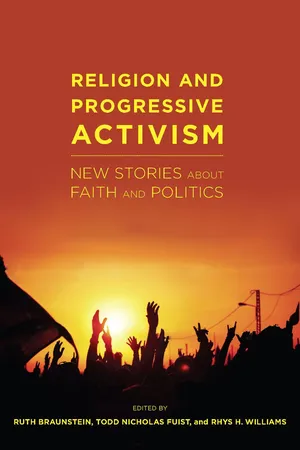
eBook - ePub
Religion and Progressive Activism
New Stories About Faith and Politics
- 368 pages
- English
- ePUB (mobile friendly)
- Available on iOS & Android
eBook - ePub
Religion and Progressive Activism
New Stories About Faith and Politics
About this book
Information
Topic
Theologie & ReligionSubtopic
Religion & WissenschaftPART I
Patterns of Progressive Religious Mobilization and Engagement
The chapters in this section examine patterns of progressive religious mobilization and engagement at the individual, organizational, and field levels. After reading this section, both longtime observers of political life and students being introduced to this world for the first time will better understand the following questions: Why do religious people become involved in progressive activism? Once they are involved, how do they organize and interact with other political groups, including political parties? Do participants within the progressive religious field share a common set of views, characteristics, and ideas about how to engage in political life? Or are there important sources of difference and diversity, including ethnic, religious, and even political diversity, within this group of Americans and the organizations they represent?
Moreover, for readers who are interested in how progressive religious activism differs from conservative religious and secular progressive activism, the chapters in this section illuminate the following three points of divergence. First, as we will see, many individuals who hold progressive religious views do not identify strongly as “progressive religious activists” per se, and progressive religious organizations vary in their identification with a broader progressive religious movement. This lack of collective consciousness stands in marked contrast to the conservative religious activist field. Although it is certainly not monolithic, the religious Right enjoys comparatively high levels of internal coherence and identification—especially concerning traditional views of gender and sexuality—albeit only after decades of intentional movement building by both local and national actors.
Second, we will learn about the complex relationship between progressive religious movement organizations and American political parties. In contrast to the religious Right, which has forged a close, albeit fraught, relationship with the Republican Party over the past several decades, we learn that progressive religious organizations have not been welcomed as fully into the Democratic Party coalition, which is dominated by secular (and secularist) progressive actors. This has limited progressive religious actors’ political influence and visibility, at least in electoral politics, but also shaped their tactical choices in important ways, including leading them to pursue action primarily at more local levels.
Finally, these chapters show the extent to which progressive religious organizations differ in their demographic composition from most conservative religious and secular progressive groups. High levels of religious, racial, and socioeconomic diversity within progressive religious organizations are reflections of these groups’ commitment to values like inclusion and equality as well as an important source of political legitimacy in an increasingly diverse society. Overall, by highlighting the field’s internal composition, coherence, diversity, and relationship to other political organizations, the chapters in this section provide readers with a multifaceted picture of this often-overlooked field as well as the actors that comprise it, and necessary context for the sections that follow.
1
Achieving and Leveraging Diversity through Faith-Based Organizing
BRAD R. FULTON AND RICHARD L. WOOD
After a perceived hiatus of several decades—“perceived” for reasons discussed below—religious progressives have reappeared in the public eye in recent years. Though mostly very marginal players in the Occupy Wall Street movement that made inequality a prominent public issue in American life by framing it as a struggle between “the one percent and the ninety-nine percent,” religious progressives have been prominent participants in the subsequent debates over house foreclosures, banking reform, racial inequities in law enforcement and sentencing, and comprehensive immigration reform (Sanati 2010; Waters 2010; Wood and Fulton 2015). Even before the Great Recession, religious progressives had been among the crucial sectors articulating why access to healthcare was a fundamental moral issue (Wood 2007). Their advocacy helped lead to renewal of the State Children’s Health Insurance Program that was twice vetoed by President George W. Bush before being signed by President Barack Obama; their subsequent moral advocacy was crucial to the passage of national healthcare reform in 2009—and particularly to its inclusion of significant subsidies for healthcare for the poor and lower middle class (Parsons 2010; Pear 2009).
The perception of religious progressives as absent from the public arena is itself an interesting phenomenon (Fulton 2016a). It is hard to argue that they have indeed been absent, given the presence of religious voices in favor of the successful immigration reform of the 1980s (Hondagneu-Sotelo 2001; Hondagneu-Sotelo et al. 2004), in favor of peace and human rights (Nepstad 2004; 2008; 2011) and against apartheid in South Africa in the 1980s and 1990s (Comaroff and Comaroff 1991; Kairos Theologians Group 1986; Wood 2000), in defense of social welfare in the 1990s (Marsh 2006), and in support of civil rights and against the American-led war in Iraq after 2001 (Religious News Service 2003). Rather than an actual absence of religious progressives, then, the key dynamic has been of vastly reduced efficacy of religious voices and organizations in claiming a strong position in favor of politically liberal and progressive social policy within public discourse.
We suggest this reduced efficacy of religious progressives—and thus the perception of their absence from public discourse—has less to do with religious progressivism itself than with three related factors: First, American political culture has shifted dramatically rightward since the Reagan administration, meaning that the arguments and policy positions of religious progressives get less of a public hearing. Second, religious conservatives have mobilized so effectively for a media-oriented political culture that they have crowded out religious voices supporting other policy alternatives. Third, as noted in the introduction to this volume, secular voices—sometimes simply non-religious voices, sometimes clearly anti-religious ones—increasingly dominate progressive policy discourse. The key question then is not whether religious progressives exist, but rather whether they can claim space in public discourse and power relations commensurate with their continuing presence in American society.
We explore that question by analyzing the field of faith-based community organizing (FBCO), which has enabled one sector of religious progressives to gain greater political influence. Our analysis suggests that religion need not be condemned to being a politically conservative force, nor to exist without effective public voice. It also suggests that progressive politics need not do without resonance with the moral instincts and religious ethical teachings that undergird many American communities. Progressive politics can draw on religious commitments rooted in many communities and across all social strata to bridge the racial/ethnic and socioeconomic divides that currently eviscerate progressive policy-making.
We focus on the high levels of diversity across religious, racial/ethnic, and socioeconomic divides that the FBCO field’s organizational infrastructure in congregations and other institutions has generated. That diversity and the sheer scale of mobilization enabled by the FBCO infrastructure together constitute faith-based organizing’s most significant sources of power and most important c...
Table of contents
- Cover
- Half Title
- Series Page
- Title Page
- Copyright
- Contents
- Acknowledgments
- Introduction: Religion and Progressive Activism—Introducing and Mapping the Field
- Part I. Patterns of Progressive Religious Mobilization and Engagement
- Part II. Cultural Challenges of Progressive Religious Activism
- Part III. The Roles of Religion in Progressive Political Action
- Part IV. Distinctive Styles of Progressive Religious Talk in the Public Sphere
- Conclusion: What Progressive Efforts Tell Us about Faith and Politics
- About the Contributors
- Index
Trusted by 375,005 students
Access to over 1.5 million titles for a fair monthly price.
Study more efficiently using our study tools.
Frequently asked questions
Yes, you can cancel anytime from the Subscription tab in your account settings on the Perlego website. Your subscription will stay active until the end of your current billing period. Learn how to cancel your subscription
No, books cannot be downloaded as external files, such as PDFs, for use outside of Perlego. However, you can download books within the Perlego app for offline reading on mobile or tablet. Learn how to download books offline
Perlego offers two plans: Essential and Complete
- Essential is ideal for learners and professionals who enjoy exploring a wide range of subjects. Access the Essential Library with 800,000+ trusted titles and best-sellers across business, personal growth, and the humanities. Includes unlimited reading time and Standard Read Aloud voice.
- Complete: Perfect for advanced learners and researchers needing full, unrestricted access. Unlock 1.5M+ books across hundreds of subjects, including academic and specialized titles. The Complete Plan also includes advanced features like Premium Read Aloud and Research Assistant.
We are an online textbook subscription service, where you can get access to an entire online library for less than the price of a single book per month. With over 1.5 million books across 990+ topics, we’ve got you covered! Learn about our mission
Look out for the read-aloud symbol on your next book to see if you can listen to it. The read-aloud tool reads text aloud for you, highlighting the text as it is being read. You can pause it, speed it up and slow it down. Learn more about Read Aloud
Yes! You can use the Perlego app on both iOS and Android devices to read anytime, anywhere — even offline. Perfect for commutes or when you’re on the go.
Please note we cannot support devices running on iOS 13 and Android 7 or earlier. Learn more about using the app
Please note we cannot support devices running on iOS 13 and Android 7 or earlier. Learn more about using the app
Yes, you can access Religion and Progressive Activism by Ruth Braunstein,Todd Nicholas Fuist,Rhys H. Williams, Ruth Braunstein, Todd Nicholas Fuist, Rhys H. Williams in PDF and/or ePUB format, as well as other popular books in Theologie & Religion & Religion & Wissenschaft. We have over 1.5 million books available in our catalogue for you to explore.