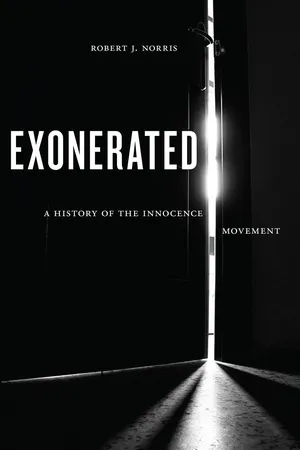
The fascinating story behind the innocence movement's quest for justice.
Documentaries like Making a Murderer, the first season of Serial, and the cause célèbre that was the West Memphis Three captured the attention of millions and focused the national discussion on wrongful convictions. This interest is warranted: more than 1,800 people have been set free in recent decades after being convicted of crimes they did not commit.
In response to these exonerations, federal and state governments have passed laws to prevent such injustices; lawyers and police have changed their practices; and advocacy organizations have multiplied across the country. Together, these activities are often referred to as the "innocence movement." Exonerated provides the first in-depth look at the history of this movement through interviews with key leaders such as Barry Scheck and Rob Warden as well as archival and field research into the major cases that brought awareness to wrongful convictions in the United States.
Robert Norris also examines how and why the innocence movement took hold. He argues that while the innocence movement did not begin as an organized campaign, scientific, legal, and cultural developments led to a widespread understanding that new technology and renewed investigative diligence could both catch the guilty and free the innocent.
Exonerated reveals the rich background story to this complex movement.
- 304 pages
- English
- ePUB (mobile friendly)
- Available on iOS & Android
eBook - ePub
About this book
Information
Topic
Ciencias socialesSubtopic
CriminologíaPart I
The History of the Innocence Movement
1
“Voices in the Wilderness”
The Beginning of Innocence
As long as there have been systems of criminal justice, there has been a chance for innocent persons to be wrongly accused, convicted, and punished. Though the widespread recognition of errors has only recently coalesced into an organized reform movement, such cases have a long history in the United States.
The U.S. story begins in Manchester, a small town in the midst of the Green Mountains in southwestern Vermont. Chartered in 1761 and named for Robert Montagu, the Third Duke of Manchester, the town is steeped in revolutionary history. It is also known as the location of the first known wrongful conviction in the United States.
A Brief History of Innocence
In 1812, farmhand Russell Colvin disappeared unexpectedly from Manchester, Vermont. Suspicion quickly fell upon his brothers-in-law, Stephen and Jesse Boorn. Seven years later, following an intricate set of circumstances involving ghostly visitations, a child born out of wedlock in need of support, and a dog digging up supposedly human bones, the Boorn brothers were convicted. The factors that led to the convictions will look familiar to anyone acquainted with wrongful convictions: a jailhouse informant who provided the state with information in exchange for his release from jail, false confessions made under threat of a death sentence, and shaky eyewitness testimony.
The sequence of events leading to the Boorns’ exonerations unfolded the same year as their convictions and was truly a stroke of luck. While in a hotel in New York, a random traveler heard the reading of a newspaper article celebrating the convictions. He knew a man named Russell Colvin who worked on a farm in New Jersey, and he wrote a letter explaining this to both the New York Post and the Manchester postmaster. When the Post published the letter, a Manchester native who lived in New York found Colvin—the same Russell Colvin who had been “murdered”1—at the New Jersey farm. The supposed murder victim returned to Manchester in December 1819, and the Boorns were ultimately exonerated. The case, considered the first wrongful conviction in the United States, generated interest around the world and later served as inspiration for Wilkie Collins’s 1873 novel The Dead Alive.2
Though records make it difficult to determine with any certainty, the Boorn brothers were certainly not alone as victims of wrongful conviction in the 1800s. In a case of mistaken identification, Thomas Berdue was convicted in 1851 for severely beating and robbing a store owner in San Francisco. William Woods and Henry Miller were both convicted and sentenced to death for the murder of John Hantz, Jr., in Kansas in 1889. And in 1891, Ameer Ben Ali was convicted in Manhattan for a particularly interesting murder; the victim’s body bore a mark of Jack the Ripper, the notorious serial killer who murdered at least five women in London between 1888 and 1891.3 The small cross on the victim’s thigh prompted several New York newspapers to proclaim the arrival of the notorious serial killer in the United States. Ali was convicted for the murder and sentenced to life in Sing Sing prison.4
The turn of the 20th century brought with it dozens more wrongful convictions—more than 25 in the first decade5—and the birth of innocence as the focus of academic study. Edwin Borchard, the law librarian of Congress, published a critical article in 1913 about compensation for the wrongly convicted, specifically the United States’ lack of support for those who had been exonerated. Borchard found it strange that in the United States, where individual rights are so vital and where the government must compensate citizens for the taking of property, “society . . . utterly disregards the plight of the innocent victim of unjust conviction or detention in criminal cases.”6
Borchard’s article called attention to the issue of compensation for exonerees, but his 1932 book Convicting the Innocent is his more famous and arguably more important work. Borchard, by then a law professor at Yale University, described 65 cases of what he believed to be erroneous convictions (including the Boorn case), described the reasons for the convictions, and proposed preventive reforms. The reforms for which Borchard advocated were mostly changes in criminal procedure including, among others, that the defendant’s prior convictions be introduced only after conviction at sentencing, that indigent defendants be provided with a public defender, that appellate courts review the facts of a case in addition to the law under which the conviction occurred, and that no defendant be given a death sentence solely on the basis of circumstantial evidence.
Although the reforms proposed by Borchard may not have actually prevented many wrongful convictions,7 the book, now an oft-cited classic, was “at the time a bold and courageous utterance”8 that “argu[ed] against the then prevailing idea that innocent people were never wrongfully convicted.”9 Borchard himself has been described as “a one-man policy juggernaut”;10 his work was motivated by the desire to enact exoneree compensation statutes, and he was heavily involved in the passage of the federal compensation law in 1938, which allowed exonerees to sue the federal government for damages up to $5,000.11 Compensation remained an important issue for Borchard; even after the federal law was passed, and nearly a decade after his groundbreaking book was published, he was still advocating for states to pass their own compensation bills.12
Borchard’s work is among the first, if not the first, real attempts at policy advocacy focused specifically on innocence, and he consciously made his work accessible to policy makers. His progressive ideology drove his passion for reform, but in terms of wrongful convictions, his focus was mainly on compensation rather than broader criminal justice reform.
Convicting the Innocent was also important in that it helped shift the question from whether wrongful convictions occur to why they happen, and in its wake, several “diagnostic and reform-minded books” followed over the next several decades.13 In 1957, the well-known judge and legal philosopher Jerome Frank and his daughter, Barbara, published Not Guilty, which narratively described a number of erroneous convictions. Similarly, author Edward Radin, known more for his portrayal of the Lizzie Borden murders, published The Innocents in 1964.
These books and others like them were written for the layperson. They often used sharp, vivid language to capture the attention and emotions of the reader; Not Guilty, for example, proclaims, “If the conviction of an innocent man were as rare as a death from the bubonic plague in the United States, we could afford to mourn the tragedy briefly and turn back to everyday affairs. Unfortunately such convictions are by no means rare.”14 They made several suggestions designed to prevent wrongful convictions, and while they mention some of the same contributors to errors that are so well-known today—eyewitness misidentification, perjury, and false confessions—their suggestions were often extremely broad. For instance, Frank and Frank suggested that the standards to become a “full-fledged prosecutor” be increased,15 and Radin argued that where the main source of evidence is an identification, “police should investigate the prisoner’s story thoroughly before starting the legal machinery against him.”16 While such statements lay out general ideals, they are far from clear-cut policy recommendations.
In addition to the seemingly once-a-decade chronicles, several other high-profile incidents throughout the 20th century raised awareness about the possibility of wrongful convictions and sparked public discussion. The questionable convictions of Sacco and Vanzetti for murder in 1921, and their executions in 1927, sparked worldwide outcry about discrimination in the criminal justice system leading to unjust outcomes.17 Several prominent individuals, including Albert Einstein, George Bernard Shaw, and H. G. Wells, advocated on behalf of Sacco and Vanzetti. Their guilt or innocence was widely debated for decades after their executions, and their case remains something of a mystery. Although the Sacco and Vanzetti case is not typically counted among the known wrongful convictions, reinvestigations into their case have led to relatively widespread belief in their innocence, and in 1977, Massachusetts governor Michael Dukakis exonerated them.18 At the very least, the Sacco and Vanzetti case sparked some debate about the possibility of erroneous convictions in the public sphere, though broadly, hearts and minds were not changed.
Other happenings throughout the century are more directly related to wrongful convictions as currently conceived. The 1940s brought the first organized attempt to uncover miscarriages of justice when lawyer and famed mystery writer Erle Stanley Gardner, the creator of the fictional detective Perry Mason, founded the Court of Last Resort, a panel of legal and investigative experts who reviewed cases of potential wrongful conviction and worked to reverse them if possible. The group is credited with exonerating at least 18 individuals and was popularized in a 1952 book, which earned Gardner an Edgar Award from the Mystery Writers of America in the category of Best Fact Crime and was portrayed in a television show that aired in the late 1950s.19
Another high-profile case in 1967 brought public attention to a questionable conviction, when rising professional boxer Rubin “Hurricane” Carter and his friend John Artis were convicted of a triple murder in New Jersey. In the mid-1970s, Carter’s case became a cause for public and celebrity action. Muhammad Ali led a public demonstration in 1975 to advocate on Carter’s behalf; the demonstration was also attended by actress Ellen Burstyn. That same year, famed singer-songwriter Bob Dylan recorded the well-known protest song “Hurricane” and visited Carter in prison. After being freed in 1976 pending a new trial, Carter was again convicted and sent back to prison. It was not until his case was discovered by teenager Lesra Martin and a group from Canada, who worked with Carter’s legal team, that his release was secured in 1985 and exoneration in 1988. Hurricane’s case attracted much media attention and sparked an outcry heard the world over.20
Carter’s case is among the most famous wrongful convictions and attracted significant attention, but it was not the only one during the 1970s. While Carter’s case was in the spotlight, and while the U.S. Supreme Court was effectively abolishing and reinstating the death penalty, 14 individuals were exonerated from death row between 1973 and 1979.21
Despite the spate of exonerations throughout the 20th century, innocence never caught on as a major reform issue in the United States. Although the specific number of wrongful convictions is unknown, particularly during this era, it is clear that such errors can and did occur, that people knew about them, and that some of those people cared. But as an issue for activism and reform, innocence lacked organization and was never sustained until the 1980s.
The Birth of an Industry
In 1978, Jim McCloskey decided to make a change in his life that surprised his friends and family. He had graduated from Bucknell University in 1964 with a degree in economics and joined the United States Navy. After being stationed in Tokyo and serving in the Vietnam War, McCloskey returned to the States and earned a master’s degree in international business. He returned to Japan for corporate work but eventually settled into a Wall Street job and later tried his hand as a management consultant in Philadelphia.22 By his mid-30s, McCloskey was financially successful yet unsatisfied: “My life was like a rainbow,” he once remarked. “It might have looked pretty, but it was vapor.”23 Single and childless, McCloskey was missing something in his life.
Feeling “shallow, selfish, unfulfilled,”24 McCloskey “wanted to lead . . . an authentic life . . . to get to the real stuff of the world.”25 He began attending church again and found inspiration in the sermons and in Scripture, the lessons from which “compelled one to serve others.”26 McCloskey decided to leave his successful job and, in 1979 at age 37, entered Princeton Theological Seminary. For the field work component of his program, he worked as a student chaplain at Trenton State Prison.27
McCloskey was not long into his student chaplain service when he met Jorge de los Santos. Known as “Chiefie,” de los Santos had served six years of his life sentence for a murder in Newark, New Jersey, during which he continually proclaimed his innocence. McCloskey described de los Santos to one journalist as “an engaging person, very compelling, and obsessed with talking about his innocence.”28 McCloskey, of course, did not know if de los Santos was innocent, but he was intrigued: “I was moved by his persistent claims of innocence, and it challenged me to do something ot...
Table of contents
- Cover
- Title Page
- Copyright Page
- Dedication
- Contents
- Acknowledgments
- Introduction: Innocence and the Criminal Justice System
- Part I. The History of the Innocence Movement
- Part II. Innocence as a Social Movement
- Appendix: Data, Methods, and Limitations
- Notes
- References
- Index
- About the Author
Trusted by 375,005 students
Access to over 1.5 million titles for a fair monthly price.
Study more efficiently using our study tools.
Frequently asked questions
Yes, you can cancel anytime from the Subscription tab in your account settings on the Perlego website. Your subscription will stay active until the end of your current billing period. Learn how to cancel your subscription
No, books cannot be downloaded as external files, such as PDFs, for use outside of Perlego. However, you can download books within the Perlego app for offline reading on mobile or tablet. Learn how to download books offline
Perlego offers two plans: Essential and Complete
- Essential is ideal for learners and professionals who enjoy exploring a wide range of subjects. Access the Essential Library with 800,000+ trusted titles and best-sellers across business, personal growth, and the humanities. Includes unlimited reading time and Standard Read Aloud voice.
- Complete: Perfect for advanced learners and researchers needing full, unrestricted access. Unlock 1.5M+ books across hundreds of subjects, including academic and specialized titles. The Complete Plan also includes advanced features like Premium Read Aloud and Research Assistant.
We are an online textbook subscription service, where you can get access to an entire online library for less than the price of a single book per month. With over 1.5 million books across 990+ topics, we’ve got you covered! Learn about our mission
Look out for the read-aloud symbol on your next book to see if you can listen to it. The read-aloud tool reads text aloud for you, highlighting the text as it is being read. You can pause it, speed it up and slow it down. Learn more about Read Aloud
Yes! You can use the Perlego app on both iOS and Android devices to read anytime, anywhere — even offline. Perfect for commutes or when you’re on the go.
Please note we cannot support devices running on iOS 13 and Android 7 or earlier. Learn more about using the app
Please note we cannot support devices running on iOS 13 and Android 7 or earlier. Learn more about using the app
Yes, you can access Exonerated by Robert J. Norris in PDF and/or ePUB format, as well as other popular books in Ciencias sociales & Criminología. We have over 1.5 million books available in our catalogue for you to explore.