Uncovers what the sociology of religion would look like had it emerged in a Confucian, Muslim, or Native American culture rather than in a Christian one
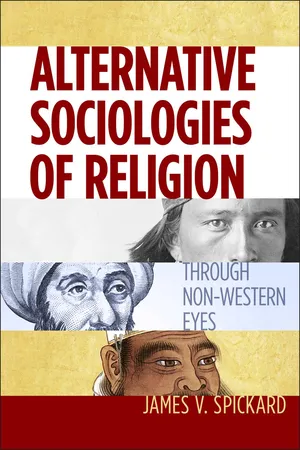
Sociology has long used Western Christianity as a model for all religious life. As a result, the field has tended to highlight aspects of religion that Christians find important, such as religious beliefs and formal organizations, while paying less attention to other elements. Rather than simply criticizing such limitations, James V. Spickard imagines what the sociology of religion would look like had it arisen in three non-Western societies. What aspects of religion would scholars see more clearly if they had been raised in Confucian China? What could they learn about religion from Ibn Khaldun, the famed 14th century Arab scholar? What would they better understand, had they been born Navajo, whose traditional religion certainly does not revolve around beliefs and organizations?
Through these thought experiments, Spickard shows how non-Western ideas understand some aspects of religions—even of Western religions—better than does standard sociology. The volume shows how non-Western frameworks can shed new light on several different dimensions of religious life, including the question of who maintains religious communities, the relationships between religion and ethnicity as sources of social ties, and the role of embodied experience in religious rituals. These approaches reveal central aspects of contemporary religions that the dominant way of doing sociology fails to notice. Each approach also provides investigators with new theoretical resources to guide them deeper into their subjects. The volume makes a compelling case for adopting a global perspective in the social sciences.
eBook - ePub
Alternative Sociologies of Religion
Through Non-Western Eyes
- 336 pages
- English
- ePUB (mobile friendly)
- Available on iOS & Android
eBook - ePub
About this book
Information
1
Sociology’s Default View of Religion
I teach a course called Saints, Sects, and Society at a small liberal arts college in California. I used to call it Sociology of Religion, but the name intimidated students. California is part of the great unchurched belt that runs along the west coast of North America from Alaska to Mexico. Fewer people belong to religious organizations there, per capita, than anywhere else on the continent, and fewer people attend religious services. Over a third of my students have never been inside a religious building. To many of them, the word “religion” means ‘old’, ‘boring’, and ‘stale’. Enrollments have doubled since I came up with the new name.
I ask students to define ‘religion’ on the first day of class. They write down their definitions, then get in small groups to compare notes. The results are telling. For most students, religion is about belief—specifically about beliefs in unseen, powerful beings. They think that religions are about God, angels, Jesus, Allah, saints, guardian spirits, etc., taking care of the universe, punishing the wicked, and responding to prayers. Most students find this implausible. Still, “That’s religion!” they say: implausible beliefs about unseen beings.
They also say that religion is about rules. Some people get to tell other people what they’re supposed to do, and those others are supposed to do it. The Pope, someone always says, tells women not to get abortions and not to use birth control. Everyone laughs, thinking of the bowls of condoms in their dorm lobbies, part of my university’s ongoing anti-AIDS campaign. Even the few students who are religious do not think much of celibate elders giving them sexual advice.
They also think that religion happens only in certain times and places. It happens on Sunday mornings in churches and cathedrals. It happens on Saturday mornings in synagogues and Fridays at mosques. The best students know that Jews celebrate Shabbos at home on Friday night, that Muslims pray five times a day wherever they are, and that Evangelical Protestants attend services on Wednesday nights as well as on Sunday mornings. Except most of them do not know what the word “Protestant” means, even if they were raised in a historically Protestant congregation. Evangelical Protestants in the U.S. now typically call themselves just “Christians” and my students do not know enough history to make the connection. Why should they? The world has changed since the 1950s heyday of Mainline Protestantism, when 40% (or more) of Americans attended religious services and Will Herberg could write a best-selling book titled Protestant, Catholic, and Jew. Now a bit over half that percentage attend weekly services and people claiming to have “no particular religion” are the fastest growing segment of the U.S. population.1
Many scholars have charted this religious decline, focusing particularly on shrinking participation in formal religious organizations.2 My course sends students to visit such organizations and to interview religious people. These interactions show them that religion consists of more than just beliefs, moral rules, and churches, synagogues, mosques, gurdwaras, and so on. Like any teacher, I try to expand my students’ conceptual universe and help them see things in new ways. I do not ask students to throw out their old ideas; I merely want them to realize that religion is a lot more complex than they ever imagined.
The Textbook View
I periodically wonder what students would learn if I did not send them out exploring. If I ran a ‘normal’ classroom, would they move beyond their beginning ideas? Not if they learned about religion from American sociology textbooks! With a few exceptions, those books describe religions as congeries of beliefs, moral teachings, and organizations—exactly the notions with which my students start.
Most people know that textbooks dominate American university teaching, giving students—and thus us—a snapshot of any discipline’s intellectual approach to the world. Though few texts contain cutting-edge material and none describe what professionals in any discipline actually do, all of them provide a standard model of their fields.3 Introductory sociology texts tell students what matters in sociology, at least as that discipline’s gatekeepers present it to the world at large. These texts tell us a lot about sociology’s default approach to religion.
In fact, American introductory sociology textbooks are all pretty much the same. Whether they come as 750-page comprehensive hardbacks, 500-page paperback ‘essentials’,4 or 250-page ‘brief introductions’, they all have the same structure. With some variation, they all begin with a chapter that defines sociology as a discipline, typically by showing how sociology can help them better understand their daily lives. Then comes a chapter about sociological theory (often titled “Thinking Sociologically”), followed by a chapter about sociological research methods. Chapters on culture and socialization almost always come next, followed either by chapters on social stratification (by class, race, and gender) or by chapters on major social institutions. Religion is presented as one of these institutions and is treated as a separate institutional sphere. It sits alongside chapters on the family, education, politics, criminal justice, work, and perhaps some others. Many texts, though not all, end with a chapter on social change.5
The ‘religion chapter’ typically takes up about 3–4% of the book.6 It always begins by defining religion, focusing on the claim that religious beliefs give meaning to people’s lives. It further highlights belief by distinguishing ‘the believer’s’ view of religion from the sociological approach. A section on religious organizations distinguishes churches, sects, denominations, and cults as competing organizational types.7 As of this writing, three of the market-leading comprehensive texts contain maps showing U.S. denominational distributions. A fourth has a list of denominational membership figures and a fifth has a chart comparing the numbers of Christians, Muslims, Jews, Hindus, and so on worldwide. Such materials encourage the reader to see ‘belonging’ as a key part of religious life and again highlight the importance of formal religious organizations.
Most texts then discuss secularization: the supposed decline in religion’s role in contemporary society. They present this either as a process of religious disenchantment—a loss of belief—or as the result of institutional differentiation: the increasing assignment of education, charity work, counseling, etc. to secular professionals rather than to the religious sphere. Both of these diminish religion’s social role. Some texts question whether secularization is really occurring, typically with polling data that show that the majority of Americans still believe in God. Some note the growth rates of self-styled ‘conservative’ religious groups, both in the U.S. and worldwide.
There are other elements. Rituals frequently appear in pictures, which tend toward the exotic; this emphasizes religion’s separateness from the ordinary world.8 Several include short essays on women’s roles in religions or on religion and race. Most mention televangelism and the continuing role of religion in politics. Several discuss Islamic fundamentalism. Though all texts cite research in the field, they are not so much sociology as slow journalism. They use sociological evidence to reinforce a common, unquestioned view of the religious world.
The most significant pattern in these texts is their strict segregation of religion into the religion chapter and their focus in that chapter on religious beliefs and organizations. Though the family, education, and other institutions have their chapters as well, only religion is so limited to one small set of pages. The few references to religion outside this chapter occur only in passing: Calvinism is usually (but not universally) mentioned in the theory chapter in connection with Weber’s “Protestant ethic” thesis about the origins of capitalism. Some texts follow Comte in arguing that religious authority was stronger before the modern era than it is now. For the most part, however, religion is missing from the chapters on other topics. One text even ignores religion in its treatment of the Israeli-Palestinian conflict! These texts portray religion as separated from the rest of life.
In short, introductory sociology textbooks portray religion as a separate institutional sphere, embodied in particular organizations that are defined by their beliefs and to which religious individuals belong.9
As we should expect, the specialty textbooks in the sociology of religion provide much more detailed information about religion, though most of them still emphasize beliefs, organizations, and moral teachings. These are designed for third- and fourth-year sociology majors, though they find a market among beginning graduate students as well. Five such texts dominate the American market. Three of have been prominent since the mid-1980s, through several editions; one of the newer texts is quite similar to these, while the other is written for undergraduates and non-sociologists, not for the discipline per se. Two European texts round out the mix. These two are aimed exclusively at graduate students and so emphasize theory and research methods more than do their American counterparts.10
In some ways, each of the American texts is a ‘religion chapter’ writ large. Each begins with a definition of religion and some discussion of the sociological point of view. Each summarizes early efforts in the field, especially the work of Émile Durkheim and Max Weber. Most have chapters entitled something like ‘Religious Groups and Organizations’ or ‘Religion as Social Organization’, though one text takes a more interpersonal, dynamic view. All cover the church-sect-denomination-cult typology. Most have a series of ‘Religion and . . .’ chapters: ‘Religion and Race’, ‘Religion and Gender’, ‘Religion and Social Change’, etc. These emphasize religion’s separation from other parts of social life. All touch on secularization and rational-choice theories, the two frameworks that have dominated American scholarship for the last few decades. All discuss the connections between religion and social inequality, religion and social conflict, how people become religious, and so on.
There are, of course, differences between them. Some treat churches as the primary religious units, and devote chapters to American denominational history, including ecumenism. One is more concerned with social processes than with institutions; another devotes considerable attention to religion’s role in popular culture. The European texts focus on European themes: secularization, the nature of the contemporary era, and the increasing number of migrants from Muslim countries.
In all cases, though, religion is treated as a matter of belief that is primarily embodied in religious organizations. That is the standard. Individual religion, religion beyond church walls, the religious aspects of public discourse, and other ‘unusual’ aspects of religious life are at the margins, not the center. If we looked at the texts alone, we would never know that these are some of the more creative areas in which sociologists have been working throughout the last decade. In textbooks, the default view holds sway.
As a sociologist who has studied religion for a long time, I find this depressing. There is too much about religion that the textbook view does not see. Most of my own fieldwork has concentrated on aspects of religion that barely receive mention here. So has much of my colleagues’ most admirable work. We will see some of their work later in this chapter, because it runs parallel to mine. It has raised the same questions that my studies of Redemption Parish and of religious social activists posed. Why does the sociology of religion continue to treat religion as a matter of beliefs embodied in formal organizations? What other options are there? What does it take to get the sociology of religion to expand its vision?
This book will present some answers. Chapter Two will trace sociology’s default view of religion to the 19th-century historical-cultural milieu that gave birth to our discipline. That milieu shaped sociology’s root ideas. It directed our attention toward certain aspects of religious life and away from others. The textbook presentations of religion are a natural result.
We can do better, and this book will do so by exploring three other historical-cultural milieux, so see what alternate sociological view of religion they might have produced, had our discipline been born in one of them. Chapters Three, Five, and Seven present, respectively, sociologies of religion based on classical Confucianism, on the social philosophy of the 14th-century Arab jurist Ibn Khaldūn, and on traditional Navajo religion, which centers on healing rituals. Chapters Four, Six, and Eight, respectively, apply these, to see what these alternate views show us about religion that we typically miss.
In short, time and place matter to intellectual life. Intellectual disciplines emerge from particular contexts and can only with difficulty recognize the blinders that those contexts impose. The default view has proved to be very strong in the sociology of religion. I am hoping that exposing it to different views will weaken its grip.
I recognize, of course, that a discipline’s textbooks do not describe that discipline completely. They do, however, capture a discipline’s first-order presumptions. The issue is not (just) that American sociology textbooks misapprehend religion. It is that they display a particular image of religion that, at this point in intellectual history, needs to be overcome.
Two Major Theories
Before engaging in that endeavor, we need to make this argument more concrete. The default view is presumed not just by textbooks but by some of the major theories in the field. We can see this by examining the two dominant theories in the sociology of religion of the last few decades. One, the secularization thesis, has been around a long time. The other, the market model of religion, was invented in the 1980s, argued strongly in the 1990s and early 2000s, and is beginning to fade. Both take what I am calling “the default view” as given: that religions are primarily about beliefs and are embodied in religious organizations. They are thus good ways to show what this default view fails to see.
We will start with the market model of religion, developed by Rodney Stark, Roger Finke, Laurence Iannaccone, and their associates. This model is admirable in its clarity and its argumentation. It focuses on religious organizations, arguing that these organizations compete for members in a “religious marketplace.” Like businesses, “religious firms” have to provide what their “customers” want. Failure to do so results in religious decline; success produces church growth.11
In their various writings, Stark and his associates have treated this market language as more than just a metaphor. They have argued that standard economic concepts help us understand a lot of things about religions that other theories do not. For one thing, they have opposed theories that traced religious decline to a changed desire for religion in the contemporary world. Following the supply-side economists who were influential in the 1980s, they argued that the demand for “religious goods” is pretty much the same in all times and places. What changes is the shape of the religious market and the supply of goods that religious “firms” make available.
Religious markets come in several varieties. Open religious markets consist of hundreds of competing churches each working hard to attract members. They offer many different flavors of religion and can thus satisfy many people’s religious demands. Closed markets, on the other hand, consist of one or a few large churches that hold a religious monopoly. They do not have to work so hard for members, because religious people have nowhere else to go. They also satisfy fewer people, so religion as a whole declines. Demand does not have to change; religions thrive when they meet more people’s needs and shrink when they need fewer of them. In this sen...
Table of contents
- Cover
- Title Page
- Copyright Page
- Dedication
- Contents
- Acknowledgments
- Introduction: A Sociologist Thinks about Religion
- 1. Sociology’s Default View of Religion
- 2. The Default View’s Historical-Cultural Origins
- 3. To China: A Confucian Alternative
- 4. China Applied: Feeding the Holy Community
- 5. To North Africa: An Arab Judge Looks at History
- 6. Ibn Khaldūn Applied: Medjugorje and the Islamic State
- 7. To the American Southwest: Navajo Ritual and the Experience of Time
- 8. Navajo Ritual Applied: World-Healing at the Catholic Worker
- 9. Are We Stealing the Elgin Marbles?
- Postscript: Living in a Global World
- Notes
- References
- Index
- About the Author
Trusted by 375,005 students
Access to over 1.5 million titles for a fair monthly price.
Study more efficiently using our study tools.
Frequently asked questions
Yes, you can cancel anytime from the Subscription tab in your account settings on the Perlego website. Your subscription will stay active until the end of your current billing period. Learn how to cancel your subscription
No, books cannot be downloaded as external files, such as PDFs, for use outside of Perlego. However, you can download books within the Perlego app for offline reading on mobile or tablet. Learn how to download books offline
Perlego offers two plans: Essential and Complete
- Essential is ideal for learners and professionals who enjoy exploring a wide range of subjects. Access the Essential Library with 800,000+ trusted titles and best-sellers across business, personal growth, and the humanities. Includes unlimited reading time and Standard Read Aloud voice.
- Complete: Perfect for advanced learners and researchers needing full, unrestricted access. Unlock 1.5M+ books across hundreds of subjects, including academic and specialized titles. The Complete Plan also includes advanced features like Premium Read Aloud and Research Assistant.
We are an online textbook subscription service, where you can get access to an entire online library for less than the price of a single book per month. With over 1.5 million books across 990+ topics, we’ve got you covered! Learn about our mission
Look out for the read-aloud symbol on your next book to see if you can listen to it. The read-aloud tool reads text aloud for you, highlighting the text as it is being read. You can pause it, speed it up and slow it down. Learn more about Read Aloud
Yes! You can use the Perlego app on both iOS and Android devices to read anytime, anywhere — even offline. Perfect for commutes or when you’re on the go.
Please note we cannot support devices running on iOS 13 and Android 7 or earlier. Learn more about using the app
Please note we cannot support devices running on iOS 13 and Android 7 or earlier. Learn more about using the app
Yes, you can access Alternative Sociologies of Religion by James V Spickard,James V. Spickard in PDF and/or ePUB format, as well as other popular books in Social Sciences & History of Religion. We have over 1.5 million books available in our catalogue for you to explore.