The ways in which pivotal spiritual figures have attempted to address the complex and various theories of salvation
Salvation – redemption or deliverance from sin – has been a key focus of Christian theology since the first days of the church. Theologians from St. Augustine to Karl Barth have debated the finer points of salvation for nearly as long, offering a bewildering array of competing and often contradictory theories.
Christian Theologies of Salvation explores the ways in which pivotal theological figures have attempted to answer these questions, tracing doctrines of salvation from the first century into the twenty-first century. Each chapter focuses on a different major theologian, first presenting the theologian's doctrine of salvation, then highlighting how the doctrine makes a distinct contribution to the church's overall dogma. The volume offers a comparative focus, including doctrines of salvation that reflect the historical development of Catholic, Orthodox, and Protestant views.
By illuminating the ways in which doctrines of salvation have evolved over the church's history, Justin Holcomb takes us across the teachings of Origin and Augustine, John Calvin and Martin Luther, and eventually to the more modern theologies of Karl Barth and Gustavo Gutiérrez. A much-needed map to the options and implications of different theologies of salvation, this book is essential reading for students and scholars of Christian thought.
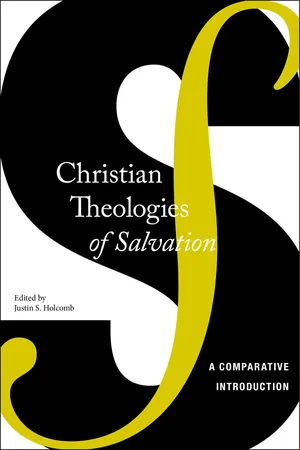
eBook - ePub
Christian Theologies of Salvation
A Comparative Introduction
- 384 pages
- English
- ePUB (mobile friendly)
- Available on iOS & Android
eBook - ePub
About this book
Information
Topic
Theology & ReligionSubtopic
Christian TheologyPart I
Patristic
1
Patristic Theologies of Salvation
An Introduction
D. H. Williams
Captain of our salvation, take
The souls we here present to thee.
And fit for thy great service make
These heirs of immortality;
And let them in thine image rise
And then transplant to paradise.
Charles Wesley first wrote these lines in 1763 for his Hymns for Children. Like much of Wesley’s material, he was indebted to the images and expressions of early Christianity, and this hymn was no exception. In these few words Wesley grasps certain fundamental concepts that appear within the patristic idea of salvation.1
But it was a long and historical bridge to cross, not merely in time; whereas eighteenth-century Methodism and most of Protestantism identified itself most prominently with a theology of soteriology, early Christian thinkers did not.
Doctrinally speaking, the era of ancient Christianity never produced a theory of salvation. One is hard-pressed to find any patristic work that even bears a title having solely to do with salvation. This is not to say that the ancients had little interest in the dynamics of salvation. Far from it. The patristic theological mind was usually very practical and pastoral, revealing that there was no value in doctrine that failed to show how God’s revelation of Himself was ultimately the basis of our redemption. Nevertheless, a reader will not find systematic and uniform teaching about salvation among patristic theologians. Like all theologies there were always new needs that required new definitions, which were no less true when it came to propounding soteriological expressions. More specifically, as a doctrine about Christ as the Son within the Trinity developed, so did ideas about what salvation must entail. But the latter was always subservient to the former. The validity of this remark will become clearer in the chapters below, which present conceptions of soteriology from different writers in different times.
If a generalization can be put forward despite the hazards of inherent limitations, it is that the early church was more dedicated to understanding the Savior as the Divine Giver of salvation than it was to salvation for the human receiver. The general idea was that if you rightly grasp the first, the other will certainly be effective. This seems to have been the major idea behind many anti-“Arian” theologies of the fourth and fifth centuries. Certain ancient writers might spell out the implications more clearly than others, as does Athanasius for example, in his De incarnatione verbi. But no one was arguing over the doctrine of the Trinity for the mere sake of perpetuating theological discourse. Patristic scholars were reminded of this obvious fact when a book published in 19812 on the Nicene-“Arian” conflicts attempted to argue that the beginnings of the Trinitarian controversies in the fourth century were not driven by a search for orthodox Trinitarian or Christology theology; rather, the theological ideas on both sides were motivated by an understanding of salvation. And thus the purpose of the conflict that began between Arius and Alexander, and later, between “Arians” and Nicenes, was about soteriological matters. As ingenious as this study was, its thesis was not generally accepted on the grounds that no one was as interested in hammering out a doctrine of salvation as they were in capturing the proper language for articulating the relation between the Father and Son. While important, the redemption of creation and humanity was not the center of the debates.
And so it seems Yocum is correct to say in chapter 5 herein that if a doctrine of atonement implies a “worked-out theory” of the utility of Christ’s work centering on a single scheme, then the early church lacked such a theory. This is not to say there was an absence of stressing the saving person and work of Christ. All used the same gospels and (for the most part) the same New Testament. There was no doubt at all that the foundational articulation was to be found here, as well as prophetically in the Old Testament. In order to understand Christ and Logos and Savior, the Bible was consulted and perceived within the church as the supreme authority for all doctrinal construction. But the need for some clarification of the way God’s gift of salvific grace came into the world was necessary.
In the chapters for part I, major figures from the patristic era are considered for the way their theologies impended on the Christian promise of salvation. Ranging from the mid-third century to the early fifth, it will become clear that certain emphases appeared and acquiesced over the years without losing track of the essential purposes of the Gospel. The differences we see in these select writers has largely to do with whom or what they were opposing; the Gnosticizing cosmogonies that occupied Irenaeus and (to a lesser extent) Origen were not an issue for Athanasius, nor were earlier writers consumed by the question of the proper relation between Christ’s divine and human natures as were Basil of Caesarea and Augustine.
While we must beware of depicting the thought of the ancients in monolithic terms, it is possible to indicate some of the broad parameters when it comes to grasping characteristics of the early Church’s approach to salvation. In doing so, we are better enabled to see the patristic age in its own light instead of one that we might create in our desire to re-appropriate their witness for today.
A very general observation can be made that God’s salvation for humanity was less important than the God who was the ground of that salvation. Obviously, it is impossible to isolate the divine work of salvation on our behalf apart from affirming the identity of who does the saving. But the point here is that there was a priority between the two in patristic theology.
A very early, anonymous document from the second century, II Clement, opens with the mandate, “Brothers, we ought to think of Jesus Christ as we do of God—as the “judge of the living and the dead.” And we ought not to belittle our salvation. For when we belittle him, we hope to get but little.” Likewise, Irenaeus (Adv. Haer. III.1) argues that all Christians learned the plan of our salvation from no others than from those through whom the gospel came to us. “They first preached it abroad, and then later by the will of God handed it down to us in Writings, to be the foundation and pillar of our faith.” His point is simple: The security of salvation was only as good as the means by which it was delivered to us.
The emphasis on the work of salvation is not the believer who accepts this gift, but the God who gives it. Despite the fact that we are hard-pressed to find a “doctrine” of soteriology, there is no question that the hundreds of references to salvation are far more theocentric than they are anthropocentric. No sin or evil scheme can thwart divine grace because nothing is greater than God’s purposes and power to save. Even if a whole people sins, as in the case of Israel in the desert, this does not overwhelm the loving-kindness of God. Gregory of Nazianzus states, “The people made a calf, yet God did not cease from His loving-kindness. Men denied God, but God could not deny Himself.”3
Turning to Origen in the mid-third century, we are told that a profession of the Son’s divinity was part of God’s saving action. While Origen claims that he must examine how fallen human are regenerated,
nevertheless, it seems proper to inquire what is the reason why he who is regenerated by God unto salvation has to do both with Father and Son and Holy Spirit, and does not obtain salvation unless with the co-operation of the entire Trinity.4
It is first necessary to describe the Father’s will, the sacrifice of the Son, and the special working of the Holy Spirit, as the beginning of describing our salvation. By the later fourth and fifth centuries, it is an essential postulate of soteriology that the Son’s salvific efforts on our behalf had become the operation of the whole Trinity. Given the Son’s sufferings and submission to death, it was critical that the Son’s passion did not mean his divinity as the Son: “The same Triune God who originally formed humanity through the work of Christ in the beginning now renews humanity through his Passion at the end.”5
Salvation Is Foremost a Demonstration of God’s Omnipotence
A close subsidiary element to the theocentric understanding of salvation above is an emphasis on the power of God which cannot be thwarted or overcome by the power of sin or the will of any creature. In no way can the rulers, the authorities, the cosmic powers of this present darkness, and spiritual forces of evil in the heavenly places (Eph 6:12) effect a change in God’s purposes or ability to enact his will. John Behr mentions this feature in Irenaeus, in whose soteriology death accomplished by human will is swallowed by the Divine life in Christ. Another way to say this is that the image of God can never be entirely obscured or dissolved by any agent of the created order. This was a lesson Augustine had to learn when he embraced the Manichaean cosmogony. In this system, there was no question the Kingdom of Light was good and exhibited the virtues of goodness. However, when the Realm of Darkness (or evil) threatened to invade the light, the “God” was incapable of defending itself against the powers of evil. In order to survive, the light had to release some of its particles into the darkness such that the darkness would be satisfied. The Manichaean “God” was good but weak and had to make a change in its original plans because of the aggressiveness of darkness.6 For the rest of his life, Augustine never propounded a theology wherein God Almighty was less than that. The point in these examples is that the dynamics of salvation was first about God demonstrating through Christ such that the divine image and life cannot be annulled by the aegis of anything that is not God (viz., created beings or powers). Bec...
Table of contents
- Cover
- Title Page
- Copyright Page
- Contents
- Introduction: Mapping Theologies of Salvation
- Part I. Patristic
- Part II. Middle Ages
- Part III. Reformation and Catholic Counter-Reformation
- Part IV. Eighteenth to Twenty-First Centuries
- About the Contributors
- Index
Trusted by 375,005 students
Access to over 1.5 million titles for a fair monthly price.
Study more efficiently using our study tools.
Frequently asked questions
Yes, you can cancel anytime from the Subscription tab in your account settings on the Perlego website. Your subscription will stay active until the end of your current billing period. Learn how to cancel your subscription
No, books cannot be downloaded as external files, such as PDFs, for use outside of Perlego. However, you can download books within the Perlego app for offline reading on mobile or tablet. Learn how to download books offline
Perlego offers two plans: Essential and Complete
- Essential is ideal for learners and professionals who enjoy exploring a wide range of subjects. Access the Essential Library with 800,000+ trusted titles and best-sellers across business, personal growth, and the humanities. Includes unlimited reading time and Standard Read Aloud voice.
- Complete: Perfect for advanced learners and researchers needing full, unrestricted access. Unlock 1.5M+ books across hundreds of subjects, including academic and specialized titles. The Complete Plan also includes advanced features like Premium Read Aloud and Research Assistant.
We are an online textbook subscription service, where you can get access to an entire online library for less than the price of a single book per month. With over 1.5 million books across 990+ topics, we’ve got you covered! Learn about our mission
Look out for the read-aloud symbol on your next book to see if you can listen to it. The read-aloud tool reads text aloud for you, highlighting the text as it is being read. You can pause it, speed it up and slow it down. Learn more about Read Aloud
Yes! You can use the Perlego app on both iOS and Android devices to read anytime, anywhere — even offline. Perfect for commutes or when you’re on the go.
Please note we cannot support devices running on iOS 13 and Android 7 or earlier. Learn more about using the app
Please note we cannot support devices running on iOS 13 and Android 7 or earlier. Learn more about using the app
Yes, you can access Christian Theologies of Salvation by Justin S Holcomb, Justin S. Holcomb in PDF and/or ePUB format, as well as other popular books in Theology & Religion & Christian Theology. We have over 1.5 million books available in our catalogue for you to explore.