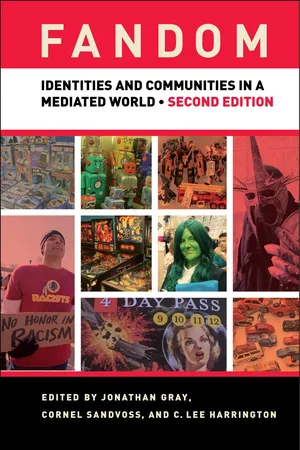
A completely updated edition of a seminal work on fans and communities
We are all fans. Whether we follow our favorite celebrities on Twitter, attend fan conventions such as Comic Con, or simply wait with bated breath for the next episode of our favorite television drama—each of us is a fan.
Recognizing that fandom is not unusual, but rather a universal subculture, the contributions in this book demonstrate that understanding fans--whether of toys, TV shows, celebrities, comics, music, film, or politicians--is vital to an understanding of media audiences, use, engagement, and participatory culture in a digital age.
Including eighteen new, original essays covering topics such as activism directed at racism in sports fandom, fan/producer interactions at Comic Con, the impact of new technologies on fandom, and the politics and legality of fanfic, this wide-ranging collection provides diverse approaches to fandom for anyone seeking to understand modern life in our increasingly mediated, globalized and binge-watching world.
eBook - ePub
Fandom, Second Edition
Identities and Communities in a Mediated World
- 448 pages
- English
- ePUB (mobile friendly)
- Available on iOS & Android
eBook - ePub
Fandom, Second Edition
Identities and Communities in a Mediated World
About this book
Information
Part I
Fan Texts and Objects
1
The Death of the Reader?
Literary Theory and the Study of Texts in Popular Culture
Cornel Sandvoss
Concerns over meaning and aesthetic value have continually haunted media and cultural studies. In many ways the field of fan studies epitomizes these concerns. The relative neglect of the question of aesthetic value (see also Hills, this volume) has made the field of media and cultural studies (hereafter cultural studies) a popular target as a “Mickey Mouse” subject. On the one hand, this is, quite literally, true: fan studies has focused on popular texts from horror films via sports events to, indeed, comics. Beyond this, however, the notion of a “Mickey Mouse” subject implies a lack of depth and theoretical rigor. It is on this level that it remains most hurtful, especially when such criticism is reiterated by those in neighboring disciplines such as literary theory. Echoing such themes and pointing to structuralism paving the way for the rise of cultural studies, Eagleton accuses the new discipline of taking advantage of the fact that
methodologically speaking, nobody quite knew where Coriolanus ended and Coronation Street began and constructed an entirely fresh field of enquiry which would gratify the anti-elitist iconoclasm of the sixty-eighters. [ . . . ] It was, in its academicist way, the latest version of the traditional avant-garde project of leaping barriers between art and society, and was bound to make its appeal to those who found, rather like an apprentice chef cooking his evening meal, that it linked classroom and leisure time with wonderful economy. (1996: 192)
If Eagleton’s words are addressed to the discipline as a whole, nowhere do they reverberate more loudly than in fan studies. Fan studies has indeed eroded the boundaries between audiences and scholars, between fan and academic more than any other field (see Hills 2002; Tulloch 2000). To Eagleton, the blurring of these formerly distinct categories has led to a decline in analytic depth and an ideological stagnation: “what happened in the event was not a defeat for this project, which has indeed been gaining institutional strength ever since, but a defeat for the political forces which originally underpinned the new evolutions in literary theory” (1996: 192). Eagleton’s critique raises a number of important questions: Has fan studies unduly neglected aesthetic value and thus become complicit in the decline of literary quality and theory alike? Have sociological studies of fan audiences in their emphasis on the micro over the macro, on fans in their subcultural context over wider social relations, undermined progressive traditions and forms of radical enquiry, as Bryan Turner (2005) has recently suggested? Is fan studies unwittingly part of a revisionist wave that has suffocated the final sparks of 1960s radicalism? Or is Eagleton’s critique just the bitter réplique of a scholar who in the shifting sands of history sees the scholarly foundations of his discipline running through his hands, witnessing the dunes of social, cultural, economic, and technological relations upon which all intellectual projects are built shifting from his field of inquiry to another?
In order to answer these questions by comparing the traditions and aims of literary theory with those of fan studies, we need to find a point of—if not compatibility—convertibility between these two fields. This point is found in the shared essence of both disciplines: the analysis and interpretation of meaning in the study of texts and their readings.
Texts and Textuality
While both disciplines share a focus on texts and the meanings that evolve around them, they already diverge in their definition of what actually constitutes a “text.” Our common understanding of texts is rooted in the idealization and imagination of closed forms of textuality that have shaped the study of written texts from the rise of modern aesthetics in Enlightenment philosophy via the Romantics, who “denied any influence from previous writers and asserted the text’s utter uniqueness” (Gray 2006: 20), to Edmund Husserl’s phenomenological search for the author’s pure intent in literary texts. “Textual studies” has thus, as Gray notes, “a long history of fetishizing the text as a solitary, pristinely autonomous object, and this notion of textuality has exerted considerable pressure, particularly on literary and film studies” (2006: 19–20). In fan studies, however, the task of defining the text has been rather more complex. To understand the origin of this difficulty, we need to briefly draw the admittedly crude distinction between form and content. Take the following textual fragment or statement: “My name is Dr. Serenus Zeitblom, Ph.D.” To those who share English as a common language, the content of this brief sentence appears clear, but it is quite impossible for anyone, myself included, to describe its content in any form other than its meaning or, even if I could, to communicate this content to others. When I summarize the content of this statement as “someone is called Serenus Zeitblom, and he has a doctorate in philosophy,” I am already describing the meaning I have generated in the act of the reading. All encounters with textual structures thus require ideational activity that inherently ties the text to its reader. No text (and content) exists independently (see Fish 1981; Holub 1992; Iser 1978).
This is, of course, hardly news. Yet, while we cannot separate content from meaning, we can observe how meaning changes in different forms of communication. If we set the same utterance or textual fragment into different contexts, its meaning, or at least its possible meanings, change. In the case of face-to-face interaction—let’s say we meet someone on the street who introduces himself with the above words—the someone who is or claims to be Serenus Zeitblom is effectively limited to the person who has been seen or heard to make this statement. Here, the reciprocity of the text limits its possible meanings. The reader of this chapter in contrast will have found it more difficult to identify who the name points to when reading the above statement. The utterer of these words does not correspond with the author, leaving you with countless possibilities as to who the possessive pronoun in “my name” refers to. It is this fundamental difference in form between written and spoken texts that Paul Ricœur accredits with what he labels as “difficulties of interpretation”: “in face-to-face interaction problems [of interpretation] are solved through a form of exchange we call conversation. In written texts discourse has to speak for itself” (1996: 56). Our observation that texts change meaning through their form, in conjunction with Ricœur’s assessment of the changing role of authorial intent in written texts, points to two important differences between fan texts and literary texts. First, in studying media audiences, we are confronted with a variety of different textual forms around which fandom evolves: alongside written texts, these include audio and sound, visual texts, audiovisual texts, and hypertexts.
The second difference concerns the way fan texts are formed across these media. Here, I owe the reader three belated definitions of “fans,” “texts,” and “fan texts.” In my earlier work, I defined “fandom as the regular, emotionally involved consumption of a given popular narrative or text” (Sandvoss 2005a: 8). In its inclusion of both texts and narratives, this definition mirrored a level of uncertainty. While we all have a sense of who fans are, conceptualizing the textual basis of their fandom seems far more difficult. Hills (1999) distinguishes between popular texts (fictional) and popular icons (factual) as possible fan objects. On the level of the author, this distinction is of course correct. In the cases of literary fandom (see Brooker 2005) or fandom based on television shows, texts are written or controlled by copyright and license holders; they are in one form or another authored. In contrast, we do not describe popular icons such as musicians, actors, or athletes, or other fan objects such as sport teams, as deliberately authored texts. Even where those in the center of the public gaze aim to maintain a public and hence staged persona, fans’ interests often focus on what lies behind the public façade, as is exemplified in the title of celebrity biographies from The Real David Beckham (Morgan 2004) to Albert Goldman’s (2001) notorious The Lives of John Lennon. However, the popularity of such biographies already signals that we cannot rely on authorship as a defining element of textuality; indeed, the success of these books is often based not on their actual author, who may be unknown to readers, but on the subject—the object of fandom. Whether a given fan object is found in a novel, on a television program, or as a popular icon, fan objects are read as texts on the level of the fan/reader. They all constitute a set of signs and symbols that fans encounter in their frames of representation and mediation, and from which they create meaning in the process of reading. Consequently, what is needed is a broad definition of texts that is based not on authorship, but on texts as frames of realizable meanings that span across single or multiple communicative acts, including visual, sound-based, and written communication. Yet, what the example of celebrity biographies shows is that we need to reflect on textual boundaries too. As we remove authorship as the essence of textuality, the notion of the single text that can be distinguished from other texts becomes impossible to maintain, as it is now not by the producer but by the reader that the boundaries of texts are set (Sandvoss 2005a, 2005b).
The capability of media audiences to define textual boundaries is inextricably linked with their media of delivery. The home-based and mobile media through which most fan texts are consumed—television, radio, magazines, Walkmen and iPods, the Internet—are firmly entrenched in the structure of everyday life in late industrialism, embedding the act of reading in a social and technological context not only that is nonreciprocal (Thompson 1995), but also in which textual boundaries at the point of production are evaded through the technological essence of such media as spaces of flow (see Williams 1974; see also Corner 1999). Television finds its true narrative form in seriality (Eco 1994), while the hypertextuality of the Internet forces the reader/user into the active construction of the text’s boundaries. Moreover, through notions of genre and the capitalist imperative of market enlargements that drives them, textual motives from narratives to fictional characters and popular icons are constituted and reconstituted across different media. A sports fan will read and watch texts in reference to his or her favorite team on television, on the radio, in newspapers, in sport magazines, and, increasingly, on the Internet; soap fans (Baym 2000) turn to the World Wide Web and entertainment magazines as part of their fandom; the fan of a given actress will watch her in different films but also follow further coverage in newspapers or read the above-mentioned celebrity biographies. Fan objects thus form a field of gravity, which may or may not have an urtext in its epicenter, but which in any case corresponds with the fundamental meaning structure through which all these texts are read. The fan text is thus constituted through a multiplicity of textual elements; it is by definition intertextual and formed between and across texts as defined at the point of production.
The single “episodes” that fans patch together to form a fan text are usefully described by Gray, drawing on Genette, as “paratext” that “infringes upon the text, and invades its meaning-making process” (2006: 36). As the fan text takes different forms among different fan groups—namely, the audience sections “fans,” “cultists,” and “enthusiasts,” with their different use of mass media, which Abercrombie and Longhurst (1998) describe—the balance between urtext and paratexts changes. In Gray’s words, to the degree that “we actually consume some texts through paratexts and supportive intertexts, the text itself becoming expendable” (2006: 37). What follows is a radically different conceptualization of “texts” than in literary theory. Individual texts at the point of production are part of a wider web of textual occurrences and the meanings derived from them. These textual elements are read in the context of other texts. Intertextuality is thus the essence of all texts. While many contemporary fan texts such as The Simpsons, on which Gray focuses, or South Park are based on parody and thus more ostensibly intertextual than others, meaning construction through text and context does not by itself allow us to distinguish between literary and mediated texts. The field of comparative literature, for instance, draws on the long-standing tradition of motive and theme research. Yet in each and every case, the textual field in which the individual text is positioned will allow the reader to construct different meanings.
On a most obvious level, this relates to existing knowledge. Those readers with an interest in twentieth-century German literature will not have been quite as clueless about who the above-mentioned Serenus Zeitblom was. They will have recognized the sentence “My name is Dr. Serenus Zeitblom, Ph.D.” as the opening sentence of the second chapter of Thomas Mann’s Doktor Faustus, in which the narrator, Serenus Zeitblom, apologizes for his belated introduction. It is then a form of preexisting interest or what we might call an object of fandom (the work of Thomas Mann) that allows us to create meaning through contextualization that will have remained hidden to other readers—just as if the sentence in question had been “My name is Slim Shady,” different paratexts would have come into play for different fan groups. Beyond this, Mann’s Doktor Faustus serves as a lucid example of intertextuality in literary works in their literary and multimediated context: “the life of the German composer Adrian Leverkühn as told by a friend,” as the subtitle of its English translations goes, is an adaptation of the Faust motive—the selling of one’s soul to the devil for earthly talents, powers, or knowledge—that spans through all forms of textuality in European literature and storytelling, beginning with the late medieval German myth via Goethe’s Urfaust to Bulgakov’s Macmep u Mapzapuma, poetry (Heine’s Der Doktor Faust), theater such as Paul Valéry’s fragment Mon Faust, music by Berlioz, Wagner, Liszt, and the Einstürzenden Neubauten, filmic adaptations, including Murnau’s Faust: Eine Deutsche Volkssage, and comic supervillains such as DC Comics’ Felix Faust, to name only a few.1 Beyond such direct adaptations, the Faust motive resurfaces in a plethora of popular texts including George Lucas’s Star Wars. Yet, Mann’s Doktor Faustus is not only part of an intertextual web; it also, like Mann’s preceding work, is based on an ironic gesture of the narrator, the by now familiar Serenus Zeitblom, which takes back the narrative and the pretense of representing the real; a gesture in Mann’s work that according to Adorno (1991) reflects the crisis of the narrator in the modern novel as a direct consequence of the proliferation of new modes and media of representation, namely, film (see also Benja...
Table of contents
- Cover
- Title Page
- Copyright Page
- Contents
- Introduction: Why Still Study Fans?
- Part I. Fan Texts and Objects
- Part II. Spaces of Fandom
- Part III. Temporalities of Fandom
- Part IV. The Fan Citizen: Fan Politics and Activism
- Part V. Fan Labor and Fan-Producer Interactions
- About the Contributors
- Index
Trusted by 375,005 students
Access to over 1.5 million titles for a fair monthly price.
Study more efficiently using our study tools.
Frequently asked questions
Yes, you can cancel anytime from the Subscription tab in your account settings on the Perlego website. Your subscription will stay active until the end of your current billing period. Learn how to cancel your subscription
No, books cannot be downloaded as external files, such as PDFs, for use outside of Perlego. However, you can download books within the Perlego app for offline reading on mobile or tablet. Learn how to download books offline
We are an online textbook subscription service, where you can get access to an entire online library for less than the price of a single book per month. With over 1.5 million books across 990+ topics, we’ve got you covered! Learn about our mission
Look out for the read-aloud symbol on your next book to see if you can listen to it. The read-aloud tool reads text aloud for you, highlighting the text as it is being read. You can pause it, speed it up and slow it down. Learn more about Read Aloud
Yes! You can use the Perlego app on both iOS and Android devices to read anytime, anywhere — even offline. Perfect for commutes or when you’re on the go.
Please note we cannot support devices running on iOS 13 and Android 7 or earlier. Learn more about using the app
Please note we cannot support devices running on iOS 13 and Android 7 or earlier. Learn more about using the app
Yes, you can access Fandom, Second Edition by Jonathan Gray,Cornel Sandvoss,C. Lee Harrington in PDF and/or ePUB format, as well as other popular books in Social Sciences & Media Studies. We have over 1.5 million books available in our catalogue for you to explore.