Accounts of remarkable women at the world's most powerful court
Consorts of the Caliphs is a seventh/thirteenth-century compilation of anecdotes about thirty-eight women who were consorts to those in power, most of them concubines of the early Abbasid caliphs and wives of latter-day caliphs and sultans. This slim but illuminating volume is one of the few surviving texts by the prolific Baghdadi scholar Ibn al-Sa'i, who chronicled the academic and political elites of his city in the final years of the Abbasid dynasty and the period following the cataclysmic Mongol invasion of 656/1258.
In this work, Ibn al-Sa'i is keen to forge a connection between the munificent wives of his time and the storied
lovers of the so-called golden age of Baghdad. Thus, from the earlier period, we find Harun al-Rashid pining for his brother's beautiful slave, Ghadir, and the artistry of such musical and literary celebrities as Arib and Fadl, who
bested the male poets and singers of their day. From times closer to Ibn al-Sa?i's own, we meet women such as Banafsha, who endowed law colleges, had bridges built, and provisioned pilgrims bound for Mecca; slave women whose funeral services were led by caliphs; and noble Saljuq princesses from Afghanistan.
Informed by the author's own sources, his insider knowledge, and well-known literary materials, these singular
biographical sketches bring the belletristic culture of the Baghdad court to life, particularly in the personal narratives and poetry of culture heroines otherwise lost to history.
An English-only edition.
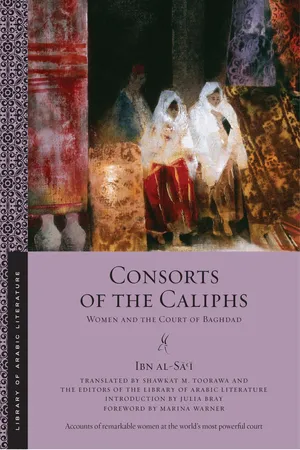
eBook - ePub
Consorts of the Caliphs
Women and the Court of Baghdad
- 176 pages
- English
- ePUB (mobile friendly)
- Available on iOS & Android
eBook - ePub
Consorts of the Caliphs
Women and the Court of Baghdad
About this book
Information
CONSORTS OF THE CALIPHS
In the name of God, Full of Compassion, Ever Compassionate, in Whom I place my trust
By praising God, lord of all the worlds, I begin * and by pronouncing blessings upon our master Muḥammad and his kin. * Having compiled The Lives of Those Gracious and Bounteous Consorts of Caliphs * Who Lived to See Their Own Sons Become Caliph * I now wish to write * about famous favorites * whether consorts or concubines of caliphs.
God grant me success! 0.1
God grant me success! 0.1
1

ḤAMMĀDAH BINT ʿĪSĀ1
WIFE OF THE CALIPH AL-MANṢŪR
I cite the trustee ʿAbd al-Wahhāb ibn ʿAlī who gave me license to cite ʿAbd al-Raḥmān ibn Muḥammad al-Shaybānī, who cites master2 Aḥmad ibn ʿAlī, who cites al-Ḥasan ibn Abī Bakr as saying that Abū Sahl Aḥmad ibn Muḥammad al-Qaṭṭān3 said: 1.1
I heard Thaʿlab4 say:
When the caliph al-Manṣūr’s wife, Ḥammādah daughter of ʿĪsā, died, al-Manṣūr and his retinue stood at the edge of the grave that had been dug for her and awaited the arrival of the funeral procession.
The poet Abū Dulāmah was in the procession. Al-Manṣūr turned to him and asked, “What have you brought us on this sad occasion, Abū Dulāmah?”
“The body of Ḥammādah daughter of ʿĪsā, Sire!” he replied, and everyone burst into laughter.5
2
GHĀDIR
“Inconstance”
SLAVE OF THE CALIPH AL-HĀDĪ
Jaʿfar ibn Qudāmah writes:6 2.1
Ghādir had the most beautiful face and voice and al-Hādī loved her intensely. As she was singing to him one day, a thought occurred to him. One of his close companions asked him why he was preoccupied.
“I’ve realized I’m going to die, and that my brother Hārūn will succeed me as caliph and marry my slave,” he replied.
“God forbid!” everyone exclaimed, “May you outlive us all!”
Al-Hādī summoned his brother and told him about his misgivings, and Hārūn did his best to reassure him. But al-Hādī insisted, “Swear to me that when I die, you will not marry her!”
He had Hārūn swear that if he broke his vow, he would perform the hajj on foot, divorce all his wives, free all his slaves, and distribute everything he owned as alms. Al-Hādī also had Ghādir make a corresponding vow.
Less than a month later al-Hādī died. Hārūn was given the oath of allegiance, becoming the caliph al-Rashīd, and immediately sent an emissary to Ghādir, asking for her hand in marriage.
“What shall we do about the vow?” she asked.
“I’ll pay an atonement for all the vows,” al-Rashīd replied, “and perform the hajj on foot.”
So she accepted his offer and he married her.
Al-Rashīd fell so deeply in love with Ghādir that he would place her head in his lap as she slept and would not move or shift position until she woke. 2.2
One day, she was asleep and woke up in a fright, sobbing.
Al-Rashīd asked what was troubling her, and she said, “I’ve just seen your brother in a dream and this is what he said:
When the dead became my neighbors
the vow you took meant nothing to you.
You forgot me and broke your word
your vow was a shameless lie.7
Treacherously you bedded my brother:
‘Inconstance’—how well they named you!
I spend my nights with corpses,
you spend your days with dark-eyed beauties!
Curse your new love!
Disaster strike you!
Drop dead before morning!
As I am now, may you be too!
“I swear, Sire, I can almost hear him now! His words are graven on my heart and I can’t get them out of my mind!”
«Muddled nightmares!»,8 al-Rashīd replied, comforting her.
“No, no!” she cried, trembling. Then she gave a shudder and died on the spot.
This happened in the year 173 [789–90].
3
ʿINĀN, DAUGHTER OF ʿABD ALLĀH9
“Restraint”
SLAVE OF AL-NĀṬIFĪ10
ʿInān was a poet and woman of wit about whom there is a written body of anecdotes. 3.1
Abū l-Faraj al-Iṣfahānī mentions her in the Book of Songs. He writes: 3.2
Al-Nāṭifī’s slave ʿInān was a blonde of mixed parentage, brought up and trained in al-Yamāmah.
Al-Nāṭifī had purchased her and al-Rashīd wanted to buy her from him. But ʿInān’s notoriety and the fact that many poets satirized her prevented him from doing so, although he was quite besotted and infatuated with her. The story goes that al-Rashīd sent for ʿInān and offered to buy her from al-Nāṭifī, who named a price of one hundred thousand silver dirhams. Al-Rashīd agreed, kept her for a while, but then sent her back. Relieved, her master al-Nāṭifī gave away thirty thousand dirhams in charity.
When al-Nāṭifī died, she was sold for two hundred thousand dirhams.
ʿInān was the first poet to become famous under the Abbasids and the most gifted poet of her generation. The major male poets of the time would seek her out in her master’s house where they would recite their verses to her and have her pass judgment. 3.3
When her master died, ʿInān was freed—either because he had bequeathed her her freedom in his will or because she had borne him a child.11 3.4
Citing sources going back to Marwān ibn Abī Ḥafṣah, Abū l-Faraj al-Iṣfahānī reports that Marwān said: 3.5
One day I ran into al-Nāṭifī, who invited me to come and meet ʿInān. We went to his house and he entered her room ahead of me saying, “Look, I’ve brought you the greatest poet of all—Marwān ibn Abī Ḥafṣah!”
ʿInān was not feeling well and said, “I have other things than Marwān to worry about right now!”
Al-Nāṭifī struck her with his whip and called out to me, “Come on in!”
I entered and found her weeping. Seeing her tears...
Table of contents
- Cover
- Title Page
- Copyright
- Contents
- Letter from the General Editor
- Abbreviations
- Foreword
- Acknowledgments
- Introduction
- Maps
- Note on the Translation
- Notes to the Front Matter
- Consorts of the Caliphs
- Notes
- The Abbasid Caliphs
- The Early Saljūqs
- Chronology of Women Featured in Consorts of the Caliphs
- Glossary of Names
- Glossary of Places
- Glossary of Realia
- Bibliography
- Further Reading
- Index
- About the NYU Abu Dhabi Institute
- About the Translators
- The Library of Arabic Literature
Trusted by 375,005 students
Access to over 1.5 million titles for a fair monthly price.
Study more efficiently using our study tools.
Frequently asked questions
Yes, you can cancel anytime from the Subscription tab in your account settings on the Perlego website. Your subscription will stay active until the end of your current billing period. Learn how to cancel your subscription
No, books cannot be downloaded as external files, such as PDFs, for use outside of Perlego. However, you can download books within the Perlego app for offline reading on mobile or tablet. Learn how to download books offline
Perlego offers two plans: Essential and Complete
- Essential is ideal for learners and professionals who enjoy exploring a wide range of subjects. Access the Essential Library with 800,000+ trusted titles and best-sellers across business, personal growth, and the humanities. Includes unlimited reading time and Standard Read Aloud voice.
- Complete: Perfect for advanced learners and researchers needing full, unrestricted access. Unlock 1.5M+ books across hundreds of subjects, including academic and specialized titles. The Complete Plan also includes advanced features like Premium Read Aloud and Research Assistant.
We are an online textbook subscription service, where you can get access to an entire online library for less than the price of a single book per month. With over 1.5 million books across 990+ topics, we’ve got you covered! Learn about our mission
Look out for the read-aloud symbol on your next book to see if you can listen to it. The read-aloud tool reads text aloud for you, highlighting the text as it is being read. You can pause it, speed it up and slow it down. Learn more about Read Aloud
Yes! You can use the Perlego app on both iOS and Android devices to read anytime, anywhere — even offline. Perfect for commutes or when you’re on the go.
Please note we cannot support devices running on iOS 13 and Android 7 or earlier. Learn more about using the app
Please note we cannot support devices running on iOS 13 and Android 7 or earlier. Learn more about using the app
Yes, you can access Consorts of the Caliphs by Ibn al-Sāʿī, Shawkat M. Toorawa, Shawkat M. Toorawa,The Editors of the Library of Arabic Literature in PDF and/or ePUB format, as well as other popular books in History & Middle Eastern History. We have over 1.5 million books available in our catalogue for you to explore.