Finalist, 2020 Latino Book Awards, Best Academic Themed Book
The surprising effects of American TV on global viewers
As a dominant cultural export, American television is often the first exposure to American ideals and the English language for many people throughout the world. Yet, American television is flawed, and, it represents race, class, and gender in ways that many find unfair and unrealistic. What happens, then, when people who grew up on American television decide to come to the United States? What do they expect to find, and what do they actually find?
In America, As Seen on TV, Clara E. Rodríguez surveys international college students and foreign nationals working or living in the US to examine the impact of American television on their views of the US and on their expectations of life in the United States. She finds that many were surprised to learn that America is racially and economically diverse, and that it is not the easy-breezy, happy endings culture portrayed in the media, but a work culture. The author also surveys US-millennials about their consumption of US TV and finds that both groups share the sense that American TV does not accurately reflect racial/ethnic relations in the US as they have experienced them. However, the groups differ on how much they think US TV has influenced their views on sex, smoking and drinking.
America, As Seen on TV explores the surprising effects of TV on global viewers and the realities they and US millennials actually experience in the US.
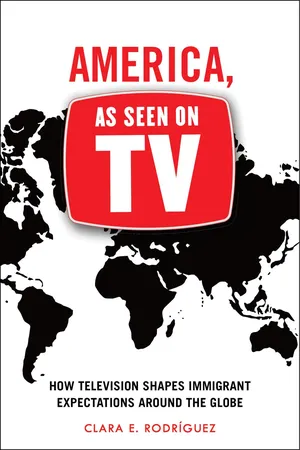
eBook - ePub
America, As Seen on TV
How Television Shapes Immigrant Expectations around the Globe
- 240 pages
- English
- ePUB (mobile friendly)
- Available on iOS & Android
eBook - ePub
America, As Seen on TV
How Television Shapes Immigrant Expectations around the Globe
About this book
Information
Part I
Overview
1
The Global Television Landscape Literature
Various works (including my own research) on racial, ethnic, and gender images led me to think about how people in other countries are influenced by American TV. But my interest in this topic has deep personal and historical roots, and my routes to this book have been many. Some have been surprising, and as I reflect on them now, some have been circuitous. I suspect that as a child I must have had some degree of awareness—as did US Supreme Court Associate Justice Sonia Sotomayor—that the people whom I saw on our small TV screen didn’t look very much like me or most of the people who were part of “my beloved world” growing up in the South Bronx (Sotomayor, 2013). At some point, I began to think more deeply about what we saw on TV and question how it influenced the ways in which we see and assess ourselves and others. That intellectual commitment may have started with my reading of Marshall McLuhan, who was among the first to successfully draw major public attention in the United States to the medium (i.e., the media) not only for the messages it conveys but also for its larger impact on society—how “we shape our tools and thereafter our tools shape us.”1 But I don’t think that I fully got the message that “the medium was the message or the massage” then. I was curious but still a bit unsure as to what the implications really were.2
My Journey to and through the Literature
Other readings, events, and comments undoubtedly influenced me along the way. The civil rights movement focused on both personal and institutional racism in its many forms. In 1968, after the race riots following Dr. Martin Luther King Jr.’s assassination, President Lyndon Baines Johnson established the National Advisory Commission on Civil Disorders, often referred to as the Kerner Commission (US Kerner Commission, 1968). Its final report shined intense light on the institutional racism that pervaded the land. One of the Kerner Commission’s focuses was on the world of mass media, especially Hollywood movies and TV shows, which were critiqued for ignoring African Americans and other groups, both behind and in front of the cameras. Some changes were made, as the movie and TV industries committed themselves to add more diversity, and to better reflect the social realities of the land. As Lichter and Amundson (1994) would later point out, we saw a shift from the “All-White World” of the 1950s to the “Return of Race” in the late 1960s and early 1970s; and then, in the 1980s, came a move to the “Let a Hundred Flowers Bloom” period, which featured a variety of women, classes, and racial and ethnic characters. Although there were (and still are) problems in representation, people of color and women began appearing in movies and on TV in increasing numbers and in better roles. So change was possible, I thought.3
But what impact did those changes in programming have? When All in the Family (1971–79) aired, the show’s creator said he sought to highlight the stupidity of prejudice by making its lead character, Archie Bunker—an outspoken, hardheaded, working-class White bigot—often look like a buffoon in his interactions with his family members and Black neighbors. But while the show’s liberal viewers saw in this a skewering of racist attitudes, others identified with Archie Bunker and had their prejudices reinforced when they watched the show (Vidmar and Rokeach, 1974).
This led me to wonder: how did the shows that did not seek to be expressly “antiracist”—the run-of-the-mill shows that populated the networks and that scholars continue to fault for under- or misrepresenting race, ethnicity, class, and gender—influence viewers and society? It was when I began teaching media-related courses at my college in the early 1990s that I became seriously aware of the extent to which such non-mission-driven shows and media in general influence how people see the world.4 My students moved me to ask questions like these: How come the then-popular shows Friends and Seinfeld, both set in New York City, were populated with characters who had no (with one or two transient exceptions) “friends” who are people of color? How come some of my brightest minority students who were fans of these shows never noticed this? By this time, I had woken up to the sad fact that television did not do right by the “glorious mosaic” that characterized New York City even then. I also became aware then of how much New York City was (and still is) a major setting for many dramas and situation comedies—and that it was and still is projected, to a large degree, from a less inclusive perspective. And so I continued to ask, where were “we” (the people I knew) on TV? And where were “we” as a society?
Along the way, as globalization increased, I wondered how the very issues that concerned me with regard to US TV—its representations of women, class, and racial and ethnic groups—might influence people in other countries. This awareness was likely influenced by the growing number of international students, faculty, and events in my life. But it was fueled as well by the evolving literature and discussions in the area, which pointed to how US media were influencing people in other countries because of increasing globalization.5 One book that contributed heavily to popular and literary discussions of these issues was Pico Iyer’s Video Night in Kathmandu: And Other Reports from the Not-So-Far East (1988). Iyer, a novelist and essayist who was born in England to parents from India and grew up partly in California, spent seven months crisscrossing the Asian continent, spending a few weeks in each country.6 His goal was to see “how America’s pop-cultural imperialism spread through the world’s most ancient civilizations.” He wanted to see “what kind of resistance had been put up against the Coca-Colonizing forces and what kind of counter-strategies were planned.” He “hoped to discover which Americas got through to the other side of the world and which got lost in translation” (5).
What he found in his travels were images of America and attitudes about American influence that were “perplexingly double-edged,” and often ripe with irony. They included the slogans “Yankee Go Home” and “America, Number One”; communist guerrillas in the Philippines fighting capitalism while wearing UCLA T-shirts; Sandinista leaders in Nicaragua waging war against “U.S. imperialism” while watching prime-time American TV on private satellite dishes; and many White people in South Africa who were still clinging to apartheid but could not get enough of Bill Cosby, Eddie Murphy, and Mr. T.—three popular African American stars of the time. Indeed, underscoring these contrasts, Iyer begins his book by describing a US veteran of the Vietnam War who returns to his old battlegrounds in Vietnam in 1984 and finds the locals jiving along to Bruce Springsteen’s major hit “Born in the U.S.A.” The vet says: “Our clothes, our language, our movies and our music—our way of life—are far more powerful than our bombs” (5). In essence, what he found in the 1980s was that “the takeover” had radically accelerated and intensified; there were now satellites beaming images of “America and other peoples” to the United States and to each other, faster than a speeding bullet. As Iyer notes, “suddenly then, America could be found uncensored in even the world’s most closed societies” (6).
On my journey to the literature there were other sources that described the globalization of media and, in particular, the impact of US media. One that stands out because of its relationship to events in the United States at the time is an article by Ron Suskind (2001) in the New York Times Magazine. Suskind had been sent by the Times to study changes in the religion, lifestyles, and daily ethics of the Ibatan people, who live on Babuyan, an island in the Philippines. These people had been totally isolated from modern society until 1977, when a 29-year-old missionary arrived there with his Chinese American wife and two daughters to translate the Christian Bible into their language.7 When Suskind arrived, the population had grown to 1,400 from 600 (since 1977) and, as Suskind relates, “400 of 1,000 were now devout Christians, a community of fervent Puritan ethicists that would make Max Weber take notice.” As it turned out, he was on his way to Babuyan on September 11, 2001, the very day that the World Trade Center and the Pentagon were attacked.
What he found on the island was fascinating. As he put it, it was a “kind of a microcosm of what the world was suddenly fighting over—not simply West versus East or Judeo-Christian vs. Islam, but the very idea of modernity and what constitutes human progress.” But what I found so interesting was the role that television played in the Ibatan people’s understanding of the world outside of Babuyan. Since they were not on the grid, the video programs they watched were limited and somewhat dated. This was evident in Suskind’s description of his arrival: “The islanders had long anticipated our arrival; they had even heard about me, a Jewish reporter from the United States, and they joyously greeted us at the airfield and accompanied us into the village.” Later that evening, Ruben, a church elder, told Suskind that a “recent hit” at his house was Ben-Hur, “the 1959 classic with Charlton Heston as a he-man Jewish slave and chariot champion during the time of Christ.” Ruben told Suskind that evening as he switched away from CNN to a station from Manila: “We thought the Jews were the world’s toughest people. . . . Everyone thought you’d be bigger.” This story—as innocent and/or odd as it may seem to be to some—illustrates the power of media to create and shape perceptions, especially when viewers have little, if any, contact with the people being portrayed on the screen, and especially when the media to which they are exposed are limited. Indeed, as much of our historical and contemporary literature suggests—and as our own personal experiences often confirm—the less one knows about a particular group, place, or system, the more one is likely to be influenced by what one sees in the media.8
The Influence of US Media in Other Countries
Having traversed these early routes, I turn now to a review of the literature that has influenced my thinking and this work more recently and more directly.9 I begin first with a review of works that have examined how US TV and Western media more generally have impacted other countries. As is the case in many academic discourses, there are more than two sides to this issue, which continues to be debated.
Cultural Imperialism?
In the 1980s and 1990s, much of the literature was concerned with (1) the extent to which people in other countries consumed US TV, (2) whether this constituted a form of “cultural or media imperialism,” and (3) how it affected people in other countries.10 To some degree these concerns were personified in the worldwide fascination with a then hugely popular US TV drama called Dallas.11 A major hit in the United States, it also absorbed numerous audiences across the globe. Indeed, in the mid-1980s, Ang (1985) counted 90 countries where Dallas succeeded in emptying the streets while the program was airing. The show’s popularity also made for overloaded telephone and water systems during its commercials. Dallas failed only in Brazil and Japan. However, it fascinated a large and diverse audience, including Danish, German, English, Israeli, and Algerian viewers. According to De Bens and de Smaele (2001), this fascination with Dallas was still important at the end of the 1990s, several years after the show’s initial run ended in the United States.
Following up on this general concern with “Dallasification,” Liebes and Katz (1990) researched the question of whether Dallas was understood in the same way in different countries and among different sectors within these countries. In essence, they asked, did the drama evoke different kinds of understanding and response among different groups? To study this question, they chose groups of three married couples that were of like age, education, and ethnicity in Israel. These included Israeli Arabs, newly arrived Russian Jews, veteran Moroccan settlers, and members of kibbutzim (typically second-generation Israelis). The Israeli groups were matched with 10 US groups of second-generation Americans in Los Angeles and with 11 groups in Japan. In total there were 65 groups of six persons each. On Sunday night, when Dallas was broadcast, each group met in the home of one of the couples together with a trained interviewer, who led a discussion after the broadcast. Researchers also observed the viewers and noted their reactions to the show during the viewing.
What they found was that the groups differed in the way they received or perceived the show, and, as the authors described it, in their inclinations to retell the specific episodes. Arabs and Moroccan Jews tended to describe Dallas as a sociological story of family. The couples in the United States and in the kibbutzim saw it as a psychological story of personality, and the Russians saw it as an ideological paradigm with primordial themes, such as the story of Genesis and the rivalry between brothers. The Japanese, however, rejected the story’s bid for acceptance as reality; they saw the show as incongruent with what they knew of Japan or the United States, in the traditional or modern sense. They also did not see it as art. They just were not fans. Liebes and Katz’s work challenged the then-prevalent view of American cultural imperialism as “a hegemonic message [that] was transferred to the defenseless minds of viewers all over the world; and that this reflected the self-serving interests of the economy and ideology of the exporting country” (4).12
Sponges or Filters?
Many other scholars also questioned the cultural imperialism thesis (Downey and Mihelj, 2012; De Bens and de Smaele, 2001). Many began to argue that people in other countries (as well as in the United States) were “not simply passive receivers of information” and that they could alter and interpret the media they watched (Carroll, 2001; Rentfrow, Goldberg, and Zilca, 2011). Elasmar (2003:206) perhaps put it best when he quoted Browne (1967:206), who said that if a picture is worth a thousand words, “those words will not mean the same thing to everyone.” I would add that if this is the case, then how many meanings will a moving picture stimulate—especially within different cultures and subcultures?
This is not to deny the fact that US TV is often framed unconsciously by viewers, as well as intentionally by producers, as a representative expression of a major power, if not the major power in the world, or that this context may also influence—and make for similar responses to—the “American brand.” Indeed, as many of my respondents emphasized, and as Carroll (2001:1) and many others have noted, the United States is generally perceived as an exceedingly powerful country, possessing wealthy transnational corporations, great influence within and among international regulatory organizations, major military might, and the ability to structure and control economic and other interactions all over the world. This macro political and economic context is not without its own influence on viewers consuming US TV. The rapidity of contemporary transnational information flows—many of which emanate from the United States—likely accentuates this view.
Regional Markets
Still other scholars contest and complicate the literature on cultural imperialism, arguing in effect “not so fast”: there are and always have been other dynamics at play that influence reception. Straubhaar (2007), for example, analyzed TV schedules he gathered for the past 10 years in over 22 different countries; he examined one week of programming in each year.13 He did not find that US TV reigned supreme with regard to programming, but rather that there were cultural-linguistic regional markets where viewers watched mainly domestic programming. He found that in Latin America, Asia, and the Middle East, more people watched transnational programming—soaps, comedies, news, and variety shows—than truly global channels such as CNN, HBO, MTV, or Discovery.14 He concluded that there was a multilayered world of television, in which what was common was not US cultural imperialism but hybridization or glocalization, in other words, adaptations or hybrids of global programs and formats to conform to local patterns. Straubhaar also countered the idea, suggested by some media scholars at the time, that people were not really watching much TV, that the medium was no longer as powerful as it once was:
[F]or most people in most countries, television remains the central element in their consumption of the cultural industries. A television set (or a better television set) is still the main consumer priority for most people in the developing world (and still a high priority elsewhere, as large recent spending on digital high-definition television sets in the richer countries also shows). (Straubhaar, 2007:1)15
However, he also held that global TV involved many actors and many levels. Moreover, he argued that most people sought “cultural proximity” (i.e., how culturally similar the programs were to their own cultures) in viewing.16 He added that although European and African countries continued to import programs primarily from the United ...
Table of contents
- Cover
- Title Page
- Copyright Page
- Dedication
- Contents
- Introduction
- Part I. Overview
- Part II. The Foreign Born
- Part III. Comparing US Millennials and the Foreign Born
- Acknowledgments
- Appendix
- Notes
- Bibliography
- Index
- About the Author
Trusted by 375,005 students
Access to over 1.5 million titles for a fair monthly price.
Study more efficiently using our study tools.
Frequently asked questions
Yes, you can cancel anytime from the Subscription tab in your account settings on the Perlego website. Your subscription will stay active until the end of your current billing period. Learn how to cancel your subscription
No, books cannot be downloaded as external files, such as PDFs, for use outside of Perlego. However, you can download books within the Perlego app for offline reading on mobile or tablet. Learn how to download books offline
Perlego offers two plans: Essential and Complete
- Essential is ideal for learners and professionals who enjoy exploring a wide range of subjects. Access the Essential Library with 800,000+ trusted titles and best-sellers across business, personal growth, and the humanities. Includes unlimited reading time and Standard Read Aloud voice.
- Complete: Perfect for advanced learners and researchers needing full, unrestricted access. Unlock 1.5M+ books across hundreds of subjects, including academic and specialized titles. The Complete Plan also includes advanced features like Premium Read Aloud and Research Assistant.
We are an online textbook subscription service, where you can get access to an entire online library for less than the price of a single book per month. With over 1.5 million books across 990+ topics, we’ve got you covered! Learn about our mission
Look out for the read-aloud symbol on your next book to see if you can listen to it. The read-aloud tool reads text aloud for you, highlighting the text as it is being read. You can pause it, speed it up and slow it down. Learn more about Read Aloud
Yes! You can use the Perlego app on both iOS and Android devices to read anytime, anywhere — even offline. Perfect for commutes or when you’re on the go.
Please note we cannot support devices running on iOS 13 and Android 7 or earlier. Learn more about using the app
Please note we cannot support devices running on iOS 13 and Android 7 or earlier. Learn more about using the app
Yes, you can access America, As Seen on TV by Clara E Rodríguez,Clara E. Rodríguez in PDF and/or ePUB format, as well as other popular books in Social Sciences & Television. We have over 1.5 million books available in our catalogue for you to explore.