Trenchant and witty critiques of life in Cairo under British rule
What ??s? ibn Hish?m Told Us is a masterpiece of early twentieth-century Arabic prose. Penned by the Egyptian journalist Mu?ammad al-Muwayli??, this highly original work was first introduced in serialized form in his family's pioneering newspaper Mi?b?? al-Sharq (Light of the East) and later published in book form in 1907. Widely hailed for its erudition and mordant wit, What ??s? ibn Hish?m Told Us was embraced by Egypt's burgeoning reading public and soon became required reading for generations of school students.
Bridging classical genres and modern Arabic fiction, What ??s? ibn Hish?m Told Us is divided into two parts. Sarcastic in tone and critical in outlook, the first part of the book relates the excursions of its narrator, ??s? ibn Hish?m, and his companion, the Pasha, through a rapidly westernizing Cairo and provides vivid commentary on a society negotiating—however imperfectly—the clash between traditional norms and imported cultural values. The second half takes the narrator to Paris to visit the Exposition Universelle of 1900, where al-Muwaylihi casts a critical eye on European society, modernity, and the role of Western imperialism as it ripples across the globe.
Paving the way for the modern Arabic novel, What ??s? ibn Hish?m Told Us is invaluable both for its insight into colonial Egypt and its pioneering role in Arabic literary history.
An English-only edition.
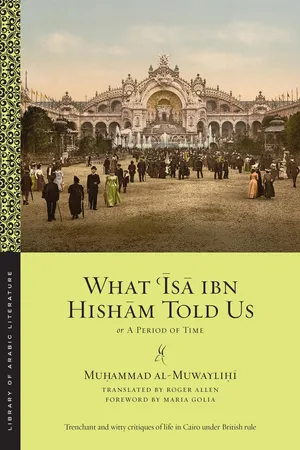
eBook - ePub
What ʿĪsā ibn Hishām Told Us
Or, A Period of Time
- 524 pages
- English
- ePUB (mobile friendly)
- Available on iOS & Android
eBook - ePub
What ʿĪsā ibn Hishām Told Us
Or, A Period of Time
About this book
Information

Miṣbāḥ al-sharq 57, June 1, 1899114
16.1
ʿĪsā ibn Hishām said: So in compliance with the decree of Fate, we decided to take a trip. The idea was to give the Pāshā a chance to recover from his illness by having a change of air. We stayed in a mansion in the suburbs of Alexandria with lush gardens. It was set in a sweet-smelling district. The only sound to be heard was the cooing of wood pigeons; when they sang, their song was in harmony with the rippling water. When the billows moistened the edge of the breeze and hovered over that smiling meadow, they scattered drops of water like pearls on the flowery diadems and bathed the eyes of the narcissus in tears. Lovers would have craved to borrow those tears and put them on their own eyelids so that they could soften the heart of their coy and distant beloved. Young girls would love to use pearls to make a necklace for their neckline or a belt for their waists.
This place is an object of wonder;
the earth laughs at heaven’s tears.
Gold wherever we go, pearls
wherever we turn, and silver in the sky.115
16.2
Rather liken it to the Milky Way, where bright flowers have taken the place of glittering stars, clusters of vines the place of the Pleiades, and gleaming fruits the place of suns and moons.
So we stayed in this place, secluded from the world of people; for in this world there can be no peace save in the ascetic life, no escape from mankind except through seclusion and privacy. The most noble of people are those furthest from contact with mankind.
My very separation from people saves me contamination
whereas their proximity infects both mind and faith.
Just as a line of poetry, if left on its own,
cannot be affected by common faults.116
16.3
This pleasant sojourn would have led to my friend’s complete recovery if the very devil in human form had not terrified us with the news of a plague. We reflected that all God’s creatures are in His hands (glory and praise to Him). We kept nursing our soul’s ills through an avoidance of disaster and misfortune, and yet calamities and griefs seemed to beset us wherever we went. We told ourselves that we had to flee from one of God’s decrees to another, He being the One who tests His servants when He wishes for them a good outcome.
So we set out to return to Cairo after saying farewell to this beautiful spot. We knew that we could trust our friends and relatives who lived in the capital and that no jealous snoopers would be able to spread any false rumors there. We sat down in the train compartment next to some ministers, but, as it was nighttime, it was very dark and so we were able to hear their innermost secrets. As the train took us back to Cairo, we listened to their conversation. One of them was saying things neither contentious nor polished.
16.4
MINISTER OF WAR By God, in the face of these worries and dangers all precautions are useless! I’ve been living on my nerves throughout the Sudanese campaign till it came to an end. Thank God I’m still safe and sound. I’ve spent the entire time in Europe, taking exercise and having a wonderfully relaxing time in Karlsbad. That aggravating newspaper reporter who kept asking me questions about things I knew nothing about was the only thing that bothered me while I was there.117 But now, just when I’ve recovered from such dreadful perils, the plague has struck at a time when we can’t leave the country or even get out of Alexandria where it’s struck. If it weren’t for this terrible judicial situation, we wouldn’t find ourselves being shunted backwards and forwards between two towns like some weaver’s shuttle. God is my witness that at this point I’d rather be in command of the army in the Sudan, riding to and fro along the ranks in the heat of battle, than be subjected to death by the plague in peacetime. At least in war, there is pride and glory to be won, not to mention decorations and booty, all of which lessens the impact of the dangerous situation. But what is there to make our situation with regard to this Shariah Court project easier to swallow? How can the risk of catching the plague be made even bearable? If there’s any prestige to be gained, then it’s the Foreign Minister who has got it all for himself while leaving us all empty-handed.
16.5
FOREIGN MINISTER By God Almighty, tell me, what’s this prestige I’m supposed to have acquired? All I know is that I’ve lost everything I’ve spent my entire life cultivating, namely the trust and affections of Muslims and their continuing favor towards me. Now they’ve started accusing me of interfering in their judicial affairs, something I was careful to avoid from the moment I took office. I could have avoided the entire situation if the Minister of Justice had treated me fairly. He could have taken the entire burden on his shoulders. Such is his piety, devoutness, probity, and asceticism that no Muslim would ever think of criticizing him.
MINISTER OF WAR If all you did was to stand up at the conclusion of your period in office and speak eloquently in the Egyptian parliament without being at a loss for something to say or faltering, then that alone would be enough to satisfy your quest for prestige during your earthly life.
FOREIGN MINISTER What kudos can you see in getting up to speak in front of the members of the Legislative Council?
16.6
MINISTER OF WAR I regard the art of oration as being a very glorious and praiseworthy profession. People often associate it with war because of the perilous situations both involve. Even though I’ve never had any experience of war myself, I’ve still gone through things which would turn your hair grey. When I was saying a few words in the general assembly about taxes, I got so completely distracted that, to this day, I don’t know whether I kept to the point or not. As I left the building, I would have been thoroughly annoyed with myself if someone who specializes in the study of anecdotes from past eras had not provided some consolation by telling me a number of amusing tales about great orators. I’ll tell you some of them now, and then you’ll realize God’s kindness to you in saving you from similar situations when you got up to make a speech and I felt so sorry for you.
16.7
When ʿAbdallāh ibn ʿĀmir ibn Karīz, a renowned homilist, faltered while standing in the minbar in Basra, he was upset. Ziyād ibn Abīhi who was standing behind him told him, “Do not worry, amir. If I put some of the ordinary folk up there first, they would be even worse off than you.” When Friday came, ʿAbdallāh was late, and so Ziyād told the people that he was indisposed. One of the prominent tribal amirs was told to go up; when he reached the top, he was lost for words and said, “Praise be to God who feeds these folk,” and then stood there in silence. They brought him down and sent up another prominent person. Once he was finally in place, he turned towards the people and spotted a bald head. “People,” he said, “this bald-headed man has prevented me from speaking, so God curse his bald pate!” So they brought him down too and told Wāziʿ al-Yashkurī to go up and address the assembly. When he got up there and saw all the people, he said, “People, I was reluctant to come to the Friday prayer today, but my wife forced me to do so; I call you to witness that she is divorced three times.” At that, Ziyād turned to ʿAbdallāh ibn ʿĀmir. “Do you see what I mean?” he said. “Now go up there and address the people.”
16.8
Muṣʿab ibn Ḥayyān was giving a wedding sermon when he faltered. “Remember your dead; there is no God but He,” he said on the spur of the moment. “May God hasten your death too,” the bride’s mother retorted. Similarly, when Marwān ibn al-Ḥakam faltered while delivering a sermon, he said: “O God, we praise You, seek refuge with You, and we offer You thanks.”
And so, Minister, since you haven’t encountered the same kind of problems as these prominent figures from Arab history who were masters of rhetoric and the spoken word, how can you deny that you’ve achieved a good deal of prestige and distinction. On the day you adopted your position on this matter, I can only imagine that the mummies of the Pharaohs, your ancestors, were quivering with delight. And even though their fame may have rested on getting people to drag huge stones around and erect artificial mountains, I’m sure they never imagined that, with someone like your eminent self in mind, they could surpass the Arabs in the rhetorical art delivered from the wooden portals of the minbar.
FOREIGN MINISTER Stop this sarcasm and let’s be serious. What about what the Minister of Justice was saying?
16.9
MINISTER OF JUSTICE I’m amazed that the Shaykh Professor of al-Azhar has rejected the ideas I’ve put forward for this project and accused me of acting contrary to the Shariah. Everything I know about the subject I’ve learned from him; I studied with him and bear him no grudge. After all, the way he’s behaving now is just like the way he behaved when we were students as a way of reprimanding us. It wasn’t long before his anger and disapproval disappeared, and he was kind and sympathetic to us again. Every time I recall those days of my youth and the lessons I took with him, I long to be back there; and that takes my mind off his feelings towards me at the moment. Even so, I’ve done nothing unprecedented. I’ll read out to you now the stipulations for the office of judge just as I’ve copied them directly from their books. Then you can decide whether or not I’ve contravened the Shariah as they claim I have:
16.10
“People eligible for the position of judge are those who are entitled to testify as witnesses as it says in al-Ḥawāshī al-Saʿdiyyah; other qualifications for such people are adherence to Islam, intelligence, eloquence, freedom, non-blindness, and avoidance of slander.118 These are all conditions for the acceptability of his appointment and also of his jurisdiction thereafter.”
No one denies that Court of Appeal judges fulfill these stipulations regarding the qualifications for judge. Who can claim that either of the two representative judges from that court is either a polytheist, insane, a slave, or blind, or anything else which would disqualify him from holding the office of judge? While they have insisted on accusing the two judges of immorality, our retort has come from the very same law books, namely that “the immoral person is still qualified to testify, so he is also qualified to be a judge. However, it should not be compulsory, and anyone who installs a judge in that way commits a sin. The al-Qāʿidiyyah chooses to restrict this point to a situation in which the appointer deems him to be truthful. So let this be memorized. [Al-Durr].”119
I am personally quite happy to accept this notion of sin, but why are they so opposed to the general idea? Why do they keep fussing when, if they turn the page in the very same volume, they’ll find the following passage: “The second authority makes an exception for the immoral person who has both status and virtue. His testimony must be accepted.” From the Bazzāziyyah, while in the Nahr we find “accordingly, he is not considered to be committing a crime if he appoints a person judge in such a condition.”120
16.11
The people who keep arguing that the judges of the Court of Appeal are neither prestigious nor courteous object that the highest court in the land does not just pass judgments but also issues fatwas. They note that the mufti must be well versed in both the preferable and the acceptable, the weak and the strong, principles well known in the Ḥanafī school of law. These stipulations, they say, are not satisfied by the Court of Appeal judges, particularly since they’re accusing them of depravity and backing up their statements with the following text: “The sinner will not be a good mufti because fatwas are religious matters and the sinner’s word cannot be accepted on such matters,” as Ibn Malak duly noted, amplified by Al-ʿAynī, followed by a number of recent scholars, and specifically stipulated by the author of Al-Majmaʿ.
However, these people fail to recall that the author of Al-Durr al-mukhtār cites this phrase and then goes on to say: “Yes indeed, it is valid. In the Kanz there is an authoritative statement that offers an individual judgment on the relative nature of the fault involved.121 There can be no disagreement about such a person’s Islamic faith nor his intellect. Some scholars make alertness a criterion, but not freedom, being male, or ability to speak. Thus a speech-impaired person may issue a fatwa.”
Now, thanks be to God, you are all aware that the judges of the Court of Appeal all prefer to be dumb. So how can their fatwas have no validity if such people are allowed to pronounce them?
16.12
The author of Al-Durr goes on to say: “The judge can issue a fatwa even in a court of law, and it is still valid. In so doing, the judge in his role as mufti is exactly following the dictum of Abū Ḥanīfah, then Abū Yūsuf, then Muḥammad al-Shaybānī, then Zufar and al-Ḥasan ibn Ziyād who is the most authoritative and enlightened.” Here ends the extract from Al-Durr.
It seems abundantly clear from what I’ve just read to you that, if these people are using such passages as those I have just read to you as criteria, then the Court of Appeal judges are fully qualified and no one can object. If they have authorized the judge to issue fatwas as a mufti, following the dictum of Abū Ḥanīfah without exception, then the criteria of “preferable and acceptable, weak and strong” have to be subsumed as wel...
Table of contents
- Cover
- Letter from the General Editor
- About this Paperback
- Title Page
- Copyright
- Contents
- Foreword
- Introduction
- Note on the Translation
- Notes to the Introduction
- What ʿĪsā ibn Hishām Told Us
- Miṣbāḥ al-sharq 21, September 8, 1898
- Miṣbāḥ al-sharq 23, September 22, 1898
- Miṣbāḥ al-sharq 24, September 29, 1898
- Miṣbāḥ al-sharq 30, November 10, 1898
- Miṣbāḥ al-sharq 31, November 17, 1898
- Miṣbāḥ al-sharq 32, November 24, 1898
- Miṣbāḥ al-sharq 34, December 8, 1898
- Miṣbāḥ al-sharq 35, December 15, 1898
- Miṣbāḥ al-sharq 39, January 12, 1899
- Miṣbāḥ al-sharq 40, January 19, 1899
- Miṣbāḥ al-sharq 41, January 26, 1899
- Miṣbāḥ al-sharq 42, February 2, 1899
- Miṣbāḥ al-sharq 43, February 9, 1899
- Miṣbāḥ al-sharq 44, February 16, 1899
- Miṣbāḥ al-sharq 48, March 23, 1899
- Miṣbāḥ al-sharq 49, March 30, 1899
- Miṣbāḥ al-sharq 50, April 6, 1899
- Miṣbāḥ al-sharq 54, May 11, 1899
- Miṣbāḥ al-sharq 55, May 18, 1899
- Miṣbāḥ al-sharq 57, June 1, 1899
- Miṣbāḥ al-sharq 58, June 8, 1899
- Miṣbāḥ al-sharq 59, June 15, 1899
- Miṣbāḥ al-sharq 63, July 13, 1899
- Miṣbāḥ al-sharq 64, July 20, 1899
- Miṣbāḥ al-sharq 68, August 17, 1899
- Miṣbāḥ al-sharq 69, August 24, 1899
- Miṣbāḥ al-sharq 71, September 7, 1899
- Miṣbāḥ al-sharq 72, September 14, 1899
- Miṣbāḥ al-sharq 74, September 28, 1899
- Miṣbāḥ al-sharq 80, November 9, 1899
- Miṣbāḥ al-sharq 87, January 4, 1900
- Miṣbāḥ al-sharq 88, January 11, 1900
- Miṣbāḥ al-sharq 89, January 18, 1900
- Miṣbāḥ al-sharq 90, January 25, 1900
- Miṣbāḥ al-sharq 91, February 8, 1900
- Miṣbāḥ al-sharq 92, February 15, 1900
- Miṣbāḥ al-sharq 103, May 11, 1900
- Miṣbāḥ al-sharq 104, May 18, 1900
- Miṣbāḥ al-sharq 105, May 25, 1900
- Miṣbāḥ al-sharq 106, June 1, 1900
- Miṣbāḥ al-sharq 107, June 8, 1900
- Miṣbāḥ al-sharq 116, August 17, 1900
- Miṣbāḥ al-sharq 117, August 34, 1900
- Miṣbāḥ al-sharq 118, August 31, 1900
- Miṣbāḥ al-sharq 121, September 21, 1900
- Miṣbāḥ al-sharq 123, October 5, 1900
- Miṣbāḥ al-sharq 126, October 26, 1900
- Miṣbāḥ al-sharq 130, November 23, 1900
- Miṣbāḥ al-sharq 133, December 14, 1900
- Miṣbāḥ al-sharq 192, February 14, 1902
- Miṣbāḥ al-sharq 193, February 21, 1902
- Miṣbāḥ al-sharq 196, March 14, 1902
- Notes
- Glossary of Names and Terms
- Bibliography
- Index
- About the NYU Abu Dhabi Institute
- About the Translator
- The Library of Arabic Literature
Trusted by 375,005 students
Access to over 1.5 million titles for a fair monthly price.
Study more efficiently using our study tools.
Frequently asked questions
Yes, you can cancel anytime from the Subscription tab in your account settings on the Perlego website. Your subscription will stay active until the end of your current billing period. Learn how to cancel your subscription
No, books cannot be downloaded as external files, such as PDFs, for use outside of Perlego. However, you can download books within the Perlego app for offline reading on mobile or tablet. Learn how to download books offline
Perlego offers two plans: Essential and Complete
- Essential is ideal for learners and professionals who enjoy exploring a wide range of subjects. Access the Essential Library with 800,000+ trusted titles and best-sellers across business, personal growth, and the humanities. Includes unlimited reading time and Standard Read Aloud voice.
- Complete: Perfect for advanced learners and researchers needing full, unrestricted access. Unlock 1.5M+ books across hundreds of subjects, including academic and specialized titles. The Complete Plan also includes advanced features like Premium Read Aloud and Research Assistant.
We are an online textbook subscription service, where you can get access to an entire online library for less than the price of a single book per month. With over 1.5 million books across 990+ topics, we’ve got you covered! Learn about our mission
Look out for the read-aloud symbol on your next book to see if you can listen to it. The read-aloud tool reads text aloud for you, highlighting the text as it is being read. You can pause it, speed it up and slow it down. Learn more about Read Aloud
Yes! You can use the Perlego app on both iOS and Android devices to read anytime, anywhere — even offline. Perfect for commutes or when you’re on the go.
Please note we cannot support devices running on iOS 13 and Android 7 or earlier. Learn more about using the app
Please note we cannot support devices running on iOS 13 and Android 7 or earlier. Learn more about using the app
Yes, you can access What ʿĪsā ibn Hishām Told Us by Roger Allen,Maria Golia,Muḥammad al-Muwayliḥī, Roger Allen in PDF and/or ePUB format, as well as other popular books in Literature & Middle Eastern History. We have over 1.5 million books available in our catalogue for you to explore.