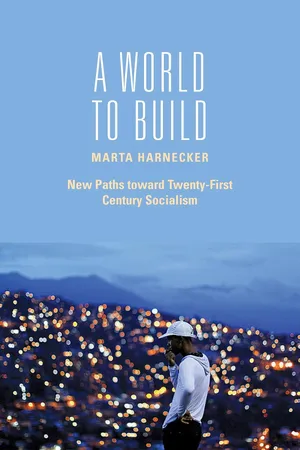
Over the last few decades Marta Harnecker has emerged as one of Latin America’s most incisive socialist thinkers. In A World to Build, she grapples with the question that has bedeviled every movement for radical social change: how do you construct a new world within the framework of the old? Harnecker draws on lessons from socialist movements in Latin America, especially Venezuela, where she served as an advisor to the Chávez administration and was a director of the Centro Internacional Miranda.
A World to Build begins with the struggle for socialism today. Harnecker offers a useful overview of the changing political map in Latin America, examining the trajectories of several progressive Latin American governments as they work to develop alternative models to capitalism. She combines analysis of concrete events with a refined theoretical understanding of grassroots democracy, the state, and the barriers imposed by capital. For Harnecker, twenty-first century socialism is a historical process as well as a theoretical project, one that requires imagination no less than courage. She is a lucid guide to the movements that are fighting, right now, to build a better world, and an important voice for those who wish to follow that path.
- 240 pages
- English
- ePUB (mobile friendly)
- Available on iOS & Android
eBook - ePub
About this book
Information
PART 1
Latin America Advances
1. The Pioneer in Rejecting Neoliberalism
Latin America was the first region in which neoliberal policies were introduced. Chile, my country, was used as a testing ground for neoliberal policies before prime minister Margaret Thatcher’s government implemented them in the United Kingdom. But it was also the first region in the world that gradually came to reject those policies which only served to increase poverty, aggravate social inequalities, destroy the environment, and weaken working-class and popular movements in general.
It was in our subcontinent that left and progressive forces first began to rally after the collapse of socialism in Eastern Europe and the Soviet Union. After more than two decades of suffering, new hope was born. At first this took the form of struggles to resist neoliberal policies, but after a few years, people went on the offensive and began conquering spaces of power. Within Europe, itself in crisis and decline, sections of the impoverished masses have begun to see Latin America as a ray of hope.1
For the first time in Latin American history—and with the crisis of the neoliberal model as a backdrop—candidates from left and center-left groupings managed to win elections in most of the region’s countries.
Let us remember that in 1998, when Chávez won elections in Venezuela, this country was a lonely island in a sea of neoliberalism that covered the continent, except, of course, for the honorable exception of Cuba. Shortly after, Ricardo Lagos was elected in Chile (2000), Luiz Ignácio Lula da Silva in Brazil (2002), Néstor Kirchner in Argentina (2003), Tabaré Vázquez in Uruguay (2005), Evo Morales in Bolivia (2005 and 2009), Michelle Bachelet in Chile (2006), Rafael Correa in Ecuador (2006, 2009, and 2013), Daniel Ortega in Nicaragua (2006 and 2010), Cristina Fernández in Argentina (2007 and 2012), Álvaro Colom in Guatemala (2007), Fernando Lugo in Paraguay (2008), Mauricio Funes in El Salvador (2009), José Mujica in Uruguay (2009), Dilma Rousseff in Brazil (2010), and Ollanta Humala in Peru (2011)—and Chávez was reelected for the fourth time in 2012.2
I agree with Cuban theoretician Roberto Regalado that these leaders are heterogeneous. “In some countries such as Bolivia, Ecuador and Venezuela, the collapse or extreme weakness of neoliberal institutions brought to power leaders who capitalized on the left’s organizational and political capital to win the presidency. Then there were situations like in Honduras and Argentina where, because there were no presidential candidates from the popular sectors, progressive people from traditional parties won elections.”3
POPULAR MOVEMENTS: THE GREAT PROTAGONISTS
We can say that in each and every country, albeit in different ways, popular movements and not political parties were at the forefront of the struggle against neoliberalism. Even in those countries where the role of left political parties was important, they were not in the vanguard of the fight against neoliberalism; the popular movements, however, were. These movements developed in the context of the neoliberal model’s crisis of legitimacy and the crisis its political institutions were facing. In many cases, they grew out of the dynamics of resistance present in their communities or local organizations.
Overview of Key Mobilizations
Let us briefly look back at some of the most important social struggles that helped pave the way for what we see today in Latin America. Without a doubt, this new reality stands in stark contrast to the solitary struggle waged by Fidel Castro in 1985 for the non-repayment of foreign debt.4
El Caracazo, Venezuela. On February 27, 1989, a tremendous social explosion took place in Venezuela in opposition to a package of neoliberal economic measures demanded by the International Monetary Fund and imposed by the government of Carlos Andrés Pérez. According to renowned French intellectual Ignacio Ramonet, the Venezuelan people “were the first in the world to rise up against the tyranny of neoliberalism,” and they did so at a time when the neoliberal model was on the rise globally.5
The package included, among other things, cuts to public spending, liberalization of prices and trade, promotion of foreign investment, and the privatization of state companies. But the most immediate cause for the popular rebellion was the increase in transport costs that resulted from the hike in petrol prices.
Residents from the poorest barrios (neighborhoods) came out onto the streets in huge numbers and began to burn buses, as well as loot and destroy supermarkets and shops. The military were called out to impose order. The Caracazo—as it was referred to because the rebellion had as its epicenter the capital of Venezuela, even though similar protests occurred in various other states—ended in a massacre of epic proportions and was a determining factor in the politicization of many young military officers.6
Ecuador’s indigenous peoples spearhead the struggles of the 1990s. By 1986, the disintegration of Ecuador’s workers’ movement and the Frente Unitario de los Trabajadores (United Front of Workers, FUT) as a result of neoliberalism was evident. Water, sewerage, and rubbish collection services were all privatized, and thousands of municipal workers were fired. Yet while the workers’ movement was on the decline, the level of conflict in the countryside was on the rise. The early 1990s saw the country become a powder keg, with a wave of land occupations occurring against latifundios and in favor of land reform.
The indigenous movement erupted onto the scene in 1990 with the occupation of the Santo Domingo Church. The occupation, which lasted ten days, gave national prominence to the demands of the indigenous people and forced the Rodrigo Borja government to open up a dialogue with the movement.
Shortly afterward, the indigenous movement began to raise demands of national concern such, as opposition to oil privatization, as well as other privatizations. Non-indigenous sectors, including neighborhood-based social movements and radical youth inspired by the ideas of liberation theology, began to accompany them in their protests. The broad Frente Patriótico (Patriotic Front) was initiated, within which CONAIE, the most important indigenous organization in the country, played a leading role.
In 1995, a broad coalition of social movements—indigenous, urban sectors, youth—formed the Coordinadora por el NO (NO Coalition) and successfully defeated a government-initiated referendum that sought to institutionalize neoliberalism. The proposal was rejected by 75 percent of voters.
Thanks to indigenous resistance against neoliberalism, the government was unable to privatize strategic companies in the areas of oil, electricity, and telecommunications. In 1997, the indigenous movement rose up and deposed President Abdalá Bucaram. The indigenous movement’s proposal for a Constituent Assembly was accepted, but the right organized itself and successfully co-opted the process. Even though the June 1998 constitution recognized some rights for indigenous peoples, it also improved the institutional framework for deepening neoliberalism.
At the start of 2000, a peaceful indigenous uprising against privatization led to an occupation of the National Congress and forced the ouster of President Jamil Mahuad. The indigenous movement gradually transformed itself into one of the central axes of political action and an indispensable factor for any attempt to transform the country.7
Chile’s Mapuche movement—in the front line of the struggle against neoliberalism. The Mapuche, an indigenous people that inhabit the Araucanía region of Chile, were greatly affected by neoliberal agricultural policies imposed by the military dictatorship and successive Concertación—coalition of center-left—governments. Mapuche communities were not only driven off lands granted to them under the land reform program initiated by the Christian Democratic government of Eduardo Frei (1964–70) and continued by the Socialist government of Salvador Allende (1970–73), but were also affected by the process of economic liberalization and foreign direct investment in forestry, tourism, and energy mega-projects carried out in their territories. The immediate result of all this was the forced migration of entire communities, an increase in logging to the detriment of agricultural activities, soil degradation, water contamination, and environmental destruction.
At the beginning of the 1990s, the Consejo de Todas las Tierras (Council of All the Lands), a Mapuche organization, carried out various symbolic occupations of ancestral Mapuche lands that were now in private hands. Up until 1997, the demands of this social sector were confined to individual communities; however, from that year onward, “other forms of demands for territories emerged, where issues of land, natural resources, participation and development were all integrated.” This allowed the Mapuche movement to “develop a new discourse and construct supra-community alliances.” As Chilean investigator Víctor Toledo Llancaqueo said, the situation went from one of “lands in conflict” to “territories in conflict.”8 “They were no longer simply demanding land, but rather a spatial continuum, a territory with its own water, species and cultivable soils, as well as their right to participate in decisions that affect their territory.”9
In order to contain these struggles, Concertación governments and the recent government of Sebastián Piñera made efforts to co-opt the movement through paternalistic welfare policies. Unable to defeat the Mapuche people via this route, they turned to open and systematic repression against Mapuche communities and leaders, a number of whom ended up in prison.10 From there emerged another form of struggle: hunger strikes. A hunger strike begun in March 2006 by three indigenous leaders and a theologian, Patricia Troncoso, who became a symbol of the Mapuche struggle against the state, had big repercussions across the world. Since then, these types of protests have represented a continuous form of pressuring the government to listen to their demands.
Referendum against privatization triumphs in Uruguay. In December 1992, one of the first successful struggles against neoliberalism took place: the little known triumph of the Uruguayan people in a referendum that repealed a law passed the previous year authorizing the privatization of large public companies.11
The Frente Amplio (Broad Front) waged a formidable propaganda campaign, including via numerous televised debates, to explain what privatization entailed and the reasons why it was dangerous. This meant that when people voted, they knew what project for the country they were voting for. That is why various commentators dubbed this Uruguay’s first modern election.
The referendum united 70 percent of voters, from a truly diverse political background, behind a movement with tremendous political potential. This broad base of support was due to the fact that, following big debates within the leadership, the Frente Amplio decided not to challenge the entire law and its thirty articles, as the more radical currents were proposing, but rather to focus on the five key clauses that referred to strategic companies.
At the same time, this political organization understood that a media campaign was not enough, that it was necessary to meticulously campaign, going neighborhood to neighborhood, and, as much as possible, house to house. Retired workers, who represent a significantly large part of the Uruguayan population, played a big role in this task
Two years later, in 1994, the government attempted to modify the constitution in order to facilitate the deepening of neoliberalism. Retired workers, a social sector severely affected by the privatization of the social security system, were once again one of the forces to oppose this, carrying out a tremendous grassroots campaign, particularly in the interior of the country. A large number of experienced and excellent trade union leaders helped create the Organización Nacional de Jubilados (National Organization of Retired Workers), which prepared itself for battle and mobilized across the country. As all their members were retired, they had all day to actively campaign.12 In the end, the government’s initiative was rejected.
EZLN fights against NAFTA in Mexico. On January 1, 1994, in the indigenous southeastern Mexican town of Chiapas, the Ejército Zapatista de Liberación Nacional (Zapatista National Liberation Army, EZLN) erupted onto the scene, raising the banner of opposition to the North American Free Trade Agreement (NAFTA). Irrespective of how successful their struggle has been, I believe that this movement was critical to shedding light on the oppression and discrimination that Mexico’s indigenous peoples have endured. Moreover, everyone recognizes the spectacular initiatives the ELZN has promoted on the international sphere, provoking great sympathy and support for their cause, especially among intellectuals and students. The EZLN has been capable not only of building social force in the areas they operate in, but also of influencing public opinion at the national and international level, something that, on many occasions, the left has not been able to do.13
Brazil’s MST—the key national movement in the fight against neoliberalism. In Brazil, the Movimento dos Trabalhadores Rurais Sem Terra (Movement of Rural Landless Workers, MST) consolidated itself as the ke...
Table of contents
- Cover
- Half title
- Title
- Copyright
- Contents
- Dedication
- Introduction
- Part 1 Latin America Advances
- Part 2 Where Are We Going? Twenty-First Century Socialism
- Part 3 A New Political Instrument for a New Hegemony
- Bibliography
- Notes
- Index
Trusted by 375,005 students
Access to over 1.5 million titles for a fair monthly price.
Study more efficiently using our study tools.
Frequently asked questions
Yes, you can cancel anytime from the Subscription tab in your account settings on the Perlego website. Your subscription will stay active until the end of your current billing period. Learn how to cancel your subscription
No, books cannot be downloaded as external files, such as PDFs, for use outside of Perlego. However, you can download books within the Perlego app for offline reading on mobile or tablet. Learn how to download books offline
We are an online textbook subscription service, where you can get access to an entire online library for less than the price of a single book per month. With over 1.5 million books across 990+ topics, we’ve got you covered! Learn about our mission
Look out for the read-aloud symbol on your next book to see if you can listen to it. The read-aloud tool reads text aloud for you, highlighting the text as it is being read. You can pause it, speed it up and slow it down. Learn more about Read Aloud
Yes! You can use the Perlego app on both iOS and Android devices to read anytime, anywhere — even offline. Perfect for commutes or when you’re on the go.
Please note we cannot support devices running on iOS 13 and Android 7 or earlier. Learn more about using the app
Please note we cannot support devices running on iOS 13 and Android 7 or earlier. Learn more about using the app
Yes, you can access A World to Build by Marta Harnecker in PDF and/or ePUB format, as well as other popular books in Politics & International Relations & Communism, Post-Communism & Socialism. We have over 1.5 million books available in our catalogue for you to explore.