The agribusiness/food sector is the second most profitable industry in the United States — following pharmaceuticals — with annual sales over $400 billion. Contributing to its profitability are the breathtaking strides in biotechnology coupled with the growing concentration of ownership and control by food's largest corporations. Everything, from decisions on which foods are produced, to how they are processed, distributed, and marketed is, remarkably, dictated by a select few giants wielding enormous power. More and more farmers are forced to adopt new technologies and strategies with consequences potentially harmful to the environment, our health, and the quality of our lives. The role played by trade institutions like the World Trade Organization, serves only to make matters worse.
Through it all, the paradox of capitalist agriculture persists: ever-greater numbers remain hungry and malnourished despite an increase in world food supplies and the perpetuation of food overproduction.
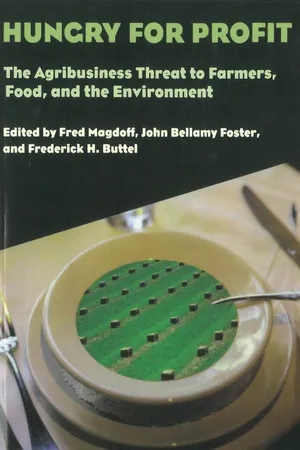
Hungry for Profit presents a historical analysis and an incisive overview of the issues and debates surrounding the global commodification of agriculture. Contributors address the growing public concern over food safety and controversial developments in agricultural biotechnology including genetically engineered foods. Hungry for Profit also examines the extent to which our environmental, social, and economic problems are intertwined with the structure of global agriculture as it now exists.
Hungry for Profit demystifies the reasons why hunger proliferates in the midst of plenty and points the way toward sustainable solutions. Perhaps most important, it highlights the ways in which farmers, farmworkers, environmental and sustainable agriculture groups — as well as consumers — are engaged in the struggle to create a just and environmentally sound food system which, its editors argue, cannot be separated from a just and environmentally sound society.
eBook - ePub
Hungry for Profit
The Agribusiness Threat to Farmers, Food, and the Environment
- 220 pages
- English
- ePUB (mobile friendly)
- Available on iOS & Android
eBook - ePub
Hungry for Profit
The Agribusiness Threat to Farmers, Food, and the Environment
About this book
Information
Chapter One
THE AGRARIAN ORIGINS OF CAPITALISM
ELLEN MEIKSINS WOOD
One of the most well established conventions of Western culture is the association of capitalism with cities. Capitalism is supposed to have been born and bred in the city. But more than that, the implication is that any city—with its characteristic practices of trade and commerce—is by its very nature potentially capitalist from the start, and only extraneous obstacles have stood in the way of any urban civilization giving rise to capitalism. Only the wrong religion, the wrong kind of state, or any kind of ideological, political, or cultural fetters tying the hands of urban classes, have prevented capitalism from springing up anywhere and everywhere, since time immemorial—or at least since technology has permitted the production of adequate surpluses.
What accounts for the development of capitalism in the West, according to this view, is the unique autonomy of its cities and of their quintessential class, the burghers or bourgeois. In other words, capitalism emerged in the West less because of what was present than because of what was absent: constraints on urban economic practices. In those conditions, it took only a more or less natural expansion of trade to trigger the development of capitalism to its full maturity. All that was needed was a quantitative growth, which occurred almost inevitably with the passage of time (in some versions, of course, helped along but not originally caused, by the Protestant Ethic).
There are many things to be said against these assumptions about the natural connection between cities and capitalism. Among the objections is the fact that these assumptions tend to naturalize capitalism, to disguise its distinctiveness as a historically specific social form, with a beginning and (no doubt) an end. The tendency to identify capitalism with cities and urban commerce has generally been accompanied by an inclination to make capitalism appear as a more or less automatic consequence of practices as old as human history, or even the automatic consequence of human nature, the “natural” inclination, in Adam Smith’s words, to “truck, barter, and exchange.”
Perhaps the most salutary corrective to these assumptions—and their ideological implications—is the recognition that capitalism, with all its very specific drives of accumulation and profit-maximization, was born not in the city but in the countryside, in a very specific place, and very late in human history. It required not a simple extension or expansion of barter and exchange but a complete transformation in the most basic human relations and practices, a rupture in age-old patterns of human interaction with nature in the production of life’s most basic necessities. If the tendency to identify capitalism with cities is associated with a tendency to obscure the specificity of capitalism, one of the best ways of understanding that specificity is to consider the agrarian origins of capitalism.
WHAT WAS “AGRARIAN CAPITALISM”?
For millennia, human beings have provided for their material needs by working the land. And probably for nearly as long as they have engaged in agriculture they have been divided into classes, between those who worked the land and those who appropriated the labor of others. That division between appropriators and producers has taken many forms in different times and places, but one general characteristic they have had in common is that the direct producers have typically been peasants. These peasant producers have remained in possession of the means of production, specifically land. As in all precapitalist societies, these producers have had direct access to the means of their own reproduction. This has meant that when their surplus labor has been appropriated by exploiters, it has been done by what Marx called “extra-economic” means—that is, by means of direct coercion, exercised by landlords and/or states employing their superior force, their privileged access to military, judicial, and political power.
Here, then, is the most basic difference between all precapitalist societies and capitalism. It has nothing to do with whether production is urban or rural and everything to do with the particular property relations between producers and appropriators, whether in industry or agriculture. Only in capitalism is the dominant mode of surplus appropriation based on the dispossession of the direct producers, whose surplus labor is appropriated by purely “economic” means. Because direct producers in a fully developed capitalism are propertyless, and because their only access to the means of production, to the requirements of their own reproduction, even to the means of their own labor, is the sale of their labor-power in exchange for a wage, capitalists can appropriate the workers’ surplus labor without direct coercion.
This unique relation between producers and appropriators is, of course, mediated by the “market.” Markets of various kinds have existed throughout recorded history and no doubt before, as people have exchanged and sold their surpluses in many different ways and for many different purposes. But the market in capitalism has a distinctive and unprecedented function. Virtually everything in capitalist society is a commodity produced for the market. And even more fundamentally, both capital and labor are utterly dependent on the market for the most basic conditions of their own reproduction. Just as workers depend on the market to sell their labor-power as a commodity, capitalists depend on it to buy labor-power, as well as the means of production, and to realize their profits by selling the goods or services produced by the workers. This market-dependence gives the market an unprecedented role in capitalist societies, as not only a simple mechanism of exchange or distribution but as the principal determinant and regulator of social reproduction. The emergence of the market as a determinant of social reproduction presupposed its penetration into the production of life’s most basic necessity, food.
This unique system of market-dependence entails some very distinctive “laws of motion,” specific systemic requirements and compulsions shared by no other mode of production: the imperatives of competition, accumulation, and profit-maximization. And these imperatives, in turn, mean that capitalism can, and must, constantly expand in ways and degrees unlike any other social form—constantly accumulating, constantly searching out new markets, constantly imposing its imperatives on new territories and new spheres of life, on human beings and the natural environment.
Once we recognize just how distinctive these social relations and processes are, how different from other social forms which have dominated most of human history, it becomes clear that more is required to explain the emergence of this distinctive social form than the question-begging assumption that it has always existed in embryo, just needing to be liberated from unnatural constraints. The question of its origins, then, can be formulated this way: given that producers were exploited by appropriators in noncapitalist ways for millennia before the advent of capitalism, and given that markets have also existed “time out of mind” and almost everywhere, how did it happen that producers and appropriators, and the relations between them, came to be so market dependent?
Now obviously the long and complex historical processes that ultimately led to this condition of market dependence could be traced back indefinitely. But we can make the question more manageable by identifying the first time and place that a new social dynamic is clearly discernible, a dynamic that derives from the market dependence of the main economic actors. And we can then explore the specific conditions surrounding that unique situation.
As late as the seventeenth century, and even much later, most of the world, including Europe, was free of the market-driven imperatives outlined here. A vast system of trade certainly existed, by now extending across the globe. But nowhere, neither in the great trading centers of Europe nor in the vast commercial networks of the Islamic world or Asia, was economic activity, and production in particular, driven by the imperatives of competition and accumulation. The dominant principle of trade everywhere was “profit on alienation,” or “buying cheap and selling dear”—typically, buying cheap in one market and selling dear in another.
International trade was essentially “carrying” trade, with merchants buying goods in one location to be sold for a profit in another. But even within a single, powerful, and relatively unified European kingdom like France, basically the same principles of noncapitalist commerce prevailed. There was no single and unified market, a market in which people made profit not by buying cheap and selling dear, not by carrying goods from one market to another, but by producing more cost-effectively in direct competition with others in the same market.
Trade still tended to be in luxury goods, or at least goods destined for more prosperous households or answering to the needs and consumption patterns of dominant classes. There was no mass market for cheap everyday consumer products. Peasant producers would typically produce not only their own food requirements but other everyday goods like clothing. They might take their surpluses to local markets, where the proceeds could be exchanged for other commodities not produced at home. And farm produce might even be sold in markets further afield. But here again, the principles of trade were basically the same as in manufactured goods.
These noncapitalist principles of trade existed side-by-side with noncapitalist modes of exploitation. For instance, in Western Europe, even where feudal serfdom had effectively disappeared, other forms of “extra-economic” exploitation still prevailed. In France, for example, where peasants still constituted the vast majority of the population and still remained in possession of most land, office in the central state served as an economic resource for many members of the dominant classes, a means of extracting surplus labor in the form of taxes from peasant producers. And even rent-appropriating landlords typically depended on various extra-economic powers and privileges to enhance their wealth.
So peasants had access to the means of production, the land, without having to offer their labor-power as a market commodity. Landlords and office-holders, with the help of various “extra-economic” powers and privileges, extracted surplus labor from peasants directly in the form of rent or tax. In other words, while all kinds of people might buy and sell all kinds of things in the market, neither the peasant-proprietors who produced, nor the landlords and office-holders who appropriated what others produced, depended directly on the market for the conditions of their self-reproduction, and the relations between them were not mediated by the market.
But there was one major exception to this general rule. England, by the sixteenth century, was developing in wholly new directions. Although there were other relatively strong monarchical states, more or less unified under the monarchy (such as Spain and France), none was as effectively unified as England (and the emphasis here is on England, not other parts of the “British Isles”). In the sixteenth century, England—already more unified than most in the eleventh century, when the Norman ruling class established itself on the island as a fairly cohesive military and political entity—went a long way toward eliminating the fragmentation of the state, the “parcellized sovereignty,” inherited from feudalism. The autonomous powers held by lords, municipal bodies, and other corporate entities in other European states were, in England, increasingly being concentrated in the central state. This was in contrast to other European states where even powerful monarchies continued for a long time to live uneasily alongside other post-feudal military powers, fragmented legal systems, and corporate privileges whose possessors insisted on their autonomy against the centralizing power of the state.
The distinctive political centralization of the English state had material foundations and corollaries. Already in the sixteenth century, England had an impressive network of roads and water transport that unified the nation to a degree unusual for the period. London, becoming disproportionately large in relation to other English towns and to the total population of England (and eventually the largest city in Europe), was also becoming the hub of a developing national market.
The material foundation on which this emerging national economy rested was English agriculture, which was unique in several ways. The English ruling class was distinctive in two major and related respects.1 On the one hand, as part of an increasingly centralized state, in alliance with a centralizing monarchy, they did not possess to the same degree as their Continental counterparts the more or less autonomous “extra-economic” powers on which other ruling classes could rely to extract surplus labor from direct producers. On the other hand, land in England had for a long time been unusually concentrated, with big landlords holding an unusually large proportion of land. This concentrated landownership meant that English landlords were able to use their property in new and distinctive ways. What they lacked in “extra-economic” powers of surplus extraction they more than made up for by their increasing “economic” powers.
This distinctive combination had significant consequences. On the one hand, the concentration of English landholding meant that an unusually large proportion of land was worked not by peasant-proprietors but by tenants (the word “farmer,” incidentally, literally means “tenant”—a usage suggested by phrases familiar today, such as “farming out”). This was true even before the waves of dispossession, especially in the sixteenth and eighteenth centuries, conventionally associated with “enclosure,” in contrast, for example, to France, where a larger proportion of land remained, and long continued to remain, in the hands of peasants.
On the other hand, the relatively weak “extra-economic” powers of landlords meant that they depended less on their ability to squeeze more rents out of their tenants by direct, coercive means than on their tenants’ productivity. Landlords had a strong incentive, then, to encourage—and, wherever possible, to compel—their tenants to find ways of increasing their output. In this respect, they were fundamentally different from rentier aristocrats who throughout history have depended for their wealth on squeezing surpluses out of peasants by means of simple coercion, enhancing their powers of surplus extraction not by increasing the productivity of the direct producers but rather by improving their own coercive powers—military, judicial, and political.
As for the tenants themselves, they were increasingly subject not only to direct pressures from landlords but to market imperatives that compelled them to enhance their productivity. English tenancies took various forms, and their were many regional variations, but a growing number were subject to economic rents, that is, rents not fixed by some legal or customary standard but responsive to market conditions. By the early modern period, even many customary leases had effectively become economic leases of this kind.
The effect of the system of property relations was that many agricultural producers (including prosperous “yeomen”) were market-dependent, not just in the sense that they were obliged to sell produce on the market but in the more fundamental sense that their access to land itself, to the means of production, was mediated by the market. There was, in effect, a market in leases, in which prospective tenants had to compete. Where security of tenure depended on the ability to pay the going rent, uncompetitive production could mean outright loss of land. To meet economic rents in a situation where other potential tenants were competing for the same leases, tenants were compelled to produce cost-effectively, on penalty of dispossession.
But even those tenants who enjoyed some kind of customary tenure which gave them more security, but who might still be obliged to sell their produce in the same markets, could go under in conditions where competitive standards of productivity were being set by farmers responding more directly and urgently to the pressures of the market. The same would increasingly be true even of landowners working their own land. In this competitive environment, productive farmers prospered and their holdings were likely to grow, while less competitive producers went to the wall and joined the propertyless classes.
In all cases, the effect of market imperatives was to intensify exploitation in order to increase productivity—whether exploitation of the labor of others or self-exploitation by the farmer and his family. This pattern would be reproduced in the colonies, and indeed in post-Independence America, where independent small farmers, who were supposed to be the backbone of a free republic, from the beginning faced the stark choice of agrarian capitalism: at best, intense self-exploitation, and at worst, dispossession and displacement by larger, more productive enterprises.
THE RISE OF CAPITALIST PROPERTY
So English agriculture, already in the sixteenth century, was marked by a unique combination of conditions, at least in certain regions, which would gradually set the economic direction of the whole economy. The result was an agrarian sector more productive than any other in history. Landlords and tenants alike became preoccupied with what they called “improvement,” the enhancement of the land’s productivity for profit.
It is worth dwelling for a moment on this concept of “improvement,” because it tells us a great deal about English agriculture and the development of capitalism. The word “improve” itself, in its original meaning, did not mean just “making better” in a general sense but literally (based on the old French for “into,” en, and “profit,” pros—or its oblique case, preu) doing something for monetary profit, and especially cultivating land for profit. By the seventeenth century, the word “improver” was firmly fixed in the language to refer to someone who rendered land productive and profitable, especially by enclosing or reclaiming waste. Agricultural “improvement” was by then a well-established practice, and in the eighteenth century, in the golden age of agrarian capitalism, “improvement,” in word and deed, came truly into its own.
The word was, at the same time, gradually acquiring a more general meaning, in the sense that we know it today (we might like to think about the implications of a culture in which the word for “making better” is rooted in the word for monetary profit); and even in its association with agriculture, it eventually lost some of its old specificity—so that, for example, some radical thinkers in the nineteenth century might embrace “improvement” in the sense of scientific farming, without its connotation of commercial profit. But in the early modern period, productivity and profit were inextricably connected in the concept of “improvement,” and it nicely sums up the ideology of a rising agrarian capitalism.
In the seventeenth century, then, a whole new body of literature emerged, a literature spelling out in unprecedented detail the techniques and benefits of improvement. Improvement was also a major preoccupation of the Royal Society, which brought together some of England’s most prominent scientists (Isaac Newton and Robert Boyle were both members of the Society), with some of the more forward-looking members of England’s ruling classes—like the philosopher John Locke’s mentor, the first Earl of Shaftesbury, and Locke himself, both of whom were keenly interested in agricultural improvement.
Improvement did not, in the first instance, depend on significant technological innovations—although new equipment was used, like the wheelplow. In general, it was more a matter of developments in farming techniques: for example, “convertible” or “up and down” husbandry—alternating cultivation with fallow periods; crop rot...
Table of contents
- Cover Page
- Title Page
- Copyright Page
- Contents
- An Overview
- Chapter One: The Agrarian Origins Of Capitalism
- Chapter Two: Liebig, Marx, and the Depletion of Soil Fertility: Relevance for Today’s Agriculture
- Chapter Three: Concentration of Ownership and Control in Agriculture
- Chapter Four: Ecological Impacts of Industrial Agriculture and the Possibilities for Truly Sustainable Farming
- Chapter Five: The Maturing of Capitalist Agriculture: Farmer as Proletarian
- Chapter Six: New Agricultural Biotechnologies: the Struggle For Democratic Choice
- Chapter Seven: Global Food Politics
- Chapter Eight: The Great Global Enclosure of our Times: Peasants and the Agrarian Question at the End of the Twentieth Century
- Chapter Nine: Organizing U.S. Farm Workers: A Continuous Struggle
- Chapter Ten: Rebuilding Local Food Systems From the Grassroots up
- Chapter Eleven: Want Amid Plenty: From Hunger to Inequality
- Chapter Twelve: Cuba: A Successful Case Study of Sustainable Agriculture
- Chapter Thirteen: The Importance of Land Reform in the Reconstruction of China
- Appendix
- Contributors
- Index
Trusted by 375,005 students
Access to over 1.5 million titles for a fair monthly price.
Study more efficiently using our study tools.
Frequently asked questions
Yes, you can cancel anytime from the Subscription tab in your account settings on the Perlego website. Your subscription will stay active until the end of your current billing period. Learn how to cancel your subscription
No, books cannot be downloaded as external files, such as PDFs, for use outside of Perlego. However, you can download books within the Perlego app for offline reading on mobile or tablet. Learn how to download books offline
Perlego offers two plans: Essential and Complete
- Essential is ideal for learners and professionals who enjoy exploring a wide range of subjects. Access the Essential Library with 800,000+ trusted titles and best-sellers across business, personal growth, and the humanities. Includes unlimited reading time and Standard Read Aloud voice.
- Complete: Perfect for advanced learners and researchers needing full, unrestricted access. Unlock 1.5M+ books across hundreds of subjects, including academic and specialized titles. The Complete Plan also includes advanced features like Premium Read Aloud and Research Assistant.
We are an online textbook subscription service, where you can get access to an entire online library for less than the price of a single book per month. With over 1.5 million books across 990+ topics, we’ve got you covered! Learn about our mission
Look out for the read-aloud symbol on your next book to see if you can listen to it. The read-aloud tool reads text aloud for you, highlighting the text as it is being read. You can pause it, speed it up and slow it down. Learn more about Read Aloud
Yes! You can use the Perlego app on both iOS and Android devices to read anytime, anywhere — even offline. Perfect for commutes or when you’re on the go.
Please note we cannot support devices running on iOS 13 and Android 7 or earlier. Learn more about using the app
Please note we cannot support devices running on iOS 13 and Android 7 or earlier. Learn more about using the app
Yes, you can access Hungry for Profit by Fred Magdoff,John Bellamy Foster,Frederick H. Buttel, Fred Magdoff, John Bellamy Foster, Frederick H. Buttel in PDF and/or ePUB format, as well as other popular books in Economics & Environmental Economics. We have over 1.5 million books available in our catalogue for you to explore.