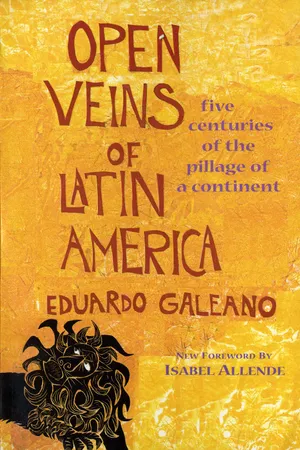
The classic survey of Latin America's social and cultural history, with a new introduction by Isabel Allende
Since its U.S. debut a quarter-century ago, this brilliant text has set a new standard for historical scholarship of Latin America. It is also an outstanding political economy, a social and cultural narrative of the highest quality, and perhaps the finest description of primitive capital accumulation since Marx.
Rather than chronology, geography, or political successions, Eduardo Galeano has organized the various facets of Latin American history according to the patterns of five centuries of exploitation. Thus he is concerned with gold and silver, cacao and cotton, rubber and coffee, fruit, hides and wool, petroleum, iron, nickel, manganese, copper, aluminum ore, nitrates, and tin. These are the veins which he traces through the body of the entire continent, up to the Rio Grande and throughout the Caribbean, and all the way to their open ends where they empty into the coffers of wealth in the United States and Europe.
Weaving fact and imagery into a rich tapestry, Galeano fuses scientific analysis with the passions of a plundered and suffering people. An immense gathering of materials is framed with a vigorous style that never falters in its command of themes. All readers interested in great historical, economic, political, and social writing will find a singular analytical achievement, and an overwhelming narrative that makes history speak, unforgettably. This classic is now further honored by Isabel Allende's inspiring introduction. Universally recognized as one of the most important writers of our time, Allende once again contributes her talents to literature, to political principles, and to enlightenment.
Mankind’s Poverty as a Consequence of the Wealth of the Land
1. Lust for Gold, Lust for Silver
THE SIGN OF THE CROSS ON THE HILT OF THE SWORD
When Christopher Columbus headed across the great emptiness west of Christendom, he had accepted the challenge of legend. Terrible storms would play with his ships as if they were nutshells and hurl them into the jaws of monsters; the sea serpent, hungry for human flesh, would be lying in wait in the murky depths. According to fifteenth-century man, only 1,000 years remained before the purifying flames of the Last Judgment would destroy the world, and the world was then the Mediterranean Sea with its uncertain horizons: Europe, Africa, Asia. Portuguese navigators spoke of strange corpses and curiously carved pieces of wood that floated in on the west wind, but no one suspected that the world was about to be startlingly extended by a great new land.
America not only lacked a name. The Norwegians did not know they had discovered it long ago, and Columbus himself died convinced that he had reached Asia by the western route. In 1492, when Spanish boats first trod the beaches of the Bahamas, the Admiral thought these islands were an outpost of the fabulous isle of Zipango—Japan. Columbus took along a copy of Marco Polo’s book, and covered its margins with notes. The inhabitants of Zipango, said Marco Polo, “have gold in the greatest abundance, its sources being inexhaustible.… In this island there are pearls also, in large quantities, of a red color, round in shape, and of great size, equal in value to, or even exceeding that of white pearls.”1 The wealth of Zipango had become known to the Great Kubla Khan, stirring a desire to conquer it, but he had failed. Out of Marco Polo’s sparkling pages leaped all the good things of creation: there were nearly 13,000 islands in the Indian seas, with mountains of gold and pearls and twelve kinds of spices in enormous quantities, in addition to an abundance of white and black pepper.
Pepper, ginger, cloves, nutmeg, and cinnamon were as prized as salt in preserving meat against putrefaction and loss of flavor in winter. Spain’s Catholic rulers decided to finance the adventure to get direct access to the sources and to free themselves from the burdensome chain of intermediaries and speculators who monopolized the trade in spices and tropical plants, muslins and sidearms, from the mysterious East. The desire for precious metals, the medium of payment in commercial dealings, also sparked the crossing of the sinister seas. All of Europe needed silver; the seams in Bohemia, Saxony, and the Tyrol were almost exhausted.
For Spain it was an era of reconquest: 1492 was not only the year of the discovery of America, the new world born of that error which had such momentous consequences, but also of the recovery of Granada. Early that year Ferdinand of Aragón and Isabella of Castile, whose marriage had linked their dominions, stormed the last Arab redoubt on Spanish soil. It had taken nearly eight centuries to win back what was lost in seven years, and the war of reconquest had drained the royal treasury. But this was a holy war, a Christian war against Islam; and it was no accident that, in that same year of 1492, 150,000 Jews were expelled from the country. Spain achieved unity and reality as a nation wielding swords with the Sign of the Cross on their hilts. Queen Isabella became the patroness of the Holy Inquisition. The feat of discovering America can only be understood in the context of the tradition of crusading wars that prevailed in medieval Castile; the Church needed no prompting to provide a halo for the conquest of unknown lands across the ocean. Pope Alexander VI, who was Spanish, ordained Queen Isabella as proprietor and master of the New World. The expansion of the kingdom of Castile extended God’s reign over the earth.
Three years after the discovery Columbus personally directed the military campaign against the natives of Haiti, which he called Espanola. A handful of cavalry, 200 foot soldiers, and a few specially trained dogs decimated the Indians. More than 500, shipped to Spain, were sold as slaves in Seville and died miserably. Some theologians protested and the enslavement of Indians was formally banned at the beginning of the sixteenth century. Actually it was not banned but blessed: before each military action the captains of the conquest were required to read to the Indians, without an interpreter but before a notary public, a long and rhetorical Requerimiento exhorting them to adopt the holy Catholic faith:
If you do not, or if you maliciously delay in so doing, I certify that with God’s help I will advance powerfully against you and make war on you wherever and however I am able, and will subject you to the yoke and obedience of the Church and of their majesties and take your women and children to be slaves, and as such I will sell and dispose of them as their majesties may order, and I will take your possessions and do you all the harm and damage that I can.2
America was the vast kingdom of the Devil, its redemption impossible or doubtful; but the fanatical mission against the natives’ heresy was mixed with the fever that New World treasures stirred in the conquering hosts. Bernal Díaz del Castillo, faithful comrade of Hernán Cortés in the conquest of Mexico, wrote that they had arrived in America “to serve God and His Majesty and also to get riches.”
At his first landing on San Salvador atoll, Columbus was dazzled by the transparent hues of the Caribbean, the green landscape, the soft clean air, the magnificent birds, and the youths “with size and with good faces and well made” who lived there. He gave the natives “some red caps and strings of beads, and many other trifles of small value, which gave them great pleasure. Wherewith they were much delighted, and this made them so much our friends that it was a marvel to see.” They knew nothing of swords, and when these were shown to them they grasped the sharp edges and cut themselves. Meanwhile, as the Admiral relates in his logbook, “I was very attentive to them, and strove to learn if they had any gold. Seeing some of them with little bits of metal hanging at their noses, I gathered from them by signs that by going southward or steering round the island in that direction, there would be found a king who possessed great cups full of gold, and in large quantities.”3 For “of gold is treasure made, and with it he who has it does as he wills in the world and it even sends souls to Paradise.”
On his third voyage, Columbus still believed he was in the China Sea when he was off the coast of Venezuela. This did not prevent him from reporting that an endless land which was earthly paradise extended from there. Later Amerigo Vespucci, an early sixteenth-century explorer of the Brazilian coast, reported to Lorenzo de Médicis: “The trees are of such beauty and sweetness that we felt we were in earthly Paradise.”4* In 1503 Columbus wrote to his monarchs from Jamaica: “When I discovered the Indies, I said they were the greatest rich domain in the world. I spoke of the gold, pearls, precious stones, spices.…”
* The lawyer Antonio de Léon Pinelo devoted two entire volumes to demonstrating that the Garden of Eden was in America. In El Paraíso en el Nuevo Mundo (1656) he had a map of South America showing, in the center, the Garden of Eden watered by the Amazon, the Río de la Plata, the Orinoco, and the Magdalena. The forbidden fruit was the banana. The map showed the exact spot from which Noah’s Ark took off at the time of the Flood.
In the Middle Ages a small bag of pepper was worth more than a man’s life, but gold and silver were the keys used by the Renaissance to open the doors of paradise in heaven and of capitalist mercantilism on earth. The epic of the Spaniards and Portuguese in America combined propagation of the Christian faith with usurpation and plunder of native wealth. European power stretched out to embrace the world. The virgin lands, bristling with jungles and dangers, fanned the flames of avarice among the captains, the hidalgos on horseback, and the ragged soldiers who went out after the spectacular booty of war: they believed in glory, in “the sun of the dead,” and in the key to achieving it, which Cortrtés defined thus: “Fortune favors the daring.” Cortés himself had mortgaged everything he owned to equip his Mexican expedition. With a few exceptions—Columbus, Pedrarias Dávila, Magellan—the expeditions of conquest were not financed by the state but by the conquistadors themselves, or by businessmen who put up money for their ventures.
The myth of El Dorado, the golden king, was born: golden were the streets and houses of his kingdom’s cities. In search of El Dorado a century after Columbus, Sir Walter Raleigh sailed up the Orinoco and was defeated by its cataracts. The will-o’-the-wisp of the “mountain that gushed silver” became a reality in 1545 with the discovery of Potosí, but before this many adventurers who sailed up the Río Paraná in a vain search for the silver spring had died of hunger or disease or pierced by native arrows.
There was indeed gold and silver in large quantities, accumulated in the Mexican plateau and the Andean altiplano. In 1519 Cortés told Spain of the fabulous magnitude of Montezuma’s Aztec treasure, and fifteen years later there arrived in Seville the gigantic ransom—a roomful of gold and two of silver—which Francisco Pizarro had made the Inca Atahualpa pay before strangling him. Years earlier the Crown had paid the sailors on Columbus’s first voyage with gold carried off from the Antilles. The Caribbean island populations finally stopped paying tribute because they had disappeared: they were totally exterminated in the gold mines, in the deadly task of sifting auriferous sands with their bodies half submerged in water, or in breaking up the ground beyond the point of exhaustion, doubled up over the heavy cultivating tools brought from Spain. Many natives of Haiti anticipated the fate imposed by their white oppressors: they killed their children and committed mass suicide. The mid-sixteenth-century historian Fernández de Oviedo interpreted the Antillean holocaust thus: “Many of them, by way of diversion, took poison rather than work, and others hanged themselves with their own hands.”5*
* His interpretation founded a school. I am amazed to read, in the latest (1970) book by the French technician René Dumont, Cuba: Is It Socialist?: “The Indians were not totally exterminated. Their genes subsist in Cuban chromosomes. They felt such an aversion for the tension which continuous work demands that some killed themselves rather than accept forced labor.…”
THE GODS RETURN WITH SECRET WEAPONS
While passing Tenerife on his first voyage, Columbus had witnessed a great volcanic eruption. It seemed an omen of all that would come later in the immense new lands which, surprisingly, stood athwart the western route to Asia. America was there—at first the subject of conjecture from its endless coasts, then conquered in successive waves like a furious tide beating in. Admirals gave place to governors, ships’ crews were converted into invading hosts. Papal bulls had apostolically granted Africa to the Portuguese Crown, and the lands “unknown like those already discovered by your envoys and those to be discovered in the future” to the Crown of Castile. America had been given to Queen Isabella. In 1508 another bull granted the Spanish Crown, in perpetuity, all tithes collected in America. The coveted patronage of the New World Church included a royal prerogative over all ecclesiastical benefices.
The Treaty of Tordesillas, signed in 1494, allowed Portugal to occupy Latin American territories below a dividing line traced by the Pope, and in 1530 Martim Affonso de Sousa founded the first Portuguese communities in Brazil, expelling French intruders. By then the Spaniards, crossing an infinity of hellish jungles and hostile deserts, had advanced far in the process of exploration and conquest. In 1513 the South Pacific glittered before the eyes of Vasco Núñez de Balboa. In the fall of 1522 the eighteen survivors of Ferdinand Magellan’s expedition returned to Spain: they had for the first time united both oceans and confirmed that the world was round by circling it. Three years earlier Hernán Cortés’s ten ships had sailed from Cuba toward Mexico, and in 1523 Pedro de Alvarado launched the conquest of Central America. Francisco Pizarro, an illiterate pig-breeder, triumphantly entered Cuzco in 1533 and seized the heart of the Inca empire. In 1540 Pedro de Valdivia crossed the Atacama desert and founded Santiago de Chile. The conquistadors penetrated the Chaco and laid bare the New World from Peru to the mouth of the mightiest river on our planet.
There was something of everything among the natives of Latin America: astronomers and cannibals, engineers and Stone Age savages. But none of the native cultures knew iron or the plow, or glass, or gunpowder, or used the wheel except on their votive carts. The civilization from across the ocean that descended upon these lands was undergoing the creative explosion of the Renaissance: Latin America seemed like another invention to be incorporated, along with gunpowder, printing, paper, and the compass, in the bubbling birth of the Modern Age. The unequal development of the two worlds explains the relative ease with which native civilizations succumbed. Cortés landed at Veracruz with no more than 100 sailors and 508 soldiers; he had 16 horses, 32 crossbows, 10 bronze cannon, and a few harquebuses, muskets, and pistols. Pizarro entered Cajamarca with 180 soldiers and 37 horses. That was enough. Yet the Aztec capital, Tenochtitlán, was then five times larger than Madrid and had double the population of Seville, Spain’s largest city, and in Peru Pizarro met an army of 100,000 Indians.
The Indians were also defeated by terror. The emperor Montezuma received the first news in his palace: a large hill was moving over the sea. More messengers arrived: “He was very alarmed by the report of how the cannon exploded, how its thunder reverberated, and how it filled one with awe and stunned one’s ears. And when it went off, a sort of stone ball came from its entrails and it rained fire.” The strangers sat on “deer as high as the rooftops.” Their bodies were completely covered, “only their faces can be seen. They are white, as if made of lime. They have yellow hair, although some have black. Long are their beards.”6 Montezuma thought it was the god Quetzalcoatl returning: there had been eight prophesies of this not long before. Hunters had brought him a bird with a round mirror-like crest on its head in which the sunset was reflected; in this mirror Montezuma saw squadrons of warriors marching on Mexico. Quetzalcoatl had come from the east and gone to the east: he was white and bearded. Also white and bearded was Viracocha, the bisexual god of the Incas. And the east was the cradle of the Mayas’ hero-ancestors.*
* These remarkable coincidences have given rise to the hypothesis that the gods of the native religions were really Europeans who reached our shores long before Columbus.7
The avenging gods who were now returning to settle accounts with their peoples had armor and coats of mail, lustrous caparisons that deflected arrows and stones; their weapons emitted deadly rays and darkened the air with suffocating smoke. The conquistadors also practiced the arts of treachery and intrigue with refined expertise. They sagely allied themselves with the Tlaxcalans against Montezuma and effectively exploited the split in the Inca empire between the brothers Huáscar and Atahualpa. They knew how to win accomplices for their crimes among the intermediate ruling classes, priests, officials, and defeated soldiers and high Indian chiefs. But they also used other weapons—or, if you prefer, other factors operated objectively for the victory of the invaders. Horses and bacteria, for example.
Horses, like camels, had once been indigenous to Latin America but had become extinct. In Europe, where they were introduced by Arab horsemen, they had proved to be of enormous military and economic value. When they reappeared in Latin America during the conquest, they lent magic powers to the invaders in the natives’ astonished eyes. Atahualpa saw the first Spanish soldiers arriving on spirited steeds adorned with plumes and little bells, making thunder and clouds of dust with their swift hooves: panic-stricken, the Inca fell down on his back. The chief Tecum, leading the descendants of the Mayas, beheaded the horse of Pedro de Alvarado with his lance, convinced that it was part of the conquistador: Alvarado stood up and killed him. A few horses in medieval war trappings scattered the mass of Indians, sowing terror and death. During the colonizing process, priests and missionaries spread for the superstitious Indians’ benefit the tale that horses were of sacred origin, for Santiago, Spain’s patron saint, rode a white horse which had won valiant victories against the Moors and the Jews with the aid of Divine Providence.
Bacteria and viruses were the most effective allies. The Europeans brought with them, like biblical plagues, smallpox and tetanus, various lung, intestinal, and venereal diseases, trachoma, typhus, leprosy, yellow fever, and teeth-rotting caries. Smallpox was the first to appear. Must not this unknown and horrible epidemic, which produced burning fever and decomposed the flesh, be a chastisement from the gods? The invaders “moved into Tlaxcala,” one native eyewitness reported, “and then the epidemic spread: cough, burning hot pustules.” Reported another: “The contagious, oppressive, cruel pustule sickness brought death to many.”8 The Indians died like flies; their organisms had no defense against the new diseases. Those who survived were feeble and useless. The Brazilian anthropologist Darcy Ribeiro estimates that more than half the aboriginal population of America, Australia, and Oceania died from the contamination of first contact with white men.
“THEY CRAVE GOLD LIKE HUNGRY SWINE”
Firing their harquebuses, hacking with their swords, and breathing pestilence, the little band of implacable conquistadors advanced into America. The conquered tell us what it was like. After the Cholula massacre Montezuma sent new envoys to Cortés, who was advancing on the Valley of México. They brought gifts of golden collars and quetzal-bird feather banners. The Spaniards “were in seventh heaven,” says the Nahuatl text preserved in the Florentine Codex. “They lifted up the gold as if they were monkeys, with expressions of joy, as if it put new life into them and lit up th...
Table of contents
Cover Page
Dedication
Title Page
Copyright Page
Contents
Foreword Isabel Allende
In Defense of the Word
Acknowledgement
Introduction: 120 Million Children in the Eye of the Hurricane
Part I Mankind’s Poverty as a Consequence of the Wealth of the Land
Part II Development Is a Voyage with More Shipwrecks than Navigators
Part III Seven Years After
References
INDEX
Trusted by 375,005 students
Access to over 1.5 million titles for a fair monthly price.
Study more efficiently using our study tools.
Frequently asked questions
Yes, you can cancel anytime from the Subscription tab in your account settings on the Perlego website. Your subscription will stay active until the end of your current billing period. Learn how to cancel your subscription
No, books cannot be downloaded as external files, such as PDFs, for use outside of Perlego. However, you can download books within the Perlego app for offline reading on mobile or tablet. Learn how to download books offline
We are an online textbook subscription service, where you can get access to an entire online library for less than the price of a single book per month. With over 1.5 million books across 990+ topics, we’ve got you covered! Learn about our mission
Look out for the read-aloud symbol on your next book to see if you can listen to it. The read-aloud tool reads text aloud for you, highlighting the text as it is being read. You can pause it, speed it up and slow it down. Learn more about Read Aloud
Yes! You can use the Perlego app on both iOS and Android devices to read anytime, anywhere — even offline. Perfect for commutes or when you’re on the go. Please note we cannot support devices running on iOS 13 and Android 7 or earlier. Learn more about using the app
Yes, you can access Open Veins of Latin America by Eduardo Galeano in PDF and/or ePUB format, as well as other popular books in History & Latin American & Caribbean History. We have over 1.5 million books available in our catalogue for you to explore.