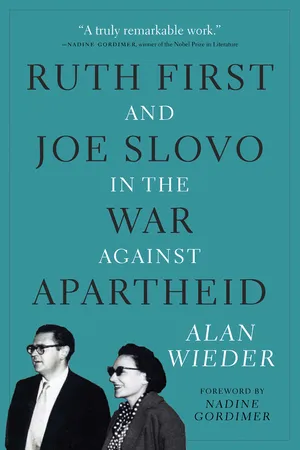
Ruth First and Joe Slovo, husband and wife, were leaders of the
war to end apartheid in South Africa. Communists, scholars, parents,
and uncompromising militants, they were the perfect enemies
for the white police state. Together they were swept up in the
growing resistance to apartheid, and together they experienced
repression and exile. Their contributions to the liberation struggle,
as individuals and as a couple, are undeniable. Ruth agitated
tirelessly for the overthrow of apartheid, first in South Africa and
then from abroad, and Joe directed much of the armed struggle
carried out by the famous Umkhonto we Sizwe. Only one of them,
however, would survive to see the fall of the old regime and the
founding of a new, democratic South Africa.
This book, the first extended biography of Ruth First and Joe
Slovo, is a remarkable account of one couple and the revolutionary
moment in which they lived. Alan Wieder's deeply researched
work draws on the usual primary and secondary sources but also
an extensive oral history that he has collected over many years.
By weaving the documentary record together with personal interviews,
Wieder portrays the complexities and contradictions of this
extraordinary couple and their efforts to navigate a time of great
tension, upheaval, and revolutionary hope.
- 464 pages
- English
- ePUB (mobile friendly)
- Available on iOS & Android
eBook - ePub
Ruth First and Joe Slovo in the War Against Apartheid
About this book
Information
1—From the Shtetl to South Africa
RUTH FIRST IS BURIED in Llanguene Cemetery in a dusty Mozambican suburb. Her grave lies next to those of other members of the African National Congress who were killed by the apartheid government in a 1981 raid, referred to as the Matola Massacre, where South African soldiers in blackface committed cold-blooded murder. Ruth’s killing was no less brutal: the South African regime sent a letter bomb that detonated in her hands and sent shrapnel into the bodies of her colleagues at Eduardo Mondlane University. Joe Slovo is one of two white South Africans that lie in rest at Avalon Cemetery in Soweto, one of Johannesburg’s massive black townships. His funeral, a national event, took place before a crowd of over 40,000 people packed into Orlando Stadium, home of Soweto’s premier soccer club, where he was eulogized by among others, the Chief Rabbi of South Africa, Cyril Harris. Though the stadium was quiet during Joe’s funeral, on the streets of the township on the way to the cemetery Joe Slovo was remembered by the South African people as they danced, laughed, and sang “Hamba Kahle Umkhonto” (Go Well, Spear of the Nation) in a celebration of Joe’s life. At Avalon Cemetery, Joe was lowered into his grave not by the South African military, but rather by Umkhonto we Sizwe cadres, Joe Slovo’s comrades in the fight against the apartheid regime.
Both Ruth and Joe’s funerals and resting places offer stark contrast to their Eastern European Jewish roots in Latvia and Lithuania. Joe Slovo was born May 23, 1926, in Obelei, a small village close to Vilna, the city that Napoleon referred to as the “Jerusalem of Lithuania.” He left when he was ten years old and his memories were of a small Yiddish-speaking world and an ear-pinching rabbi. Ruth First was a native South African, born May 4, 1925; her father, Julius First, had immigrated with his mother and older brother to South Africa from Latvia in 1907 when he was ten years old. Ruth’s mother, Tilly, whose birth name was Matilda Leveton, emigrated from Lithuania three years earlier.
Eastern European Jews began to come to South Africa in the late nineteenth century, an exodus that parallels even greater numbers moving to North America. Forty thousand had arrived in South Africa by 1914. Although there had always been anti-Semitism in Eastern Europe, it escalated greatly in 1881 with the assassination of the modestly liberal Russian tsar, Alexander II, who had freed over 40 million serfs and had also eased military conscription, opened up universities, and liberalized business practices for Russian Jews. Upon his death, in places like Latvia and Lithuania, Jews were removed from certain areas and excluded from many occupations and employment opportunities, an ironic foreshadowing of what was to happen to blacks in South Africa. In effect, Jews were ghettoized and were unable to support themselves and their families. In World of Our Fathers, Irving Howe refers to them as the “poor and the hopelessly poor.” In addition, violent oppression, the worst form taking shape in the pogroms, made life unlivable—dangerous and life-threatening.
Though life had never been easy for the ancestors of Ruth First and Joe Slovo in the Diaspora, the families were part of a rich history. Vilna was one of the centers of Jewish piety, scholarship, and intellect and was later a city that celebrated the Yiddish writing and humor of Shalom Aleichem. Irving Howe’s description of Yiddish might unwittingly be a portrayal of Joe Slovo: “Yiddish was a language intimately reflecting the travail of wandering, exile, dispersion; it came, in the long history of the Jews, like a late and beloved, if not fully honored, son.”7 In addition to Yiddish culture, a semblance of socialism began to grow in the last decade of the nineteenth century, as more and more Jews were displaced.
There is no detailed record of Ruth’s family’s journey. The reasonable assumption is that they made the same migration into Western Europe that was made by the masses of Jews. It might be that it was the success stories of two Lithuanian Jews, Sammy Marks and Isaac Lewis, who had both prospered economically when they immigrated to South Africa in the nineteenth century, that led the Levetons and Firsts to choose South Africa. Ruth’s family was part of the wave of immigration that began in 1882, after Alexander II’s assassination, and ended with the beginning of the First World War in 1914. The Levetons and Firsts might have traveled overland, but more likely they sailed from the Baltic port of Libau, which, though more expensive, was safer than land travel. Most of the people who journeyed to South Africa initially departed from the European mainland to London, where they were aided and supported by an organization called the Jewish Shelter.
We can assume that the Levetons and Firsts made the long train trip from Cape Town to Johannesburg once they landed on the shores of South Africa. It should be remembered that Johannesburg was then in its infancy. The city began as a mining camp when gold was discovered in 1886. Rapid growth followed as the camp grew from 300 to 3,000 people by the end of the year. In 1892, a railroad line was built between Johannesburg and Cape Town, a city that dates back to the seventeenth century. By 1895, Johannesburg was the largest African city south of the equator. By the time Tilly and Julius arrived in Johannesburg approximately 200,000 people lived in the city including over 25,000 Jews. Tilly and Julius both attended the Jewish Government School in Doornfontein, the same school that Ruth and Joe would briefly attend as children.
Although there are no descriptions of Ruth’s parents’ childhood, awareness of the geography and culture of early twentieth century Johannesburg Jews is helpful, as is the early history of the left in South Africa. Jews worked as clerks in small shops adjacent to gold mines where blacks shopped for food and supplies. They also worked as tailors, carpenters, jewelers, cobblers, barbers, butchers, bakers, clerks, grocers, peddlers, drivers, shopkeepers, and gangsters. When they arrived in the city, they moved to low-rent neighborhoods such as Ferreirastown, Fordsburg, Doornfontein, and Yeoville. Tilly’s family initially lived in Fordsburg and according to Ronald First, his birth family inhabited these neighborhoods as well as the more upscale Kensington because of the family’s changing economic status. Like the rest of the population of Johannesburg, class distinctions quickly developed in the Jewish community. As some Jews accrued wealth even before Ruth First and Joe Slovo were born, Johannesburg was sometimes disparagingly referred to as “Jewhannesburg.” At the other end of the continuum, poor Jews were called “Peruvians,” a negative, racist epithet.
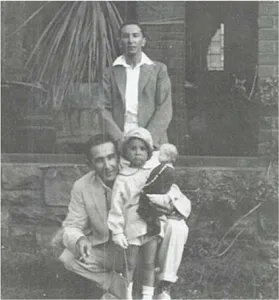
Ruth at a very young age with her father and uncle. (courtesy of Ronald First)
The first twenty years of the twentieth century witnessed competing movements among South African Jews. The large Zionist movement that originated in Johannesburg with the Transvaal Zionist Organization quickly affiliated with the South African Zionist Federation. Neither organization appealed to Tilly Leveton or Julius First. By the time they married in 1924, they were each involved in socialist politics. Julius viewed the International Socialist League (ISL) leader and Communist Party of South Africa (CPSA) founding member David Ivon Jones as somewhat of a mentor. Jones was one of the key spokesmen of the Party and was committed to non-racial politics. During the 1920 strike by black mine workers, Jones publicly called for whites not to cross strike lines. Tilly noted that her future husband was upset when in 1918 at age twenty he was not initially accepted as a member of the ISL, but shortly after this rejection, both he and Tilly were accepted for membership in the organization. Neither Tilly nor Julius were practicing Jews at the time. This fact is only relevant because the ISL in Johannesburg had various branches, one being the active and vocal Yiddish Speaking Branch (YSB) that existed between 1918 and 1920. Its members were deeply involved in the arguments and debates held at West’s Academy, the Johannesburg socialist venue, when the ISL became one of the organizational leaders in the forming of the CPSA. There is no listing of Julius or Tilly in the records of the YSB: however, Julius First did become the chairman of the CPSA in 1923.
Ruth First was born a year after Tilly and Julius were married, on May 4, 1925. Similar to the story of her parents’ lives during the first quarter of the twentieth century, there is not a great deal of information about Ruth’s childhood. For the first ten years of her life, while her future husband Joe Slovo still lived in Lithuania, Ruth was growing up in Kensington, a relatively wealthy Johannesburg community. Ruth appeared to be strong and vocal even as a child, and the family lived a privileged life as upper-middle-class white South Africans. Ruth began kindergarten when she was four years old. The initial years of Ruth’s education are sketchy, but it is known that just before she moved to the Jewish Government School in Doornfontein in 1936, about the same time Joe came to Johannesburg, her mother traveled to the Soviet Union. Tilly First had been awarded a trip to Yalta because of the family’s contributions to the CPSA. Ronald First remembers the trip as a crucial experience for his mother, ideologically: “For my mother where the dedication became a mission, a vocation, something to pursue awake or sleeping, was her visit to Russia in 1936.”8
Adele Bernstein, one of Ruth’s new classmates at the Jewish Government School, remembered that Ruth was a reader who was articulate in class. Bernstein recalled her being “a skinny girl in a navy gym and white shirt who wore her fuzzy hair short. She was always neat, impeccably dressed and a bit of a class above us.”9 It is ironic that Ruth First went to school in Doornfontein, because the area was one of the immigrant Jewish enclaves in Johannesburg, and very, very Jewish, unlike Ruth’s family. The area was bustling with Jewish signs everywhere: kosher butchers, synagogues, bakeries, and delicatessens lining the streets. Finally, recent immigrant children attended the school.
Joe Slovo was born in the village of Obelei in Lithuania in 1926. Later in life he visited his birth village twice, first in 1981 with his Soviet friend Alexei Makarov, and then again in 1989 with Makarov and Joe’s second wife, Helena Dolny. In the introduction of Slovo: The Unfinished Autobiography, Joe speaks of his early years. He describes himself as a “thin, scraggy youth,” and has memories of a green and ochre run-down wood house, yellow and mauve flowers, the river, and “dark winter mornings and winter nights, through the snow with paraffin lamp in hand, trudging to and from the synagogue school.”10 He also recalls Friday baths at the mikvah, the Jewish ritual bath, sledding, a large house where a more affluent relative lived, and festivals with singing, eating, and drinking. At the conclusion of his 1981 visit, Joe reflected on anti-Semitism and Jewish tribalism in the village and that a hundred-year-old Catholic Church was the most dominant building in Obelei. “I remember the rhyming chant … Jesus Christ lies in the earth dead like a horse. … We the chosen (for persecution?) were taught that we were superior to the goyim, and for boys the greatest taboo was the shiksha—a non-Jewish girl.”11 There is immense irony in the fact that in his ANC and SACP responsibilities Joe Slovo often visited the Soviet Union, the place of his birth. It might be that his reflections on anti-Semitism and Judaism are not far afield from his internal and intellectual struggles with aspects of the Soviet Union during the final decade of his life.
Wolfus Slovo, Joe’s father, was by varied accounts a fisherman and a woodcutter in Obelei. His mother was a homemaker. Wolfus left Lithuania in 1928; Joe was two years old and would not see his father again until he was ten. When he was a toddler his mother, Chaya, sang him the lullaby, “Rosinkes und Mandlen” (Raisins and Almonds), a tune that wished for more riches for shtetl children. Wolfus Slovo immigrated to Argentina with plans to bring his family when he became settled. Although there is no evidence of his motive for choosing Argentina, it is not imprudent to assume that he had made some type of contact with the Jewish Colonization Society (JCS), an organization founded in 1891 by Baron de Hirsch with the mission of raising the material and moral status of Russian Jews. JCS had offices throughout Russia and worked to facilitate Jewish emigration. One of their programs was agricultural colonization in Argentina. Wolfus Slovo sailed from England to Buenos Aires, but it is unclear whether he ever became a part of any of the three agricultural colonies supported by the JCS. He opted to leave Argentina. In his memoir, Joe wondered how different things might have been if Wolfus had been successful in South America.
In 1936, with help from her family, the Sachs, Chaya Slovo prepared to immigrate to South Africa with Joe and her daughter Sonia. Joe Slovo met his father as a ten-year-old Yiddish-speaking boy. Although Wolfus had lived in South Africa for many years, he maintained Yiddish as his primary language. The family flat was located in Doornfontein, the site of the Jewish Government School. The family’s first house had a tin roof, typical for the area, but it was soon demolished to enable the building of the Apollo Cinema and Crystal Bakery, where both Joe’s father and his sister Sonia later worked. Shortly after his arrival, Joe was enrolled in the Jewish Government School, and like all immigrant children, his head was shaved to prevent lice. Although many of the other children were also Yiddish-speaking immigrants from Eastern Europe, they quickly took to calling him the “Bald Bolshie.” Business prospered and the family moved to a better house in Bellevue with Joe completing his primary education at Observatory Junior School and Yeoville School for Boys.
The family house in Bellevue was a row house situated on the tram line just across the street from the family’s fruit stand, a business that was successful due to Chaya’s extensive work regimen from five in the morning to eight at night. Joe remembers being a part of a gang of kids that he referred to as his smoking “club.” He supplied them cigarettes from his parents’ fruit stand until they were caught smoking at school and his father became vigilant about his behavior. Joe writes of his first crush and also of him and Sonia burying their dog, Spotty, who was killed by a car as it ran to greet Joe. He also reflects on the death of his mother, after only two years in Johannesburg. This, undoubtedly, was the event that changed the lives of the Slovo family. Joe’s reflections on his mother’s death are both ethnographic and psychological:
I was not told of her death. I suddenly woke up in the middle of the night to find the mirror covered with a white sheet. The walk around the coffin, the hysterical wailing of women and, above all, the yellow, yellow face haunted me for years. But the shaft of horror and shock, which struck me on our return from the funeral still evokes a shudder within me. As we entered the dining room, staring at me from the mantelpiece was a large doll (a present for my sister Reina) completely wrapped in bright yellow cellophane paper. It was particularly horrifying since my mother had died in childbirth and I expected to see the stillborn child in the coffin.12
Joe Slovo admits that he did not have a rich recollection of his mother, but he does recall her warmth, her hard work, and her being pregnant. He also remembers his older sister, in defiance of Jewish law, privately reciting the Kaddish, the Jewish prayer for the dead, in respect for their mother. Chaya’s death totally disrupted the family. Joe, who attended daily services at the synagogue prior to his Bar Mitzvah, began to question the existence of God. Because his mother was the force supporting the success of the fruit shop, it collapsed after her death. Wolfus returned to a life of transient work, which prompted him to send Reina to an orphanage, while Sonia went to work and live at the Crystal Bakery. Joe moved with his father to various rooming houses in Doornfontein, where, unbeknownst to him at the time, one of his neighbors was the future ANC leader Walter Sisulu.
As Joe was forced to leave school and watch his family life disintegrate, Ruth was proceeding with her traditional schooling. What was not traditional in Ruth’s life was her family’s commitment and involvement in socialist politics. Ruth lived a comfortable middle-class life and attended three secondary schools: Barnato Park, Jeppe Girls High, and an Afrikaner school. She loved clothes and was interested in boys. She was also immersed in radical politics through her parents, mostly from her mother’s influence. Tilly and Julius First introduced Ruth and Ronald to the world of politics as children through weekly left-wing meetings on the steps of the Johannesburg City Hall, where the topics included Western imperialism and South African racism. As Tilly recalled: “When we used to go to the Town Hall steps (to hear Communist speakers) we took the children with us. We made them conscious. We wanted them to have an understanding of what was going on.”13
Ruth definitely accepted her parents’ political education. She met Myrtle Berman at Barnato Park and they became close friends. In the early 1960s, Berman and her husband, Monty, along with John Lang, Jerry Mbuli, and Baruch Hirson, founded the National Committee for Liberation, an organization that became the African Resistance Movement, with a manifesto that argued for armed resistance against the apartheid regime. When Myrtle was interviewed, she spoke about her first history class with Ruth at Bar...
Table of contents
- Cover Page
- Title Page
- Copyright Page
- Contents
- Dedication
- Foreword
- Preface
- Acknowledgments
- Introduction
- 1. From the Shtetl to South Africa
- 2. War, Wits, Politics, and Ruth Meets Joe
- 3. Apartheid, Children, and the Beginning of the Struggle
- 4. The Treason Trial and Underground Action
- 5. Sharpeville, Prison, and Exile
- 6. The Initial Exile: Living in London
- 7. Academics, Writing, and Activism: Moving toward Africa
- 8. Academics and Revolution: Taking the Struggle Home
- 9. Assassination, Grief, and Expulsion from Maputo
- 10. Lusaka, Marriage, and the Beginning of the Journey Home
- 11. Home
- 12. Election, Ministry: To Rest in Soweto
- Epilogue
- Abbreviations
- Sources
- Notes
- Index
Trusted by 375,005 students
Access to over 1.5 million titles for a fair monthly price.
Study more efficiently using our study tools.
Frequently asked questions
Yes, you can cancel anytime from the Subscription tab in your account settings on the Perlego website. Your subscription will stay active until the end of your current billing period. Learn how to cancel your subscription
No, books cannot be downloaded as external files, such as PDFs, for use outside of Perlego. However, you can download books within the Perlego app for offline reading on mobile or tablet. Learn how to download books offline
Perlego offers two plans: Essential and Complete
- Essential is ideal for learners and professionals who enjoy exploring a wide range of subjects. Access the Essential Library with 800,000+ trusted titles and best-sellers across business, personal growth, and the humanities. Includes unlimited reading time and Standard Read Aloud voice.
- Complete: Perfect for advanced learners and researchers needing full, unrestricted access. Unlock 1.5M+ books across hundreds of subjects, including academic and specialized titles. The Complete Plan also includes advanced features like Premium Read Aloud and Research Assistant.
We are an online textbook subscription service, where you can get access to an entire online library for less than the price of a single book per month. With over 1.5 million books across 990+ topics, we’ve got you covered! Learn about our mission
Look out for the read-aloud symbol on your next book to see if you can listen to it. The read-aloud tool reads text aloud for you, highlighting the text as it is being read. You can pause it, speed it up and slow it down. Learn more about Read Aloud
Yes! You can use the Perlego app on both iOS and Android devices to read anytime, anywhere — even offline. Perfect for commutes or when you’re on the go.
Please note we cannot support devices running on iOS 13 and Android 7 or earlier. Learn more about using the app
Please note we cannot support devices running on iOS 13 and Android 7 or earlier. Learn more about using the app
Yes, you can access Ruth First and Joe Slovo in the War Against Apartheid by Alan Wieder in PDF and/or ePUB format, as well as other popular books in Politics & International Relations & Politics. We have over 1.5 million books available in our catalogue for you to explore.