In 1966, Paul Baran and Paul Sweezy published Monopoly Capital,
a monumental work of economic theory and social criticism
that sought to reveal the basic nature of the capitalism of their
time. Their theory, and its continuing elaboration by Sweezy, Harry
Magdoff, and others in Monthly Review magazine, infl uenced generations
of radical and heterodox economists. They recognized
that Marx’s work was unfi nished and itself historically conditioned,
and that any attempt to understand capitalism as an evolving
phenomenon needed to take changing conditions into account.
Having observed the rise of giant monopolistic (or oligopolistic)
fi rms in the twentieth century, they put monopoly capital at the
center of their analysis, arguing that the rising surplus such fi rms
accumulated—as a result of their pricing power, massive sales
efforts, and other factors—could not be profi tably invested back
into the economy. Absent any “epoch making innovations” like the
automobile or vast new increases in military spending, the result
was a general trend toward economic stagnation—a condition that
persists, and is increasingly apparent, to this day. Their analysis
was also extended to issues of imperialism, or “accumulation on
a world scale,” overlapping with the path-breaking work of Samir
Amin in particular.
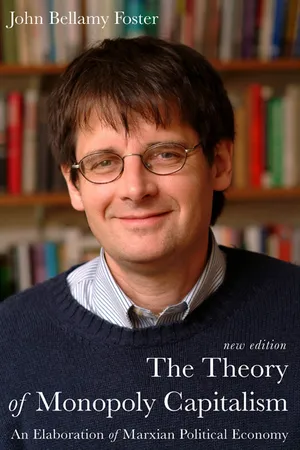
John Bellamy Foster is a leading exponent of this theoretical perspective
today, continuing in the tradition of Baran and Sweezy’s
Monopoly Capital. This new edition of his essential work, The
Theory of Monopoly Capitalism, is a clear and accessible explication
of this outlook, brought up to the present, and incorporating
an analysis of recently discovered “lost” chapters from Monopoly
Capital and correspondence between Baran and Sweezy. It also
discusses Magdoff and Sweezy’s analysis of the fi nancialization
of the economy in the 1970s, ‘80s, and ‘90s, leading up to the
Great Financial Crisis of the opening decade of this century. Foster
presents and develops the main arguments of monopoly capital
theory, examining its key exponents, and addressing its critics in a
way that is thoughtful but rigorous, suspicious of dogma but adamant
that the deep-seated problems of today’s monopoly-fi nance
capitalism can only truly be solved in the process of overcoming
the system itself.
- 320 pages
- English
- ePUB (mobile friendly)
- Available on iOS & Android
eBook - ePub
The Theory of Monopoly Capitalism
About this book
Information
1
The Monopoloy Capital Debate
With the turn for the worse in the U.S. and world economy in the early 1970s, a majority of mainstream economists turned their backs on reality and the Keynesian “revolution” and reverted to the supply-side perspective that had always been the preferred liberal response to crisis. Thus when Paul Samuelson told his readers in 1983 that Keynes’s “prescription in its most simple form self-destructed, as the obligation to run a full-employment humanitarian state caused modern economies to succumb to the new disease of stagflation—high inflation along with joblessness and excess capacity,” he was simply giving further evidence of the general “about-face” of received economics, which had endeavored to blame the new period of severe economic distress on the overindulgent attitude toward the poor and unemployed that had supposedly characterized the earlier, Keynesian era.1 The only way out of the present crisis, according to this viewpoint, was through a direct assault on employment and wages, the granting of additional tax concessions to corporations and the wealthy, and massive cutbacks in state welfare spending.
That mainstream economists should “reverse themselves” in this way, in response to the return of stagnation, was of course to be expected. More surprising was the fact that many economists on the left turned around at about the same time and began to argue that the chief constraints of the system were to be found on the supply side, with high costs at the point of production squeezing profitability.
Among radicals, this shift in perspective frequently took the form of criticism of Monopoly Capital: An Essay on the American Economic and Social Order (1966) by Paul Baran and Paul Sweezy, which in the years immediately following its publication had received widespread recognition as the leading attempt to bring Marx’s Capital up to date, describing those laws of motion that constituted the differentia specifica of advanced accumulation.2 In Baran and Sweezy’s conception, the concentration on lowering costs and maximizing profits, under the reign of giant corporations with significant monopoly power, had contributed to the “widening gap, at any given level of production, between output and socially necessary costs of production. This gap we call surplus.”3 The main problem of accumulation under monopoly capitalism was therefore to find ways in which this increasing surplus could be absorbed. Capitalist consumption—which constituted one possible outlet for the surplus—tended to account for a decreasing share of capitalist demand as income grew, while investment itself was held down by the fact that it took the form of new productive capacity, which could not be expanded for long periods of time independently of final, wage-based demand. Thus the system became increasingly dependent on the promotion of economic waste, both through the private channel of the “sales effort” and the public channel of military spending (which accounted for the greater bulk of federal expenditures on goods and services). Even then, the surplus was not entirely absorbed, with the unrealized or unabsorbed portion leaving its “statistical trace” in actual unemployment and excess capacity. Hence what could be called the “relative over-exploitation” of labor power under monopoly capitalism manifested itself in a realization crisis, or—in Keynesian terms—a shortage of effective demand.
Monopoly Capital had pointed to a strong tendency toward secular stagnation under advanced capitalism, reflected in a widening underemployment gap. But with the reemergence of stagnation only three or four years later this type of analysis increasingly lost ground to two forms of radical supply-side theory: (1) the classical Marxian “law of the tendency of the rate of profit to fall,” and (2) the underexploitation theory of the “neo-Ricardian” profit-squeeze school. For those who turned to the former—which gained numerous adherents following the publication of Paul Mattick’s Marx and Keynes (1969) and David Yaffe’s “The Marxian Theory of Crisis, Capital, and the State” (1973)—the issue had less to do with changing historical conditions or transformations in liberal ideology than with what were viewed as the categorical imperatives of Marxian political economy.4 Since Marx himself had devoted three whole chapters of Capital to this “tendential law”—according to which any increases in the rate of exploitation of labor power, as accumulation proceeds, will be overshadowed by a rising organic composition of capital (capital-labor ratio), thereby decreasing labor’s production of new value (and hence profits) per unit of constant (material) capital—and had advanced demand-side or “underconsumptionist” notions of crisis, like those of Baran and Sweezy, only in a scattered way, the falling rate of profit theory was seen by many to be the most definitively “Marxist” approach to the question of crisis. Moreover, while Baran and Sweezy had referred to the “tendency of the surplus to rise” as a new law of monopoly capitalism, replacing the classical law of the tendency of the rate of profit to fall, the growing turbulence surrounding profits in the 1970s gave the impression—to those with only a superficial understanding of their theory—that they had spoken too soon.5 Finally, the more traditionalist Marxists were inclined to view the substitution of the surplus category for the concept of surplus value in Monopoly Capital, along with the emphasis on monopoly and the location of economic contradictions within the exchange process (i.e., on the demand side), as indications of fundamental departures from Marxism. Similar reservations were to be raised with respect to the dependency theory of imperialism, which Baran had helped to introduce into the Marxian discussion on the basis of the same analytical framework.
Nevertheless, as the debate lingered on it became increasingly apparent that there was absolutely no empirical evidence whatsoever to indicate that a rising organic composition of capital (capital-labor ratio) was a major factor contributing to crisis tendencies in the twentieth century. Theorists continuing to stress the direct importance of the law of the falling tendency of the rate of profit therefore either contended that it was simply a “tendential law” that never had to materialize, or resorted to ever more eclectic formulations in which the falling rate of profit theory played a secondary, and highly ambiguous, role.6 Hence, discussions of crisis within this tradition seldom if ever got beyond the mere repetition of Marx’s original ideas of a century before.
The falling rate of profit theory had argued that the shift in the organic composition of capital away from variable capital (or wage labor) and toward constant (or material) capital was endangering profits at the point of production, thereby causing a capital shortage. The logic of the crisis, from the standpoint of the system, therefore demanded a supply-side strategy that would intensify the exploitation of labor and redistribute income from the poor to the rich. But since (1) the rising capital intensiveness of production (in value terms) was presumed to be an inherant feature of technological progress under capitalism; (2) the rate of exploitation was constantly rising as well (although at a slower pace); and (3) a revolutionary response could sooner or later be expected from the working class, such a strategy was bound to fail in the medium and long run in the eyes of most fundamentalist Marxists.7 In contrast, the profit-squeeze interpretation of contemporary economic distress that emerged within the “neo-Ricardian” left in the 1970s and 1980s—in such works as Capitalism in Crisis (1972) by Andrew Glyn and Bob Sutcliffe, and Beyond the Wasteland (1983) by Samuel Bowles, David Gordon, and Thomas Weisskopf—saw the problem as one of a rising wage share in national income and a decline in the rate of growth of labor productivity.8 Since the cause of the crisis, in this case, was presumed to be a relative underexploitation of labor power, resulting from the growing strength of labor during the long post-World War II boom, the type of policy solutions adopted by President Reagan in the United States and Prime Minister Thatcher in Great Britain were thought to improve the underlying conditions of accumulation—though such policies were to be resisted on the left, and countered by either revolutionary strategy (Glyn and Sutcliffe), or radical industrial policy initiatives, including the reorganization of class relations within the labor process (Bowles, Gordon, and Weisskopf).9
Within the United States, profit-squeeze theorists argued against the “stagnation theory” of neo-Marxian, underconsumptionist thinkers like Michael Kalecki, Josef Steindl, Paul Baran and Paul Sweezy by pointing to what appeared to be an increasing share of wages in national income during the Vietnam war period (1965–73).10 However, for theorists within the neo-Marxian tradition (as well as for many of those in the fundamentalist, falling rate of profit school) this simply confused the wage and profit shares in national income accounts with the rate of exploitation at the level of production. Thus for Baran and Sweezy the rate of exploitation could be rising rapidly within production even if the wage share was increasing in national income accounts, as long as the potential surplus had its statistical trace in various forms of waste production, as well as unemployment and excess capacity. As Baran said in his reply to the same argument when utilized by Nicholas Kaldor to attack Marxian theory in the 1950s, “Treating productive and unproductive labor indiscriminately as labor and equating profits with surplus obviously obscure this very simple proposition.”11 By 1985 profit-squeeze theorists such as Bowles, Gordon, and Weisskopf were forced to admit that the main economic constraints of the system had, in the United States at any rate, “shifted back” to the demand side (a fact that they attributed to the effectiveness of the Reagonomic strategy), and therefore had to supplement their original analysis with the heroic observation that “There can be little doubt that the familiar supply-side contradictions of the 1970s will reemerge in the 1980s, unless the Reagan administration chooses instead to put the economy through the wringer once again.”12
As can be seen from the foregoing discussion, the profit-squeeze argument was related to the modern, neo-Ricardian rejection of the labor theory of value, and thus of any theory of the rate of exploitation along strict Marxian lines. Hence Bowles and Gintis were to declare that, “The labor theory of value, once the centerpiece of Marxist thought, has become its embarrassment”—in a 1985 essay abandoning the proposition that “Labor values, or more technically, the socially necessary abstract labor time embodied in commodities, is the foundation of the Marxian theory of exploitation and accumulation.”13 Baran and Sweezy’s “law of the tendency of the surplus to rise,” in sharp contrast, had been based on a radical extension of the surplus value category, emphasizing such elements as (1) the “upkeep of the state apparatus,” (2) the “incomes of unproductive workers,” and (3) the “expenses of circulation” (those expenses that, in Marx’s words, “arise only from changes of form” and thus “do not add any value to the commodities” themselves)—elements that Marx had considered secondary under freely competitive capitalism but that had come to play an important part in what Sweezy called the “protective reaction of the system” under monopoly capitalism.14
The present study is concerned with demonstrating that the basic analytical approach adopted in Monopoly Capital—which was also utilized by Baran to investigate imperialism and by Sweezy to investigate actually existing socialism—was rooted in a deep appreciation of Marxian methodology, one that leads to conclusions that are radically opposed not only to modern supply-side theories of capitalist crisis in the advanced states but also to “vicious circle of poverty” explanations of underdevelopment in the periphery and to economistic explanations of the “laws” governing postrevolutionary social formations. Since the purpose of what follows is to elaborate upon a particular Marxian methodology, the main focus is on various methodological criticisms raised by the more traditionalist Marxists—although the relation to neo-Ricardian and neoclassical perspectives is always implicit and occasionally explicit. The areas of contention can thus be grouped into six categories: (1) the value status of the surplus concept; (2) the issue of competition and monopoly; (3) the theory of accumulation and crisis; (4) the theory of the state; (5) the problem of imperialism; and (6) the meaning of actually existing socialism.
Economic Surplus and Surplus Value
What is at issue with respect to the economic surplus concept employed by Baran and Sweezy is best elucidated by referring to one of the most frequently quoted passages in Monopoly Capital. Pointing out that “in a highly developed monopoly capitalist society, the surplus [or “the difference between total social output and the socially necessary costs of producing it”] assumes many forms and disguises,” they added in a footnote that:
It is for this reason that we prefer the concept of “surplus” to the traditional Marxian “surplus value,” since the latter is probably identified in the minds of most people familiar with Marxian economic theory as equal to the sum of profits + interest + rent. It is true that Marx demonstrates—in scattered passages of Capital and Theories of Surplus Value—that surplus value also comprises other items such as the revenues of state and church, the expenses of transforming commodities into money, and the wages of unproductive workers. In general, however, he treated these as secondary factors and excluded them from his basic theoretical schema. It is our contention that under monopoly capitalism this procedure is no longer justified, and we hope that a change in terminology will help to effect the needed shift in theoretical position.15
This passage makes it clear that for Baran and Sweezy the use of the surplus concept, rather than surplus value as such, had to do with the necessity of dealing with the various forms of economic waste—namely, realization costs and unproductive labor—that are central to the entire accumulation process under monopoly capitalism. Yet they also imply that an inquiry of this sort could be conducted in terms of surplus value itself, although presumably with greater difficulty. Thus the reasoning behind their preference for the surplus value concept over Marx’s key category remains obscure and difficult to grasp when viewed solely from the vantage point of their own explanation.
However, the whole question is radically transformed once one realizes that Baran and Sweezy’s use of the surplus concept is tied to theoretical considerations which suggest that much more than a mere “change in terminology” is actually at stake. This can be understood through the critical assessment of a comment by the fundamentalist Marxist economist Mario Cogoy. Writing of the passage from Monopoly Capital quoted above, Cogoy states:
In complete contrast to this, all those who are familiar with Marxian economic theory know that for Marx “… the best points in my book are … the treatment of surplus value independently of its particular forms as profit, interest, ground rent, etc. … The treatment of the particular forms by classical political economy, which always mixes them up with the general form, is a r...
Table of contents
- Cover Page
- Title Page
- Copyright Page
- Contents
- Preface to the New Edition
- Preface to the First Edition
- Introduction to the New Edition
- 1. The Monopoloy Capital Debate
- 2. The Economic Surplus Concept
- 3. Free Competition and Monopoly Capital
- 4. Accumulation and Crisis
- 5. The Issue of Excess Capacity
- 6. The State of the Economy
- 7. Imperialism and the Political Economy of Growth
- 8. Some Notes on Socialist Construction and Postrevolutionary Society
- Appendix: The Early Introduction
- Notes
- Index
- Footnote
Trusted by 375,005 students
Access to over 1.5 million titles for a fair monthly price.
Study more efficiently using our study tools.
Frequently asked questions
Yes, you can cancel anytime from the Subscription tab in your account settings on the Perlego website. Your subscription will stay active until the end of your current billing period. Learn how to cancel your subscription
No, books cannot be downloaded as external files, such as PDFs, for use outside of Perlego. However, you can download books within the Perlego app for offline reading on mobile or tablet. Learn how to download books offline
Perlego offers two plans: Essential and Complete
- Essential is ideal for learners and professionals who enjoy exploring a wide range of subjects. Access the Essential Library with 800,000+ trusted titles and best-sellers across business, personal growth, and the humanities. Includes unlimited reading time and Standard Read Aloud voice.
- Complete: Perfect for advanced learners and researchers needing full, unrestricted access. Unlock 1.5M+ books across hundreds of subjects, including academic and specialized titles. The Complete Plan also includes advanced features like Premium Read Aloud and Research Assistant.
We are an online textbook subscription service, where you can get access to an entire online library for less than the price of a single book per month. With over 1.5 million books across 990+ topics, we’ve got you covered! Learn about our mission
Look out for the read-aloud symbol on your next book to see if you can listen to it. The read-aloud tool reads text aloud for you, highlighting the text as it is being read. You can pause it, speed it up and slow it down. Learn more about Read Aloud
Yes! You can use the Perlego app on both iOS and Android devices to read anytime, anywhere — even offline. Perfect for commutes or when you’re on the go.
Please note we cannot support devices running on iOS 13 and Android 7 or earlier. Learn more about using the app
Please note we cannot support devices running on iOS 13 and Android 7 or earlier. Learn more about using the app
Yes, you can access The Theory of Monopoly Capitalism by John Bellamy Foster in PDF and/or ePUB format, as well as other popular books in Politics & International Relations & American Government. We have over 1.5 million books available in our catalogue for you to explore.