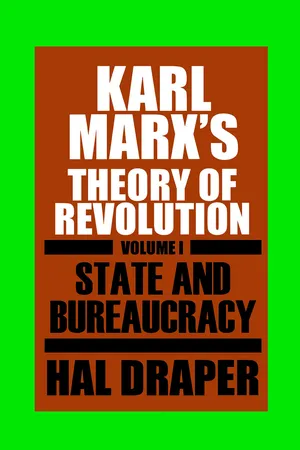
Volume I of Hal Draper’s definitive and masterful study of Marx’s political thought, which focuses on Marx’s attitude toward democracy, the state, intellectuals as revolutionaries, and much, much more.
This series, Karl Marx’s Theory of Revolution, represents an exhaustive and definitive treatment of Marx’s political theory, policy, and practice. Marx and Engels paid continuing attention to a host of problems of revolution, in addition to constructing their “grand theory.” All these political and social analyses are brought together in these volumes, as the author draws not only on the original writings of Marx and Engels but also on the sources that they used in formulating their ideas and the many commentaries on their published work.
Draper’s series is a massive and immensely valuable scholarly undertaking. The bibliography alone will stand as a rich resource for years to come. Yet despite the scholarly treatment, the writing is direct, forceful, and unpedantic throughout, and will appeal to the beginning student as much as the advanced reader.
- 272 pages
- English
- ePUB (mobile friendly)
- Available on iOS & Android
eBook - ePub
Karl Marx’s Theory of Revolution I
About this book
Information
1 THE DEMOCRATIC EXTREMIST
Marx entered active political life at the age of twenty-four as a liberal democratic journalist, the champion of political democracy. This period opens at the beginning of 1842, when he wrote his first published political article, and closes toward the latter part of the following year, when he became a communist. The development in between, which transformed him from a radical-democratic liberal into a revolutionary-democratic communist, is centered around his work for the Rheinische Zeitung (RZ) of Cologne, of which he became the editor in October 1842.
At the beginning of this period Marx’s main interest lay in and around the field of philosophy; by its end he had reoriented toward social and political issues. That is, he began it as a radical philosopher and ended it as a social revolutionary.
The transition was not primarily a philosophical process, nor one made through philosophical lucubrations. This young Marx is often portrayed as having come to a revolutionary understanding of society through a critique of Hegel’s texts on the state and society. The biographical fact, however, is that he came to the content of his critique of the Hegelian view of the state through a year and a half of rubbing his nose against the social and political facts of life, which he encountered as the crusading editor of the most extreme leftist democratic newspaper in pre-1848 Germany, as well as in reading contemporary political literature.
1. STATE AND CIVIL SOCIETY IN HEGELESE
During this RZ period and for some time after, Marx shared a stock of conceptions about the state with the Young Hegelian milieu in which he had matured, within a framework of ideas that remained basically Hegelian even while departing from Hegel in important conclusions. For our purposes it is especially vital to understand the Hegelian distinction between state and civil society, a way of thinking we will encounter often in the next few chapters.
The difficulty for the modern reader is not simply terminological, a matter of learning the Hegelian tag for phenomena which go by some other label in plain English or German. One reason Hegelian terminology remains puzzling even after a formal explanation is that it reflects a different way of ordering social phenomena in one’s mind; it dissects social reality along different lines.
To begin with: the “rational” state, involving a just and ethical relationship of harmony among the elements of society, is an ideal against which existing states are to be measured. The extent to which it “really” is a state depends on its closeness to the ideal.1 The essence of the state is eternal, not historical. For Hegel, its aim is the “realization of rational freedom”; as “an association of free men mutually educating each other,” it is the “great organism in which juridical, ethical, and political freedom has to achieve realization.” (These phrases are, as a matter of fact, from an article by Marx in the RZ.)2 The frame of reference, then, is not necessarily anything that actually exists, but rather what should exist.
Next, the word state does not refer merely to the political institutions of society, but to all of public affairs and life in a certain broad sense. It embraces the totality or collectivity of humanity’s communal concerns; it is the institutionalization of communality in society, not of political organization in our narrower sense. The “political state” is only one aspect of this.
If the state is the communal sphere of society, in contrast civil society (bürgerliche Gesellschaft) embraces the private world of individual strivings and interests. Hence it especially comprises the economic strivings of individuals. In modern times, bourgeois economic activity, with its emphasis on privatized dog-eat-dog relations, is preeminently in the realm of civil society.*
But the term becomes ambiguous as its meaning shifts from the civil society of the old regime to the civil society of modern times; the medieval Bürger becomes the modern bourgeois. In German, bürgerliche Gesellschaft can mean either “civil society” or “bourgeois society,” depending on its context and the user’s intention. When the context is modern times, and therefore the bourgeois society of modern times, it inevitably tends to connote bourgeois society even when it is properly translated “civil society.” The term operates on a sliding scale of meaning. In translations a conscious choice must be made, but the German usage did not necessarily involve a consciousness of the alternatives.
This caution is interestingly confirmed by the fact that Marx first showed awareness of the slipperiness of the term in The German Ideology, the work in which he first thoroughly emancipated himself from the Hegelian framework in social thought. Here he uses bürgerliche Gesellschaft explicitly to mean the economic sphere of society, which determines the state as its political superstructure: “It embraces the whole commercial and industrial life of a given [historical] stage. …” He now sees the ambiguity of the term from outside Hegelianism, and feels called on to explain:
The term bürgerliche Gesellschaft emerged in the eighteenth century, when property relationships had already extricated themselves from the ancient and medieval communal society. Bürgerliche Gesellschaft as such only develops with the bourgeoisie; the social organization evolving directly out of production and commerce, which in all ages forms the basis of the state and of the rest of the ideological superstructure, has however always been designated by the same name.6**
In full maturity, in one of his most important summary statements, Marx traced his developed theory of the state back to his first critique of Hegel’s conception of state and civil society:
My investigation led to the result that legal relations as well as forms of the state are to be grasped neither from themselves nor from the so-called general development of the human mind, but rather have their roots in the material conditions of life, the sum total of which Hegel, following the example of the Englishmen and Frenchmen of the eighteenth century, combines under the name of “civil society”; that, however, the anatomy of civil society is to be sought in political economy.8
That is: Marx’s investigation led him to believe that Hegel’s views on the relation between state and civil society had to be changed. Nevertheless, it is useful to remember that his central starting point was the problem so posed.
The broad use of state in Hegelese presents translation problems. Marx’s early formulations, in the Hegelian spirit, often come close to counterposing the state concept (the ideal state) against what we would now understand by the term. What we would call the state he might label the political state or the Beamtenstaat—the bureaucracy’s state apparatus, or just the bureaucracy. Thus, in one article Marx wrote that the “bureaucracy is still too powerful, that not so much the whole state as part of the state, the ‘government,’ carries on a real political life [Staatsleben].”9 In the present chapter, Staat in one context is translated the “body politic,” in the hope of suggesting a wider sphere of public affairs than is presently connoted by state. In another context Staatgeist is translated “public spirit,” for today “state spirit” would suggest almost the very opposite of what Marx was trying to say in 1842.
2. THE WINDS OF FREEDOM
The arena of Marx’s political debut was the Rhineland, which differed from the rest of Germany in significant respects.
1. When Marx was born his native Rhineland was only three years away from having been part of revolutionary France. In 1795 it had been taken over by Napoleon’s armies and socially remolded. Only in 1815 was it annexed by Prussia: annexed, but far from completely Prussianized even by the 1840s. Even the legal system remained gallicized. As Heine put it, the Rhinelander was thus made into “a Prussian by the power of conquest.” Engels echoed this in the midst of revolution in Cologne in 1849: “It was only by force that we [Rhinelanders] became subjects to Prussia and remained so. We were never Prussians.” He adds: “But now, when we are marched against Hungary, when Prussian territory is trodden by Russian robber bands—now we feel like Prussians, yes indeed, we feel what a disgrace it is to bear the name of Prussian!”10
2. The Rhineland was the most industrialized and economically developed section of Germany, with the most conscious liberal bourgeoisie. Top leaders of the 1848 revolutionary government were going to be Rhenish—indeed, were to be men who had been sponsors of the Rheinische Zeitung.* The Prussian bureaucratic system, wrote a modern historian, “harmonized but poorly with the free industrial communities of the Rhenish provinces, where Prussian bureaucrats were perpetually at daggers’ points with the native population.”13 Further, the peasantry of the Rhineland was advanced and modern as compared with that of Prussia.14
3. In consequence of these facts, the intellectual and social climate of the region retained some of the heat generated by the revolutionary furor on the other side of the Rhine. “French” ideas—constitutionalism, representative democracy, Liberty-Equality-Fraternity, etc.—were not so foreign.
Have we forgotten [wrote Engels in 1888] that the whole left bank of the Rhine … was pro-French-minded when the Germans moved into it again in 1814, and remained pro-French-minded till 1848 when the revolution rehabilitated the Germans in the Rhinelanders’ eyes? that Heine’s pro-French enthusiasm and even his Bonapartism were nothing but the echo of general public feeling west of the Rhine?15
Even French socialist ideas had penetrated, especially in the form most appealing to a modernizing, industrializing new class: Saint-Simonism. These new notions were denounced from the pulpit by the archbishop in Trier, Marx’s birthplace; Marx’s future father-in-law talked them up at home; and his law professor did the same at the University of Berlin.16 The first German socialist propagandist, Ludwig Gall, had recently used Trier as his center of operation. Marx’s mind, long before it turned to social issues, was formed on the front where French ideas met German cultural patterns.
The winds from France, and the breezes wafted up from the Rhenish liberal bourgeoisie, bore the word liberté/Freiheit to the ears of those interested in widening political participation in decision-making by the people. A specific freedom was the occasion for Marx’s debut as a political activist.
The new king, Friedrich Wilhelm IV, whose accession to the throne in 1840 had been eagerly awaited by the liberals, had made noises about broadening the freedom of the press, and in December 1841 he promulgated new regulations (“instructions”) on the censorship. Liberals and even Young Hegelians hailed the step enthusiastically; indeed, so did the Rheinische Zeitung at first.17 In two articles Marx set out to dissect the pseudoliberalism of the new regulations and counterpose his own conception of freedom—that is, political democracy.
We must stress that under the existing circumstances the issue of free press and censorship was not just one of many liberal issues. The liberal democrats considered it, along with the constitution, the key to political change.18
3. THE “FREEDOM OF THE PRESS” ARTICLES
We shall consider Marx’s two articles together. One, “Comments on the Latest Prussian Censorship Instructions,” was the first article he ever wrote, but although it was written in January 1842, it was not published till the following year, in Switzerland. The other, dealing with the debates on freedom of the press in the Rhenish Diet, was his first article to see print, in the RZ.
The RZ article first takes up the speakers who opposed freedom of the press, analyzing the arguments used by deputies of three of the social estates (Stände)* represented in the Diet: the princes, the landed gentry, and the “cities” (the urban bourgeoisie). It then discusses the arguments used by supporters of freedom of the press, from the cities and from the fourth estate (the peasantry).
At this point Marx is writing within the framework of a bourgeois-democratic view of society, in the sense that he does not question private property in production, especially in land. Similarly, his operative social theory is that of his intellectual milieu: to defend freedom, he writes, “I must grasp it in its essential character, not in external relations”19—a characteristically idealist formulation. But the important thing about these first two articles is how far he goes in a direction which is incompatible with the framework, and becomes ready to burst through it. For while theory (“philosophy”) tells him he must grasp the subject in some way other than “in external relations,” it is preci...
Table of contents
- Cover Page
- Title Page
- Copyright Page
- Dedication
- Contents
- Foreword
- Part I: The Political Development of the Young Marx
- Part II: The Theory of the State
- Appendices
- Reference Notes
- Bibliography (Works Cited)
- Index
- Footnotes
Trusted by 375,005 students
Access to over 1.5 million titles for a fair monthly price.
Study more efficiently using our study tools.
Frequently asked questions
Yes, you can cancel anytime from the Subscription tab in your account settings on the Perlego website. Your subscription will stay active until the end of your current billing period. Learn how to cancel your subscription
No, books cannot be downloaded as external files, such as PDFs, for use outside of Perlego. However, you can download books within the Perlego app for offline reading on mobile or tablet. Learn how to download books offline
Perlego offers two plans: Essential and Complete
- Essential is ideal for learners and professionals who enjoy exploring a wide range of subjects. Access the Essential Library with 800,000+ trusted titles and best-sellers across business, personal growth, and the humanities. Includes unlimited reading time and Standard Read Aloud voice.
- Complete: Perfect for advanced learners and researchers needing full, unrestricted access. Unlock 1.5M+ books across hundreds of subjects, including academic and specialized titles. The Complete Plan also includes advanced features like Premium Read Aloud and Research Assistant.
We are an online textbook subscription service, where you can get access to an entire online library for less than the price of a single book per month. With over 1.5 million books across 990+ topics, we’ve got you covered! Learn about our mission
Look out for the read-aloud symbol on your next book to see if you can listen to it. The read-aloud tool reads text aloud for you, highlighting the text as it is being read. You can pause it, speed it up and slow it down. Learn more about Read Aloud
Yes! You can use the Perlego app on both iOS and Android devices to read anytime, anywhere — even offline. Perfect for commutes or when you’re on the go.
Please note we cannot support devices running on iOS 13 and Android 7 or earlier. Learn more about using the app
Please note we cannot support devices running on iOS 13 and Android 7 or earlier. Learn more about using the app
Yes, you can access Karl Marx’s Theory of Revolution I by Hal Draper in PDF and/or ePUB format, as well as other popular books in Politics & International Relations & Communism, Post-Communism & Socialism. We have over 1.5 million books available in our catalogue for you to explore.