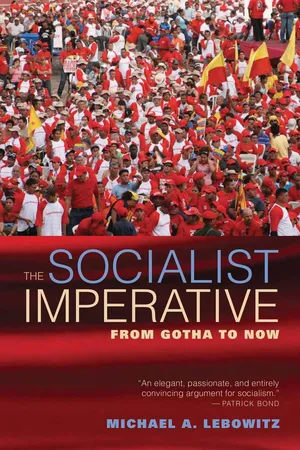
In a little more than a decade, economist Michael A. Lebowitz has written several major works about the transition from socialism to capitalism: Beyond Capital(winner of the Deutscher Prize), Build It Now, The Socialist Alternative, and The Contradictions of “Real Socialism.” Here, he develops and deepens the analysis contained in those pathbreaking works by tracing major issues in socialist thought from the nineteenth century through the twenty-first.
Lebowitz explores the obvious but almost universally ignored fact that as human beings work together to produce society’s goods and services, we also “produce” something else: namely, ourselves. Human beings are shaped by circumstances, and any vision of socialism that ignores this fact is bound to fail, or, at best, reproduce the alienation of labor that is endemic to capitalism. But how can people transform their circumstances in a way that allows them to re-organize production and, at the same time, fulfill their human potential? Lebowitz sets out to answer this question first by examining Marx’s Critique of the Gotha Programme, and from there investigates the experiences of the Soviet Union and more recent efforts to build socialism in Venezuela. He argues that socialism in the twenty-first century must be animated by a central vision, in three parts: social ownership of the means of production, social production organized by workers, and the satisfaction of communal needs and communal purposes. These essays repay careful reading and reflection, and prove Lebowitz to be one of the foremost Marxist thinkers of this era.
- 224 pages
- English
- ePUB (mobile friendly)
- Available on iOS & Android
eBook - ePub
About this book
Information
Ideas and Experiences
1. The Capitalist Nightmare and
the Socialist Dream
In this essay, I revisit themes from earlier books with new insights and a new urgency as the result of my belated consideration of the ecological dimension to which I have given lip service in the past.
In the beginning is the dream, the promise of a society that permits the full development of human potential, a society in which we relate to each other as human beings and where the mere recognition of the need of another is sufficient to induce our deed. In the beginning is the vision of a society where the products of our past activity serve our own need for development and where in working together we develop our capacities, our needs, our human wealth.
Vampires and Zombies
Capitalism is not that dream. Rather, as David McNally has illustrated, it is a world haunted by vampires and zombies—the vampire that lives by sucking living labor and not letting go “while there remains a single muscle, sinew or drop of blood to be exploited,” the zombies whose life-energies have been absorbed into capital and who stagger hungrily through the shopping malls.1
Like the vampire, capital has a never-ending “thirst for the living blood of labour” because that is the source of its growth, and growth is at the very core of its nature.2 Capital, Marx understood, constantly drives to go beyond its quantitative barrier: “The goal-determining activity of capital can only be that of growing wealthier, i.e. of magnification, of increasing itself.”3 Capital, indeed, has “one sole driving force, the drive to valorize itself, to create surplus value” and “vampire-like, lives only by sucking living labour, and lives the more, the more labour it sucks.”4
At the heart of capitalist relations is the process in which a worker relinquishes control over her productive activity and the property rights in the product of that activity to the capitalist and receives in return a wage. That transaction gives the capitalist the power to compel the performance of surplus labor in the process of production; the sale of labor-power, in short, is the condition for capitalist exploitation—a process facilitated by the capitalist’s ability to increase the amount of work performed by workers (extensively or intensively) and to reduce the wage component (either by driving down wages or by increasing productivity relative to wages). As with the metabolism of the vampire, which converts the blood of its victims into its eternal life, capital consumes human beings and nature (the elements of the labor process) and transforms these through its particular metabolism into products containing surplus value, the source of its life-blood.5
Yet, capital cannot survive simply by exploitation within the sphere of production. It must sell the commodities produced under its reign to secure money, its true life-blood. Once it succeeds (in this “second act”) in making the surplus value contained in commodities real, it can use a portion of the proceeds (surplus value in its form as money) to expand. The accumulation of capital is the result of its “constant drive to go beyond its quantitative limit: an endless process,” its search for eternal life.6
Capital’s Barriers
There is more, however, to the advance of capital than merely quantitative growth. Capital’s never-ending hunger brings it constantly up against obstacles to its growth and, as it drives beyond those barriers, it develops qualitatively. Consider some of the barriers that capital has encountered in the sphere of production. The resistance of workers to the extension of the workday and to the driving down of wages compelled capital to find ways to change the mode of production it inherited in order to grow upon the basis of increased productivity. Capital succeeded by introducing a new form of organization based upon new divisions of labor. Capital’s dependence upon the training of skilled workers under the system of manufacture emerged, however, as another barrier; accordingly, capital introduced machines, allowing it to go beyond this “regulating principle of social production.” Thus“the barriers placed in the way of domination by this same regulating principle” fell.7 Similarly, on the basis of the labor-intensive mode of production it inherited, capital’s ability to grow without limit was checked by the pace of natural population growth: “The demand for wage-labor therefore grew rapidly with every accumulation of capital, while the supply only followed slowly behind.”8
For these reasons, capital went beyond these particular barriers to the extraction of surplus labor by developing a “specifically capitalist mode of production,” one characterized by machinery and the factory system. To the extent, though, that the machine builders themselves were “a class of workers who, owing to the semi-artistic nature of their employment, could increase their numbers only gradually, and not by leaps and bounds,” capital’s advance was still checked.9 With the development of production of machines by machines, however, capital now created for itself “an adequate technical foundation.”10 The story of capital, in short, is one of qualitative as well as quantitative change—the result of its continuing ability to leap over all barriers to its growth. With the development of a specifically capitalist mode of production, capital acquired “an elasticity, a capacity for sudden extension by leaps and bounds, which comes up against no barriers but those presented by the availability of raw materials and the extent of sales outlets.”11
What are those barriers presented by the availability of raw materials? One that Marx stressed was that the output of natural products could not grow by leaps and bounds. Given that the growth and production of plant and animal products are “subject to certain organic laws involving naturally determined periods of time,” they cannot be suddenly increased. Accordingly, in periods of expansion, “the demand for these raw materials grows more rapidly than their supply, and their price therefore rises.”12 And the result of this relative underproduction of raw materials, as with all barriers to the growth of capital, is reflected in a fall in the rate of profit: “The general law [is] that, with other things being equal, the rate of profit varies inversely as the value of the raw material.”13
Yet even here, capital contains within it the means by which it can transcend this barrier: “Raw materials are supplied from a greater distance,” “their production is expanded,” and “all kinds of surrogates are now employed that were previously unused.”14 Marx was clear that capital refuses to accept any limits posed by organic conditions to its growth:
Hence exploration of all of nature in order to discover new, useful qualities in things; . . . new (artificial) preparation of natural objects, by which they are given new use values. The exploration of the earth in all directions, to discover new things of use as well as new useful qualities of the old; such as new qualities of them as raw materials etc; the development of the natural sciences, hence, to their highest point. . . . is likewise a condition of production founded on capital.15
This tendency of capital to drive beyond immediate barriers posed by organic requirements can be seen clearly in Marx’s discussion of the original “metabolic rift,” which John Bellamy Foster has done so much to bring to our attention.16 Drawing upon Justus von Liebig’s groundbreaking analysis of how urbanization prevented “the return to the soil of its constituent elements consumed by man in the form of food and clothing” and thereby hindered “the operation of the eternal natural condition for the lasting fertility of the soil,” Marx described this development as the disturbance of “the metabolic interaction between man and the earth.”17 There has been, he argued, “a squandering of the vitality of the soil”—the result of “an irreparable rift in the interdependent process of social metabolism, a metabolism prescribed by the natural laws of life itself.”18
Capital found several ways to navigate past this particular obstacle. As Foster has detailed, the exhaustion of the soil as the result of “the blind desire for profit” led first to the necessary “manuring of English fields with guano” and then to the development of synthetic phosphates, which could restore nitrogen content to the soil.19 Further, consider inventions such as the cotton gin, which “increased the production of cotton,” “colonization of foreign lands, which are thereby converted into settlements for growing the raw material of the mother country,” “a new and international division of labour”—all ways in which capital went beyond the barrier posed by “the availability of raw materials.”20
And then there are the barriers presented by “the extent of sales outlets.” Here it is obvious that capital produces its own barriers, that “the true barrier to capitalist production is capital itself.”21 All the successes of capital that allow it to drive up the rate of exploitation in the sphere of production come back to haunt it when it comes to realizing the surplus value contained in commodities: “The more productivity develops, the more it comes into conflict with the narrow basis on which the relations of consumption rest.” Accordingly, since the commodities must be sold within this “framework of antagonistic conditions of distribution,” there is a “contradiction between the conditions in which this surplus-value was produced and the conditions in which it was realized.”22 And the result is “constant tension between the restricted dimensions of consumption on the capitalist basis, and a production that is constantly striving to overcome these immanent barriers.”23
Thus capital must find ways to expand consumption, without at the same time engaging in self-denial with respect to its thirst for surplus labor: “A precondition of production based on capital is therefore the production of a constantly widening sphere of circulation.”24 To satisfy this requirement, capital is driven to find ways for “the production of new consumption,” and it pursues this by: (1) “quantitative expansion of existing consumption,” (2) “creation of new needs by propagating existing ones in a wide circle,” and (3) “production of new needs and discovery and creation of new use values.”25
Nothing must stop capital. Thus capital “drives beyond natural barriers and prejudices . . . as well as all traditional, confined, complacent, encrusted satisfactions of personal needs.” Capital’s tendency to grow without limit is present in the sphere of circulation as well as in production. “The tendency to create the world market is directly given in the concept of capital itself. Every limit appears as a barrier to be overcome.”26 And, as capital drives forward “to tear down every spatial barrier” to exchange and to “conquer the whole earth for its market,” it also strives “to annihilate this space with time, i.e. to reduce to a minimum the time spent in motion from one place to another.”27
Capital’s success in creating the world market and global capitalism, however, does not allow it to escape the contradiction between the production of surplus value and its realization. It cannot escape the recurring tendency for economic crises that are the result of “overproduction, the fundamental contradiction of developed capital.”28 Marx was clear on this point: “The bourgeois mode of production contains within itself a barrier to the free development of the productive forces, a barrier which comes to the surface in crises and, in particular, in overproduction—the basic phenomenon in crises.”29
But crises “are never more than momentary, violent solutions for the existing contradictions, violent eruptions that reestablish the disturbed balance for the time being.”30 What was significant about a crisis is that it reveals the existence of a barrier to capital. It does not, however, in itself portend an end to capitalism.
The Undead
Consider what our discussion of capital’s barriers reveals. Over and over, Marx talks about barriers: in the sphere of production, in the sphere of circulation, in capital as a whole. And, over and over again, he demonstrates that capital can drive beyond each barrier to its growth; indeed it goes beyond all barriers. In doing so, too, it develops qualitatively. Barriers, contradictions, are not impasses; rather, they are a source of movement, change, and development. A barrier is not a limit. Rather, a barrier is a limit that can be negated, that can be surpassed. As Hegel explained the concept in his Science of Logic, “By the very fact that something has been determined as barrier, it has already been surpassed.”31 Indeed, the surpassing of barriers is the way in which a thing develops: “The plant passes over the barrier of existing as a seed, and over the barrier of existing as blossom, fruit or leaf.”32
As we have seen, Marx embraced this concept of the barrier. “Capital,” he explained, “is the endless and limitless drive to go beyond its limiting barrier. Every boundary is and has to be a barrier for it.”33 In that tendency to drive beyond every barrier, capital posits Growth as the third term in the sequence: Growth-Barrier-Growth. Although its barriers are constantly overcome, they are just as constantly posited, “and inasmuch as it [capital] both posits a barrier specific to itself, and on the other side equally drives over and beyond every barrier, it is the living contradiction.”34
This process of creating barriers, transcending them, and creating them anew is endless. It is an infinite process. Indeed, it was in the course of exploring the relationship between Ought and Barrier that Hegel investigated the manner in which the concept of the Finite passes into the concept of Infinity: “The Finite (containing both Ought and Barrier) thus is self-contradictory; it cancels itself and passes away. . . . [But] the finite in perishing has not perished; so far it has only become another finite, which, however, in turn perishes in the sense of passing over into another finite, and so on, perhaps ad infinitum.”35
Does capital’s ability to drive over and beyond all barriers, then, mean that it is infinite, that eternal life is its fate? For capital to be other than infinite, for it to be finite, it must be incapable of surpassing a particular barrier. One barrier must, in fact, be its Limit. If it does have a Limit, then capital is finite and must perish. As Hegel put it, “its perishing is not merely contingent, so that it could be without perishing. It is rather the very being of finite things, that they contain the seeds of perishing as their own Being-in-Self and the hour of their birth is the hour of their death.”36
Is capital a finite thing? If it has only barriers, it will always find a way to renew itself. Although repeatedly facing crises, these will be temporary, mere obstacles that, in their transcendence, allow capital to develop qualitatively. However much we struggle against capitalism, dead labor will continue to nourish itself by drawing upon l...
Table of contents
- Cover
- Title
- Copyright
- Contents
- Dedication
- Foreword
- Building Socialism: Ideas and Experiences
- Struggling to Build Socialism Now
- Bibliography
- Notes
- Index
Trusted by 375,005 students
Access to over 1.5 million titles for a fair monthly price.
Study more efficiently using our study tools.
Frequently asked questions
Yes, you can cancel anytime from the Subscription tab in your account settings on the Perlego website. Your subscription will stay active until the end of your current billing period. Learn how to cancel your subscription
No, books cannot be downloaded as external files, such as PDFs, for use outside of Perlego. However, you can download books within the Perlego app for offline reading on mobile or tablet. Learn how to download books offline
We are an online textbook subscription service, where you can get access to an entire online library for less than the price of a single book per month. With over 1.5 million books across 990+ topics, we’ve got you covered! Learn about our mission
Look out for the read-aloud symbol on your next book to see if you can listen to it. The read-aloud tool reads text aloud for you, highlighting the text as it is being read. You can pause it, speed it up and slow it down. Learn more about Read Aloud
Yes! You can use the Perlego app on both iOS and Android devices to read anytime, anywhere — even offline. Perfect for commutes or when you’re on the go.
Please note we cannot support devices running on iOS 13 and Android 7 or earlier. Learn more about using the app
Please note we cannot support devices running on iOS 13 and Android 7 or earlier. Learn more about using the app
Yes, you can access The Socialist Imperative by Michael A. Lebowitz in PDF and/or ePUB format, as well as other popular books in Politics & International Relations & Communism, Post-Communism & Socialism. We have over 1.5 million books available in our catalogue for you to explore.