Traces the expansive influence of The Council of Foreign Relations in advancing Wall Street's foreign policy agendas and U.S. influence abroad
The Council on Foreign Relations is the most influential foreign-policy think tank in the United States, claiming among its members a high percentage of government officials, media figures, and establishment elite. For decades it kept a low profile even while it shaped policy, advised presidents, and helped shore up U.S. hegemony following the Second World War. In 1977, Laurence H. Shoup and William Minter published the first in-depth study of the CFR, Imperial Brain Trust, an explosive work that traced the activities and influence of the CFR from its origins in the 1920s through the Cold War.
Now, Laurence H. Shoup returns with this long-awaited sequel, which brings the story up to date. Wall Street's Think Tank follows the CFR from the 1970s through the end of the Cold War and the collapse of the Soviet Union to the present. It explains how members responded to rapid changes in the world scene: globalization, the rise of China, wars in Iraq and Afghanistan, and the launch of a "War on Terror," among other major developments. Shoup argues that the CFR now operates in an era of "Neoliberal Geopolitics," a worldwide paradigm that its members helped to establish and that reflects the interests of the U.S. ruling class, but is not without challengers. Wall Street's Think Tank is an essential guide to understanding the Council on Foreign Relations and the shadow it casts over recent history and current events.
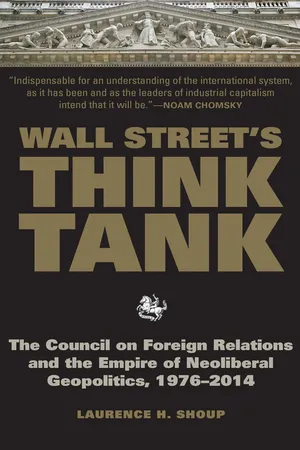
eBook - ePub
Wall Street's Think Tank
The Council on Foreign Relations and the Empire of Neoliberal Geopolitics, 1976-2014
- 400 pages
- English
- ePUB (mobile friendly)
- Available on iOS & Android
eBook - ePub
Wall Street's Think Tank
The Council on Foreign Relations and the Empire of Neoliberal Geopolitics, 1976-2014
About this book
Information
Topic
EconomiaSubtopic
Politica economicaPART I

Wall Street’s Think Tank 1976–2014
The CFR is a central element of a large network of people and institutions that organize the strategic planning and ideological control needed to maintain and expand the wealth and power of the U.S. plutocracy. The first chapter in this section will put the Council on Foreign Relations in its proper class context, as an organization of, by, and for the dominant sector of the U.S. capitalist class. The second chapter will illustrate how the Council operates as an organization, presented together with a detailed examination of its recent (since 1976) organizational history. The third chapter focuses on the CFR’s domestic networks, elaborating the Council’s links to the federal government, other major think tanks, top corporations, leading universities, important media, and lobbying bodies. The fourth chapter covers the organization’s international networks, discussing its close ties to a variety of powerful individuals and groups that have influence in their home countries, regionally or globally.
Part I as a whole illustrates how the Council is indeed “Wall Street’s think tank,” an organization with great range and power, in service to a ruling financialized monopoly capitalist class.
1
THE U.S. CAPITALIST CLASS AND THE COUNCIL ON FOREIGN RELATIONS
The first revolutionary act is to call things by their true names.
The economic-owning class is always the political ruling class.
In the realm of political economy, societal and state domination, powerful classes and the organizations they control have the most to hide about their great power and how the world actually works. In contrast, the emancipatory potential of social science resides in its honesty and truth-telling, in illustrating how such power actually operates for the benefit of the few and to the detriment of the vast majority of the people. This is its subversive effect, its resistance function. In the case of the Council on Foreign Relations, understanding the truth involves above all comprehending that this organization is run by and for a plutocracy, the capitalist class of the United States of America.
The United States is first and foremost a class society, a key fact often left out in educational, political, and media discussions about the country. Classes are socioeconomic and power groupings of people that have common relationships with one another and different relationships with other classes. In a capitalist-class society, wealth and income are key aspects of life: having or not having a well-paying, secure job and ownership or non-ownership of capital largely determine one’s socioeconomic class. Access to capital and jobs has a huge influence on the daily existence and life chances of people in every societal group. From the time an individual is born, access or lack of access to wealth, capital, property, and employment affects family life, where he or she lives, with what possessions, and in what conditions. It influences the individual’s educational opportunities and health including access to doctors, securing healthy food, and limiting exposure to hazards such as crime and pollution. The United States is a particular type of class society, a racialized one, where some groups are stigmatized as inferior because of their race, a belief spreading to all segments of society. Once this oppressive idea becomes widespread, the resulting divisions within the working class can be used by the rulers to divide and conquer, preventing unity among the workers. People with a darker skin color than Europeans are frequent victims of this discrimination. Gender is another point of division fostered by those with capital; women are routinely paid significantly less for the same work, for example, and are discriminated against in other ways, assuring that there is no equality in the workplace, and most women are, like people of color, kept in the lower ranks of workers generally. In this system, class realities are largely downplayed or completely avoided in public discourse, and racial and gender issues are highlighted. The capitalist class always wants to highlight differences and divisions within the underlying population. In this racialized and gendered class system, class, race, and gender are all central to people’s lived experience.
The two great major classes in today’s United States are a numerically small capitalist class and a very much larger working class. The capitalist class is characterized by ownership of large amounts of wealth, much of which is capital, obtained mainly through investment in and control of the corporations that organize production, distribution, and the financing of the economy. The working class lacks such ownership and needs to enter the labor market to secure employment. Since they are without significant capital, the worker must sell to others his or her ability to labor, usually to the capitalists, in order to survive on the resulting wages. This inequality of ownership does three things. It allows the capitalist to exploit the individual worker—profits are extracted from the laborer’s efforts. It confers tremendous economic and political power upon the capitalist. And it generates overt and covert conflicts over wages, hours, working conditions, and sometimes the system itself. This conflict must of necessity take a collective form, which is class struggle. With these facts in mind, class can be summed up as a relationship of exploitation, dispossession, oppression, and conflict between owners and workers, while each class has a potential relationship of internal solidarity.
Although the capitalist-worker class relation is central in any capitalist society, there is another group, well-educated professionals, that is also important. This group, which stands between the two key classes, is usually and inaccurately called the “middle class,” but will be called here the “professional class.” These professionals, with their education, intellect, and skills, are very important to capitalists and they are often appropriately rewarded. Some of them even profit enough from their work and connections to gradually, step by step, rise to fill capitalist occupations and become capitalists themselves. Many others aspire to this status, subordinating themselves to the capitalist class, both as a technique of survival and in hope of gaining a measure of power and status with greater rewards.
The capitalist class of the United States is defined here as people and families with financial or productive assets of at least $10 million, or a position as a top officer or director of a Fortune 500 corporation, or as a principal of a major law firm. Such corporate and legal positions are very well paid, making it possible to rapidly accumulate assets and, if not already wealthy, join the capitalist class in a relatively short time. This group is a very small percentage of the U.S. population. Official wealth statistics show that the top 1 percent of U.S. households had an average wealth of $19 million in 2007, dropping to $14 million in 2009. In contrast, 37.1 percent of U.S. households had a net worth of less than $12,000, and 24.8 percent had a zero or negative net worth.36
At the $10 million level, or as a top corporate executive or law firm partner, an individual member of the capitalist class does not ever have to enter the labor market, hat in hand, to seek a job. If employed—an option, not a requirement for much of the capitalist class—he or she often works for the family corporation, or, through ownership and connections, gets a comfortable and well-paid corporate position. Some top capitalist-class institutions also use the $10 million figure as a cutoff point. The Private Wealth Management unit of the JPMorgan Chase Bank, for example, has decided not to include clients with less than $10 million in financial assets, since their coverage model, using an integrated team of specialist advisers to meet the client’s investing, wealth transfer, credit, and philanthropic needs, is most profitable when limited to only high-net-worth individuals and families.37
Viewing the percentage of wealth (total net worth) owned and controlled by key groups is also instructive. In 2010 the top 1 percent owned about 35 percent of total U.S. wealth. The next 4 percent had 28 percent, and the 15 percent after that owned 26 percent. The top 5 percent thus had 63 percent, and the top 20 percent had 89 percent of total U.S. wealth. The top about 20 percent together make up the capitalist class and the professional class, with the dividing line difficult to determine as some individuals from the professional class are rising into the ranks of the capitalists. The bottom 80 percent of the population, approximately corresponding to the working class, owned only 11 percent of the wealth. Financial wealth is even more concentrated.38
The World Wealth Report by Capgemini and Merrill Lynch Wealth Management has recently estimated the wealth of the world capitalist class. In 2010, the wealth of the world’s eleven million super-rich individuals stood at $43 trillion, or 70 percent of global gross domestic product.39 The U.S. capitalist class held more of that wealth than any other national capitalist class. The 2011 Capgemini/Merrill Lynch World Wealth Report found that North America (United States and Canada) had 3.4 million high-net-worth individuals worth a total of $11.6 trillion. Forty thousand ultra-high-net-worth individuals, over half of them living in a few large cities, held the bulk of this wealth. The Asia-Pacific and European regions were second and third with $10.8 and $10.2 trillion held by high-net-worth individuals respectively. These three world regions, and especially the top nations and key cities within them, held the vast majority of the world’s wealth. Among U.S. cities, New York, the headquarters of both finance capital (Wall Street) and the CFR, had by far the largest number of super-rich (roughly three times as many as second-place Los Angeles), with San Francisco, Chicago, Washington, D.C., Houston, and Dallas rounding out the top seven.40 Although London is also important, New York is the top command center of the world economy, controlling a large percentage of the world’s finances. It was ranked number one in 2012 and 2014 articles on the world’s most economically powerful cities, with London in second place.41
The capitalist class of the United States is by far the most organized, class-conscious, and powerful segment of society. It has, in fact, more power than any ruling class in world history. It has its own expensive private schools for its children, such as college “prep” schools at the high school level, as well as the eastern “Ivy League” private universities, like Harvard, Yale, Princeton, and Columbia, and elite outposts around the nation like Stanford and the University of Chicago. It has its own luxurious “high society” culture and lifestyle. Families in this class tend to intermarry, strengthening their connections and economic and political power. They are also usually open to allowing well-educated members of the professional class to enter their ranks, as long as these newcomers want to be of service to the capitalist class and are willing to adhere to the cultural, social, and political norms of their betters. The CFR is one place where such ambitious outsiders meet and form alliances with members of the capitalist class. Just one example illustrates the possibilities: William Jefferson Clinton was not born into a capitalist-class family, but he was intelligent and ambitious, worked to become a professional by gaining a college education, and was awarded a Rhodes Scholarship in England. He ran for political office and was, with the help of capitalist-class member Madeleine K. Albright, able to become a member of the Council in the 1980s. The contacts he made at the CFR helped him get the favorable media attention, funding, and top advisers to validate his candidacy and successfully become president. He brought many fellow Council members into leading positions in his administration, and implemented a raft of pro-capitalist CFR policies. Once out of office, lucrative speaking engagements and book deals made him wealthy, a member of the capitalist class himself, with his own foundation. One estimate is that by 2014 he had $80 million in personal assets, another estimate puts the total at $38 million.42 He was also able to bring his daughter Chelsea into the CFR, allowing her to expand her network to the rich, well-educated, and powerful people that she will meet at the Council. This is a common pattern: CFR members often bring relatives into the organization to promote individual and family agendas.
In the United States the capitalist class is numerically a large group, amounting to tens of thousands of extended families. These families usually maintain close ties with one another because their wealth is tied up in corporations with shared ownership and control, and inheritance generally depends upon blood relationships. Within wealthy circles, the age of the fortune is one key source of internal differentiation. Members of the old plutocracy, dominant in the CFR’s early history, are usually included in the Social Register, a book that lists and promotes social relationship among the “prominent” families (that is, those wealthy for a long time) of the United States. These old plutocratic families have also, whatever the original source of their wealth, usually diversified it, especially into finance but also into other sectors of the economy. They are also more transnational: they and their corporations have invested significant amounts overseas. Newer wealth is usually more concentrated in one industry, such as manufacturing or trade. Newer wealth also tends to be more locally and nationally based. The capitalist class also supports both the Democratic and Republican parties, with the newer, more localized rich more strongly supporting Republicans and the financialized old rich more balanced in their support for both “moderate” Democrats and “moderate” Republicans. But all sectors of the U.S. capitalist class organize their economic power through the corporate system, which they control, as families and as a class. If the modern corporation is one of the key locations in which the power of the capitalist class is institutionally crystallized, another central place of capitalist-class power is the Council on Foreign Relations and its larger network of associated organizations. The activities of the CFR are one important way that this class organizes itself, develops a generalized unity, and projects itself and its special class interests (portrayed by the Council, of course, as the general interest) upon the national and world stage. The CFR’s key role is to move the capitalist class from being a class in itself (the owners of the corporate-dominated economic system) to a class for itself (with consciousness, agency, and heightened power).
This chapter discusses ...
Table of contents
- Cover
- Title Page
- Copyright
- Contents
- Preface
- Introduction: The Early History of the CFR
- Part I: Wall Street’s Think Tank, 1976–2014
- Part II: The Empire of Neoliberal Geopolitics
- Concluding Reflections: Capitalist Class Rule vs. Democracy and the Public Interest
- Afterword
- Appendix: CFR Officers and Directors, 1921–2013
- Bibliography
- Notes
- Index
Trusted by 375,005 students
Access to over 1.5 million titles for a fair monthly price.
Study more efficiently using our study tools.
Frequently asked questions
Yes, you can cancel anytime from the Subscription tab in your account settings on the Perlego website. Your subscription will stay active until the end of your current billing period. Learn how to cancel your subscription
No, books cannot be downloaded as external files, such as PDFs, for use outside of Perlego. However, you can download books within the Perlego app for offline reading on mobile or tablet. Learn how to download books offline
Perlego offers two plans: Essential and Complete
- Essential is ideal for learners and professionals who enjoy exploring a wide range of subjects. Access the Essential Library with 800,000+ trusted titles and best-sellers across business, personal growth, and the humanities. Includes unlimited reading time and Standard Read Aloud voice.
- Complete: Perfect for advanced learners and researchers needing full, unrestricted access. Unlock 1.5M+ books across hundreds of subjects, including academic and specialized titles. The Complete Plan also includes advanced features like Premium Read Aloud and Research Assistant.
We are an online textbook subscription service, where you can get access to an entire online library for less than the price of a single book per month. With over 1.5 million books across 990+ topics, we’ve got you covered! Learn about our mission
Look out for the read-aloud symbol on your next book to see if you can listen to it. The read-aloud tool reads text aloud for you, highlighting the text as it is being read. You can pause it, speed it up and slow it down. Learn more about Read Aloud
Yes! You can use the Perlego app on both iOS and Android devices to read anytime, anywhere — even offline. Perfect for commutes or when you’re on the go.
Please note we cannot support devices running on iOS 13 and Android 7 or earlier. Learn more about using the app
Please note we cannot support devices running on iOS 13 and Android 7 or earlier. Learn more about using the app
Yes, you can access Wall Street's Think Tank by Laurence H. Shoup in PDF and/or ePUB format, as well as other popular books in Economia & Politica economica. We have over 1.5 million books available in our catalogue for you to explore.