The Haitian Revolution, the product of the first successful slave revolt, was truly world-historic in its impact. When Haiti declared independence in 1804, the leading powers—France, Great Britain, and Spain—suffered an ignominious defeat and the New World was remade. The island revolution also had a profound impact on Haiti’s mainland neighbor, the United States. Inspiring the enslaved and partisans of emancipation while striking terror throughout the Southern slaveocracy, it propelled the fledgling nation one step closer to civil war. Gerald Horne’s path breaking new work explores the complex and often fraught relationship between the United States and the island of Hispaniola. Giving particular attention to the responses of African Americans, Horne surveys the reaction in the United States to the revolutionary process in the nation that became Haiti, the splitting of the island in 1844, which led to the formation of the Dominican Republic, and the failed attempt by the United States to annex both in the 1870s.
Drawing upon a rich collection of archival and other primary source materials, Horne deftly weaves together a disparate array of voices—world leaders and diplomats, slaveholders, white abolitionists, and the freedom fighters he terms Black Jacobins. Horne at once illuminates the tangled conflicts of the colonial powers, the commercial interests and imperial ambitions of U.S. elites, and the brutality and tenacity of the American slaveholding class, while never losing sight of the freedom struggles of Africans both on the island and on the mainland, which sought the fulfillment of the emancipatory promise of 18th century republicanism.
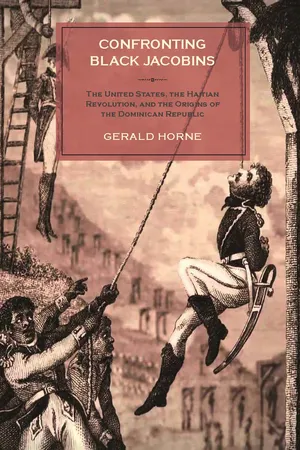
eBook - ePub
Confronting Black Jacobins
The U.S., the Haitian Revolution, and the Origins of the Dominican Republic
- 416 pages
- English
- ePUB (mobile friendly)
- Available on iOS & Android
eBook - ePub
Confronting Black Jacobins
The U.S., the Haitian Revolution, and the Origins of the Dominican Republic
About this book
Information
Subtopic
Politique1
Confronting the Rise of Black Jacobins 1791–1793
GEORGE WASHINGTON WAS ELATED.
“I am happy,” he rhapsodized in September 1791, weeks after a transforming Caribbean eruption, about “how well disposed the United States are to render every aid in their power to our good friends and Allies [the French] to quell ‘the alarming insurrection of the Negroes in Hispaniola’” Signaling the urgent importance of this fraught matter to his own slave-holding republic, President Washington added, “I have not delayed a moment since the receipt of your communications.”1 Quickly, the president advanced French planters on the island a sizeable amount that was to come to $726,000 within months, a sum drawn against the formidable debt incurred by the United States during the anti-London revolt. This is a telling indicator of how the fiscal crisis in Paris, leading to revolt in France and the island alike, was driven in part by the rebellion led by Washington.2
The president’s alacrity was comprehensible in that on 22 August 1791 at least 1500 Africans acted in concert on the island, an assemblage that dwarfed comparable revolts in South Carolina in 1739 and Jamaica in 1760. It was a grim situation that could be readily envisioned on the mainland. This thought had occurred to Governor Charles Pinckney of South Carolina who, just after the revolt was launched, remarked that it represented a “flame which will extend to all the neighboring islands and may eventually prove not a very pleasing or agreeable example to the Southern states.”3
Capable of teasing out the abolitionist implications of the revolt, South Carolina—where the African majority had proven to be difficult to control in a manner not unlike Hispaniola—was the first state to take legislative steps to abolish the slave trade when in 1792 it sought to bar the importation of this troublesome property. Neighboring Georgia and North Carolina quickly followed in 1793 and 1794 respectively. It was no secret that the fires of Hispaniola aided immeasurably in assisting enslaving republicans in seeing the light. During a contemporaneous congressional debate concerning taxation imposed on imported Africans, Willis Alston of North Carolina reminded the House that Negroes from the Caribbean were one hundred times more dangerous than slaves imported directly from Africa.4 The implications for the continent were unpropitious.
The exigency of Washington’s response was also driven by the immediacy of the desperation experienced by island settlers. Within hours of the August 1791 turbulence, dire letters were sent northward to the slave-holding republic requesting munitions, troops, and food. The United States was closer to the island than France, a factor that had shaped the island for some time and was to continue.5 This closeness, in the real and figurative senses, also serves to explain why when frantic messages were sent in the immediate aftermath of August 1791 to Jamaica, Cuba, and the United States for military aid, it was the latter republic that responded with eagerness.6
Of course, this reflected enlightened self-interest on the part of the chief executive. Not only were the properties—and lives—of his compatriots in jeopardy on the island,7 raising searching questions about a similar conflict detonating on the mainland, but also Jefferson already had raised an alarm about the possibility of an “American Algiers” arising nearby. As early as 1580, the notorious Sir Francis Drake himself had found and freed Turks, North African Moors, and even a few Frenchmen and Germans among the Spanish galley slaves toiling ignominiously in Santo Domingo and Cartagena.8 Who was to say if the future held the prospect of finding Euro-Americans among these island mudsills, but this time with revenge-seeking Africans wielding the whip-hand? In the midst of the “quasi-war” between the United States and France, a few years after Washington’s elation, a U.S. Navy man exclaimed, “Look out! United States of America! Or you will share the fate of the Swedes at Tripoli—the Danes at Tunis—and of many other Nations at Algiers.”9
Jefferson was fixated on this idea, reminding Albert Gallatin in mid-1801 to “expect pirates from St. Domingo.” This may have been doubtful but, nevertheless, the possibility was “not peculiar to Charleston but threatens all the Southern states.”10
Even if this chilling dystopia were ruled out, there were continuing repercussions that proved hard to ignore. The alliance of the North American rebels with Paris effectively had meant an alliance with France’s richest—nearby—colony. Just weeks after the hinge moment that was August 1791, complaints were pouring forth from the mainland about the rise in prices of sugar, coffee, and similar articles, too often sourced from the fortress of slavery that was Hispaniola. Elizabeth Drinker, the prim Philadelphia Quaker, after making note of the inflation in the prices of these commodities in her diary, then added “cloudy this evening.”11 Given the circumstances, this appears more like a historical prediction than a weather report.
As President Washington was told subsequently, there was yet another and more frightening deficit that had appeared on the mainland concomitant with the upheaval on the island: Charleston merchants—who shared uneasily a land with often rambunctious Africans—were “deeply impressed with the deplorable condition in which many of the inhabitants of St. Domingo, now residing in this City with their families, have been reduced, from Affluence to Want of the necessaries of life.”12 Was the stark reality of these families a presentiment, perhaps, of what these now affluent merchants might themselves face within decades? And how would they react—not least in their now quotidian maltreatment of Africans—to this potential likelihood?
WHAT HAD ATTRACTED MERCHANTS TO Hispaniola was the wealth there. Gold, silver, copper, mahogany, and iron ore were among the bounty. “Haiti,” according to indigenes, was the “mother of nations,” but their numbers, estimated to be in the millions on the island before contact with Europeans, had dwindled tremendously by 1791. The soak of bloodletting served to create the harsh conditions that greeted enslaved Africans who were dragged there by the tens of thousands as the numbers of indigenes were dwindling.13
By the late 17th century, the island had been split effectively between French colonizers (on the west) and Spanish (on the east)—though what was to mark Hispaniola to this day is that Madrid seized the lion’s share, perhaps two-thirds of the territory. Both “Catholic” powers proved to be instrumental in seeking to oust their mutual adversary—“Protestant” London—from its mainland colonies, with Hispaniola being critical to this powerful new reality. As evidenced by the fact that English and Spanish remain the dominant languages of the hemisphere, France wielded less influence in the Americas, which serves to explain why so much Parisian capital flowed into the island. But from the viewpoint of the nascent United States, France’s relationship with New Orleans—emerging in the early 18th century was critical.
Certainly the tie between the western portion of the island and the mouth of the Mississippi was close from an early stage. The 1724 Code Noir in Louisiana was borrowed with only slight modification from the island’s 1685 slave code,14 both of which were—in a sense—more “liberal” than their counterparts under the Union Jack.15 The 1724 code, for example, forbade masters from breaking up families by selling spouses or children below the age of puberty to different masters. The British retained this regime after 1763, when they formally asserted their claim to Illinois.16 This did not endear them to settlers on the verge of rebellion—as evidenced by their junking of this blatant restriction on “free trade” upon asserting control over what was to become a powerful midwestern state.
As early as 1763, mainland slaveholders were expressing trepidation about the importation of Africans from the island because of their supposed sinister reputation for revolting, particularly their demonstrated skill in dispensing poisons. This was a reaction to the so-called Mackandal Conspiracy of 1755, when the Africans on the island contemplated poisoning the entire settler population, which was followed in succeeding years by yet another wave of poisonings.17
Given the violent ructions that rocked the mainland periodically, it was—in a sense—comprehensible why settlers found it necessary to assume a stance of hawkish vigilance. The Natchez Massacre of 1729 featured a ferocious revolt, against settlers principally led by indigenes—though Africans were involved. The seizing of hundreds of the leading indigenous rebels and their sale into slavery in Hispaniola was guaranteed to bring the two oppressed groups closer together.18
In response to such far-reaching plots, French settlers were fleeing to Charleston and other mainland sites too but often continued to hold interests in the Caribbean. This meant that their reaction—or overreaction—to slave conspiracies there could redound to the detriment of enslaved mainland Africans, a trend that was to continue for decades to come.19 Suggestive of why there was flux in jurisdictions administered by Paris was a comprehensive legal code drafted in France in 1777 that brazenly mandated that “in the end, the race of Negroes will be extinguished in the kingdom,”20—this was akin to an invitation to Africans to rebel in response.
Ironically, the man given credit for arriving at the mouth of the Chicago River in 1779 and founding a leading metropolis was thought to be a man of color—with a Gallic name: Jean Baptiste Point Du Sable.21 It was also not without irony that as this town was being founded, the famed Marquis de Lafayette—still celebrated on the mainland—was happily telling Benjamin Franklin that Senegal had been “taken by our troops” in West Africa. It was “previously in the enemy’s hands” and this, he noted, was “preventing the Nigro [sic] trade,” which had been benefiting “the Southern Gentlemen of America.” Thus, he concluded with effervescence, “I believe our conquest will be pleasing to them.”22 What neither correspondent was able to envision was that their energetic enchaining of Africans, who were then dumped in Hispaniola, was to create a demographic nightmare for slavery.
Nonetheless, the developing difference between French and British slavery was then parlayed into a developing abolitionist movement in Paris, which then influenced both the island and the mainland.23 Nevertheless, it did seem that as Frenchmen came into closer contact with the rougher mainland settlers24 a coarsening took place, driving them closer to the latter’s often harsher modes. This, however, was unsustainable on the island in light of the demographic imbalance. Yet the anti-monarchism of the mainland and the resultant close contact with Paris that led to the founding of the new republic doubtlessly influenced the July 1789 emergence of revolution.
But there were contradictory trends—contrary to and constitutive of the rise of revolution. It was necessary to regulate slavery for the simple reason there were so many enslaved Africans being driven into the Mississippi River basin, not least given the inferno of slave plots that the Caribbean was becoming. This too was connected to Hispaniola insofar as African slavery in Missouri dates at least from 1719 when a Frenchman known as Renault purchased 500 Africans in Hispaniola and brought them to the mainland to work in mines. Yet, again, the ascendancy of the Stars and Stripes marked a qualitative—and quantitative—transformation of slavery, with numerous consequences, often dimly understood. By 1803, as the loss of Hispaniola was influencing Paris to abandon what became known as the Louisiana Purchase, there were almost 3000 enslaved Africans in Missouri—but by 1860 there were 114,931 of this debased group and 3572 free Africans.25
There was also a gravitational pull that drove Hispaniola and erstwhile British settlers into a warm embrace: Paris was far away.26...
Table of contents
- Cover
- Half title
- Title
- Copyright
- Contents
- Introduction
- 1. Confronting the Rise of Black Jacobins, 1791–1793
- 2. Confronting Black Jacobins on the March, 1793–1797
- 3. Confronting the Surge of Black Jacobins, 1797–1803
- 4. Confronting the Triumph of Black Jacobins, 1804–1819
- 5. Hemispheric Africans and Black Jacobins, 1820–1829
- 6. U.S. Negroes and Black Jacobins, 1830–1839
- 7. Black Jacobins Weakened, 1840–1849
- 8. Black Jacobins under Siege, 1850–1859
- 9. The U.S. Civil War, the Spanish Takeover of the Dominican Republic, and U.S. Negro Emigrants in Haiti, 1860–1863
- 10. Haiti to Be Annexed and Reenslaved? 1863–1870
- 11. Annex Hispaniola and Deport U.S. Negroes There? 1870–1871
- Notes
- Index
Trusted by 375,005 students
Access to over 1.5 million titles for a fair monthly price.
Study more efficiently using our study tools.
Frequently asked questions
Yes, you can cancel anytime from the Subscription tab in your account settings on the Perlego website. Your subscription will stay active until the end of your current billing period. Learn how to cancel your subscription
No, books cannot be downloaded as external files, such as PDFs, for use outside of Perlego. However, you can download books within the Perlego app for offline reading on mobile or tablet. Learn how to download books offline
Perlego offers two plans: Essential and Complete
- Essential is ideal for learners and professionals who enjoy exploring a wide range of subjects. Access the Essential Library with 800,000+ trusted titles and best-sellers across business, personal growth, and the humanities. Includes unlimited reading time and Standard Read Aloud voice.
- Complete: Perfect for advanced learners and researchers needing full, unrestricted access. Unlock 1.5M+ books across hundreds of subjects, including academic and specialized titles. The Complete Plan also includes advanced features like Premium Read Aloud and Research Assistant.
We are an online textbook subscription service, where you can get access to an entire online library for less than the price of a single book per month. With over 1.5 million books across 990+ topics, we’ve got you covered! Learn about our mission
Look out for the read-aloud symbol on your next book to see if you can listen to it. The read-aloud tool reads text aloud for you, highlighting the text as it is being read. You can pause it, speed it up and slow it down. Learn more about Read Aloud
Yes! You can use the Perlego app on both iOS and Android devices to read anytime, anywhere — even offline. Perfect for commutes or when you’re on the go.
Please note we cannot support devices running on iOS 13 and Android 7 or earlier. Learn more about using the app
Please note we cannot support devices running on iOS 13 and Android 7 or earlier. Learn more about using the app
Yes, you can access Confronting Black Jacobins by Gerald Horne in PDF and/or ePUB format, as well as other popular books in Politique et relations internationales & Politique. We have over 1.5 million books available in our catalogue for you to explore.