Millions of words have been written about the Cuban Revolution, which, to both its supporters and detractors, is almost universally understood as being won by a small band of guerillas. In this unique and stimulating book, Stephen Cushion turns the conventional wisdom on its head, and argues that the Cuban working class played a much more decisive role in the Revolution’s outcome than previously understood. Although the working class was well-organized in the 1950s, it is believed to have been too influenced by corrupt trade union leaders, the Partido Socialist Popular, and a tradition of making primarily economic demands to have offered much support to the guerillas. Cushion contends that the opposite is true, and that significant portions of the Cuban working class launched an underground movement in tandem with the guerillas operating in the mountains.
Developed during five research trips to Cuba under the auspices of the Institute of Cuban History in Havana, this book analyzes a wealth of leaflets, pamphlets, clandestine newspapers, and other agitational material from the 1950s that has never before been systematically examined, along with many interviews with participants themselves. Cushion uncovers widespread militant activity, from illegal strikes to sabotage to armed conflict with the state, all of which culminated in two revolutionary workers’ congresses and the largest general strike in Cuban history. He argues that these efforts helped clinch the victory of the revolution, and thus presents a fresh and provocative take on the place of the working class in Cuban history.
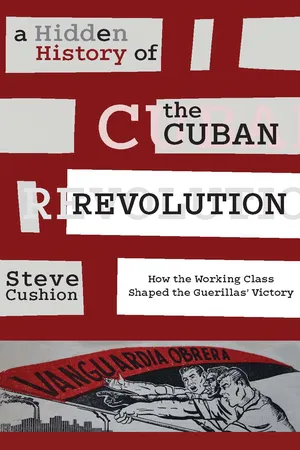
eBook - ePub
A Hidden History of the Cuban Revolution
How the Working Class Shaped the Guerillas’ Victory
- 336 pages
- English
- ePUB (mobile friendly)
- Available on iOS & Android
eBook - ePub
A Hidden History of the Cuban Revolution
How the Working Class Shaped the Guerillas’ Victory
About this book
Information
1. ORGANIZED LABOR IN THE 1950s
In the early 1950s, the Cuban trade union federation, the Confederación de Trabajadores de Cuba (CTC, Cuban Workers’ Confederation), headed by General Secretary Eusebio Mujal, was widely seen as corrupt and undemocratic. It had not always been like this, but the Cold War attack on organized labor, which affected the whole of the Americas, north and south, was particularly successful in Cuba. Following the 1947 CTC Congress, the communists had been removed from their previous position of leadership and replaced by a new bureaucracy that seemed more interested in enhancing their own comfortable existence than in defending workers’ wages and conditions. However, the actions of the trade union leadership cannot be explained solely by corrupt practices but must be understood in relation to analysis of their politics, which prevented them from seeing beyond the parameters set by the capitalist system. In the difficult economic circumstances facing postwar Cuba, the CTC leadership was prepared to restrict the demands they put forward on behalf of their members to the employers’ “ability to pay.” But though the leadership accepted that trade union demands had to be “affordable” and “realistic,” growing numbers of Cuban workers did not see it that way. This resulted in tensions within the unions between the rank and file and the bureaucracy, which led militant Cuban workers to build unofficial structures in order to defend their interests.1
Nevertheless, trade unions are never monolithic, relying on voluntary officials such as shop stewards and branch secretaries to maintain local organization. There is therefore nearly always a space in which militants can organize to counteract the domination of the bureaucracy. During the crisis in which Cuba found itself during the 1950s, there was still a lively independent milieu within the labor movement at the local level, where the authority of the CTC bureaucracy was contested and became a battleground between the various currents competing for influence within the working class.
Historical Background
The organized labor movement in Cuba dates back to the guilds and craft unions of the nineteenth century, but the first nationwide trade union federation, the Confederación Nacional Obrera de Cuba (CNOC, Cuban National Labor Confederation), was not founded until 1925. In the same year, Gerardo Machado was democratically elected president, but his regime became increasingly repressive as the effects of the economic crisis of the late 1920s raised the temperature of the class struggle. Cuba’s sugar-based economy was already suffering from reductions in U.S. purchases as a result of political pressure from mainland producers, with the result that the Wall Street Crash of 1929 had a particularly devastating effect on the island.2
The situation came to a head in 1933 when a strike by Havana bus drivers developed into a general strike that, in conjunction with a rebellion by students and an army mutiny led by Sergeant Fulgencio Batista, brought down the government. It is worth noting that the Cuban Communist Party (PCC), which had progressively gained control of the CNOC toward the end of the 1920s, tried unsuccessfully to call off the strike in return for minor concessions from the Machado government, and this may be seen as confirmation of the politically moderating effect of having control of a trade union apparatus. The government of Ramón Grau San Martín, which took office after the uprising, proved to be neither capable of satisfying the aspirations of the workers nor being able to bring them under control. The state of dual power that resulted from this contradiction was brought to a close by Batista, who, working closely with the U.S. ambassador, used his control of the army to defeat a general strike in 1935. Initially ruling through puppet presidents, Batista imposed a regime that has been described as both co-optive and repressive, a model that operated by combining a mixture of nationalist demagogy and minor social reforms with repression of any attempt by workers to exceed the boundaries established by the government.3
The CNOC did not recover from the defeat of the 1935 general strike, while the PCC, itself considerably weakened by police repression, reached an understanding with Batista whereby, in return for legalization, they worked to broaden its narrow social base. One of the outcomes of this arrangement was the replacement of the CNOC by a new organization, the Confederación de Trabajadores de Cuba, which was, from the outset, a state-sponsored trade union. A low level of subscription payment led to dependency on the state, a dependency that was increased by the CTC’s approach to defending its members’ interests, which mainly depended on the leadership’s relationship with the Ministry of Labor, rather than industrial action or collective bargaining.4 This relationship left the CTC leadership vulnerable to a change of government.
Batista finally tired of indirect rule and, in 1940, with the support of the communists, won the first honest general election in Cuban history. The PCC, now renamed the Partido Socialista Popular (PSP), under the influence of Moscow, declared a class truce during the Second World War, which resulted in a wage freeze and no-strike deal. This reduced its credibility among the general CTC membership, the majority of whom were more interested in their material conditions than in the war in Europe. Thus, when Batista’s chosen successor stood for election with PSP support in 1944, he was defeated by Grau San Martín and his Auténtico Party.5 The communists’ wartime “non-political” approach made them superfluous, while their trade union practice, a combination of undemocratic bureaucratic control and a reliance on government patronage, left them in a weak position. The logic of dependence on a relationship with the state is that with the arrival of a new government other factions could offer a closer relationship and thereby gain popular support. The Comisión Obrera Nacional Auténtica (CONA, National Labor Commission of the Auténtico Party) led by Eusebio Mujal and linked to the ruling Auténtico Party, did just this. Throughout the spring of 1947, the Auténticos made gains in the sugar and port workers’ unions, while some PSP officials defected to CONA.
There were some armed skirmishes between members of the PSP and the CONA in 1944–45, but matters came to a head at the 5th CTC Congress in 1947 when, following a violent dispute over credentials, the Minister of Labor, Carlos Prío, suspended the congress and then used the powers of his ministry to give control of the federation to the CONA, although initially the general secretary was an independent, an official of the electrical workers’ union named Angel Cofiño. The PSP did not have sufficient active support to prevent the takeover of the CTC and an attempted general strike called by the displaced communist leadership failed, with only the Havana dockworkers and tram drivers coming out in support. In areas where government intervention proved insufficient to impose a new leadership, gangsters linked to the Auténticos used violence to enforce the change of officials. This included the murder of three of the most respected communist workers’ leaders, the dockworker Aracelio Iglesias, the cigar-roller Miguel Fernández Roig, and the sugar worker, Jésus Menéndez.6 An attempt to form a communist-controlled breakaway federation failed when a new law required a union to be affiliated to the official federation before it could sign a collective agreement and this led many previously PSP-led unions to reenter the official CTC controlled by the Auténticos in order to preserve their legal status.7
Thereafter, Mujal, who quickly succeeded Cofiño as general secretary, used his links to Carlos Prío, who was elected president in 1948, to secure enough economic gains for his members to maintain his position and to prove that his grouping, referred to as mujalistas, were at least as effective as the communists they had replaced.8 Thus, in 1950, a Havana tram strike, led by communists, was defeated by police repression, while bank workers were granted their demands on condition that they affiliate with the CTC(A). Reports from the British ambassador in 1952 are full of criticism of the “endless irresponsible demands of the labor movement,” which he blamed on Mujal, who “imposed his will on President Prío and secured satisfaction for his every whim, however irresponsible and prejudicial to the long term interests of the country it might be.” The U.S. embassy made similar complaints; they used more moderate language, but their frustration with the strength of organized labor comes through just as clearly.9
Cuba in the 1950s had the highest percentage of unionized workers in Latin America (see Table 1.1).10 The Cuban labor movement was organized in a single confederation, the CTC, which had a membership of over one million workers out of a total national population of six million. This membership was divided into industrial federations with the sugar workers’ federation, the FNTA, accounting for half the membership. These federations were in turn divided into local unions covering either a geographical area or a single employer depending on the structure of the industry. There were also provincial and city-wide confederations of all of the CTC unions in the area covered. The Cuban trade union movement was highly centralized, with the CTC leadership claiming and exerting authority over the individual federations. By the mid-1950s, this centralized control was exerted with the support of the Ministry of Labor, backed up by the police where necessary. The removal of the communists from office may have suited the Cold War foreign policy objectives of the U.S. government, but did little in itself to improve the productivity of Cuban workers. This would require a more structural weakening of their industrial organization.
TABLE 1.1: CTC Membership
Industrial Federation | Membership |
Sugar | 550,000 |
Tobacco | 98,000 |
Transport | 80,000 |
Construction | 75,000 |
Commerce | 65,000 |
Textiles | 50,000 |
Maritime | 35,000 |
Food Processing | 32,000 |
Petroleum | 27,000 |
Railways | 25,000 |
Cattle Farming | 22,000 |
Flour Processing | 20,000 |
Shoes | 19,000 |
Medicine | 19,000 |
Gastronomy | 16,800 |
Metallurgy | 16,000 |
Barbers | 15,000 |
Beverages | 12,000 |
Printing | 10,000 |
Furniture | 8,500 |
Electric, Gas, Water | 7,300 |
Cinema | 5,200 |
Insurance | 5,200 |
Banking | 4,000 |
Shows | 4,000 |
Musicians | 4,000 |
Salesmen | 4,000 |
Telephone | 3,500 |
Aviation | 2,000 |
Medical Sales | 2,000 |
Telegraph | 600 |
TOTAL | 1,237,100 |
Source: U.S. Embassy, Havana, Dispatch 1309 (June 29, 1955).
Much of the Cold War was fought on the battleground of organized labor and the mujalista takeover of the CTC, and the subsequent purges can be seen as part of the Cold War anti-communist offensive. The 1950s were a period of great tension in the Cold War and the extent of communist influence in Cuba was a matter of great concern, often verging on paranoia, as can be seen by the British embassy’s pleasure that the singer Josephine Baker, “this hot gospeller of racism, Peronism and communism,” fell afoul of the military intelligence authorities and was deported from the island.11 The Western powers had a firm public ally in the International Congress of Free Trade Unions (ICFTU), which had its origins in an anti-communist split from the World Federation of Trade Unions (WFTU) in 1949. The CTC affiliated to the ICTFU at its 6th Congress and would go on to organize the anti-communist work of the ICTFU’s Latin American section, the Organización Regional Interamericana de Trabajadores (ORIT, InterAmerican Regional Organization of Workers), using money provided by Batista, who acted as a “laundry service” for the U.S. State Department.12 A major figure in this process was Serafino Romualdi, who was employed openly by the AFL and covertly by the...
Table of contents
- Cover
- Title Page
- Copyright
- Dedication
- Contents
- Foreword
- Introduction
- 1. Organized Labor in the 1950s
- 2. A Crisis of Productivity
- 3. The Employers’ Offensive
- 4. Workers Take Stock
- 5. Responses to State Terror
- 6. Two Strikes
- 7. Last Days of Batista
- 8. The First Year of the New Cuba
- Conclusion: What Was the Role of Organized Labor in the Cuban Insurrection?
- Bibliography
- Notes
- Index
Trusted by 375,005 students
Access to over 1.5 million titles for a fair monthly price.
Study more efficiently using our study tools.
Frequently asked questions
Yes, you can cancel anytime from the Subscription tab in your account settings on the Perlego website. Your subscription will stay active until the end of your current billing period. Learn how to cancel your subscription
No, books cannot be downloaded as external files, such as PDFs, for use outside of Perlego. However, you can download books within the Perlego app for offline reading on mobile or tablet. Learn how to download books offline
Perlego offers two plans: Essential and Complete
- Essential is ideal for learners and professionals who enjoy exploring a wide range of subjects. Access the Essential Library with 800,000+ trusted titles and best-sellers across business, personal growth, and the humanities. Includes unlimited reading time and Standard Read Aloud voice.
- Complete: Perfect for advanced learners and researchers needing full, unrestricted access. Unlock 1.5M+ books across hundreds of subjects, including academic and specialized titles. The Complete Plan also includes advanced features like Premium Read Aloud and Research Assistant.
We are an online textbook subscription service, where you can get access to an entire online library for less than the price of a single book per month. With over 1.5 million books across 990+ topics, we’ve got you covered! Learn about our mission
Look out for the read-aloud symbol on your next book to see if you can listen to it. The read-aloud tool reads text aloud for you, highlighting the text as it is being read. You can pause it, speed it up and slow it down. Learn more about Read Aloud
Yes! You can use the Perlego app on both iOS and Android devices to read anytime, anywhere — even offline. Perfect for commutes or when you’re on the go.
Please note we cannot support devices running on iOS 13 and Android 7 or earlier. Learn more about using the app
Please note we cannot support devices running on iOS 13 and Android 7 or earlier. Learn more about using the app
Yes, you can access A Hidden History of the Cuban Revolution by Stephen Cushion in PDF and/or ePUB format, as well as other popular books in Politics & International Relations & Politics. We have over 1.5 million books available in our catalogue for you to explore.