The complete collection of Samir Amin's work on Marxism value theory
Unlike such obvious forms of oppression as feudalism or slavery, capitalism has been able to survive through its genius for disguising corporate profit imperatives as opportunities for individual human equality and advancement. But it was the genius of Karl Marx, in his masterwork, Capital, to discover the converse law of surplus value: behind the illusion of the democratic, supply-and-demand marketplace, lies the workplace, where people trying to earn a living are required to work way beyond the time it takes to pay their wages. Leave it to the genius of Samir Amin to advance Marx's theories—adding to them the work of radical economists such as Michal Kalecki, Josef Steindl, Paul Baran, and Paul Sweezy—to show how Marxian theory can be adapted to modern economic conditions.
Amin extends Marx's analysis to describe a concept of "imperialist rent" derived from the radically unequal wages paid for the same labor done by people in both the Global North and the Global South, the rich nations and the poor ones. This is global oligopolistic capitalism, in which finance capital has come to dominate worldwide production and distribution. Amin also advances Baran and Sweezy's notion of economic surplus to explain a globally monopolized system in which Marx's "law of value" takes the form of a "law of globalized value," generating a super-exploitation of workers in the Global South. Modern Imperialism, Monopoly Finance Capital, and Marx's Law of Value offers readers, in one volume, the complete collection of Samir Amin's work on Marxian value theory. The book includes texts from two of Amin's recent works, Three Essays on Marx's Value Theory and The Law of Worldwide Value, which have provoked considerable controversy and correspondence. Here, Amin answers his critics with a series of letters, clarifying and developing his ideas. This work will occupy an important place among the theoretical resources for anyone involved in the study of contemporary Marxian economic and political theory.
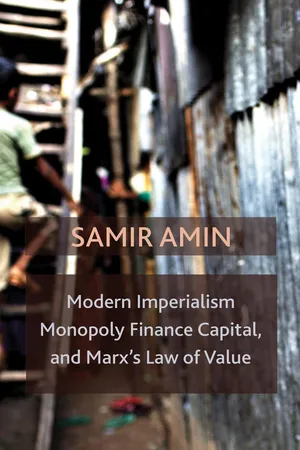
eBook - ePub
Modern Imperialism, Monopoly Finance Capital, and Marx's Law of Value
Monopoly Capital and Marx's Law of Value
- 280 pages
- English
- ePUB (mobile friendly)
- Available on iOS & Android
eBook - ePub
Modern Imperialism, Monopoly Finance Capital, and Marx's Law of Value
Monopoly Capital and Marx's Law of Value
About this book
Information
PART ONE
The Law of Worldwide Value
Introduction to the English Edition
Marx is not a philosopher, a historian, an economist, a political scientist, or a sociologist. He is not even a scholar of the first rank in any of those disciplines. Nor even a talented professor who prepared a good multidisciplinary dish cooked with all these ingredients. Marx’s place is quite outside all that. Marx is the beginning of the radical critique of modern times, starting with the critique of the real world. This radical critique of capitalism demands and allows discovery of the basis of market alienation and, inseparable from it, the exploitation of labor. The foundational status of the concept of value derives from this radical critique. It alone allows a grasp of the objective laws that govern the reproduction of the system, underlying those surface movements perceptible through direct observation of reality. Marx links to this critique of the real world the critique of discourses about that reality: those of philosophy, economics, sociology, history, and political science. This radical critique uncovers their true nature which, in the last analysis, is always an apologetic one, legitimizing the practices of capital’s dominating power.
To be a “Marxist” is to continue the work that Marx merely began, even though that beginning was of an unequaled power. It is not to stop at Marx, but to start from him. For Marx is not a prophet whose conclusions, drawn from a critique of both reality and how it has been read, are all necessarily “correct” or “final.” His opus is not a closed theory. Marx is boundless, because the radical critique that he initiated is itself boundless, always incomplete, and must always be the object of its own critique (“Marxism as formulated at a particular moment has to undergo a Marxist critique”), must unceasingly enrich itself through radical critique, treating whatever novelties the real system produces as newly opened fields of knowledge.
The subtitle of Capital—“A Critique of Political Economy”—does not mean a critique of a “bad” (Ricardian) political economy, with a view to replacing it with a “good” (Marxian) one. It is rather a critique of so-called economic science, an exposure of its true nature (as what the bourgeoisie has to say about its own practice); and so of its epistemological status, an exposure of its limitations, and an invitation to realize that this alleged science, claimed to be independent of historical materialism, cannot possess such independence. Political economy is the outward form assumed by historical materialism (the class struggle) under capitalism. On the logical plane historical materialism is prior to economics, but class struggle under capitalism does not take place in a vacuum: it operates on an economic basis, and shapes laws that appear economic in character.
I shall study this articulation first as it is presented in Capital itself, that is, in the theory of the capitalist mode of production, and then in the reality of the capitalist system of our own day—in imperialism.
My thesis is: (a) that historical materialism constitutes the essence of Marxism; and therefore (b) that the epistemological status of the economic laws of capitalism is such that they are subordinate to the laws of historical materialism; (c) that under the capitalist mode of production economic laws possess a theoretical status different from that which they possess under precapitalist modes; and even (d) that, strictly speaking, economic laws are to be found only under the capitalist mode; (e) that the economic laws of capitalism do indeed exist objectively; and, finally, (f) that these laws are governed, in the last analysis, by the law of value.
Thus, in my view, the class struggle under capitalism in general, and in the imperialist world system in particular, operates on a definite economic basis and, in its turn, changes that basis.
My readings in Marx certainly brought considerable intellectual fulfillment and convinced me of the power of his thought. Still, I was left unsatisfied. For I was asking a central question, that of the “underdevelopment” of contemporary Asian and African societies, and I found no answer in Marx. Far from “abandoning” Marx and counting him “outdated,” I simply came to the conclusion that his opus had remained incomplete. Marx had not finished the opus that he had set out to complete, and that included not integrating the “global dimension” of capitalism into his analysis. So I have tried to do so. The central axis of the conclusions reached by my efforts is defined by the formulation of a “law of globalized value,” coherent, on the one hand, with the bases of the law of value proper to capitalism as discovered by Marx and, on the other, with the realities of unequal globalized development.
My major contribution concerns the passage from the law of value to the law of globalized value, based on the hierarchical structuring—itself globalized—of the prices of labor-power around its value. Linked to the management practices governing access to natural resources, this globalization of value constitutes the basis for imperialist rent. This, I claim, orders the unfolding of really existing capitalism/imperialism’s contradictions and of the conflicts linked to them, so that classes and nations are imbricated, in their struggles and clashes, in all the complex articulation, specific and concrete, of those contradictions. I claim that our reading of the twentieth and twenty-first centuries can be nothing other than that of the emergence—or of the “reawakening”—of peoples and nations peripheric to the globalized capitalist/imperialist system.
In order to carry out my exposition, I have chosen to take up again my book The Law of Value and Historical Materialism in a new, revised and expanded, edition. In the extensive borrowings that I have made from this old (1978) book I have conserved its essential argument. The new paragraphs draw the reader’s attention to the challenging questions arising from that retained exposition. If them I have tried to present synthetic explanations which—in themselves adequate—do not preclude coming back to deeper readings.
My theoretical analysis of the really existent globalized capitalist system starts from the law of value formulated by Marx in Volume I of Capital. There is no other possible point of departure, because without the concept of value there is no meaning to that of the accumulation of capital—and so we cannot skip over this detour through value in favor of a direct grasp of reality—which is implied by a positivist/empiricist methodology, as revealed through observed prices.
The analysis that I am putting forward thus looks next at the three stages in the transformation of value: (1) into “prices of production”; (2) into “market prices” (oligopolistic prices, in contemporary capitalism); and (3) into “globalized prices” (in the globalized imperialist system).
The first of these transformations, taken up in the first chapters of Volume III of Capital, is indispensable to grasping the meaning of the market alienation that governs economic and social life under capitalism and to giving to the laws ruling its systemic reproduction their true stature.
The second of these transformations, that of prices of production into “market prices,” had been partially treated by Marx, also in Volume III of Capital, in the instance, among others, when he came to consider the distribution of surplus-value in regard to agrarian landownership. We have next to consider the deformations of the price system linked to the emergence of oligopolies/monopolies and above all to take fully into account the gigantic transformation of the system of expanded equilibrium resulting, after the First, but above all after the Second World War, from the accelerated expansion of a third department—of absorption of surplus surplus-value. Baran and Sweezy, with the concept of surplus that they put forward, replied to the challenge and unhesitatingly extended and enriched Marxian theory. I claim that those Marxists who still refuse to recognize the central importance of Baran and Sweezy’s contribution lack the means to put forth an effective critique of contemporary capitalism. Their “Marxism” thus remains confined to exegeses of Marx’s texts.
The central object of my reflections has been the third transformation, which allows us to go from the law of value, taken at its highest level of abstraction (the capitalist mode of production), to what I have called the law of globalized value, which is operative on the scale of the really extant polarizing system of capitalism/imperialism. It is only this transformation that allows us to take the measure of the imperialist rent which is at the origin of the polarization deepened and reproduced by the globalized unfolding of capitalism.
It is impossible to “understand the world” by a realistic analysis of really existing capitalism outside the framework traced by the treatment of these transformations of value. Equally, a strategy aiming to “change the world” can be based only on these foundations. As against this, the positivist/empiricist method of vulgar economics allows us neither to “understand the world” and to grasp the nature of the challenges confronting workers and peoples, nor, a fortiori, to “change” it. Furthermore, that vulgar economics does not seek to go beyond capitalism, which it sees as the “end of history.” It seeks only to legitimize the basic principles of capitalism and to show how to manage it.
I believe that this new edition, drawn broadly from The Law of Value and Historical Materialism, comes at the right moment. This is because the current crisis revolves altogether around different possible developments of the social and international relationships that govern the form of the law of value, under the combined effects of popular struggles in the central and peripheral societies of contemporary capitalism and of struggles between dominant imperialist societies and those of the dominated periphery—struggles that call into question the continued dominance of what I call “the later capitalism of the generalized, financialized, and globalized oligopolies.”
CHAPTER ONE
The Fundamental Status of the Law of Value
After devoting Volume I of Capital to the foundations of the law of value, Marx concerns himself in Volume II with what might seem to be a purely “economic” argument. He tries, in fact, to show that accumulation can take place in a “pure” capitalist system, and to determine the technical conditions for dynamic equilibrium.
In Marx’s illustrative examples, the system is characterized by a certain number of magnitudes and proportions, all of which belong strictly to the economic field. These magnitudes and proportions are: (a) the proportions in which labor-power and means of production are distributed between the two departments that define the main basis of the social division of labor, making possible the simultaneous production of means of production and of consumer goods; (b) the proportions that characterize, for each department, the degree of intensity in the use of means of production by direct labor; this intensity measures the level of development of the productive forces; (c) the evolution from one phase to another of these latter proportions, measuring the pace and direction of the progress of the productive forces; and (d) the rate of exploitation of labor (the rate of surplus-value).
Marx offers a series of examples in which the magnitudes are all given in value terms, and he is right to do so. But what he deduces from these examples—namely the economic conditions for expanded reproduction—could, to some extent, be deduced in the same way from a model constructed directly in terms of prices of production, in which profit is shown in proportion to capital employed and not to labor exploited. Within this precise and limited context, the two arguments, both of them “economic,” are equivalent to each other.
There is nothing, then, to prevent one from expressing directly—in terms either of value or of price—the general economic conditions for expanded reproduction by formulating a system of linear equations in which the various variable magnitudes allowed to each department, defined correctly in relation to the parameters of sectoral distribution and of evolution from one phase to the next, are related to each other by the equality in value from one phase to the next in the respective supply of and demand for consumer goods and means of production.
I have done this—in value terms, defining, with the Greek letters lambda (λ) and gamma (γ), two parameters for measuring the progress of the productive forces in each department and from one phase to the next, and then characterizing this progress by the increase in the physical quantity of use-values produced with a decreasing quantity of labor. I therefore set out a model of expanded...
Table of contents
- Cover
- Title Page
- Copyright
- Contents
- Part One: The Law of Worldwide Value
- Part Two: Further Comments on Marx’s Capital and Historical Capitalism
- Part Three: Essays on Marx’s Value Theory
- Index
Trusted by 375,005 students
Access to over 1.5 million titles for a fair monthly price.
Study more efficiently using our study tools.
Frequently asked questions
Yes, you can cancel anytime from the Subscription tab in your account settings on the Perlego website. Your subscription will stay active until the end of your current billing period. Learn how to cancel your subscription
No, books cannot be downloaded as external files, such as PDFs, for use outside of Perlego. However, you can download books within the Perlego app for offline reading on mobile or tablet. Learn how to download books offline
We are an online textbook subscription service, where you can get access to an entire online library for less than the price of a single book per month. With over 1.5 million books across 990+ topics, we’ve got you covered! Learn about our mission
Look out for the read-aloud symbol on your next book to see if you can listen to it. The read-aloud tool reads text aloud for you, highlighting the text as it is being read. You can pause it, speed it up and slow it down. Learn more about Read Aloud
Yes! You can use the Perlego app on both iOS and Android devices to read anytime, anywhere — even offline. Perfect for commutes or when you’re on the go.
Please note we cannot support devices running on iOS 13 and Android 7 or earlier. Learn more about using the app
Please note we cannot support devices running on iOS 13 and Android 7 or earlier. Learn more about using the app
Yes, you can access Modern Imperialism, Monopoly Finance Capital, and Marx's Law of Value by Samir Amin in PDF and/or ePUB format, as well as other popular books in Politics & International Relations & Political Economy. We have over 1.5 million books available in our catalogue for you to explore.