Providing educators at all levels with a research and evidence based understanding of the educational opportunities and challenges facing refugees (both children and adults), this important book considers related and overlapping issues such as equality, equity, power, privilege, identity, rights, and pluralism, and addresses the relevant issues at the theory, policy, and practice levels.
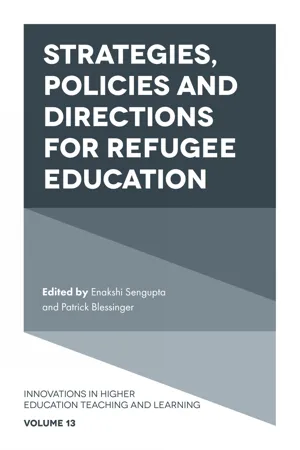
eBook - ePub
Strategies, Policies and Directions for Refugee Education
- 288 pages
- English
- ePUB (mobile friendly)
- Available on iOS & Android
eBook - ePub
Strategies, Policies and Directions for Refugee Education
About this book
This volume examines how Governmental agencies, non-profit organizations and educational institutions are mobilizing their resources to promote inclusion of refugees and internally displaced people. It explores the grass root campaigns that are working towards participation and full involvement for disadvantaged groups, and towards equitable distribution of opportunities in both home and host countries. The case studies included emphasize the importance of effective cooperation and coordination across multi-sectoral responses, and the need to take into account the social and economic dimensions of inclusion.
Information
PART I
ACCESS TO HIGHER EDUCATION
CHAPTER 1
INTRODUCTION TO REFUGEE EDUCATION: STRATEGIES, POLICIES AND DIRECTIONS
ABSTRACT
This chapter highlights the plight of refugees and the strategies and policies crafted by international agencies and non-governmental institutions in providing better access to education especially for refugee children. The chapter explores some of the key terminologies that distinguish refugees from asylum seekers and internally displaced person. The terminologies are significant as the opportunities and facilities handed out differ significantly depending on their status. The chapter then talks about some of the policies toward imparting education and the school- and system-level factors responsible for accessing education. The last section of the chapter summarizes the overview of various chapters that will feature in this volume, talking about cases and interventions from Malawi to Australia.
Keywords: Migrants; internally displaced people; armed conflicts; stateless person; system-level factors; deportation; school-level factors
INTRODUCTION
The world is witnessing an era of unprecedented human mobility with a growing number of people fleeing every day from their home country to avoid being killed or used as a human shield by the extremists. Children comprise a sizeable proportion of those fleeing their countries or as part of the resettled populations in the camps and other relief centers which have grown over the last seven years across Europe. School children numbered 154,680, aged 5–18, were resettled in the United States between 2002 and 2013 from 113 countries (Migration Policy Institute, 2014, pp. 4–5).
Almost all refugee children arrive in North America, Europe, and Australia lacking previous educational experiences. Most often it is found that these pre-resettlement experiences of refugee children constitute a “black box” in their post-resettlement education (Dryden-Peterson, 2015).
In addition to deprivation of education the other issues faced by the migrant population are labor demands and employment, economic crises, urbanization, entrenched poverty, political instability, and conflict with the host community. Managing migrant populations and providing basic social and educational services have become pressing concerns by both government and non-governmental bodies, especially that of the host countries.
Between January and September 2017, close to 145,000 refugees and migrants arrived on European shores, many losing their lives during the perilous journey. Two-thirds of them came through the Central Mediterranean Route. In just three months (July–September 2017), Greece saw over 10,500 arrivals (of whom 4,239 were children), compared to 9,272 during the entire first-half of the year. This is coupled with potentially new migration routes appearing through the Western Mediterranean, where 8,558 refugees and migrants (including around 8% of children) arrived between June and August 2017 (UNICEF, 2017).
Reception and resettlement conditions at refugee camps remain a cause of grave concern, particularly on the Greek islands, where the refugee and migrant stranded population increased by 27% in September 2017, leading to overcrowding and thus resulting in chaos and lack of basic services such as reception and holding area and also in the Identification Centers (UNICEF, 2017). The camps have also witnessed a growth of unaccompanied and separated children (UASC) in protective custody on the islands and other border areas – reaching up to 142 in August (compared to 50–60 in June 2017).
The European governments have taken commendable steps toward improving the access to education for refugee and migrant children in order to minimize the legal and practical barriers and protocols. A notable progress can be measured in enrolment of refugee and migrant children into formal education – reaching up to 40% of stranded refugee and migrant children in Greece and the Balkans, but the daily surge of migrants makes this relief effort look insignificant.
Studies conducted by UNICEF and other relief agencies have shown that less than half of unaccompanied children on the Central Mediterranean Route left home with the idea to come to Europe with the aim to access a better world comprised of opportunities for better education and human rights. In one-third of cases the main factor that led them to undertake such arduous a journey was violence. Four in every five adolescents travelling alone reported direct abuse, exploitation, and trafficking practices along the Central Mediterranean Route and mentioning their stay in Libya as the most traumatizing part of their journey (UNICEF, 2017).
Migration and asylum demand cannot be dealt with by one country alone and requires international cooperation and intervention because of the constant influx of migrants and large populations involved. Accepting and processing applications for refugees can vary from country to country and has different designations such as guest, temporary stay, and permanent stay. Individual asylum seekers or groups of migrants consist of people who intend to stay permanently in the host countries. It is often found that large numbers of refugees who flee from extraordinary situations such as war return to their countries as peace prevails. The United Nations, the governmental and charitable organizations of the refugee hosting countries, and other national and international organizations cooperate in order to provide basic life requirements and education. They continue to craft strategies and directional policies to handle this sudden upsurge of refugee crisis.
IMPORTANT TERMINOLOGIES
The processes of migration and asylum are codified and processed according to the national and international legal texts, which results in a significant terminology of migration and asylum. There are various categories of migrants and are termed according to their need for assistance, and it ranges from refugees, asylum seekers, pending cases, internally displaced people (IDP) protected/assisted by UNHCR, returned refugees, returned IDPs, and stateless people. The term refugee is often used to identify a person who is entitled to benefit from the protection of the United Nations granted by UNHCR, regardless of being in a country agreeing with the terms of Convention relating to the Status of Refugees, Art. 1A (2), 1951 as modified by the 1967 Protocol, or being recognized as a refugee by a hosting country (IOM, 2014).
An asylum seeker differs in his need for assistant and is a person who looks for safety from oppression or serious damage in a country other than his or her own and files for an application and awaits for a decision on the application for refugee status under suitable international and national arguments. In case the decision differs from his/her desired one and turns out to be negative then the asylum seeker must leave the country unless authorization to stay is provided on humanitarian or other related grounds (IOM, 2014).
People who are displaced (IDPs protected/assisted by UNHCR) are forced to leave their own house in order to avoid armed conflicts, general violence, violations of human rights, or the effects of natural or human-created disasters. These people do not cross their country’s own borders but rather stay in some other part of their own country. Returned refugees, returnees, returned IDPs refer to those who actually return back to their own home once the conflict has been resolved. This return takes into consideration return of those displaced from their own countries, as well as refugees, asylum seekers returning from the host country to the origin country. Return categories are divided into voluntary, forced or deported assisted and spontaneous returns. A stateless person is one who is not accepted as a citizen by any State according to its law (Art. 1, UN Convention relating to the Status of Stateless Persons, 1954) as we are now witnessing the plights of the Rohingya Muslims who continue to be stateless in spite of having spent their entire lives and that of their forefathers in Myanmar. As such, a stateless person lacks those rights attributable to national diplomatic protection of a State, with no inherent right of sojourn in the State of residence and no right of return in case he or she travels (Beltekin, 2016).
A migrant, on the other hand, or an immigrant is considered to be someone who chooses to move, motivated by the desire to seek better opportunities in life to avoid economic hardship and poor governance of their own country. Documented refugees are entitled to receive support from resettlement agencies in the form of economic support, employment services, education, and psychological services, while immigrants and undocumented refugees are largely left to fend for themselves, unless they are fortunate enough to find NGOs and other charitable organizations offering such assistance.
The Convention Relating to the Status of Refugees has included refugee educational status in addition to other facilities specified in the charter. The Convention was confirmed on July 28, 1951, in Geneva. It became effective on April 22, 1954. Article 22 concerns refugee education:
- The Contracting States shall accord to refugees the same treatment as is accorded to nationals with respect to elementary education.
- The Contracting States shall accord to refugees treatment as favorable as possible, and, in any event, not less favorable than that accorded to aliens generally in the same circumstances, with respect to education other than elementary education and, in particular, as regard access to studies, the recognition of foreign school certificates, diplomas and degrees, the remission of fees and charges and the award of scholarships (The Refugee Convention 1951, Article 22, p. 117).
MAIN OBSTACLES
A review of the available literature suggests a number of major challenges facing the education of migrant children. These can be broadly divided into two categories: system-level and school-level factors.
System-level Factors
Access to education is not universally guaranteed especially for children having irregular or undefined status. Such children have denied access to schools or charged fees beyond their means. A survey of migration policies in 28 countries, including 14 “developed” countries with high rates of human development and 14 “developing” countries with lower human development scores, found that 40% of the former and more than 50% of the latter did not allow children with irregular status access to schooling (Klugman & Pereira, 2009, p. 14). In addition to formal restrictions, migrants with an irregular status on their own avoid formal enrollment to schools for fear of revealing their identity which might result in detention or deportation. Children who migrate unaccompanied by adults are especially vulnerable, as work requirements to survive, poverty, poor health, and language barriers are easily exclude from schools (UNDP, 2009). This educational gap in the future has significant impact and implications for employment and earnings. In situations lacking clear processing time of legal documents for refugees has resulted in people remaining in unauthorized status for longer periods, and educational inequalities persist.
Deportation policies have been found to have detrimental effect on migrant children and their education. Parental detention and deportation results in disrupting to education, causes economic strain and housing instability, and even adversely affects the health of children, through lack of food and increased...
Table of contents
- Cover
- Title
- Part I. Access to Higher Education
- Part II. Education Toward Career Development
- About the Authors
- Index
Trusted by 375,005 students
Access to over 1.5 million titles for a fair monthly price.
Study more efficiently using our study tools.
Frequently asked questions
Yes, you can cancel anytime from the Subscription tab in your account settings on the Perlego website. Your subscription will stay active until the end of your current billing period. Learn how to cancel your subscription
No, books cannot be downloaded as external files, such as PDFs, for use outside of Perlego. However, you can download books within the Perlego app for offline reading on mobile or tablet. Learn how to download books offline
Perlego offers two plans: Essential and Complete
- Essential is ideal for learners and professionals who enjoy exploring a wide range of subjects. Access the Essential Library with 800,000+ trusted titles and best-sellers across business, personal growth, and the humanities. Includes unlimited reading time and Standard Read Aloud voice.
- Complete: Perfect for advanced learners and researchers needing full, unrestricted access. Unlock 1.5M+ books across hundreds of subjects, including academic and specialized titles. The Complete Plan also includes advanced features like Premium Read Aloud and Research Assistant.
We are an online textbook subscription service, where you can get access to an entire online library for less than the price of a single book per month. With over 1.5 million books across 990+ topics, we’ve got you covered! Learn about our mission
Look out for the read-aloud symbol on your next book to see if you can listen to it. The read-aloud tool reads text aloud for you, highlighting the text as it is being read. You can pause it, speed it up and slow it down. Learn more about Read Aloud
Yes! You can use the Perlego app on both iOS and Android devices to read anytime, anywhere — even offline. Perfect for commutes or when you’re on the go.
Please note we cannot support devices running on iOS 13 and Android 7 or earlier. Learn more about using the app
Please note we cannot support devices running on iOS 13 and Android 7 or earlier. Learn more about using the app
Yes, you can access Strategies, Policies and Directions for Refugee Education by Enakshi Sengupta, Patrick Blessinger, Enakshi Sengupta,Patrick Blessinger in PDF and/or ePUB format, as well as other popular books in Social Sciences & Discrimination & Race Relations. We have over 1.5 million books available in our catalogue for you to explore.