eBook - ePub
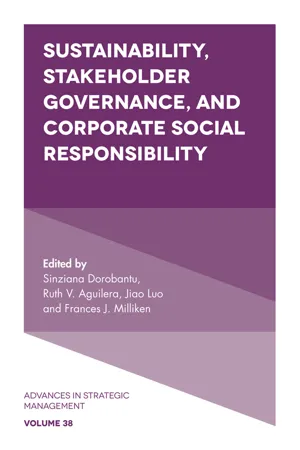
Sustainability, Stakeholder Governance, and Corporate Social Responsibility
- 410 pages
- English
- ePUB (mobile friendly)
- Available on iOS & Android
eBook - ePub
Sustainability, Stakeholder Governance, and Corporate Social Responsibility
About this book
Scholarly interest in the areas of sustainability, stakeholder relations and corporate social responsibility (CSR) has increased considerably in recent years. In this volume, we take a step back to consider the fundamental questions that underlie and tie research across these areas together. The chapters in this volume cover a wide range of theoretical perspectives grounded in strategy, economics and sociology, employ various methodological approaches, and offer new arguments on the connections that exist between firms' decisions relating to sustainability, CSR, and the governance of their stakeholder relations. The chapters in this volume highlight that business decisions relating to sustainability and CSR are ultimately decisions about the governance of stakeholder relations, and suggest that future work in these areas should consider more closely both the firms and their stakeholders as strategic actors driving firm decisions.
Information
OWNERSHIP AND ITS
IMPLICATIONS FOR
SUSTAINABILITY, STAKEHOLDER
GOVERNANCE, AND CSR
STAKEHOLDERS AND CORPORATE SOCIAL RESPONSIBILITY: AN OWNERSHIP PERSPECTIVE
ABSTRACT
We argue that the stakeholder and CSR literature can benefit from more systematic thinking about ownership. We discuss general notions of ownership in the economics and legal literature and the entrepreneurial notion of ownership we have developed in prior work. On this basis, we argue that stakeholder theory needs to deal more systematically with ownership as an economic function that can be exercised with greater or lesser ability, may be complementary to other economic functions, and works better when assigned to homogeneous groups. Some stakeholder groups are likely to lack what we call “ownership competence,” even if they have made relationship-specific investments, in part because of a diversity of interests. We also discuss CSR from the perspective of ownership and support Friedman’s original position, but with a twist. The point of Friedman’s paper is not that firms “should” maximize profits, but that managerial pursuit of “socially responsible” activities in a discretionary way imposes costs on owners. We suggest this problem is exacerbated with entrepreneurial managers who can devise new ways to prop up their self-interested actions with new creative CSR initiatives.
Keywords: Ownership; economics of the firm; stakeholder theory; corporate social responsibility; ownership competence; Milton Friedman
INTRODUCTION
Based on the neoclassical economics theory of the firm and its extension into agency theory (Jensen & Meckling, 1976), many scholarship in corporate finance and strategic management has embraced the model of shareholder primacy in which the firm’s objective is to maximize shareholder value. Milton Friedman’s (1970) popular and influential essay typifies this view, which became central to corporate governance in the 1980s. Around this time, however, an alternative perspective, emphasizing the role of a broader set of stakeholders, began to emerge (e.g., Freeman, 1984).1 Both views are highly visible in the mission statements of corporations. For example, when the Fortune 500 petroleum and natural gas exploration and production company, Texas-based Anadarko, proclaims that its “mission is to deliver a competitive and sustainable rate of return to shareholders by developing, acquiring, and exploring for oil and gas resources vital to the world’s health and welfare,”2 it is straight out of the shareholder rulebook. Conversely, the world leader in toys, Denmark’s family-owned Lego, announces that its “ultimate purpose is to inspire and develop children to think creatively, reason systematically, and release their potential to shape their own future – experiencing the endless human possibility.”3 Here the emphasis is on a broad set of stakeholders.
Perspectives of both shareholder and stakeholder come in positive and normative versions – the former type analyzes the performance effects of alternative governance arrangements, the latter type urges firms to adopt one structure or another.4 For instance, normative stakeholder approaches argue that firms should take the interests of nonshareholder stakeholders – primarily workers and other input suppliers – into account (Freeman, 1984). Positive stakeholder approaches examine the effects of alternative ownership and governance arrangements; Klein, Mahoney, McGahan, and Pitelis (2017), for example, argue that a firm’s ability to adapt to external shocks depends on which stakeholder groups are enfranchised and whether their claims are perceived by other stakeholders as legitimate. More generally, much of the positive stakeholder literature has claimed that firms which give greater decision authority to non-owner stakeholders, and which consider a variety of objectives, perform better than other firms, even on conventional financial criteria (Berman, Wicks, Kotha, & Jones, 1999). According to Blair and Stout (1999), the board of directors is best understood not as an agent for shareholders but as a “mediating hierarchy” that solves disputes among the firm’s enfranchised stakeholders (see also Klein, Mahoney, McGahan, & Pitelis, 2012).
While the neoclassical theory of the firm and agency theory are conceptually clear and proffer transparent theoretical mechanisms, the discussion around stakeholders, and related discussions on corporate social responsibility has been characterized by conceptual ambiguity and lack of clarity regarding the claimed positive effects of adopting stakeholder rather than shareholder goals. A primary challenge is defining exactly who is, and who isn’t, included in the set of relevant stakeholders. A recent strand of research follows property rights economics (Hart, 1995; Hart & Moore, 1990) in defining stakeholders with legitimate claims on firm value as those agents who make relationship-specific investments in the firm’s activities, whether they own equity or not (Hoskisson, Gambetta, Green, & Li, 2017). Other approaches define the set of stakeholders more broadly, to include virtually any individuals or groups whose well-being is affected by the firm (see Aguinis & Glavas, 2012). This is the view reflected in the Lego corporate mission mentioned above; the emphasis is on children, and hence society’s future, not simply customers whose actions contribute to the firm’s bottom line. Corporate social responsibility (CSR), then, is the act of maximizing the welfare of all legitimate stakeholders.5
Central to stakeholder and CSR discussions are background assumptions about ownership. Thus, theories dealing with relation-specific investments and “legitimate claims” are about ownership of tangible and intangible assets. When people argue about whether shareholders should be privileged over other stakeholders, or whether this or that group should get more decision or income rights, they are essentially dealing with broad questions about ownership: Who owns the firm, and what implications does this have for how firms are run, or should be run? What do we mean by “ownership” anyway? What are the functions of ownership? We think stakeholder and CSR debates can be improved by focusing more specifically on these fundamental questions. We do so from the perspective of key ideas on ownership from economics (e.g., Coase, 1960; Hansmann, 1996; Hart, 1995) as well as from the perspective of our own theorizing which has stressed the crucial linkages between entrepreneurship and ownership (Foss & Klein, 2012).
To illustrate the relevance of ownership ideas to these discussions, note that the stakeholder view is basically suggesting that the shareholder view is wrong about the set of legitimate owners of the firm. Other individuals besides shareholders, if they make firm-specific investments, should have legitimate claims on not only residual income but also on decision-making (Blair & Stout, 1999). On commonsense as well as theoretical and normative grounds, these individuals and groups may be rightful owners. Similarly, CSR is fundamentally about what economists call externalities (external benefits or costs that are not received or born by the actor). If a company’s decisions have a harmful effect on third parties – members of the nearby community, the natural environment, or other elements of society – then strict profit maximization will lead companies to make decisions that are not in the best interest of all parties. As a long stream of research, Coase (1960) has revealed that at the core of the concept of externality is the allocation of titles to ownership. Owners’ interests are taken into account, while nonowners may benefit or not. Such observations suggest that stakeholder and CSR research should feature discussions of ownership as a central part of the theorizing. This, however, is often not the case.
More generally, the ownership construct is undertheorized in management research (Foss, Klein, Lien, & Zenger, 2017). Even in legal and economics scholarship, there is no unanimity regarding what exactly ownership entails. What does it mean to “own” a resource or asset? For example, while many would think of the right to exclude other individuals from using the resource as key to the notion of ownership, excludability can clearly be circumscribed by legislation, laws, and norms. How much real excludability does one need to be an owner? What kinds of resources and assets are ownable? What are the implications of ownership for the owner’s rights and responsibilities, legally or ethically? How do alternative ownership arrangements affect individual behavior and firm performance? While the legal literature as well as property rights economics (Hart, 1995) have offered many answers to such questions, they have not really been at the forefront of stakeholder and CSR discussions.
We have argued that the stakeholder and CSR literatures can benefit from more systematic thinking about ownership, particularly as ownership is discussed in various branches of the theory of the firm (e.g., Fama & Jensen, 1983; Hart, 1995; Hart & Moore, 1990; Jensen & Meckling, 1976). Consider, for example, the relationship between residual decision rights and residual cash flow rights. Both sets of rights are typically held by corporate shareholders, but they are distinct. As we have argued below (see also Foss & Klein, 2012; Knight, 1921), residual decision rights – the right to decide how the firm’s resources will be used in conditions not specified by prior agreement – are intrinsic to ownership itself. Residual cash flow rights, however, can be delegated to nonowners (e.g., any employee whose pay is linked to firm performance is a residual claimant). The literature also confuses ownership, as residual decision authority, with day-to-day control, which is often possessed by non-owners. It is also common to associate ownership per se with ownership ability, the skill with which ownership rights are used, though the current owners of a resource or firm may not be the optimal owners (Foss et al., 2017). Greater clarity on these points can, we think, greatly improve the stakeholder and CSR literatures.
Accordingly, in this chapter, we have discussed the meaning of “ownership.” We discussed general notions of ownership in the economics and legal literature as well as the entrepreneurial notion of ownership that we have developed in prior work (Foss & Klein, 2012). We then discussed the role of ownership in stakeholder theories. We argued that, for example, Blair and Stout’s (1999) influential approach mistakenly classifies nonalienable assets controlled by non-owner stakeholders as “part of the firm.” Moreover, they claim that making firm-specific investments gives the investor a legitimate claim to ownership of complementary assets (particularly under conditions of team-production).
As we show below, much of contemporary stakeholder theory fails to deal with ownership as an economic function that can be exercised with greater or lesser ability, may be complementary to other economic functions, and works poorly when assigned to heterogeneous groups. We rely on what Foss et al. (2017) call ownership competence, the skill with which ownership activities are performed. Certain stakeholder groups are likely to be low in ownership competence, even if they have specific investments, in part because of a diversity of interests. We then discuss CSR from the perspective of ownership. Our perspective basically reinforces Friedman’s original position, but with a twist. The real point of Friedman’s paper is not that firms “should” maximize profits, but that managerial pursuit of “socially responsible” activities in a discretionary way imposes costs on owners. However, there is nothing in Friedman’s paper, or in our ownership perspective, to suggest that owners cannot instruct managers to pursue such activities. Indeed, those activities may sometimes be means to more “enlightened value maximization” (cf. Birkinshaw, Foss, & Lindenberg, 2014; Jensen, 2002).
WHAT IS OWNERSHIP?
A Thorny Concept
Although ownership is a complex and controversial construct (e.g., Bell & Parchomovsky, 2004; Underkuffler, 2003), it is generally agreed that ownership can be conceived as a bundle of rights, the most important being possession, exclusion, and control. Ownership is thus typically seen as involving the rights to extract income from an asset (e.g., by selling it or deploying it), to exclude others from accessing it, and to transform it (e.g., in productive activities), within legal limits. Commonsense suggests that what is meant by “ownership,” exactly, is determined by the prevailing institutions (cf. Demsetz, 1967). Thus, ownership can be very narrowly circumscribed or it can be quite extensive, depending, for example, on the specific society regulating ownership, the relevant class of assets (e.g., gun ownership is regulated differently from house ownership), and much else.
The multidimensional nature of ownership is recognized not only in law, but also in economics, particularly in the “economics of property rights” literature that took off after Coase (1960) (e.g., Alchian, 1965; Barzel, 1997; Hart, 1995; Libecap, 1989), and in related work on contracts such as agency theory, transaction cost theory, and incomplete contract theory. Economists and finance scholars, building largely on principal-agent theory, associate ownership with the right to derive residual income (i.e., profits). Thus, the owners of the firm are, in this conception, the shareholders. The familiar challenge to this notion of ownership ...
Table of contents
- Cover
- Half Title Page
- Introduction: Contemplating the Connections between Sustainability, Stakeholder Governance, and Corporate Social Responsibility
- Part I Ownership and Its Implications for Sustainability, Stakeholder Governance, and CSR
- Part II Stakeholder Alignment and Coalitions
- Part III Dynamic Evolution of Concepts and Industry Practices
- Index
Trusted by 375,005 students
Access to over 1.5 million titles for a fair monthly price.
Study more efficiently using our study tools.
Frequently asked questions
Yes, you can cancel anytime from the Subscription tab in your account settings on the Perlego website. Your subscription will stay active until the end of your current billing period. Learn how to cancel your subscription
No, books cannot be downloaded as external files, such as PDFs, for use outside of Perlego. However, you can download books within the Perlego app for offline reading on mobile or tablet. Learn how to download books offline
Perlego offers two plans: Essential and Complete
- Essential is ideal for learners and professionals who enjoy exploring a wide range of subjects. Access the Essential Library with 800,000+ trusted titles and best-sellers across business, personal growth, and the humanities. Includes unlimited reading time and Standard Read Aloud voice.
- Complete: Perfect for advanced learners and researchers needing full, unrestricted access. Unlock 1.5M+ books across hundreds of subjects, including academic and specialized titles. The Complete Plan also includes advanced features like Premium Read Aloud and Research Assistant.
We are an online textbook subscription service, where you can get access to an entire online library for less than the price of a single book per month. With over 1.5 million books across 990+ topics, we’ve got you covered! Learn about our mission
Look out for the read-aloud symbol on your next book to see if you can listen to it. The read-aloud tool reads text aloud for you, highlighting the text as it is being read. You can pause it, speed it up and slow it down. Learn more about Read Aloud
Yes! You can use the Perlego app on both iOS and Android devices to read anytime, anywhere — even offline. Perfect for commutes or when you’re on the go.
Please note we cannot support devices running on iOS 13 and Android 7 or earlier. Learn more about using the app
Please note we cannot support devices running on iOS 13 and Android 7 or earlier. Learn more about using the app
Yes, you can access Sustainability, Stakeholder Governance, and Corporate Social Responsibility by Sinziana Dorobantu, Ruth V. Aguilera, Jiao Luo, Frances J. Milliken, Sinziana Dorobantu,Ruth V. Aguilera,Jiao Luo,Frances J. Milliken in PDF and/or ePUB format, as well as other popular books in Business & Business Ethics. We have over 1.5 million books available in our catalogue for you to explore.