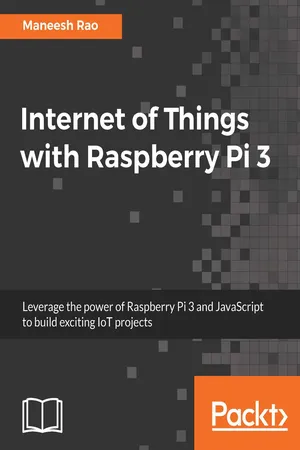
Unleash the power of the Raspberry Pi 3 board to create interesting IoT projectsAbout This Book• Learn how to interface various sensors and actuators with the Raspberry Pi 3 and send this data to the cloud.• Explore the possibilities offered by the IoT by using the Raspberry Pi to upload measurements to Google Docs.• A practical guide that will help you create a Raspberry Pi robot using IoT modules.Who This Book Is ForIf you're a developer or electronics engineer and are curious about the Internet of Things, then this is the book for you. With only a rudimentary understanding of electronics, the Raspberry Pi, or similar credit-card sized computers, and some programming experience, you will be taught to develop state-of-the-art solutions for the Internet of Things in an instant.What You Will Learn• Understand the concept of IoT and get familiar with the features of Raspberry Pi • Learn to integrate sensors and actuators with the Raspberry Pi• Communicate with cloud and Raspberry using communication protocols such as HTTP and MQTT • Build DIY projects using Raspberry Pi, JavaScript/node.js and cloud (AWS) • Explore the best practices to ensure the security of your connected devicesIn DetailThis book is designed to introduce you to IoT and Raspberry Pi 3. It will help you create interesting projects, such as setting up a weather station and measuring temperature and humidity using sensors; it will also show you how to send sensor data to cloud for visualization in real-time. Then we shift our focus to leveraging IoT for accomplishing complex tasks, such as facial recognition using the Raspberry Pi camera module, AWS Rekognition, and the AWS S3 service. Furthermore, you will master security aspects by building a security surveillance system to protect your premises from intruders using Raspberry Pi, a camera, motion sensors, and AWS Cloud. We'll also create a real-world project by building a Wi-Fi – controlled robot car with Raspberry Pi using a motor driver circuit, DC motor, and a web application.This book is a must-have as it provides a practical overview of IoT's existing architectures, communication protocols, and security threats at the software and hardware levels—security being the most important aspect of IoT.Style and approachInternet of Things with the Raspberry Pi 3 contains the tools needed to design, sense the environment, communicate over the Internet, and visualize the results.
- 248 pages
- English
- ePUB (mobile friendly)
- Available on iOS & Android
eBook - ePub
Internet of Things with Raspberry Pi 3
About this book
Information
Image Recognition
In this chapter, we will understand what image recognition is, how image recognition works, and how we train a machine to recognize images. Then, we will learn about all the resources that are required to perform image recognition tasks. The following are the resources that we will cover in this chapter:
- Raspberry Pi
- Raspberry Pi camera module to capture real-time images
- IR sensor
- Amazon Web Services
- Amazon's IAM service
- Amazon's command-line interface
- Amazon's S3 storage service to store the captured images
- Amazon's Rekognition web services, which we will use to perform image recognition
Understanding image recognition
Image recognition is the ability of a machine or computer to see and identify places, logos, people, objects, buildings, and other variables in an image, where an image can be any graphic, still photo, and/or video. Image recognition not only identifies the content in the images, but performs a large number of machine-based visual tasks, such as labeling images with informational tags, searching the content in an image, such as identifying a cat in an image that has multiple animals in it and guiding autonomous robots and self-driving vehicles.
Human and animal brains recognize images and objects with ease, but it is extremely difficult for computers to perform the same task. Image recognition requires deep machine learning techniques. Image recognition tasks are best performed on convolution neural network-based processors. Image recognition algorithms perform tasks by use of comparative 3D models, comparing images taken from different angles using edge-detection techniques. These algorithms need to be trained with millions of already labeled pictures with guided computer learning.
Deep learning
Let's understand what deep learning is. Deep learning is a part of machine learning that deals with emulating the learning approach of human beings. Traditional machine learning algorithms are linear in nature, whereas deep learning algorithms are nonlinear and stacked in a hierarchy of increasing complexity and abstraction, for example, when the parents of a toddler teach him what a cat looks like by pointing at it, and when he points to an object the next time and tags it as a cat, then the parents confirm by saying "Yes, it is a cat" or if the toddler identifies it wrongly, then the parents say "No, it is not a cat." In this way, a toddler learns to identify a cat and makes himself aware of all the features of a cat over a period of time. In this process, what a toddler does is unconsciously build a stack of information in their mind about a cat, where each layer of this information in the stack is created using the information from the previous layer. Every next layer of information becomes more complex and weighted than the previous one. A deep learning algorithm applies the same technique to learn and identify the content of images that are fed to it.
In traditional machine learning, the learning is supervised, where the programmer has to specifically define all the features of an object that the algorithm should look for and identify in an image that is fed to it as input. The programmer has to define the feature of a cat (object) and tag the cat in the training dataset. This process is called feature extraction, which is very time consuming. Also, the accuracy of the result depends on how efficiently the features are defined and the object is tagged in the input dataset.
The advantage of deep machine learning (or simply deep learning) over traditional machine learning is that the programmer is not required to do the feature extraction task by themselves. Here, the software program creates the feature list by itself; hence, deep learning is called unsupervised learning, which is not only fast but more accurate than supervised learning.
To implement deep learning, we need to provide the training dataset, which contains the images tagged as cat or no cat. Then, the program uses the input images to extract the features of a cat and build a model around it to predict a cat in a new dataset, which is untagged. This model is called the predictive model. The deep learning algorithm looks for patterns in pixels from digital image data and with each iteration, the predictive model becomes more complex and accurate. Unlike a toddler, who takes a long time to accurately identify a cat every time, the deep learning algorithm can do it in minutes. So, to achieve an acceptable level of accuracy, deep learning algorithms need huge volumes of data and processing power.
Since deeplearning techniques depict the human brain, they are sometimes called neural networks. There are different types of neural networks such as recurrent neural networks, convolutional neural networks, artificial neural networks, and feed forward neural networks. Each one of them has its own implementation and use cases.
Deep learning is mostly used in image recognition, natural language processing, and speech recognition tools.
The limitation of deep learning is that it knows only what has been taught to it. This means that if it is trained to identify a cat, then it cannot identify a dog by itself. And to identify the cat accurately, it needs huge volumes of pretagged training data, which is not an ea...
Table of contents
- Title Page
- Copyright and Credits
- Packt Upsell
- Contributors
- Preface
- Introduction to IoT
- Know Your Raspberry Pi
- Let's Communicate
- Weather Station
- Controlling the Pi
- Security Surveillance
- Image Recognition
- Bot Building
- Security in IoT
- Other Books You May Enjoy
Trusted by 375,005 students
Access to over 1.5 million titles for a fair monthly price.
Study more efficiently using our study tools.
Frequently asked questions
Yes, you can cancel anytime from the Subscription tab in your account settings on the Perlego website. Your subscription will stay active until the end of your current billing period. Learn how to cancel your subscription
No, books cannot be downloaded as external files, such as PDFs, for use outside of Perlego. However, you can download books within the Perlego app for offline reading on mobile or tablet. Learn how to download books offline
Perlego offers two plans: Essential and Complete
- Essential is ideal for learners and professionals who enjoy exploring a wide range of subjects. Access the Essential Library with 800,000+ trusted titles and best-sellers across business, personal growth, and the humanities. Includes unlimited reading time and Standard Read Aloud voice.
- Complete: Perfect for advanced learners and researchers needing full, unrestricted access. Unlock 1.5M+ books across hundreds of subjects, including academic and specialized titles. The Complete Plan also includes advanced features like Premium Read Aloud and Research Assistant.
We are an online textbook subscription service, where you can get access to an entire online library for less than the price of a single book per month. With over 1.5 million books across 990+ topics, we’ve got you covered! Learn about our mission
Look out for the read-aloud symbol on your next book to see if you can listen to it. The read-aloud tool reads text aloud for you, highlighting the text as it is being read. You can pause it, speed it up and slow it down. Learn more about Read Aloud
Yes! You can use the Perlego app on both iOS and Android devices to read anytime, anywhere — even offline. Perfect for commutes or when you’re on the go.
Please note we cannot support devices running on iOS 13 and Android 7 or earlier. Learn more about using the app
Please note we cannot support devices running on iOS 13 and Android 7 or earlier. Learn more about using the app
Yes, you can access Internet of Things with Raspberry Pi 3 by Maneesh Rao in PDF and/or ePUB format, as well as other popular books in Ciencia de la computación & Ciencias computacionales general. We have over 1.5 million books available in our catalogue for you to explore.